Behavioral Cart Recovery Automation 2026: Festival FOMO Video Triggers for India’s Peak Shopping
Estimated reading time: 15 minutes
Key Takeaways
- Shift from static reminders to real-time, personalized video nudges that leverage loss aversion, social proof, and scarcity.
- Adopt a WhatsApp-first strategy for delivery, using high open rates to trigger timely, contextual recovery messages.
- Design enterprise-grade automation with event triggers, data fabric integration, and DPDP-compliant governance.
- Deploy festival-specific FOMO creatives and flows with live inventory, countdowns, and hyper-local signals.
- Measure impact through incremental lift, recovered revenue, time-to-recover, and discount efficiency KPIs.
The landscape of Indian e-commerce has reached a critical inflection point where static retargeting is no longer sufficient to capture the fleeting attention of the modern shopper. As we move into the peak shopping cycles of 2026, the industry has shifted toward behavioral cart recovery automation 2026, a sophisticated orchestration of real-time, personalized video interventions. This approach moves beyond simple reminders, utilizing deep-seated cognitive biases—such as loss aversion, social proof, and scarcity—to re-engage shoppers at the precise moment of hesitation.
In India, the stakes for cart recovery have never been higher. Recent data indicates that festive season Gross Merchandise Value (GMV) crossed INR 1.15 trillion in 2025, representing a 20% year-on-year growth. Projections for 2026 suggest this figure will surge toward INR 1.4 trillion, driven by increased penetration in Tier 2 and Tier 3 cities. During these peak periods, abandonment rates often spike as consumers “window shop” across multiple tabs, comparing bank offers and delivery timelines. To combat this, enterprise leaders are prioritizing a WhatsApp-first omnichannel strategy. With WhatsApp open rates hovering near 98% in the Indian market, it serves as the primary conduit for high-impact video delivery.
Platforms like TrueFan AI enable brands to bridge the gap between intent and purchase by generating hyper-personalized video nudges in under 30 seconds. These videos are not merely generic advertisements; they are dynamic assets that reflect the user’s specific cart items, local language, and real-time inventory levels. By automating the deployment of these video triggers, enterprises can transform a lost session into a high-value conversion, ensuring that the momentum of India’s festive spirit is captured through data-driven precision.
Source: Redseer: E-commerce Festive 1st Leg Analysis
Source: Business Standard: India Festive Season E-commerce Growth
Source: Route Mobile: WhatsApp Marketing Strategies for Enterprises 2025-2026
1. Behavioral Economics Toolkit for Conversion Psychology Personalization India
To master conversion psychology personalization India, enterprise marketers must move beyond “one-size-fits-all” discounts and embrace cognitive bias marketing automation. This involves the systematic application of behavioral economics principles to influence consumer choice at the checkout stage without resorting to coercive tactics. By matching a specific cognitive bias to the shopper’s likely objection, brands can create a more persuasive and relevant recovery sequence.
Loss Aversion Cart Reminders
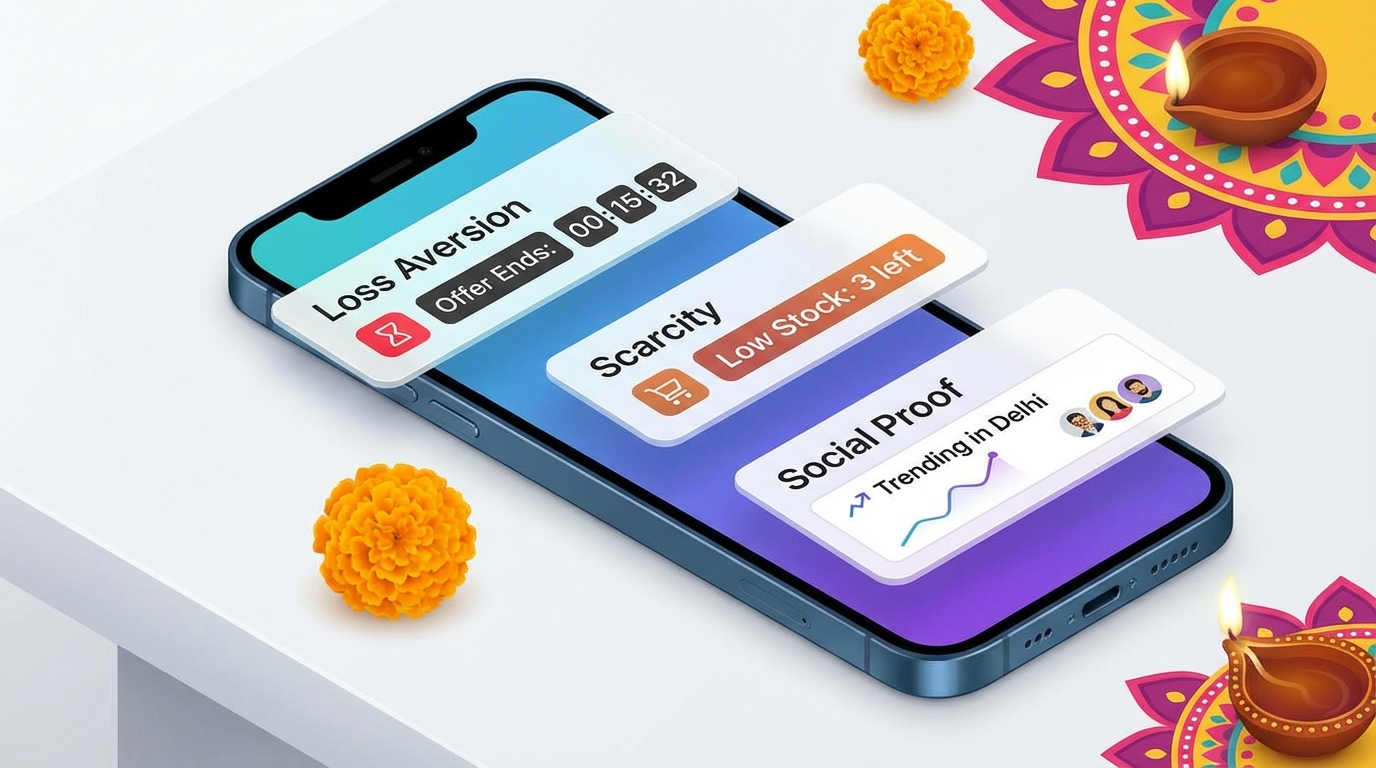
Loss aversion is the psychological principle that the pain of losing something is twice as powerful as the joy of gaining it. In the context of cart recovery, this means framing the message around what the shopper stands to lose. Instead of saying “Get 10% off,” a video nudge might say, “Your ₹500 festive discount expires in 4 hours.” By using dynamic video overlays that highlight the specific savings amount and a ticking clock, brands trigger a powerful psychological response that compels the user to complete the transaction to avoid the “loss” of the deal.
Scarcity Principle Video Campaigns
Scarcity creates a perceived increase in value when an item is seen as limited. During India’s peak shopping periods, inventory for high-demand items like electronics or limited-edition apparel fluctuates rapidly. Scarcity principle video campaigns leverage real-time API data to show live inventory overlays. A video might feature a brand ambassador or a high-quality product render with a dynamic text overlay stating, “Only 4 units left in your size in Mumbai.” This creates a legitimate reason for the shopper to act immediately, grounded in factual stock data rather than artificial pressure.
Social Proof Cart Recovery Videos
Social proof is perhaps the most influential bias in the Indian market, where community validation drives purchasing decisions. Social proof cart recovery videos utilize peer purchase counters and user-generated content (UGC) montages. A recovery video sent via WhatsApp might include a ticker showing, “217 people in Bangalore bought this in the last hour,” or a quick montage of customer reviews. This reassures the shopper that they are making a popular and trusted choice, effectively neutralizing the fear of “buyer’s remorse.”
Reciprocity Checkout Incentives
The principle of reciprocity suggests that when someone does something for us, we feel an innate obligation to return the favor. In e-commerce, reciprocity checkout incentives involve offering a small, unexpected gift or a “prepaid-only” cashback bonus. A video nudge might say, “We’ve added a free sample of our best-selling serum to your cart—complete your order now to claim it.” This small gesture of goodwill often provides the final push needed to convert a hesitant shopper into a loyal customer.
Psychological Abandonment Prevention
Effective recovery starts before the user even leaves the site. Psychological abandonment prevention involves reducing cognitive load and friction. This includes clear shipping timelines, transparent return policies, and “soft defaults” like pre-selecting the most popular payment method (e.g., UPI). When these elements are reinforced through video—such as a 15-second clip explaining the easy 7-day return process—it builds the confidence necessary to proceed to the final payment step.
Source: TrueFan AI: Nudge Theory Video Implementation
Source: TrueFan AI: Psychological Trigger Video Campaigns
2. Festival FOMO Video Triggers India: Capturing Peak Shopping Psychology
The Indian festive calendar—spanning from Navratri and Dussehra to Diwali and the New Year—presents a unique psychological landscape. Consumers are in a “giving” mindset, often making high-AOV (Average Order Value) purchases for family and friends. This period is characterized by a heightened sense of cultural urgency, which brands can tap into using festival FOMO video triggers India.
Festival Shopping Psychology Videos
During peak sales like the Big Billion Days or the Great Indian Festival, the consumer's decision-making process is accelerated. Festival shopping psychology videos should be tailored to these specific cultural moments. For instance, a Diwali-themed video might feature festive aesthetics, highlighting “Gift Wrapping Available” or “Guaranteed Delivery before Dhanteras.” By aligning the creative assets with the shopper's immediate cultural needs, brands increase the relevance of their recovery efforts.
Peer Purchase Notification Videos
In a high-density market like India, knowing what others in your vicinity are buying is a powerful motivator. Peer purchase notification videos take social proof to a hyper-local level. Using the shopper's IP or profile data, a video can display overlays such as “Trending in South Delhi” or “1,500 families in Pune chose this festive hamper.” This creates a sense of belonging and ensures the shopper doesn't feel they are missing out on a regional trend.
Limited Stock Alert Automation
The “sold out” phenomenon is a major driver of FOMO (Fear Of Missing Out). Limited stock alert automation ensures that as soon as an item in an abandoned cart hits a critical inventory threshold (e.g., less than 10 units), a video trigger is dispatched. This is particularly effective for “Limited Edition” festival launches. The video serves as a service-oriented alert rather than a sales pitch: “We noticed you liked the Silk Saree—it’s nearly sold out. We’ve reserved it in your cart for the next 30 minutes.”
Omnichannel Timing and Channel Primacy
The timing of these triggers is as crucial as the content. In 2026, the strategy is WhatsApp-first, followed by SMS and push notifications as fallbacks. During festivals, the “peak browsing hours” often shift to late evenings or weekend afternoons. Automation sequences should be calibrated to these windows. For example, a “Price Drop” video trigger might be scheduled for a Friday evening when consumers are most likely to be engaging with their mobile devices for weekend shopping.
Source: Storyboard18: India's Advertising Playbook 2026 - AI and Personalization
Source: Redseer: Festive Season GMV Trends
3. Automation Architecture: Building the Enterprise-Grade Recovery Engine
To execute behavioral economics cart optimization at scale, enterprises require a robust technical architecture that can handle millions of triggers with sub-second precision. This architecture must integrate seamlessly with existing CRM, CDP, and inventory management systems to ensure that every video sent is accurate and timely.
The Triggering Model: Events and Webhooks
The engine is fueled by real-time events. Key triggers include:
cart_abandoned: No activity for 15–30 minutes post-item addition.payment_failed: A critical moment where a video can offer immediate support or an alternative payment method (e.g., “Try UPI for a faster checkout”).inventory_threshold_crossed: Triggered when a carted item is low on stock.price_drop: Automated reactivation when a previously carted item goes on sale.
Identity and Data Fabric
Personalization is only as good as the data supporting it. The system must ingest attributes such as the user’s name, preferred language (from 175+ options), city, and historical AOV tier. Crucially, it must also pull real-time SKU data, including product images, current price, and applicable bank offers. This data is fed into the video rendering engine to create a unique asset for every individual.
Video Generation at Scale
TrueFan AI's 175+ language support and Personalised Celebrity Videos allow brands to create content that resonates deeply with India’s diverse demographic. The rendering pipeline must achieve a “render-to-send” latency of less than 30 seconds. This ensures that if a user abandons a cart at 2:00 PM, they receive a personalized video on WhatsApp by 2:15 PM, while the intent is still fresh. The video includes dynamic countdown timers personalization, showing exactly how much time is left to claim a specific festive offer.
Governance, Security, and DPDP Compliance
In 2026, data privacy is non-negotiable. The architecture must comply with India’s Digital Personal Data Protection (DPDP) Act. This involves:
- Lawful Purpose: Ensuring data is processed only for the intended recovery purpose.
- Consent Management: Verifying WhatsApp opt-ins before sending any communication.
- Data Minimization: Only using the specific attributes required to personalize the video.
- Security: Implementing Role-Based Access Control (RBAC) and audit logs to protect consumer PII (Personally Identifiable Information).
Source: PRS India: Digital Personal Data Protection Bill 2023 Summary
Source: MeitY: Official Text of the DPDP Act
4. Shippable Recipes: Ready-to-Run Cart Recovery Flows
Implementing social proof cart recovery videos and other behavioral triggers requires a structured flow. Below are five enterprise-grade “recipes” designed for the Indian market in 2026.
Flow A: High-AOV “Loss Aversion + Reciprocity”
Target: Cart value > ₹5,000 (Premium electronics, luxury fashion).
- T+30 min (WhatsApp): A reciprocity checkout incentives video. “We’ve reserved your premium selection and added an exclusive 1-year extended warranty for free if you complete your order today.”
- T+6 h (Push/SMS): Loss aversion cart reminders. “Your ₹1,200 festive bundle discount is about to expire. Don't let these savings slip away.”
- T+22 h (WhatsApp): Final nudge with dynamic countdown timers personalization set to midnight.
Flow B: Festival FOMO Bundle Rescue
Target: Carts containing festival-specific collections or gift sets.
- T+15 min (WhatsApp): Festival FOMO video triggers India. A video showing a live counter: “1,284 Diwali hampers just like yours were shipped from our Mumbai warehouse today!”
- T+8 h (WhatsApp): Scarcity principle video campaigns. “Only 12 sets of this limited-edition Diya collection remain. Secure yours now.”
- T+20 h (Email/SMS): Last-chance video with a “Guaranteed Delivery by [Date]” overlay.
Flow C: COD Skeptics to Prepaid Uplift
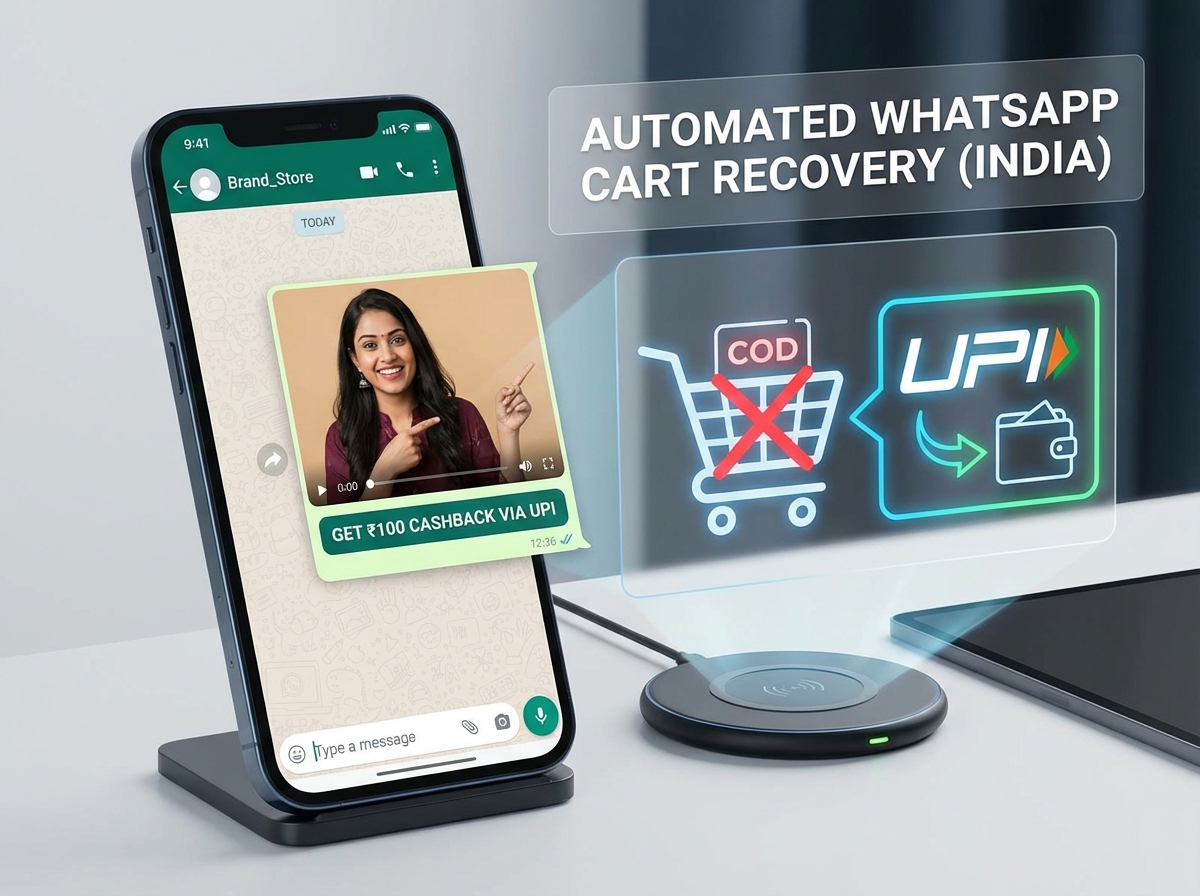
Target: Users who selected Cash on Delivery (COD) but abandoned at the final step.
- T+20 min (WhatsApp): A video highlighting the benefits of UPI. “Switch to prepaid and get an instant ₹100 cashback. It's faster, safer, and contact-free.”
- T+6 h (WhatsApp): Urgency-based checkout nudges showing the cashback offer expiring.
Flow D: Price-Drop Reactivation (The 48-Hour Window)
Target: Users who abandoned a cart within the last 48 hours where the price has since decreased.
- Immediate (WhatsApp): A personalized video showing the new, lower price. “Good news! The price of the [Product Name] in your cart just dropped by 15%. Grab it before the stock runs out.”
- Overlay: Limited stock alert automation showing current units available.
Flow E: Social Proof-First for New Shoppers
Target: First-time visitors with no prior purchase history.
- T+10 min (WhatsApp): Social proof cart recovery videos featuring a montage of real customer unboxing videos and a 4.8-star rating overlay.
- Support: A brief mention of psychological abandonment prevention tactics, such as “Easy 7-day returns” and “24/7 Customer Support.”
5. Script and Creative System: Reusable Lines and Overlays
The success of scarcity principle video campaigns and reciprocity checkout incentives depends on the creative execution. In 2026, the trend is toward “Modular Creative,” where video elements are swapped dynamically based on user data.
On-Screen Dynamic Elements:
- Personalization: “Hi [Name] from [City]!”
- Product Visualization: High-res image or 3D render of the specific item left in the cart.
- Urgency Indicators: Dynamic countdown timers personalization and “Live Stock” badges.
- Trust Badges: “Verified Purchase,” “Secure UPI Payment,” and “DPDP Compliant.”
Sample Script Fragments for AI Video Generation:
- For Loss Aversion: “You're one step away from saving ₹[Amount]. This festive offer is tied to your session—don't let it expire.”
- For Social Proof: “Join [Number] shoppers in [City] who chose this today. It's our #1 trending item this Navratri.”
- For Scarcity: “We're down to the last few units of your [Product Name]. We can't guarantee it will be in stock tomorrow.”
- For Urgency: “The clock is ticking on your Diwali discount. Use code FESTIVE10 before the timer hits zero.”
Language and Localization:
With 175+ languages supported, the script should automatically switch to the user's preferred tongue. A shopper in Tamil Nadu should receive a video in Tamil, featuring regional festive motifs, while a shopper in Punjab receives one in Punjabi. This level of localization is a key component of conversion psychology personalization India, as it builds immediate rapport and trust.
6. Measurement, ROI, and India-Specific Strategy
To justify the investment in behavioral cart recovery automation 2026, enterprise leaders must track a specific set of North-star and diagnostic KPIs. Success is measured not just by “orders recovered,” but by the incrementality of the video channel compared to traditional methods.
Key Performance Indicators (KPIs):
- Recovered Revenue: Total value of orders completed following a video trigger.
- Incremental Conversion Lift: The percentage increase in conversion rate for the group receiving video nudges vs. a control group receiving static SMS.
- Video Completion Rate: How much of the personalized video the user actually watched.
- Time-to-Recover: The average duration between abandonment and purchase.
- Discount Efficiency: The ratio of recovered revenue to the total value of discounts offered.
Solutions like TrueFan AI demonstrate ROI through a significant reduction in “Discount Fatigue.” By using social proof and scarcity instead of just “10% off,” brands can recover carts at a lower cost per acquisition. In fact, data from the 2025 festive season showed that video-led recovery sequences resulted in a 22% higher AOV compared to text-only sequences, as the visual medium better communicated the value proposition of premium bundles.
The 2026 Festival Cadence:
- Phase 1: The Warm-up (Pre-Sale): Use videos to encourage “Wishlisting” and capture early intent.
- Phase 2: The Peak (Main Sale): Deploy urgency-based checkout nudges and limited stock alert automation with high frequency.
- Phase 3: The Last Call (Sale End): Focus heavily on dynamic countdown timers personalization and “Guaranteed Delivery” messaging.
- Phase 4: Post-Festival: Use reciprocity checkout incentives to clear remaining inventory and build long-term loyalty.
Source: TrueFan AI: Video Personalization ROI Metrics
Source: TrueFan AI: Black Friday India Marketing 2025-2026
Source: Route Mobile: WhatsApp Open Rates and Conversion in India
Frequently Asked Questions
What is behavioral cart recovery automation 2026?
Behavioral cart recovery automation 2026 is the use of real-time data triggers and AI-generated personalized videos to re-engage shoppers who have abandoned their carts. It utilizes behavioral economics principles like FOMO, social proof, and loss aversion, delivered primarily through high-engagement channels like WhatsApp.
How do urgency-based checkout nudges stay ethical under the DPDP Act?
Ethical urgency-based checkout nudges must be grounded in truth. This means countdown timers should reflect actual offer expiry times, and stock alerts must be based on real-time inventory API data. Under the DPDP Act, brands must also ensure they have explicit consent to contact the user and provide a clear way to opt-out of future communications.
Why is video more effective than SMS for cart recovery in India?
Video is a high-bandwidth medium that can convey emotion, trust, and complex information (like product features or social proof) in seconds. In the Indian market, where visual storytelling is culturally significant, personalized videos achieve higher engagement and recall than text-based SMS, leading to better conversion rates.
Can these automation flows handle the scale of a major Indian festival?
Yes. Enterprise-grade solutions are built on cloud infrastructure capable of handling millions of concurrent triggers. By using optimized rendering engines, platforms can generate and deliver thousands of personalized videos per minute, ensuring no shopper is missed during peak traffic hours like Diwali night.
How does TrueFan AI help with these recovery strategies?
TrueFan AI's 175+ language support and Personalised Celebrity Videos allow brands to create hyper-localized, high-impact recovery content at scale. By integrating with a brand's existing tech stack via APIs, it enables the automated delivery of video nudges that feel personal, trustworthy, and culturally relevant to the Indian consumer.
What is the typical ROI for video-based cart recovery?
While results vary by category, enterprises typically see a 15% to 30% increase in recovered revenue when switching from static reminders to personalized video triggers. Additionally, the use of psychological triggers often allows brands to reduce their reliance on heavy discounting to close the sale.