Behavioral Nudge Marketing Automation 2026: AI-Powered Psychological Trigger Video Campaigns That Convert
Key Takeaways
- 2026 ushers in autonomous orchestration with AI-powered behavior prediction and psychological trigger video campaigns that adapt in real time.
- Privacy-first strategies using first-party data and short-form personalized video outperform static, generic nudges.
- Bias-driven playbooks—anchoring, reciprocity, social proof, scarcity/loss aversion, and commitment/consistency—lift conversions measurably.
- Decision fatigue reduction via predictive nudges and micro-commitment sequences, synchronized across WhatsApp, in-app, and web, is critical.
- Measurement and ethics matter: align to a KPI ladder and uphold transparency, autonomy, and accessibility while scaling with enterprise platforms.
Behavioral nudge marketing automation 2026 represents the pinnacle of autonomous customer engagement, moving beyond static drip sequences into a realm of predictive, privacy-first orchestration. In this landscape, growth marketing teams and product managers utilize psychological trigger video campaigns to guide users through complex decision matrices, effectively reducing friction in high-intent moments. By leveraging AI-powered behavior prediction, enterprises can now deliver hyper-personalized video content that addresses cognitive biases in real-time, ensuring that every micro-interaction serves a strategic purpose in the user journey.
The stakes for 2026 are exceptionally high as the digital ecosystem shifts toward autonomous orchestration. Marketers are no longer just setting up rules; they are deploying AI agents capable of optimizing nudge timing, channel selection, and messaging dynamics on the fly. This shift is driven by a necessity to combat rising acquisition costs and the "attention recession," where generic static nudges are increasingly ignored by a sophisticated consumer base.
1. The 2026 Landscape: Why Behavioral Nudge Marketing Automation is Non-Negotiable
The marketing environment of 2026 is defined by four seismic shifts that make behavioral nudge marketing automation 2026 the primary driver of enterprise growth. First, the transition to AI as a co-pilot has evolved into full autonomous orchestration. Predictive triggers now allow systems to anticipate a user's next-best-action with 94% accuracy, deploying psychological trigger video campaigns before a user even realizes they are reaching a decision bottleneck.
Second, the "Privacy-First" mandate has turned consent-centric personalization into a competitive advantage. In 2026, third-party cookies are a relic of the past; success depends on how effectively a brand uses first-party behavioral data to create value-driven micro-experiences. Third, the dominance of short-form, personalized video has rendered static banners obsolete. Consumers in 2026 demand snackable, high-production-value content that feels tailor-made for their specific context.
Finally, omnichannel execution has reached a state of total synchronization. A nudge initiated on WhatsApp is contextually aware of a previous interaction on a mobile app or a web overlay, ensuring a seamless narrative. This level of integration is essential for implementing decision fatigue reduction strategies, as it prevents the cognitive overload associated with fragmented messaging.
Source: Martechvibe – 7 Things Marketers in 2026 Should Know
Source: Klaviyo – 2026 Marketing Automation Trends
Source: MoEngage – Customer Engagement Guide 2026
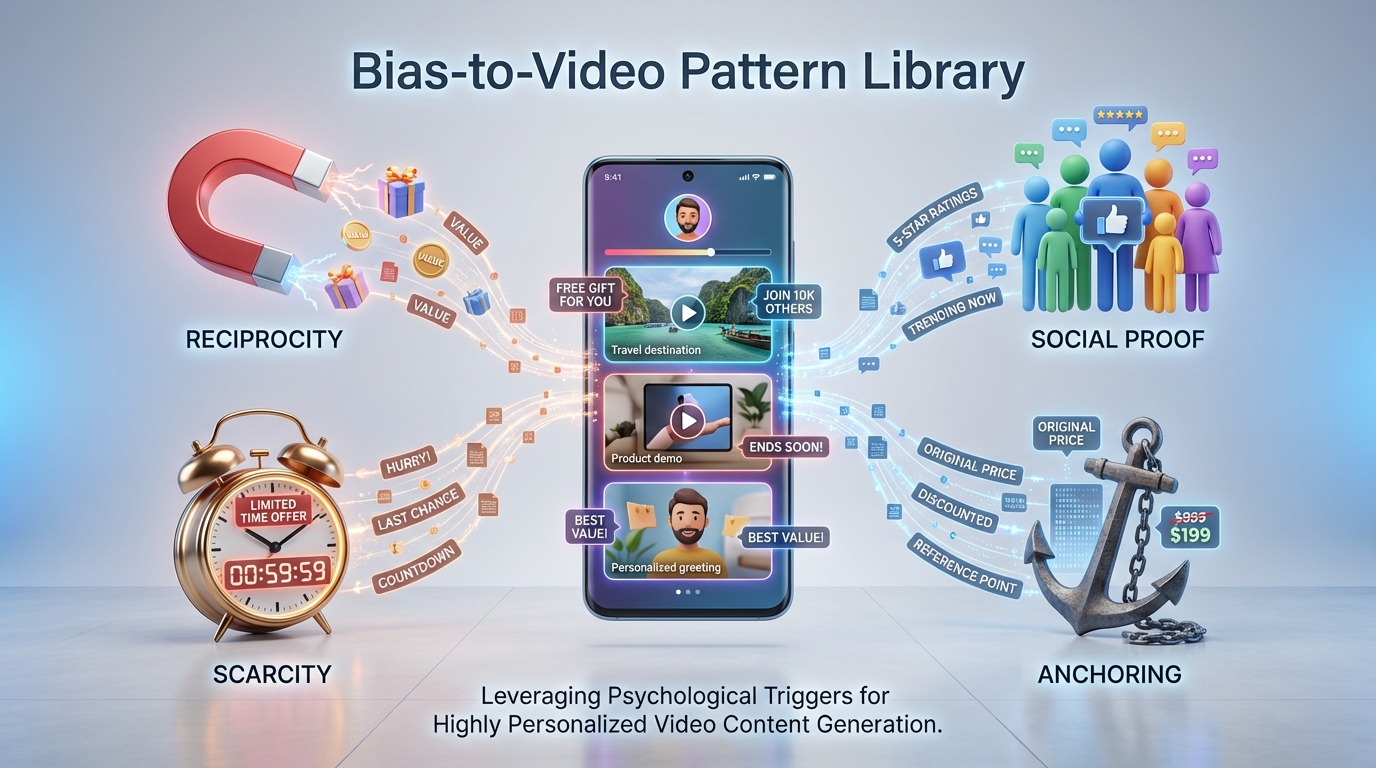
2. Psychological Trigger Video Campaigns: The Bias-to-Video Pattern Library
Psychological trigger video campaigns are short, personalized video messages triggered by specific behavioral signals. These campaigns are grounded in cognitive bias personalization, designed to reduce the mental effort required for a user to take a single, clear action. By translating complex behavioral economics into visual narratives, brands can achieve conversion uplifts that traditional text-based automation cannot match. Explore related insights on AI celebrity video marketing in India.
Anchoring Effect Personalization
In the context of subscription upgrades, the anchoring effect is a powerful tool. By presenting a high-value "anchor" plan before showing a personalized upgrade offer, marketers can shift the user's perception of value. For example, a video might highlight the comprehensive features of an Enterprise tier before nudging a Pro user toward a "specially priced" upgrade. Platforms like TrueFan AI enable the dynamic insertion of these price points and feature sets into celebrity-led or brand-led video content at scale.
Reciprocity Principle Videos
The reciprocity principle suggests that users are more likely to complete a task if they feel they have received something first. In cart completion sequences, a video offering an immediate, small "gift"—such as free expedited shipping or a bonus loyalty credit—creates a psychological obligation to finish the checkout. This "give-to-get" model is highly effective in the Indian D2C sector, where value-added incentives often outweigh flat discounts.
Social Proof Automation Videos
Social proof remains the strongest driver of trust. In 2026, social proof automation videos go beyond generic "X people bought this." They utilize real-time data to show localized trends, such as "4,213 shoppers in Mumbai added this to their cart today." Integrating User-Generated Content (UGC) snippets into these automated videos adds a layer of authenticity that resonates deeply with skeptical audiences.
Scarcity and Loss Aversion Marketing Campaigns
Scarcity urgency video triggers leverage the fear of missing out (FOMO) by highlighting real-time inventory levels or expiring offers. Loss aversion marketing campaigns take this further by focusing on what the user stands to lose—such as an accumulated streak, bonus points, or a temporary discount. These triggers are particularly effective for habit formation marketing videos, where maintaining a "streak" becomes a core part of the user's identity within the app. Learn more about scarcity-driven rapid fulfillment personalization strategies.
Commitment and Consistency Videos
The commitment consistency principle dictates that once a user takes a small step, they are psychologically driven to complete the sequence to maintain their self-image. Micro-commitment video sequences capitalize on this by celebrating small wins (e.g., "You've completed your profile!") and immediately inviting the next logical step. This reduces the perceived "weight" of the final conversion by breaking it into manageable, rewarded segments.
Source: Young Urban Project – Behavioural Marketing: Definition, Strategies, Benefits (2026)
Source: VWO – Increasing eCommerce Sales With Fewer Options
3. AI-Powered Behavior Prediction and Decision Fatigue Reduction
At the heart of behavioral nudge marketing automation 2026 lies AI-powered behavior prediction. This technology uses machine learning models to forecast user intent—such as purchase propensity, churn risk, or upgrade likelihood—by analyzing a vast array of behavioral, contextual, and lifecycle signals.
Instrumentation of Signals and Segments
To implement effective psychological trigger video campaigns, enterprises must instrument specific signals across their funnels:
- Commerce: Tracking Product Detail Page (PDP) views without add-to-cart, UPI intent initiated but not completed, and Cash on Delivery (COD) preferences.
- SaaS/OTT: Monitoring feature discovery sessions, device switching patterns, and plan limit crossings.
- BFSI: Identifying application drop-offs at the KYC (Know Your Customer) stage or premium payment reminders based on spending spikes.
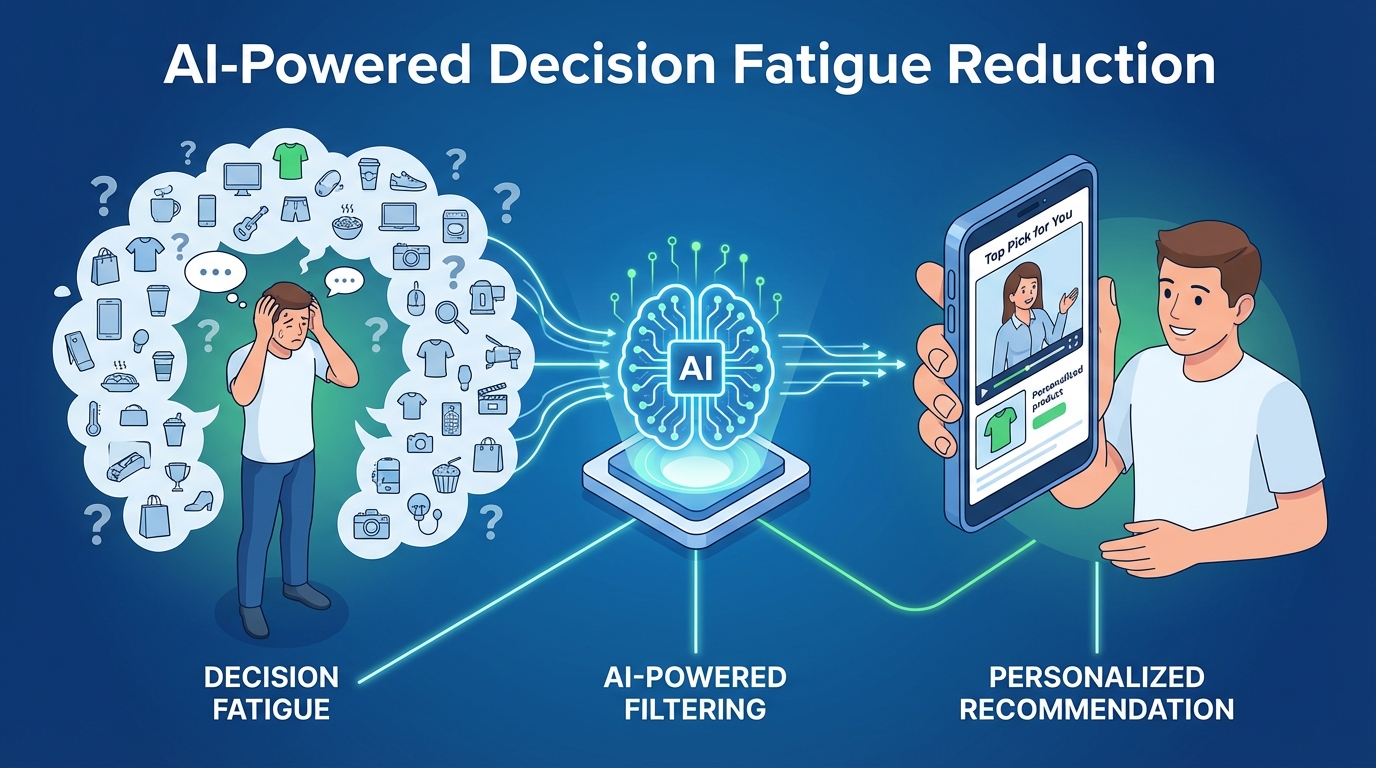
Solving for Decision Fatigue
Decision fatigue reduction strategies are critical in an era of infinite choice. When users are presented with too many options, they often default to inaction. AI-powered behavior prediction solves this by narrowing the field. Instead of showing a full catalog, a predictive nudge might show a personalized video featuring the top 2 items most likely to appeal to that specific user based on past behavior.
By using pre-selected smart defaults and personalized comparisons (e.g., "Users with your profile typically choose X"), marketers can shortcut the evaluation phase. This "choice architecture" is essential for maintaining high conversion rates in the fast-paced Indian market, where mobile-first users demand instant clarity.
Source: MoEngage – Predictive Segments and Real-Time Targeting
Source: VWO – The Paradox of Choice in Ecommerce
4. Micro-Commitment Video Sequences: The Growth Playbooks
Micro-commitment video sequences are designed to elicit a series of "small yeses" that cumulatively lead to a macro conversion. By stacking these psychological triggers, brands can move users through the funnel with significantly less resistance.
Playbook 1: The Cart Recovery Engine
- Trigger: User abandons a cart with a value > ₹2,000.
- Video 1 (Reciprocity): A 10-second video sent via WhatsApp 30 minutes later, offering free express shipping.
- Video 2 (Social Proof): Sent 4 hours later, showing a mosaic of reviews from the user's city.
- Video 3 (Scarcity): Sent the next morning, highlighting that only 2 units remain in the user's specific size.
Playbook 2: The Subscription Upgrade Path
- Trigger: User hits a feature gate for the third time in a week.
- Video 1 (Anchoring): A video comparing the user's current usage limits with the "unlimited" potential of the Premium tier.
- Video 2 (Commitment): A "Year in Review" style video celebrating the user's achievements and showing what they could unlock next.
- Video 3 (Loss Aversion): A final nudge showing a time-bound discount on the upgrade that expires in 6 hours.
Playbook 3: The Habit Formation Loop
- Trigger: User completes their first daily task in a fintech or fitness app.
- Video 1 (Identity): A video congratulating the user on starting their "Wealth-Builder" or "Athlete" journey.
- Video 2 (Reward): A teaser for a variable reward (e.g., a mystery scratch card) available after a 3-day streak.
- Video 3 (Social Proof): A leaderboard video showing how the user ranks against others in their demographic.
These sequences ensure that habit formation marketing videos are not just reminders, but emotional touchpoints that reinforce positive user behavior.
5. Behavioral Economics Marketing India: Adapting for the Subcontinent
Implementing behavioral nudge marketing automation 2026 in India requires a deep understanding of local infrastructure and cultural nuances. The Indian consumer is uniquely motivated by specific trust signals and convenience factors.
UPI-First Orchestration
India's digital economy is built on UPI. Psychological trigger video campaigns must account for this by embedding UPI-specific nudges. If a user starts a payment but doesn't complete it, a video nudge can provide a direct deep-link to their preferred UPI app or show a dynamic QR code for web-to-mobile transitions. According to NPCI data, reducing the steps to reach the UPI pin-entry screen is the single most effective way to boost checkout success rates.
The WhatsApp Dominance
In India, WhatsApp is not just a messaging app; it is the primary operating system for life. Short, bilingual videos delivered via WhatsApp outperform email and SMS by 4x in terms of engagement. TrueFan AI's 175+ language support and Personalised Celebrity Videos allow brands to speak to users in their native tongue—be it Hindi, Tamil, Telugu, or Marathi—with localized idioms that build instant rapport.
Festive Cycles and Payday Anchoring
The Indian market operates on a distinct rhythmic cycle. Festive seasons like Diwali and Navratri amplify the effectiveness of scarcity and social proof. Furthermore, "Payday" anchoring—aligning high-value nudges with the first week of the month when liquidity is highest—is a critical strategy for BFSI and high-ticket e-commerce.
Source: NPCI – Latest UPI Trends and Press Releases
Source: Young Urban Project – Behavioral Marketing Strategies in India
6. Nudge Theory Video Implementation: A Step-by-Step Framework
Deploying a successful behavioral nudge marketing automation 2026 strategy requires a structured approach to bridge the gap between data and creative execution.
- Identify Behavioral Objectives: Define exactly what action you want the user to take (e.g., "Upgrade to Annual Plan"). Map this to a primary cognitive bias (e.g., Loss Aversion).
- Define Trigger Logic: Set the parameters for the AI-powered behavior prediction model. What are the propensity thresholds? What is the recency window for the trigger?
- Script and Storyboard: Create bias-aligned video variants. These should be 10–15 seconds long, featuring a single, dominant CTA.
- Personalization Schema: Map the data fields needed for the video—name, city, SKU, price, and language. Ensure data contracts are in place for privacy compliance.
- Orchestration and Delivery: Select the primary channel (WhatsApp, In-App, etc.) and set frequency caps to avoid over-triggering.
- Experimentation: Use A/B testing to compare different biases. Does "Social Proof" work better than "Scarcity" for this specific segment?
- Scale with Autonomous Orchestration: Feed the results back into the AI model to refine future nudges.
Solutions like TrueFan AI demonstrate ROI through their ability to handle this entire workflow at enterprise scale. By offering "virtual reshoots," brands can swap lines in a video—changing an "Anchor" offer to a "BOGO" offer—without the need for expensive new production cycles. This agility is what defines the leaders in 2026 marketing.
7. Measurement, ROI, and Ethical Guardrails
To justify the investment in behavioral nudge marketing automation 2026, growth teams must move beyond vanity metrics and focus on a "KPI Ladder" that connects engagement to long-term value.
KPI Ladder for Video Nudges
- Leading Indicators: Video start rate, 95% watch-through rate, and Click-Through Rate (CTR) on the video CTA.
- Conversion Metrics: Micro-commitment completion rate, cart recovery rate, and upgrade conversion lift.
- Lagging Indicators: Customer Lifetime Value (LTV) delta, D30/D90 retention rates, and overall churn reduction.
Ethical Standards and Governance
As we leverage powerful psychological triggers, ethical guardrails are paramount. 2026 consumers are quick to identify and reject "dark patterns."
- Transparency: Scarcity and urgency must be based on real data (e.g., actual inventory levels).
- Autonomy: Users must have an easy way to opt-out of nudge sequences.
- Accessibility: All videos must include captions and be optimized for low-bandwidth environments, especially in Tier-2 and Tier-3 Indian cities.
Conclusion: The Future of Autonomous Growth
The transition to behavioral nudge marketing automation 2026 is not merely a technical upgrade; it is a fundamental shift in how brands relate to their customers. By combining the precision of AI-powered behavior prediction with the emotional resonance of psychological trigger video campaigns, enterprises can create journeys that feel less like a sales funnel and more like a guided, personalized experience.
For Indian enterprises operating in high-velocity sectors like e-commerce, fintech, and OTT, the ability to deploy these strategies at scale—respecting local nuances like UPI and regional languages—will be the defining factor of market leadership. The era of generic, one-size-fits-all automation is over. The era of the intelligent, video-first nudge has arrived.
Ready to transform your funnel?
- Book a TrueFan AI enterprise demo to explore our nudge template library and predictive orchestration capabilities.
- Request a cognitive bias personalization audit of your current user journeys to identify high-impact growth opportunities.
Frequently Asked Questions
How does behavioral nudge marketing automation 2026 differ from traditional marketing automation?
Traditional automation relies on "if-this-then-that" rules and static content. The 2026 approach uses AI-powered behavior prediction to dynamically generate and deliver personalized video content that adapts to the user's psychological state in real-time.
Are psychological trigger video campaigns considered manipulative?
No, when implemented ethically. Nudges are "choice-preserving" interventions. They don't force a user's hand; they clarify value and reduce the friction that often prevents users from completing actions they already intended to take.
What is the minimum data required to start with cognitive bias personalization?
You need first-party behavioral events (e.g., what they clicked, what they viewed) and basic consented PII like name, preferred language, and city. You do not need invasive third-party data to be effective.
How does TrueFan AI ensure that personalized videos don't feel "uncanny" or robotic?
TrueFan AI uses advanced generative models that retain the celebrity or brand ambassador's natural voice and perfect lip-sync, even when dynamically inserting thousands of different names or product details. This maintains the "human" connection essential for trust.
How do we prevent "nudge fatigue" where users start ignoring the videos?
This is managed through frequency caps, recency windows, and propensity throttling. By only triggering a nudge when the AI predicts a high likelihood of relevance, you ensure that the communication remains a value-add rather than a nuisance.