URL to video AI generator: Enterprise-grade website to video automation tool for e-commerce and content teams
Estimated reading time: ~12 minutes
Key Takeaways
- URL-to-video automation converts web pages into short videos at enterprise scale using AI-driven parsing, scripting, and rendering.
- E-commerce impact: Native workflows for Shopify and Amazon boost PDP coverage, CTR, and conversion while maintaining brand consistency.
- API-first architecture enables batch rendering, webhooks, multilingual voiceovers, and accessibility-ready captions.
- Operational ROI: 90%+ cost reduction and minutes-to-market turnarounds compared to manual production cycles.
- Governance & compliance: Built-in approval gates, audit logs, and DPDP-aligned consent management for safe scaling.
The modern digital landscape demands velocity, and for enterprise marketing teams, the URL to video AI generator has emerged as the definitive solution for scaling high-quality visual content. As we move into 2026, the traditional bottleneck of manual video production—characterized by lengthy shoots, expensive editing cycles, and fragmented asset management—is being replaced by a sophisticated website to video automation tool ecosystem. This shift allows brands to convert static product detail pages (PDPs) and landing pages into dynamic, 30-second video rendering assets in real-time.
By leveraging a URL-to-video REST API, enterprises can now automate the creation of Shopify video integration assets and Amazon listing videos at a scale previously thought impossible. This blueprint explores the technical architecture, e-commerce playbooks, and ROI frameworks required to implement web content video automation and content repurposing automation within a global enterprise framework.
1. Defining the URL to Video AI Generator: Scope and Capabilities
A URL to video AI generator is not merely a simple converter; it is a sophisticated orchestration engine that ingests a public, approved web URL and synthesizes it into a professional video asset. By parsing metadata, H1/H2 headers, structured data (schema.org), and high-resolution media from a landing page, the tool automatically assembles a share-ready video—typically optimized for a 30-to-60-second duration—without requiring manual intervention.
The core of this technology lies in automated video creation from URL workflows. Unlike manual editors that require timeline assembly, these AI-driven systems utilize AI content transformation to summarize page copy into a tight, persuasive script. They then select hero visuals and apply brand-consistent voiceovers and subtitles. This ensures that every video produced maintains the exact typography, color palette, and motion style defined in the corporate brand kit.
Furthermore, dynamic content video generation allows the scene composition to vary based on the specific page sections available. If a product page features a 360-degree view or specific customer testimonials, the AI prioritizes these elements in the final render. This level of granularity is essential for creating high-converting e-commerce product videos that feel bespoke rather than templated.
Sources:
2. The Business Case for Web Content Video Automation
In 2026, the mandate for enterprise leaders is clear: achieve more with less while maintaining absolute brand governance. Web content video automation addresses this by eliminating the “creative lag” that often delays product launches. Instead of waiting weeks for a creative agency to deliver a single promotional clip, a website to video automation tool can render thousands of variants in minutes.
The speed-to-market advantage is compounded by the ability to maintain creative freshness. As prices change or seasonal promotions fluctuate, the URL to video AI generator can re-render assets to reflect the latest data on the source URL. This ensures that Amazon listing videos and social ads are never out of sync with the actual product offering.
Localization and accessibility are also primary drivers for adoption. Modern AI video platforms can auto-generate multilingual variants and voiceovers, ensuring that a single URL can power global campaigns. With 2026 projections indicating that 85% of e-commerce traffic will be driven by short-form video, the ability to produce WCAG-friendly content with automated captions is a competitive necessity. Platforms like TrueFan AI enable enterprises to bridge this gap by providing a scalable infrastructure for high-volume video production.
Sources:
- Shopify: Video commerce and TikTok partnerships (India)
- AIP Proceedings: Analysis of shoppable video impact
3. Technical Architecture: Implementing a URL-to-Video REST API
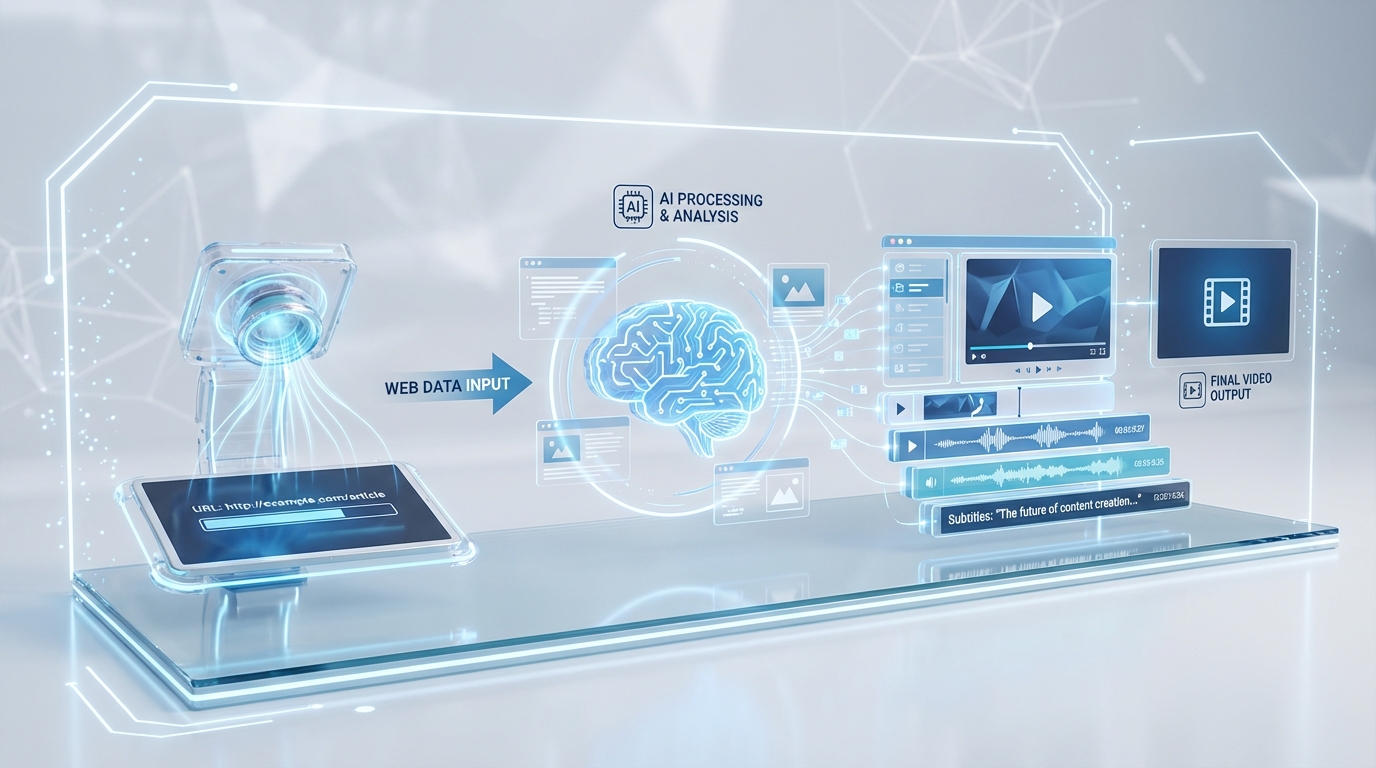
For developers and marketing technologists, the magic happens within the URL-to-video REST API. The process begins with a POST request containing the source URL, template ID, and brand parameters. The system then initiates a multi-stage pipeline:
- Crawl and Parse: The engine extracts title tags, key features, pricing, and images while respecting robots.txt and consent protocols.
- AI Content Transformation: A large language model (LLM) summarizes the extracted text into a 60–90 word script, which is then segmented into 4–6 logical scenes.
- Template Binding: These scenes are mapped to a pre-approved brand template. This is where 30-second video rendering occurs, applying transitions, animations, and lower-thirds.
- Voiceover and Audio: High-fidelity AI voices synthesize the script in the target language, perfectly synced with on-screen captions.
The output is a set of optimized files for various platforms. A product page video converter flow might generate an MP4 for Shopify, while a marketplace preset creates a 16:9 variant specifically for Amazon listing videos. TrueFan AI's 175+ language support and Personalised Celebrity Videos further enhance this pipeline, allowing for a level of engagement that standard AI voices cannot match.
The API pattern typically follows an asynchronous model. After the initial request, the system sends webhook events such as render_started and render_completed. This allows for high-concurrency batch jobs, where an enterprise can refresh its entire 10,000-SKU catalog overnight.
Sources:
4. E-commerce Playbook: Shopify Video Integration and Amazon Listing Videos
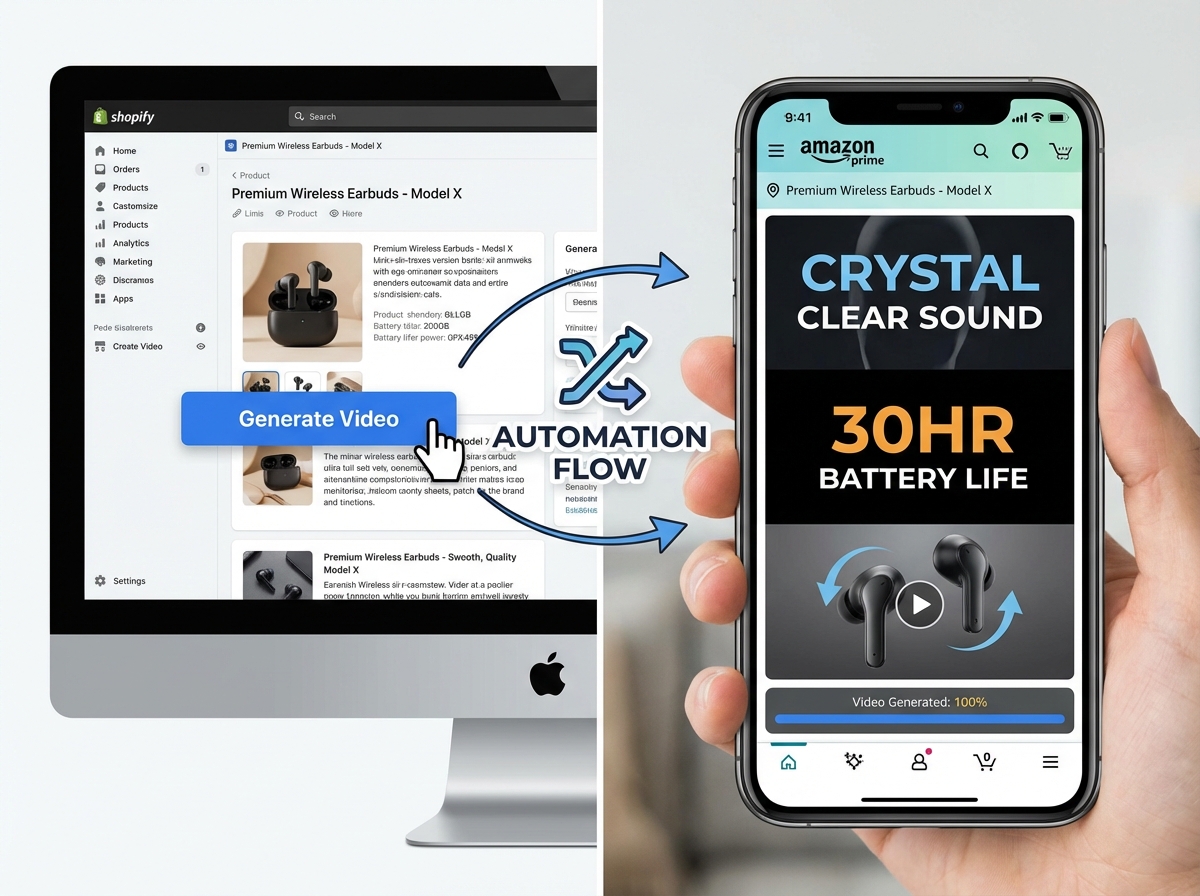
The most immediate ROI for a URL to video AI generator is found in the e-commerce sector. For Shopify video integration, the workflow is seamless. By utilizing Shopify webhooks (e.g., product/create), a brand can trigger an automated render the moment a new SKU is added. The resulting video is then automatically attached to the product's media gallery via the Shopify Admin API.
When it comes to Amazon listing videos, the requirements are more stringent. Amazon recommends a 16:9 aspect ratio, 1080p resolution, and a file size under 500MB. Most importantly, the first 3–5 seconds must capture the product's core value proposition. A website to video automation tool ensures these technical specs are met every time, including the “safe areas” required for text overlays so they aren't obscured by the Amazon UI.
In 2026, data shows that products with video content on their PDP see a 25-30% increase in add-to-cart rates compared to static listings. By automating this process, brands can ensure 100% video coverage across their entire inventory, rather than just focusing on top-tier “hero” products. This comprehensive approach to e-commerce product videos is what separates market leaders from laggards.
Sources:
5. Content Repurposing Automation and Lifecycle Management
Beyond the product page, content repurposing automation allows brands to maximize the value of their existing web assets. A long-form blog post can be transformed into a landing page video generation asset for social media or a homepage embed. This lifecycle automation ensures that as your web content evolves, your video assets follow suit.
For example, a “Release Notes” page can be automatically converted into a 30-second video rendering that highlights new features for a LinkedIn audience. If the source page is updated, a scheduled check or webhook can trigger a re-render, keeping the video content perpetually accurate. This is particularly useful for event pages or limited-time promos where information changes rapidly.
Governance is a critical component of this process. Enterprise-grade tools provide approval gates, ensuring that no video is published without a final human review. Audit logs and role-based permissions provide the security posture required by global organizations. Solutions like TrueFan AI demonstrate ROI through these efficiencies, allowing a single content manager to oversee the production of thousands of assets across multiple languages and regions.
Sources:
6. ROI Benchmarks and Enterprise Compliance Standards
Measuring the success of a URL to video AI generator implementation requires a dual focus on production savings and performance lift. Traditionally, producing 1,000 product videos would cost hundreds of thousands of dollars and take months. With web content video automation, the cost per video drops by over 90%, and the turnaround time is reduced to minutes.
From a performance perspective, the key KPIs include:
- PDP Dwell Time: Video content typically increases time-on-page by 2x.
- Conversion Rate (CVR): A/B tests consistently show a 15-20% lift in CVR for pages with video.
- Ad Click-Through Rate (CTR): Sponsored Brands Video ads on Amazon often outperform static images by 3x in terms of engagement.
Compliance is equally vital. An enterprise website to video automation tool must adhere to ISO 27001 or SOC 2 standards. It must also ensure that all AI-generated content follows marketplace policies, such as avoiding prohibited claims or ensuring proper captioning for accessibility. By integrating these checks into the URL-to-video REST API workflow, brands can scale with confidence, knowing that every asset produced is legally and ethically sound.
Sources:
7. Quickstart Guide and Frequently Asked Questions
Implementing a URL to video AI generator is a structured process that begins with template definition and ends with automated distribution.
Step-by-Step Quickstart:
- Define Brand Kits: Upload your logos, fonts, and color palettes to the platform.
- Select Templates: Choose from pre-built layouts for PDPs, Amazon SBVs, or social ads.
- API Integration: Connect your CMS or Shopify store to the URL-to-video REST API.
- Test Render: Provide a sample URL and review the 30-second video rendering output.
- Scale: Trigger batch renders for your entire catalog and monitor the results via your analytics dashboard.
Frequently Asked Questions
How do I convert a URL into a 30-second product video?
The process involves providing a source URL to the AI generator, which then crawls the page for data. The AI summarizes the content into a script, matches it with images from the page, and performs a 30-second video rendering using your pre-defined brand templates. This automated video creation from URL ensures consistency and speed.
What file specs should I follow for Amazon listing videos?
For Amazon listing videos, you should aim for a 16:9 aspect ratio, 1080p resolution, and MP4 or MOV format. The video should be between 30 and 60 seconds. It is crucial to keep text within the “safe areas” to avoid being covered by Amazon's interface elements.
Can I automate Shopify PDP uploads?
Yes, through Shopify video integration. By using the Shopify Admin API in conjunction with a URL-to-video REST API, you can automatically upload and assign video assets to the correct product media gallery as soon as they are rendered.
Will the videos stay on brand across thousands of SKUs?
Absolutely. By using a website to video automation tool that utilizes locked brand kits and templates, every video produced will adhere to your specific typography, colors, and motion guidelines, regardless of the volume.
Can I localize videos automatically?
Yes. Modern AI content transformation allows for the automatic generation of multilingual voiceovers and captions. This enables you to take a single English URL and create video variants for dozens of different global markets instantly.
Does TrueFan AI support REST API triggers for batch scale?
Yes, TrueFan AI is designed for enterprise scale, offering a robust API that supports high-concurrency rendering, webhook callbacks, and seamless integration with existing PIM and CMS systems.
Sources:
Governance and DPDP Compliance: The India-First Approach
In the context of enterprise AI adoption India, compliance with the Digital Personal Data Protection (DPDP) Act is non-negotiable. The Act mandates that personal data be processed only for specified purposes with the explicit, informed, and unambiguous consent of the individual. For marketing leaders, this means that every personalized video must be backed by a robust consent management framework.
An enterprise-grade platform ensures DPDP compliance through well-defined controls:
- Purpose Limitation: Ensuring that data used for video personalization is strictly confined to the agreed-upon marketing or service purpose.
- Consent-First Talent Management: Using celebrity AI avatars only within the scope of legally binding contracts that specify usage windows and campaign territories.
- Auditable Logs: Maintaining detailed records of data processing activities to demonstrate compliance during regulatory audits.
- Content Moderation: Implementing automated filters to prevent the generation of offensive or non-compliant content, protecting both the brand and the talent.
Frequently Asked Questions
How does URL-to-video automation work?
The platform crawls a public URL, extracts copy and media, uses AI to script 4–6 scenes, binds them to brand templates, and renders a 30–60 second video with voiceover and captions.
What are the specs for Amazon listing videos?
Use 16:9 at 1080p, MP4/MOV under 500MB, 30–60 seconds. Keep text in safe areas to avoid UI overlap and front-load the value prop in the first 3–5 seconds.
Can I automate Shopify PDP video uploads?
Yes. Trigger renders via Shopify webhooks and attach outputs to product media through the Admin API, orchestrated by a URL-to-video REST API.
Does the system support localization and accessibility?
Modern engines support multilingual voiceovers, subtitles, and WCAG-aligned captions, enabling global variants from a single source URL.
How do enterprises ensure compliance and brand governance?
Use approval gates, audit logs, policy checks, and DPDP-aligned consent frameworks. Locked brand kits ensure typography, color, and motion consistency at scale.