Vernacular Video Automation India: The Enterprise Playbook for Bharat-Scale Personalization
Estimated reading time: ~10 minutes
Key Takeaways
- Vernacular-first video outperforms English-first in tier-2/3 markets by removing cognitive friction and boosting trust.
- Enterprise stacks need CSV-to-video and URL-to-video workflows for real-time, Bharat-scale personalization.
- Indian voice cloning and AI avatars drive authenticity with native accents, cultural cues, and accurate pronunciations.
- Governance at scale requires certifications, RBAC, approval workflows, and DPDP-compliant consent logs.
- Measurable ROI comes from higher hook and conversion rates, validated by a 6-week implementation roadmap.
The rapid evolution of India’s digital landscape has reached a critical inflection point where English-centric marketing no longer suffices for national dominance. To capture the next 500 million users, CMOs are increasingly turning to vernacular video automation India as the primary driver for engagement in tier-2 and tier-3 markets. By 2026, the ability to deliver hyper-personalized, culturally resonant content at scale will separate market leaders from those struggling with stagnant acquisition costs.
Enterprise growth leaders must now navigate a complex ecosystem of multilingual AI to maintain relevance across the diverse linguistic fabric of Bharat. Platforms like TrueFan AI enable brands to transcend traditional creative bottlenecks, allowing for the simultaneous generation of thousands of localized videos that speak directly to the consumer's identity. This strategy is no longer optional; it is the foundational architecture for any brand aiming to win the “Bharat” market through high-impact, automated storytelling.
To succeed in this transition, enterprises must focus on three core pillars:
- Reach: Personalize at Bharat scale across Hindi, Tamil, Bengali, and more with a 175 language video platform.
- Resonance: Utilize an Indian AI avatar and AI voice cloning Indian accents to ensure native-like credibility and trust.
- ROI: Deploy CSV-to-video and URL-to-video workflows to significantly lift CTR/CVR while lowering CPA in vernacular channels.
The Bharat Imperative: Why Vernacular Video Beats English-First in Tier-2/3
The shift toward tier-2 city video marketing is driven by a fundamental change in consumer behavior. Recent data from the IAMAI-Kantar ICUBE 2024 report indicates that rural and tier-2/3 regions are now the primary engines of internet growth in India. For these users, English is often a functional second language, but vernacular is the language of trust, emotion, and transaction. When a brand communicates in a local dialect, it removes the cognitive friction associated with translation, leading to higher retention and faster decision-making.
In the Bharat market AI videos landscape of 2026, authenticity is the new currency. Consumers in cities like Indore, Coimbatore, or Patna are increasingly wary of generic, dubbed content that feels “imported.” They respond to “code-mixed” Hinglish or regional dialects that incorporate local slang and cultural nuances. This level of localization was historically impossible to achieve manually, but vernacular video automation has democratized high-fidelity production, allowing brands to create 1,000+ versions of a single campaign in minutes.
The distribution reality also dictates a video-first approach. Platforms like YouTube Shorts, Instagram Reels, and regional giants like Moj and ShareChat have become the primary search engines for Bharat. In these environments, a vertical, 9:16 video that starts with a localized greeting—such as “Vanakkam” or “Nomoshkar”—can see a 3x higher hook rate compared to a standard English creative. By automating this process, enterprises can ensure their message is natively optimized for every regional channel without inflating their creative overhead.
Sources:
- IAMAI-Kantar ICUBE 2024 report (India internet growth trends)
- Social Beat: Digital marketing trends 2026 in India
- LS Digital: Vernacular SEO and tier-2/3 growth
From Hinglish to Regional Mastery: Building an Enterprise Multilingual AI Video Generator Stack
For an enterprise to scale, it requires a robust multilingual AI video generator stack that goes beyond simple translation. The goal is “code-mixed” authenticity, particularly through Hinglish AI video creation. Hinglish—the natural blending of Hindi and English—serves as a bridge between aspirational global branding and local relatability. It is the dominant vernacular of urban and semi-urban India, and mastering its “code-switching” dynamics is essential for maintaining a modern brand voice.
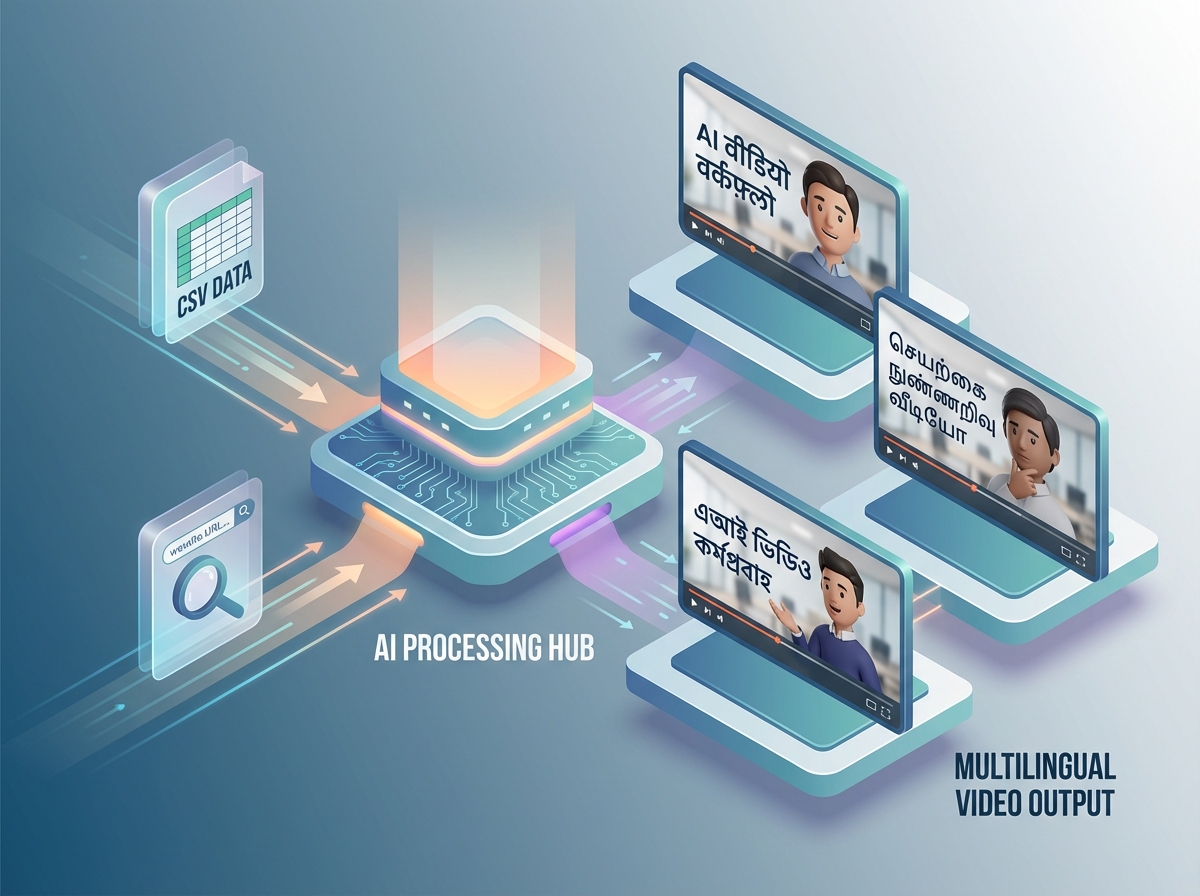
A sophisticated enterprise stack must include an orchestration layer that ingests structured data and outputs polished video assets. This involves a “CSV-to-video” workflow where a single spreadsheet containing customer names, cities, and preferred languages can trigger the creation of thousands of unique videos. Alternatively, “URL-to-video” technology allows brands to transform product detail pages (PDPs) into high-converting video ads by automatically scraping titles, prices, and USPs, then localizing them for specific regional cohorts.
The technical pipeline for this automation typically follows a structured sequence:
- Data Intake: Ingesting CRM data or product URLs to define the personalization variables.
- Creative Logic: Mapping these variables into pre-approved video templates with regional CTA variants.
- Voice Synthesis: Applying Indian accent voice synthesis to ensure the audio matches the regional context.
- Visual Generation: Integrating an Indian AI avatar with appropriate attire and gestures.
- Quality Control: Automated checks for linguistic accuracy, brand safety, and profanity filters.
By 2026, the standard for render times has dropped to sub-30 seconds, enabling real-time personalization. This means a user who abandons a cart on an e-commerce site can receive a personalized WhatsApp video in their native language within a minute, significantly increasing the likelihood of recovery. This level of regional language personalization is what defines the next generation of Indian enterprise marketing.
Sources:
Voices and Faces of Trust: AI Voice Cloning and Indian AI Avatars
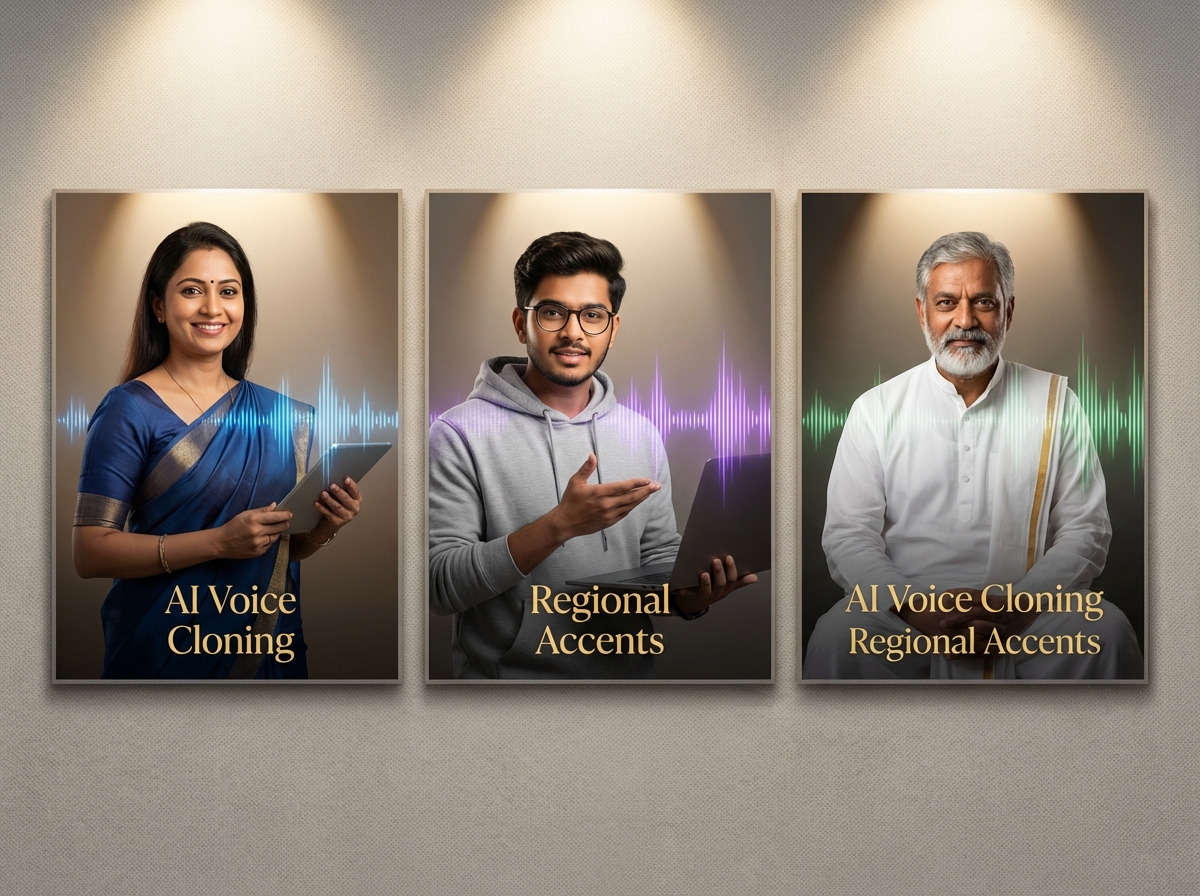
The psychological impact of a familiar voice cannot be overstated in the context of vernacular video automation India. Generic, robotic text-to-speech (TTS) is a major deterrent for Bharat audiences. Instead, enterprises are adopting AI voice cloning Indian accents, which uses neural networks trained on specific Indian phonetics and prosody. This technology ensures that the stress, tone, and intonation of the speech feel natural to a native speaker, whether they are in Punjab or Kerala.
Indian accent voice synthesis is particularly vital for handling complex regional names and city pronunciations. A generic AI might struggle with “Thiruvananthapuram” or “Chikkamagaluru,” but a localized model uses phoneme-level dictionaries to ensure 99% accuracy. This precision builds immediate trust. When a customer hears their name pronounced correctly in their local accent, the “uncanny valley” effect disappears, and the message is received as a personal communication rather than a mass-produced advertisement.
Complementing the voice is the Indian AI avatar. An enterprise-grade avatar must reflect the diversity of the Indian population, offering various options for attire (from corporate to traditional), facial features, and gestures. For instance, a Bengali AI spokesperson should not only speak the language but also embody the cultural nuances of the region. This includes subtle micro-expressions and hand gestures that resonate with a Bengali audience, creating a sense of “local-first” representation.
Brand safety and ethics are paramount when deploying these avatars. Enterprises must ensure that all AI-generated likenesses are used with explicit consent and within strictly defined usage windows. This “consent-first” model, aligned with the DPDP Act 2023, ensures that the brand remains compliant while leveraging the power of human-like AI. TrueFan AI's 175+ language support and Personalised Celebrity Videos provide the necessary guardrails and scale for these high-stakes enterprise deployments.
Sources:
Regional Playbooks: Hindi, Tamil, and Bengali Video Automation Strategies
To maximize the impact of vernacular video automation, brands must move beyond a “one-size-fits-all” translation strategy and adopt region-specific playbooks. Each linguistic market in India has its own cultural triggers, platform preferences, and consumption habits.
Hindi AI Video Marketing: The Mass Reach Strategy
Hindi remains the powerhouse for mass-market penetration. However, the 2026 trend is moving toward “Hyper-Local Hindi,” which incorporates dialects from the Hindi heartland. Hindi AI video marketing should focus on high-frequency use cases like festive offers, financial onboarding, and telecommunications updates. For maximum engagement, scripts should lead with a Hindi headline but use a Hinglish CTA, reflecting how the youth in tier-2 cities actually communicate. Personalization of the user's name and city within the first five seconds is critical for stopping the scroll on platforms like ShareChat and YouTube Shorts.
Tamil Video Automation: Depth via Cultural Relevance
The Tamil market demands a higher degree of linguistic purity and cultural sensitivity. Tamil video automation should prioritize “Vanakkam” greetings and ensure that the AI avatar's attire is aligned with South Indian aesthetics. This market has a high affinity for WhatsApp-based commerce. Using a multilingual AI video generator to send personalized service reminders or local retail updates in Tamil can see a significant lift in “read rates” and “reply rates” compared to English or Hindi alternatives.
Bengali AI Spokesperson: Building Trust and Recall
For the West Bengal and North-East markets, a Bengali AI spokesperson is essential for BFSI (Banking, Financial Services, and Insurance) and utility sectors. These sectors rely heavily on trust. A warm “Nomoshkar” and a cadence that emphasizes security and benefits can significantly improve KYC completion rates. Given the varying internet speeds in rural Bengal, these videos must be optimized for low-bandwidth delivery, often utilizing subtitle-first designs to ensure the message is conveyed even if the audio is muted.
By implementing these targeted strategies, enterprises can ensure that their regional language personalization efforts are not just linguistically accurate but culturally resonant.
Sources:
- Inkling Marketing: 2026 digital marketing trends for SMBs in India
- TrueFan AI: Voice commerce and vernacular India 2026
Enterprise Scale and Governance: Security, Compliance, and 175 Language Support
Scaling vernacular video automation India to a national level requires more than just creative tools; it requires an enterprise-grade infrastructure. A 175 language video platform allows a brand to conduct a single “base shoot” with a celebrity or brand ambassador and then programmatically generate infinite variants in every major and minor Indian dialect. This “shoot once, localize everywhere” model is the only way to achieve the volume required for modern digital advertising without a linear increase in costs.
Governance is the backbone of this scale. Enterprise leaders must insist on a platform that offers:
- ISO 27001 and SOC 2 Certification: Ensuring that customer data used for personalization is handled with the highest security standards.
- Role-Based Access Control (RBAC): Allowing different regional teams to manage their own campaigns while maintaining central brand oversight.
- Approval Workflows: Ensuring that every AI-generated video is reviewed for brand consistency before it goes live.
- DPDP Act Compliance: Managing “Notice and Consent” logs for every personalized video generated, ensuring full alignment with India’s data protection laws.
Integration is the final piece of the governance puzzle. A multilingual AI video generator must plug directly into existing CRM and Marketing Automation (MA) stacks like Salesforce, HubSpot, or Braze. This allows for real-time triggers—such as a personalized birthday greeting or a localized abandoned cart nudge—to be sent via the WhatsApp Business API catalog video marketing playbook or email without manual intervention. Solutions like TrueFan AI demonstrate ROI through these seamless integrations, providing a clear path from data to personalized engagement.
Sources:
- India Digital Advertising: 2026 market trends
- Alvarez & Marsal: AI and cross-border growth in tier-2/3
Measurement, ROI, and Implementation: The 6-Week Roadmap to Bharat Scale
The ultimate validation of vernacular video automation lies in the data. Enterprises are seeing transformative results by moving away from static, English-first assets. For example, Zomato’s Mother’s Day campaign utilized automation to generate 354,000 personalized videos in a single day, resulting in a massive social buzz and a direct lift in orders. Similarly, Hero MotoCorp used 2.4 million personalized greetings to drive dealership visits during the festive season, proving that Bharat market AI videos can drive offline actions.
To achieve these results, enterprises should follow a structured 6-week implementation roadmap:
- Week 1-2: Strategy and Asset Capture. Define use cases, KPIs, and target languages. Conduct a 10-minute base shoot with your spokesperson to create the foundation for the AI models.
- Week 3-4: Pipeline Integration. Set up the CSV-to-video or URL-to-video workflows. Build the regional pronunciation dictionaries and select the Indian AI avatar styles.
- Week 5-6: Pilot and Scale. Launch a pilot campaign in 2-3 languages (e.g., Hindi and Tamil). Analyze the CTR and CVR delta compared to English baselines, then scale to the full 175+ language capability.
The KPI framework for these campaigns should focus on the “Hook Rate” (the first 3 seconds), the “Watch-Through Rate,” and the ultimate “Conversion Rate.” By A/B testing different accents—such as a neutral Indian accent versus a regionally specific Indian accent voice synthesis—brands can continuously refine their approach to maximize ROI in tier-2 city video marketing.
Conclusion: The Future of Enterprise Growth in Bharat
The era of mass-market, English-only advertising in India is over. As we move toward 2026, the brands that thrive will be those that embrace vernacular video automation India as a core component of their growth strategy. By combining the scale of a 175 language video platform with the authenticity of AI voice cloning Indian accents and Indian AI avatars, enterprises can finally bridge the gap between their brand message and the diverse reality of the Bharat market.
The path to 10x engagement in tier-2 and tier-3 cities is clear: automate the complex, localize the message, and personalize the experience. Whether it is through a Bengali AI spokesperson for trust or Hinglish AI video creation for relatability, the tools to win Bharat are now at your fingertips.
Book an enterprise demo of vernacular video automation in India
See a Hindi/Tamil/Bengali personalized example for your brand
Frequently Asked Questions
How accurate is Indian accent voice synthesis for names and cities?
The accuracy of AI voice cloning Indian accents has reached over 95% for most major Indian languages. By utilizing phoneme-level dictionaries and regional stress-tuning, the AI can correctly pronounce complex names and specific city locations in Hindi, Tamil, Bengali, and Marathi. This ensures that the personalization feels authentic and professional.
What does a Bengali AI spokesperson include beyond just the language?
A Bengali AI spokesperson is a holistic cultural representation. It includes an Indian AI avatar styled with regional attire, the use of local idioms (like “Nomoshkar”), and a voice cadence specifically tuned to the linguistic patterns of West Bengal. Furthermore, the typography used for on-screen subtitles is optimized for the Bengali script to ensure perfect legibility.
How does Tamil video automation connect with our existing CRM?
Most multilingual AI video generator platforms offer robust API integrations. You can set up triggers in your CRM (like Salesforce or HubSpot) so that when a customer reaches a certain milestone, a request is sent to the video platform. The platform then generates a personalized Tamil video and delivers it via the WhatsApp Business API or email, all within seconds.
Can we run Hinglish and pure Hindi together to test performance lift?
Yes, this is a highly recommended strategy. Using Hinglish AI video creation alongside pure Hindi AI video marketing allows you to see which dialect resonates better with your specific audience. Most enterprises find that Hinglish performs better with younger, urban audiences, while pure Hindi or regional dialects see higher engagement in rural tier-3 markets.
What is the maximum throughput for a 175 language video platform?
Enterprise-grade platforms like TrueFan AI are built on cloud-agnostic GPU farms capable of rendering millions of videos per day. With sub-30 second render targets, the system can handle massive spikes in traffic, such as during a national festival or a flash sale, ensuring that every customer receives their personalized video in real-time.
What approvals and guardrails ensure brand safety in vernacular video automation India?
Brand safety is maintained through a multi-layered approach: locked creative templates that prevent unauthorized changes, automated moderation filters to block offensive content, and role-based approval workflows where regional managers must sign off on scripts before they are synthesized into video.