AI Impact Summit TrueFan: The Enterprise AI Video Platform Powering Generative AI Marketing Transformation
Estimated reading time: ~11 minutes
Key Takeaways
- Governed personalization at scale: From a single capture to millions of compliant, hyper-personalized videos with strict SLAs.
- LLM-agnostic orchestration: Avoid vendor lock-in by routing tasks to best-fit models for quality, latency, and cost.
- Enterprise-grade security: ISO 27001, SOC 2 alignment, and DPDP/GDPR-ready workflows embedded by design.
- Real-world ROI: 175+ language reach and campaigns from leaders like Zomato and Goibibo driving lifts in CTR and conversions.
- 90-day pilot playbook: A pragmatic path from sandbox to production with measurable outcomes and governance.
The India AI Impact Summit 2026, held on February 19–20 in New Delhi, served as a watershed moment for the nation’s technological landscape, spotlighting the shift from experimental AI to production-grade, governed deployments. Among the most significant highlights was the AI Impact Summit TrueFan showcase, which demonstrated how the next generation of marketing is being built on scalable, personalized video infrastructure. As enterprises move beyond basic automation, the demand for a sophisticated enterprise AI video platform in India has surged, driven by the need for hyper-personalized consumer engagement at population scale.
Platforms like TrueFan AI enable CMOs and CIOs to bridge the gap between creative vision and technical execution, transforming a single media capture into millions of unique, data-driven video messages. This evolution represents a fundamental generative AI marketing transformation, where content is no longer static but dynamically generated in real-time to meet the specific needs of individual users. By integrating LLM-agnostic architectures and robust orchestration layers, enterprises are now achieving unprecedented levels of ROI while maintaining strict adherence to emerging data privacy frameworks like the DPDP Act.
Executive Summary: The Future of Governed Video Personalization
- Scalable Architecture: TrueFan AI functions as a premier enterprise AI video platform in India, converting 15-minute captures into millions of hyper-personalized videos delivered in under 30 seconds via API.
- Global Reach: Support for 175+ languages ensures that brands can execute vernacular-first strategies across diverse geographies without increasing production overhead.
- Enterprise Governance: Built with ISO 27001 and SOC 2 alignment learn more, the platform ensures DPDP- and GDPR-ready workflows, providing the security required by Tier-1 BFSI and eCommerce firms.
- Orchestration Ready: Positioned among the best AI tech companies India, the platform utilizes LLM agnostic solutions and AI orchestration layers to prevent vendor lock-in and optimize model performance.
- Summit Impact: The AI Impact Summit TrueFan demonstrations highlighted the transition from “AI hype” to “AI outcomes,” focusing on measurable lifts in CTR, CVR, and customer lifetime value.
1. The Architecture of a World-Class Enterprise AI Video Platform in India
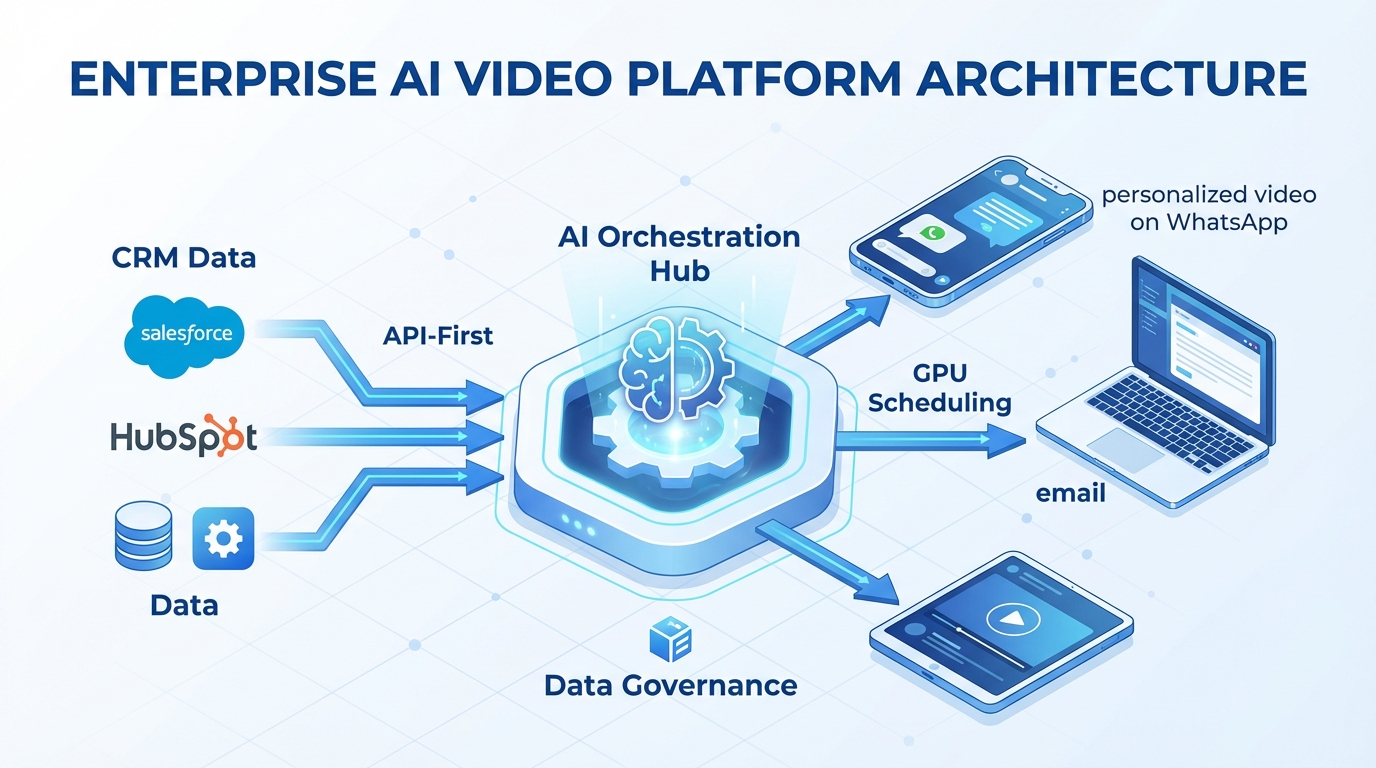
Defining a world-class enterprise AI video platform India requires looking beyond simple video editing tools toward comprehensive, API-first ecosystems. In 2026, the benchmark for enterprise-grade AI is the ability to ingest massive streams of first-party data and output compliant, personalized video variations with guaranteed Service Level Agreements (SLAs). This necessitates a cloud-agnostic GPU scheduling infrastructure that can handle the burst demands of festive seasons or massive product launches without latency spikes.
A true enterprise platform must integrate seamlessly with existing MarTech stacks, including Salesforce, HubSpot, and WebEngage. The goal is to move from manual campaign setup to automated, trigger-based video generation. For instance, an abandoned cart event in a CRM should automatically trigger the generation of a personalized video message from a brand ambassador, delivered via WhatsApp Business API within seconds. This level of integration ensures that the video content is not just a marketing asset but a functional part of the customer journey.
Furthermore, the concept of “governance-by-design” is non-negotiable for the best AI tech companies India. This includes consent-first celebrity contracts, automated content moderation to block sensitive or prohibited categories, and full auditability of every video generated. As Indian enterprises navigate the complexities of the DPDP Act, having a platform that provides data residency options and encrypted data flows is essential for maintaining consumer trust and regulatory compliance.
Sources:
- India AI Impact Summit Outcome Resources
- TrueFan AI Enterprise Offerings
- Business Standard: Post-Summit Enterprise Trends
2. Scalable Personalized Video SaaS: From Single Capture to Millions
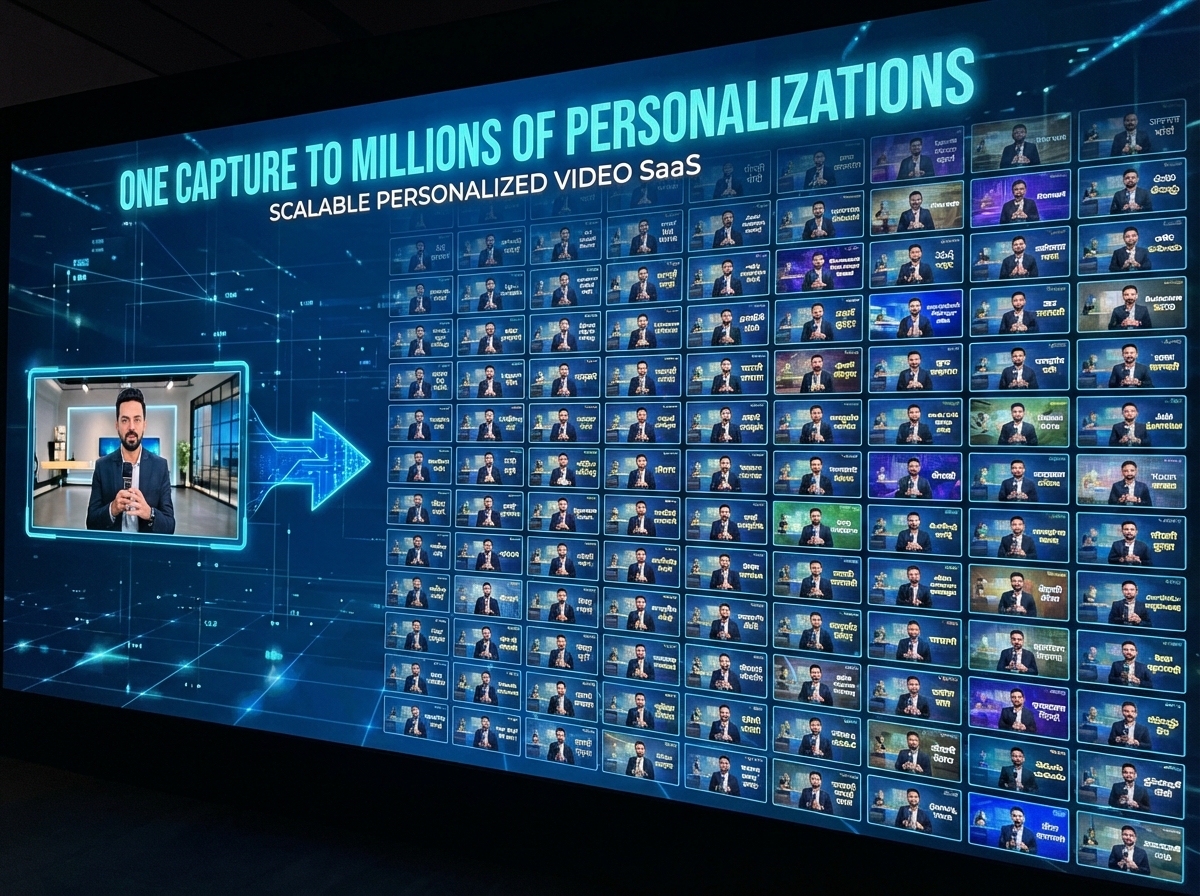
The core value proposition of a scalable personalized video SaaS lies in its ability to decouple the talent's time from the volume of content produced. Traditionally, creating personalized content for a million users would require a million different recordings—a logistical impossibility. Today, a single 10-to-15-minute media capture of a celebrity, brand ambassador, or CEO serves as the “base model.” This model is then virtually reshot using diffusion-based face reanimation and voice cloning technology to create infinite variations.
TrueFan AI's 175+ language support and Personalised Celebrity Videos see examples allow brands to speak to their customers in their native tongue, a critical factor in the Indian market where vernacular content drives significantly higher engagement. The pipeline begins with consent-backed media capture, followed by model preparation where voice cloning is tuned for name pronunciation accuracy—a common failure point in lower-tier AI tools. Once the model is ready, brand-approved scripts are fed into the system, and the AI orchestration layer manages the rendering process.
The results of this scalable approach are evident in recent high-scale campaigns:
- Zomato Mother’s Day: Generated 354,000 personalized videos in a single day, leading to a massive uplift in social shares and order volume.
- Hero MotoCorp Festive: Deployed 2.4 million personalized greetings, resulting in a measurable increase in dealership footfall across Tier-2 and Tier-3 cities.
- Goibibo: Utilized WhatsApp video nudges featuring destination-specific personalization, achieving a 17% increase in read rates and a direct lift in bookings.
These case studies demonstrate that the generative AI marketing transformation is not a future concept but a current reality for market leaders. By leveraging a scalable personalized video SaaS, brands can achieve a level of intimacy with their customers that was previously reserved for small-scale, high-touch boutique services.
Sources:
3. LLM Agnostic Solutions and AI Orchestration Layers
As the AI landscape evolves, enterprises are increasingly wary of vendor lock-in. The most sophisticated platforms now offer LLM agnostic solutions, allowing organizations to swap foundation models—whether for text, speech, or vision—based on specific task requirements, cost constraints, or latency needs. This flexibility is managed through AI orchestration layers, which coordinate the various tools, prompts, agents, and evaluation gates necessary to produce high-quality output.
An effective orchestration layer includes a “model router” that selects the best-performing model for a given script or language. For example, one model might excel at Hindi name pronunciation, while another is more efficient for English-language lip-syncing. By routing tasks to the most appropriate model, enterprises can optimize their Total Cost of Ownership (TCO) while maintaining a consistent quality standard. This is particularly relevant for companies recognized as an AWS Gen AI disruptor, where the focus is on utilizing hyperscaler-native tools while maintaining the portability of the overall stack.
Beyond routing, the orchestration layer provides essential “guardrails.” These are automated checks that scan for toxicity, PII (Personally Identifiable Information) redaction, and brand safety before any video is rendered. In 2026, observability has also become a key component, with dashboards providing real-time traces of latency, cost, and quality scoring. This level of technical depth ensures that the generative AI marketing transformation is built on a stable, transparent, and highly efficient foundation.
Sources:
4. Agentic AI Marketing and Multi-Agent AI Workflows
The next frontier in digital strategy is agentic AI marketing, a shift from simple automation to autonomous systems that can plan, generate, and deploy assets with minimal human intervention. In this model, multi-agent AI workflows chain specialized agents together to handle complex marketing tasks. For instance, a “Data Agent” might pull first-party segments and apply consent rules, while a “Creative Agent” generates scripts that adhere to the brand's unique voice and tone.
These agents work in concert to ensure that every piece of content is optimized for its intended recipient. A “Video Agent” triggers the personalized renders, checking for lip-sync accuracy, while a “Channel Agent” orchestrates the delivery across WhatsApp, email, or app push notifications. Finally, an “Analytics Agent” reads the outcome data and feeds it back into the system to refine the next iteration of the campaign. This closed-loop system represents the pinnacle of AI marketing thought leadership in 2026.
However, industry experts at the India AI Impact Summit cautioned against “agent-washing”—the practice of rebranding basic automation as agentic AI. To avoid this trap, enterprises must prioritize measurable workflows and robust governance. The focus should be on “human-in-the-loop” systems where AI agents handle the heavy lifting of production and distribution, but humans remain in control of the strategic direction and final approval gates. This approach ensures that the agentic AI marketing remains aligned with brand values and regulatory requirements.
Sources:
- Analytics India Mag: Enterprises Beware of Agent-Washing
- India AI Impact Summit: Sessions and Highlights
5. Enterprise AI Governance: Compliance, Consent, and Data Residency
In the wake of the India AI Impact Summit, enterprise AI governance has moved from a secondary concern to a primary business driver. Governance encompasses the policies, controls, and auditability required to manage data collection, model usage, and content distribution safely. For an enterprise AI video platform in India, this means providing a stack that includes ISO 27001 and SOC 2 alignment see alignment details, ensuring that data is handled with the highest security standards.
Consent-first architectures are the bedrock of ethical AI marketing. This involves not only formal talent contracts for celebrity likenesses but also approved usage windows and automated moderation to prevent the creation of offensive or politically sensitive content. As the DPDP Act comes into full effect in 2026, platforms must offer DPDP-ready processes, including clear consent flags for any PII-based personalization and the ability to provide data residency within Indian borders.
Responsible scaling, a key theme of the Summit's outcome resources, emphasizes the need for democratic diffusion of AI benefits while maintaining strict safety protocols. This includes:
- Role-Based Access Control (RBAC): Ensuring that only authorized personnel can trigger large-scale campaigns or access sensitive customer data.
- Encrypted Data Flows: Protecting data both at rest and in transit to prevent unauthorized access or leaks.
- Audit Trails: Maintaining detailed logs of every video generated, including the data inputs used and the models employed, for regulatory and internal review.
- Content Provenance: Implementing watermarking or metadata logs to identify AI-generated content, fostering transparency with the end consumer.
Sources:
6. The Generative AI Marketing Transformation Playbook (90-Day Pilot)
Transitioning to a fully AI-driven marketing strategy requires a structured approach. A 90-day pilot plan is the gold standard for achieving a successful generative AI marketing transformation. This playbook allows enterprises to move from initial use-case definition to production-scale deployment while managing risk and proving ROI at every stage.
Weeks 1–2: Foundation and Readiness
The first phase focuses on defining KPIs—such as CTR uplift or cost-per-acquisition reduction—and conducting data readiness checks. This is the time to ensure that consent workflows are in place and that the initial script templates align with brand guidelines. Establishing an integration sandbox with the enterprise CRM is also a critical step during this period.
Weeks 3–6: Execution and Iteration
During this phase, the brand launches limited cohorts on high-engagement channels like WhatsApp. This is where the scalable personalized video SaaS is put to the test, with 2–3 creative variants being rendered and delivered in real-time. Monitoring render SLAs and conducting quality assurance on the output ensures that the personalization is accurate and impactful.
Weeks 7–12: Scaling and Optimization
Once the initial results are in, the pilot expands to larger audiences and introduces vernacular variants. Solutions like TrueFan AI demonstrate ROI through these expanded phases by showing how personalized video can drive significant lifts in AOV (Average Order Value) and LTV (Lifetime Value). The final weeks are dedicated to an executive review, a security audit, and the creation of a scale blueprint for “always-on” lifecycle triggers.
Sources:
7. FAQ and Strategic Conclusion
Frequently Asked Questions
Q1: How does the AI Impact Summit TrueFan showcase differ from traditional video marketing?
The showcase focused on the transition from static, one-to-many broadcasting to dynamic, one-to-one personalized engagement. Unlike traditional marketing, which requires weeks of production, the TrueFan AI platform enables the generation of millions of unique videos in seconds, all governed by enterprise-grade security protocols.
Q2: What are the primary benefits of using an enterprise AI video platform in India?
The primary benefits include the ability to scale personalized content across 175+ languages, seamless integration with Indian MarTech ecosystems (like WhatsApp Business API), and strict adherence to the DPDP Act for data privacy and residency.
Q3: How do LLM agnostic solutions help in future-proofing marketing operations?
LLM agnostic solutions allow brands to switch between different AI models as technology improves or costs change. This prevents vendor lock-in and ensures that the marketing stack can always utilize the most efficient and high-performing models available in the market.
Q4: Is it possible to maintain brand safety when using agentic AI marketing?
Yes, by implementing multi-agent AI workflows with built-in guardrails and human-in-the-loop oversight. These systems automatically scan for toxicity and brand alignment before any content is deployed, ensuring that the autonomous agents operate within strict strategic boundaries.
Q5: What kind of ROI can enterprises expect from a generative AI marketing transformation?
Enterprises typically see a 15–30% increase in CTR and significant lifts in conversion rates. For example, brands like Goibibo and Zomato have reported substantial improvements in customer engagement and order volume by using personalized video nudges at scale.
Conclusion: Leading the AI-First Marketing Era
The insights from the India AI Impact Summit 2026 make it clear: the future of marketing is personalized, governed, and powered by sophisticated AI orchestration. By adopting a world-class enterprise AI video platform, Indian brands can move beyond the limitations of traditional content production and deliver truly resonant experiences to every customer. Whether it is through the deployment of agentic AI marketing or the implementation of robust enterprise AI governance, the path to growth lies in the strategic integration of these advanced technologies.
As you look to scale your own generative AI marketing transformation, remember that the choice of platform is critical. Prioritize solutions that offer the flexibility of LLM agnostic architectures and the security of ISO-certified workflows. The era of mass personalization is here, and those who master it will define the next decade of consumer engagement in India and beyond.
Final Strategic Recommendations:
- Book an AI Impact Summit TrueFan demo to see the platform's 30-second render capabilities in action.
- Audit your data readiness for the DPDP Act to ensure your personalization strategies are compliant.
- Explore multi-agent AI workflows to reduce the operational burden on your creative and technical teams.
Sources:
- India AI Impact Summit: Key Attendees
- TrueFan AI: Personalised Celebrity Videos
- Analytics India Mag: AI Highlights 2026
Frequently Asked Questions
How is the AI Impact Summit TrueFan showcase different from traditional video marketing?
It demonstrates a shift from static, one-to-many broadcasts to dynamic, one-to-one personalization. TrueFan AI generates millions of governed, unique videos in seconds, backed by enterprise-grade security and SLAs.
What are the benefits of an enterprise AI video platform in India?
Scalable personalization across 175+ languages, seamless integrations with local MarTech (e.g., WhatsApp Business API), and DPDP-ready data privacy and residency options.
How do LLM-agnostic solutions future-proof marketing stacks?
They let teams switch models based on task, cost, or latency without vendor lock-in, using orchestration to route workloads to the best-performing option.
Can brands maintain safety and governance with agentic AI marketing?
Yes. Multi-agent workflows apply guardrails like toxicity checks and PII redaction, with human-in-the-loop approval to ensure brand alignment and compliance.
What ROI can enterprises expect from generative AI marketing?
Typical outcomes include 15–30% CTR lifts and higher conversion rates. Case studies from leaders like Zomato and Goibibo show measurable gains in engagement and revenue.