Behavioral nudge marketing automation 2026: AI video playbooks for India’s cart abandonment, upgrades, and renewals
Estimated reading time: 11 minutes
Key Takeaways
- Adopt behavioral nudge marketing automation with AI video to improve cart recovery, upgrades, and renewals across Indian markets.
- Operationalize cognitive biases—scarcity, social proof, loss aversion, reciprocity—through personalized video nudges in regional languages.
- Leverage predictive intelligence to trigger real-time nudges and personalize by segment for higher conversion lifts.
- Ensure DPDP-compliant orchestration with lawful consent, granular opt-ins, and purpose limitation across channels like WhatsApp and SMS.
- Implement in 4 weeks: align data, integrate video templates, pilot A/B tests, and scale with continuous optimization.
Meta Description: Deploy behavioral nudge marketing automation 2026 with AI-powered behavior prediction marketing and cognitive bias personalization strategies to lift conversions on cart abandonment, upgrades, and renewals for Indian enterprises.
In 2026, the landscape of digital engagement has shifted from broad-spectrum broadcasting to precision-engineered interventions. Behavioral nudge marketing automation 2026 represents the pinnacle of this evolution, bringing together behavioral economics, nudge theory video implementation, and hyper-personalized AI video to trigger immediate actions for Indian enterprises across cart abandonment, upgrades, and renewals.
The necessity for this shift is driven by a market that is increasingly saturated and sophisticated. 2026 trends indicate that AI-first personalization, predictive analytics, and privacy-by-design are pushing marketers from reactive communication to proactive lifecycle orchestration. Indian growth teams are now tasked with navigating a complex ecosystem where first-party data and omnichannel consistency are the only ways to maintain a competitive edge.
This comprehensive guide provides the exact playbooks, psychological trigger libraries, and compliance guardrails required to master behavioral nudge marketing automation 2026. By leveraging psychological trigger video campaigns India and cognitive bias personalization strategies, brands can move beyond simple reminders to create conversion psychology personalization that resonates at a cultural and individual level.
1. The Paradigm Shift: Defining Behavioral Nudge Marketing Automation 2026
Behavioral nudge marketing automation 2026 is defined as an always-on, event-triggered system that operationalizes nudge theory—a choice architecture that steers decisions without removing options—into automated, hyper-personalized video sequences. By utilizing behavioral economics marketing automation, enterprises can time and tailor prompts that reduce friction and catalyze desired actions at scale.
In the Indian context, video has emerged as the primary carrier for these nudges. The 2026 market demands higher engagement and comprehension, particularly in multilingual regions where text-based communication often fails to convey nuance or urgency. Video fits the “WhatsApp-first” behavior of the Indian consumer, allowing for localized social proof and festival-timed scarcity that feels personal rather than transactional.
The shift toward nudge theory video implementation is backed by significant data. AI-driven personalization and predictive triggers have become table stakes for Indian brands looking to prioritize regional language content. Furthermore, with the full enforcement of the DPDP Act in 2026, consent-led personalization is no longer a luxury but a legal mandate. Hyper-personalized video delivered via WhatsApp, SMS, or email—integrated with one-click UPI deep links—consistently outperforms static messages by addressing the consumer's immediate psychological state.
Source: Leadraft Marketing: Digital marketing automation trends in 2026
Source: Tantrash: Top digital marketing trends India 2026
Source: Smart Academy: Digital marketing trends
Source: Reach Skyline: India market focus 2026
Source: Royalways: Indian digital marketing trends 2026
2. The Psychology of Action: Operationalizing Cognitive Biases in Video
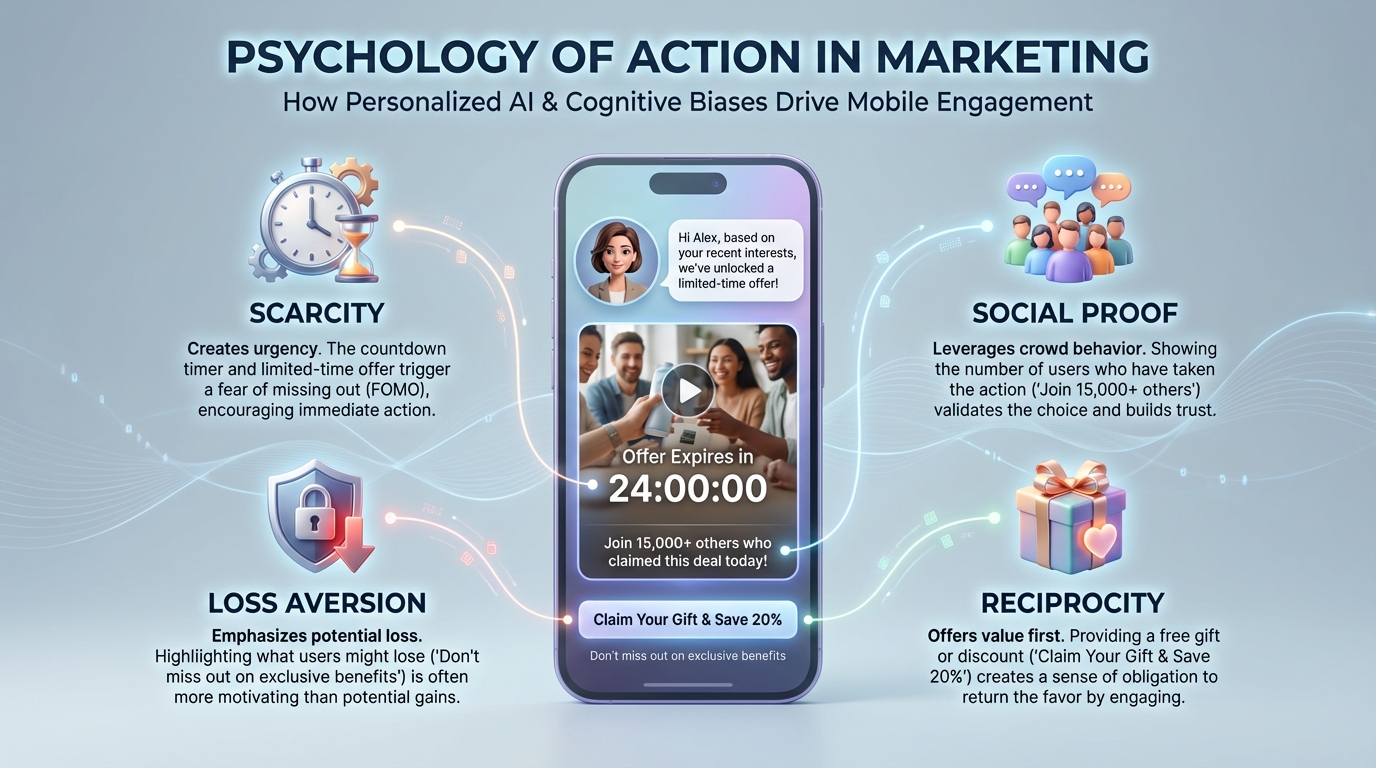
To succeed in behavioral nudge marketing automation 2026, growth teams must move beyond generic messaging and tap into the fundamental drivers of human decision-making. By embedding specific cognitive biases into psychological trigger video campaigns India, brands can bypass decision fatigue reduction strategies and drive higher conversion rates.
Scarcity and Urgency Video Triggers
Scarcity is the perception that an opportunity is limited in time or quantity, which naturally increases its perceived value. In 2026, scarcity urgency video triggers are implemented through real-time stock counters and countdown timers embedded directly within the video frame. For example, a video might show a “Diwali 48-hour Upgrade Window” or a low-seat availability cue for a travel booking. Scripts should be direct: “Only 2 left in your size—tap to complete via UPI.”
Social Proof Automation Videos India
Decisions in the Indian market are heavily influenced by the actions of peers. Social Proof automation videos India leverage geo-localized testimonials and ratings overlays. A user in Pune might receive a video stating, “5,000+ customers in Pune upgraded this week,” featuring a credible influencer snippet in Marathi or Hindi. This localized approach builds immediate trust and validates the user's intent.
Loss Aversion Marketing Campaigns
Loss aversion is the psychological principle that people prefer avoiding losses over acquiring equivalent gains. In loss aversion marketing campaigns, the focus shifts to what the user stands to lose if they do not act. Video implementation might include messages like, “Don’t lose your 1,200 reward points—renew in 1 click,” or “Retain your ad-free benefits by renewing before midnight.” This is particularly effective for renewals and retention.
Reciprocity and Commitment Sequences
The reciprocity principle video marketing involves offering value upfront to increase the likelihood of a return action. This could be a festival voucher or a free add-on trial offered before the primary CTA. Following this, commitment consistency videos utilize micro-commitment video sequences to lead the user through small steps: “Confirm your interest” → “Pick payment mode” → “Pay now.” This reduces the cognitive load of a single large decision.
Habit Formation and Decision Fatigue
Habit formation marketing videos use cue-routine-reward loops, such as streak visuals or time-based evening reminders, to build repeated behavior. Simultaneously, decision fatigue reduction strategies are employed to simplify the final choice. Instead of presenting a dozen options, the video should present one “Best-Plan” default with a prefilled cart, allowing for a seamless transition from intent to purchase.
Source: Leadraft Marketing: Automation trends 2026
Source: Royalways: Localization and creatives
Source: Maximise Media: Digital marketing trends
3. Predictive Intelligence: AI-Powered Behavior Prediction Marketing
The engine behind successful behavioral nudge marketing automation 2026 is AI-powered behavior prediction marketing. This involves using machine learning models to score a user's propensity to convert, upgrade, or churn based on a rich library of first-party signals. These signals include session depth, repeat visits, coupon attempts, and even payment method preferences (e.g., UPI vs. COD).
By analyzing these signals, enterprises can deploy a sophisticated trigger catalog. For cart abandonment, a nudge might be sent 15–60 minutes post-event, combining scarcity with social proof. For upgrade propensity, a nudge is triggered when a usage threshold is hit, utilizing reciprocity and a commitment ladder. Renewal risks are addressed 7, 3, and 1 day before expiry using loss aversion and decision simplification.
Cognitive bias personalization strategies are then applied by segment. A user with high discount sensitivity might receive a scarcity-focused nudge, while a long-tenured user might receive a status-based social proof message. This level of conversion psychology personalization ensures that the nudge feels like a helpful suggestion rather than an intrusive advertisement.
Platforms like TrueFan AI enable enterprises to execute this level of complexity by providing the infrastructure for real-time, event-driven video rendering. This allows for the immediate generation of a personalized video the moment a predictive trigger is tripped, ensuring the nudge is delivered while the user's intent is still fresh.
Source: Tantrash: AI-powered marketing automation in India
Source: Leadraft Marketing: Predictive analytics in 2026
Source: Reach Skyline: India market focus
4. The Playbook Library: Strategic Video Sequences for Indian Growth Teams
To operationalize behavioral nudge marketing automation 2026, brands need ready-to-run playbooks that define the scripts, timing, and deep links for every major lifecycle event. These playbooks are designed to move users through a structured journey using nudge theory video implementation.
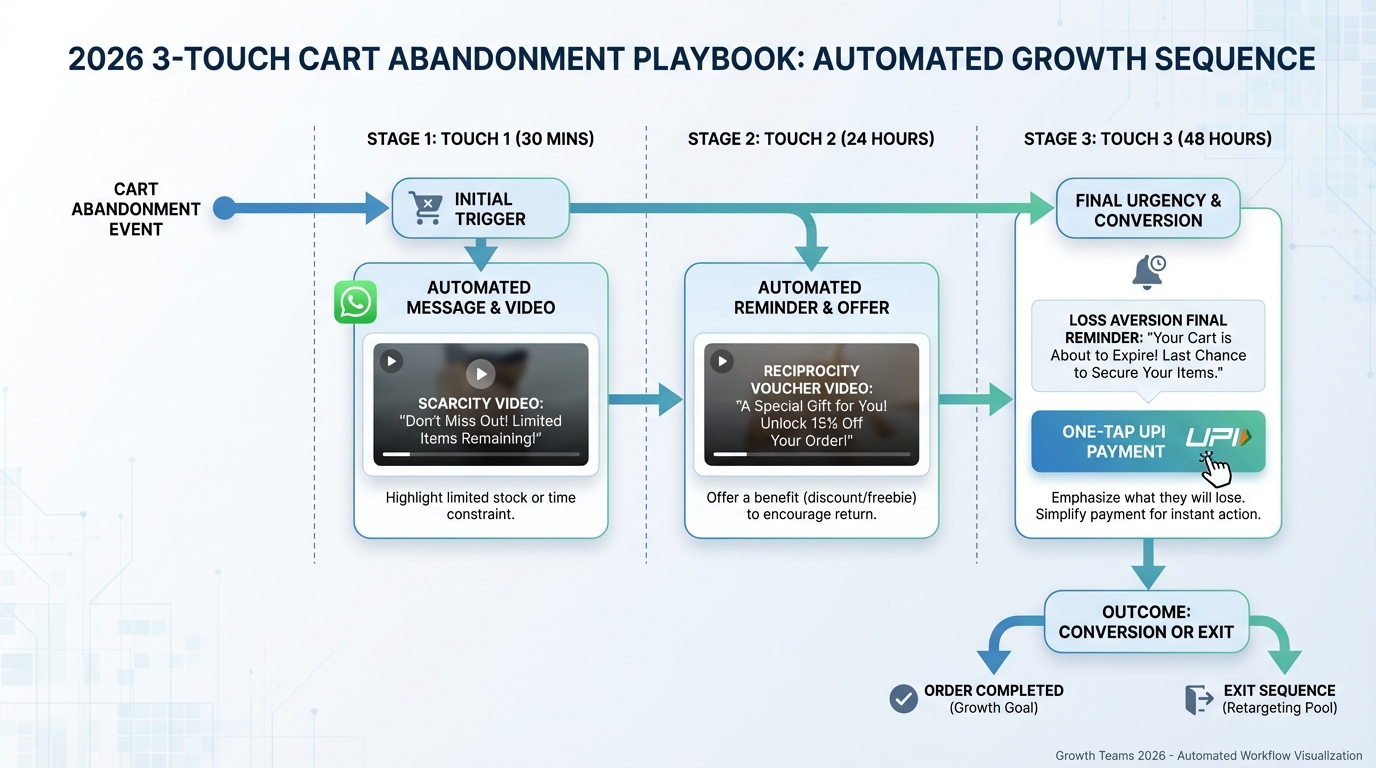
The Cart Abandonment Playbook (3-Touch Sequence)
- Touch 1 (T+30–60 min): Focuses on scarcity urgency video triggers and social proof automation videos India. The script might read: “Only 2 units left; 5,000 buyers in Mumbai grabbed this today. Tap to pay via UPI.” This is delivered primarily via WhatsApp.
- Touch 2 (T+24h): Employs reciprocity principle video marketing. The brand offers a small cashback or free shipping coupon. The video asks for a micro-commitment: “Confirm you want this held for another 6 hours.”
- Touch 3 (T+48h): Combines loss aversion marketing campaigns with decision fatigue reduction strategies. The message: “Your price lock expires at midnight; your one-tap checkout is prefilled.”
The Plan Upgrade Playbook (Usage-Triggered)
- Touch 1: Uses commitment consistency videos and reciprocity. “You’ve unlocked premium features—enjoy a 7-day trial on us. Like it? Keep it for ₹X/month.”
- Touch 2: Introduces social proof based on city-level adoption and simplifies the decision by highlighting one recommended plan.
- Touch 3: Final scarcity nudge as the trial ends, featuring a one-tap UPI deep link for immediate activation.
The Renewal Save Playbook (D-7 to D-1)
Explore the Renewal Save approach to mitigate churn with predictive nudges.
- Touch 1 (D-7): Frames the renewal around loss aversion. “Don’t lose your ad-free experience and 1,200 points; renew in 1 click.”
- Touch 2 (D-3): Offers a loyalty bonus (reciprocity) and mentions the number of tenured members who have already renewed (social proof).
- Touch 3 (D-1): Final urgency nudge regarding price reversion or late fees, using decision simplification to default the user to their current plan.
These playbooks ensure that psychological trigger video campaigns India are delivered with consistent logic and high relevance, maximizing the ROI of every automated interaction.
5. Orchestration and Compliance: Navigating DPDP and Technical Integration
The technical execution of behavioral economics marketing automation requires a seamless flow of data between the CRM, CDP, and the video rendering engine. In 2026, this orchestration must be event-driven, with video rendering occurring in under 30 seconds to maintain the relevance of the nudge.
TrueFan AI’s 175+ language support and Personalised Celebrity Videos learn more allow enterprises to scale these nudges across India’s diverse linguistic landscape while maintaining a high level of photorealistic quality. The integration involves mapping dynamic data fields—such as name, city, product, and points balance—directly into the video templates.
DPDP Compliance and Consent
With the DPDP Act in full force, compliance is a core component of behavioral nudge marketing automation 2026. Enterprises must ensure:
- Lawful Basis: Explicit consent for marketing must be captured and logged.
- Granular Opt-ins: Users must be able to opt-in or out of specific channels (WhatsApp vs. SMS).
- Purpose Limitation: Data used for personalization must be strictly for the stated purpose.
- Children’s Data: Verifiable parental consent is required for users under 18, with strict limits on profiling.
The orchestration stack must include a Consent Manager that aligns with these regulations, ensuring that every nudge sent is both legal and respectful of the user's privacy. This builds long-term trust, which is essential for conversion psychology personalization.
Source: First Launch: DPDP for marketers
Source: Consent.in: DPDP consent manager and sector patterns
Source: Smart Academy: Omnichannel and immersive experiences
6. Scaling Impact: Measurement, Optimization, and Implementation Roadmap
To truly master behavioral nudge marketing automation 2026, enterprises must adopt a culture of continuous experimentation. Measurement should go beyond simple open rates to include recovery rates for carts, upgrade lifts, and churn reduction. Solutions like TrueFan AI demonstrate ROI through comprehensive dashboards that track watch-through rates and conversion lifts at a cohort level.
The 4-Week Implementation Timeline
- Week 1: Strategy and Data Readiness. Select journeys, define bias sequencing, and map CRM data fields. Confirm consent flags and frequency caps.
- Week 2: Build and Integrate. Configure templates in the video studio, integrate event APIs, and set up delivery channels like WhatsApp Business API.
- Week 3: Pilot and Optimize. Launch to a 10–15% cohort. Run A/B tests on different biases (e.g., scarcity vs. reciprocity) and monitor initial conversion lifts.
- Week 4: Scale and Report. Roll out to the full audience and establish a weekly optimization cadence to refine scripts and timing.
India-Specific Creative Guidelines
When executing psychological trigger video campaigns India, localization is key. Brands should prioritize the top languages of their user base and ensure that name pronunciation in AI-generated voiceovers is accurate. Scarcity messages should be mapped to the Indian festival calendar to feel culturally relevant. Finally, always include one-tap UPI deep links to minimize friction in the final payment step.
Ready to transform your lifecycle marketing?
Deploying behavioral nudge marketing automation 2026 is the most effective way to recover lost revenue and drive expansion in the competitive Indian enterprise space. By combining the science of behavioral economics with the scale of AI video, your growth team can achieve unprecedented conversion lifts.
Book an enterprise demo to launch your cart, upgrade, and renewal nudges in 2–4 weeks.
Frequently Asked Questions
How do we avoid “over-nudging” our customers?
Implement strict frequency caps and channel rotation, such as a maximum of three nudges per journey spaced at least 24 hours apart. Trigger an automatic mute the moment a conversion is detected. Behavioral economics marketing automation should feel like a helpful guide, not a persistent shadow.
How does the DPDP Act affect video personalization?
The DPDP Act requires explicit, granular consent for profiling and marketing. Maintain clear consent logs, provide easy opt-out options in every message, and suppress users without consent until it is re-acquired through a compliant flow.
Can we use celebrities in these automated nudges?
Yes, approved celebrity likenesses can be used via AI to add authority and social proof in psychological trigger video campaigns India. Ensure contracts explicitly cover AI-generated personalized content and rights for usage across channels.
How fast can we change the creative if a campaign isn’t performing?
With virtual reshoots and AI-driven templates, you can iterate on scripts, offers, CTAs, and presenters within hours. This agility is a cornerstone of behavioral nudge marketing automation 2026.
Does TrueFan AI support regional Indian languages?
Yes, TrueFan AI supports over 175 languages, including major Indian regional languages and dialects. Hyper-localized video nudges with accurate lip-syncing are key to building trust in diverse markets.