How to Build Voice Commerce Video Shopping India for Bharat: AI Avatar Voice Assistant Shopping in Hindi, Tamil, and Telugu
Key Takeaways
- Build a vernacular-first, voice + video shopping experience for Bharat users to boost trust and conversions.
- Design for low bandwidth with audio-first fallbacks, ABR tuning, and connection-aware UI.
- Use an AI avatar voice assistant with accurate ASR/NLU/TTS for Hindi, Tamil, and Telugu; leverage session memory for natural conversations.
- Ensure DPDP-compliant consent flows and data minimization, and consider platforms like Studio by TrueFan AI to accelerate go-live.
In the rapidly evolving landscape of digital retail, the ability to build voice commerce video shopping India for Bharat is no longer a luxury—it is a strategic imperative. As we move into 2026, the intersection of voice technology and shoppable video is redefining how the "Next Billion Users" interact with brands. For product teams and developers, this means moving beyond static interfaces toward an integrated AI avatar voice assistant shopping experience that speaks the language of the user, literally and figuratively.
By 2026, India's internet user base is projected to exceed 950 million, with rural India accounting for over 55% of this growth. This demographic, often referred to as "Bharat," prioritizes vernacular content, video-first discovery, and voice-activated navigation. To capture this market, platforms must deploy a bharat voice commerce platform that handles the complexities of Indic languages like Hindi, Tamil, and Telugu while maintaining high performance on low-bandwidth networks.
Source: TrueFan AI: Social and Video Commerce Integration 2026
1. The Bharat Opportunity: Why Vernacular-First Video is the Future
The shift toward voice commerce video shopping India is driven by a fundamental change in user behavior. Traditional e-commerce, built on text-heavy English interfaces, creates a significant barrier for users in Tier II, III, and IV cities.
The Rise of the Vernacular Internet
Recent data from 2026 indicates that nearly 75% of all Indian internet users now prefer consuming content in their native language. This isn't just about translation; it’s about cultural resonance. Recent data A Hindi voice video commerce experience feels more trustworthy to a shopper in Uttar Pradesh than a generic English app. Similarly, providing support in Tamil and Telugu is essential for capturing the high-intent markets of Southern India.
- Statistic 1: By mid-2026, vernacular voice search is expected to grow by 150% year-on-year in rural clusters.
- Statistic 2: 90% of Indian shoppers now report that they prefer watching a product video before making a purchase decision, up from 70% in 2023.
- Statistic 3: Video commerce conversion rates in Bharat are 3.5x higher than traditional text-and-image listings.
Video-Led Trust and Discovery
In rural India, video serves as a digital "shop assistant." It bridges the gap between the physical and digital worlds. Brands that leverage audio-visual shopping experiences see a marked improvement in customer retention. According to IBEF, the surge in Indic language usage is the primary driver for the next wave of e-commerce growth.
Source: IBEF: India's Internet Growth 2025-2026
Furthermore, Maxicus highlights that video commerce is a game-changer for D2C brands because it builds immediate trust through visual demonstration. When you add a vernacular audio shopping AI to this mix, you remove the friction of typing, making the journey from discovery to checkout seamless for users with varying levels of digital literacy.
Source: Maxicus: Video Commerce for D2C Brands
2. Success Patterns: UX for the Next Billion Users
Designing for Bharat requires a departure from "Silicon Valley" UX standards. The goal is to create an audio-visual shopping experience that feels natural, guided, and resilient to technical constraints.
Interaction Design for Voice-Activated Product Videos
A successful voice-activated product video isn't just a video with a play button. It’s an interactive session where the user can talk to the content.
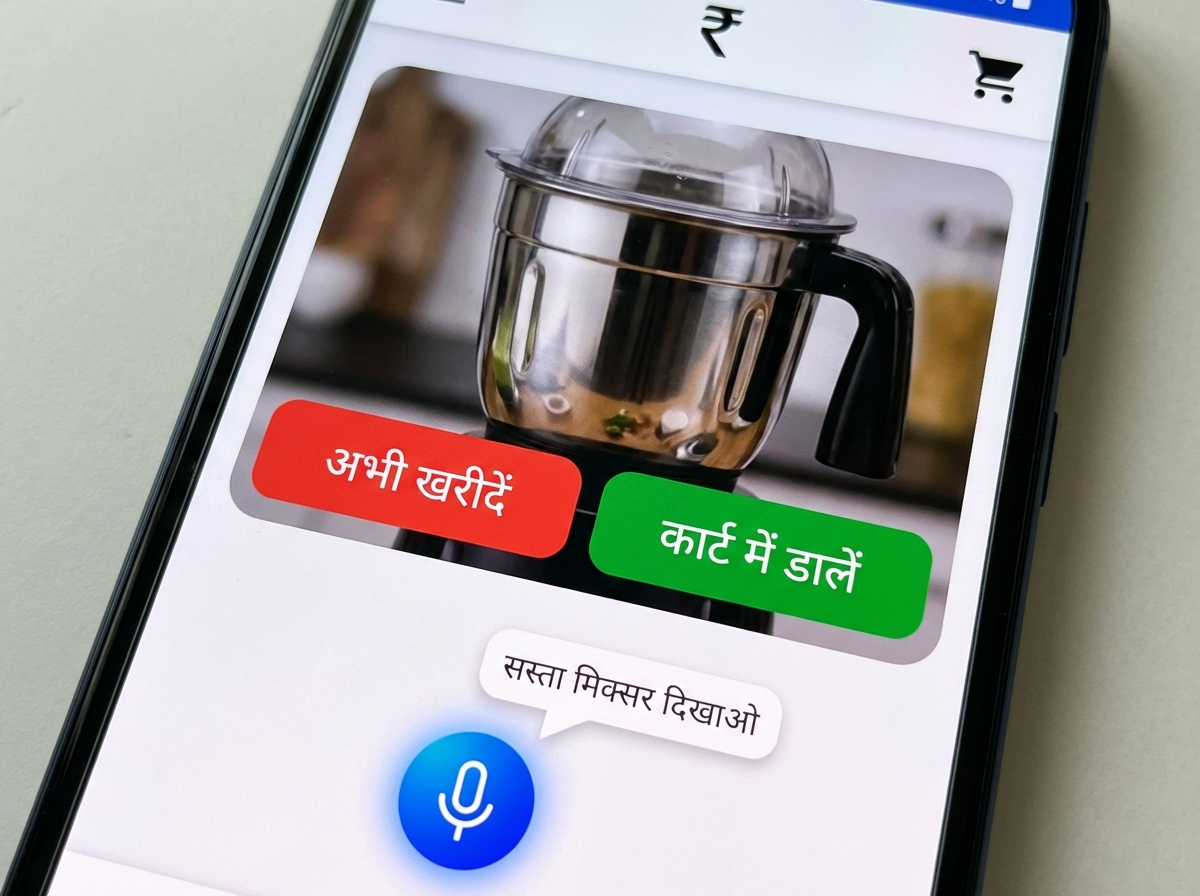
- Voice Search Video Products: Users should be able to say, "Dikhaiye sasta mixer under 2000" (Show me a cheap mixer under 2000) or "Tamizh la sollunga touchscreen phone" (Tell me about touchscreen phones in Tamil).
- Code-Switching Support: The system must handle "Hinglish" or "Tanglish." If a user says, "Is phone ka camera kaisa hai?", the NLU (Natural Language Understanding) must recognize "phone" and "camera" as entities while processing the Hindi syntax.
- Tappable Overlays: While voice is the primary input, visual cues are essential. Large, high-contrast buttons (48px+) for "Add to Cart" or "Buy Now" should appear as overlays on the video, allowing for a hybrid touch-voice experience.
Source: Flipkart: Vernacular Voice Assistant Case Study
Accessibility Shopping Videos India
Accessibility in the Indian context often means "low-literacy friendly."
- Bilingual Captions: Show subtitles in both the local language and English to help users who are transitioning between the two.
- Speech Rate Control: Allow users to slow down the AI avatar’s speech for better comprehension.
- Audio Descriptions: For users with visual impairments or those in low-light environments, the AI avatar voice assistant shopping should narrate the key visual features of the product.
Connection-Aware UI
Rural India often suffers from "patchy" 4G/5G. Your rural India video shopping strategy must include:
- Audio-First Fallback: If the bandwidth drops below 150 kbps, the player should switch to a high-quality audio summary accompanied by a static poster frame.
- Micro-Previews: Pre-render 3-5 second "sizzles" that load instantly, giving the user immediate value while the full video buffers in the background.
3. Solution Architecture: Building the Multilingual Pipeline
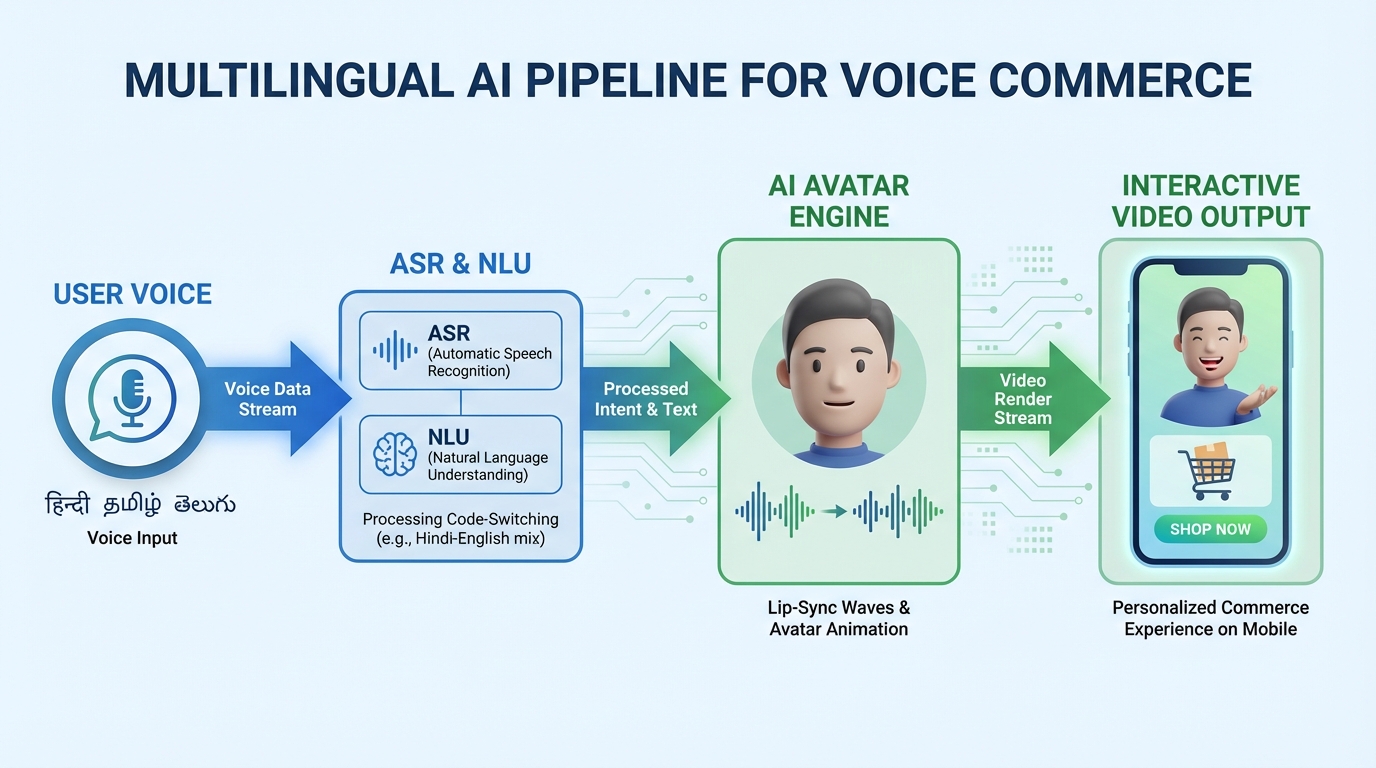
To build a robust bharat voice commerce platform, you need a sophisticated backend that orchestrates ASR (Automatic Speech Recognition), NLU, and TTS (Text-to-Speech).
The Multilingual Voice Commerce AI Pipeline
The technical stack must be optimized for low latency and high accuracy across Indic dialects.
- ASR (Automatic Speech Recognition): Use domain-tuned models that understand retail-specific vocabulary. For instance, the model should know that "Udan speed" refers to a specific fan feature in a rural context.
- NLU (Natural Language Understanding): This layer handles intent resolution. If a user says, "Mee svaram tho konugolu cheyadaniki mic anumati ivvandi" (Give mic permission to buy with your voice), the NLU must trigger the correct permission flow.
- TTS (Text-to-Speech): The voice must sound human, not robotic. High-quality Indic TTS with proper prosody (rhythm and intonation) is crucial for building trust. Studio by TrueFan AI’s 175+ language support and AI avatars provide a turnkey solution for generating these high-fidelity voice-overs and lip-synced videos at scale.
AI Avatar Voice Assistant Shopping Layer
The avatar acts as the face of your brand. Instead of a faceless chatbot, an AI avatar can greet the user, explain product specs, and guide them through the checkout.
- Lip-Sync Accuracy: The avatar’s mouth movements must perfectly align with the Indic phonemes. Poor lip-syncing breaks the "uncanny valley" and reduces trust. Lip-syncing benchmarks
- Visual Prosody: The avatar should use natural gestures—a nod, a smile, or a hand movement—that match the tone of the voice.
Conversational Commerce AI Video Orchestration
The "brain" of the system must maintain session memory. If a user asks about a "Red Kurta" and then says "Show me in Blue," the system must remember the "Kurta" context. This conversational commerce AI video flow ensures that the user doesn't have to repeat themselves, mimicking a real-world shopkeeper interaction.
4. Engineering Deep-Dive: Implementation and Performance
Building for voice commerce video shopping India requires specific engineering guardrails to ensure the platform doesn't fail in real-world conditions.
Handling Code-Switching and Transliteration
Indian users rarely speak "pure" Hindi or Tamil. They mix in English technical terms.
- Recipe: Train your language ID models to segment utterances. Use a "Transliteration Normalization" step where "battery" (English) and "बैटरी" (Hindi) are mapped to the same product attribute in your catalog.
- Confidence Thresholds: Set a threshold (e.g., 85%). If the ASR confidence is lower, don't guess. Instead, surface 2-3 "Did you mean?" chips on the video overlay.
Video Delivery for Rural Networks
Standard HLS (HTTP Live Streaming) settings often fail in Tier III cities.
- ABR Ladder Tuning: Create a "Bharat-specific" encoding ladder. Start as low as 144p (90-120 kbps) for audio-heavy segments and cap at 720p.
- Edge Caching: Use CDNs with points-of-presence (PoPs) in regional hubs like Indore, Coimbatore, or Vijayawada to reduce latency.
- Service Workers: Implement aggressive caching for the voice mic assets and the initial 5 seconds of the product video.
Source: Video Production Infrastructure for Enterprise Teams
Event Schema and Analytics
To optimize your voice search video products, you must track:
voice_intent_resolved: Did the system understand the user?video_completion_rate: Are users watching the full explainer?add_to_cart_via_voice: The ultimate KPI for voice commerce.stall_rate: How often does the video stop in rural areas?
5. Compliance, Privacy, and Trust: The DPDP Framework
In 2026, data privacy is not optional. The Digital Personal Data Protection (DPDP) Act of 2023 (and its 2025 refinements) sets strict rules for handling voice and video data in India.
Consent-First Architecture
According to the MeitY DPDP Guidelines, consent must be "free, specific, informed, unconditional, and unambiguous."
- Vernacular Notices: Your consent screen must be in the user’s language.
- Hindi Example: "Apni awaaz se khareedari karne ke liye mic ki anumati dijiye."
- Just-in-Time Prompts: Ask for microphone access only when the user clicks the mic icon, not upon app launch.
- Right to Erasure: Users must have a simple way to delete their voice recordings and shopping history.
Source: MeitY: Digital Personal Data Protection Act 2023
Data Minimization
Do not store raw audio files longer than necessary for intent resolution. Convert audio to text (transcripts) and store the derived intent with a pseudonymized ID. This reduces the risk of data breaches and ensures compliance with the "purpose limitation" principle of the DPDP Act.
6. Build vs. Buy: Strategic Implementation
When deciding how to launch your bharat voice commerce platform, you must weigh the speed of market entry against the need for bespoke control.
The Case for Platforms
Building a full ASR/NLU/Avatar stack from scratch can take 12-18 months and millions in R&D. Platforms like Studio by TrueFan AI enable enterprises to bypass this complexity. By using pre-trained Indic models and licensed photorealistic avatars, brands can go from concept to a live Hindi voice video commerce pilot in under 4 weeks.
Solutions like Studio by TrueFan AI demonstrate ROI through reduced content production costs and significantly faster "script-to-video" turnaround times. Instead of hiring actors and film crews for every language variant, you can generate 100+ SKU videos in Hindi, Tamil, and Telugu with a single click.
Implementation Blueprint
- Pilot (Weeks 1-4): Select a high-volume category (e.g., Small Appliances). Use an AI avatar to create 20-second "Spec Sizzles" in Hindi.
- Integration (Weeks 5-8): Connect your product feed to the video generator. Embed the voice-activated player into your mobile app.
- Expansion (Weeks 9-12): Roll out Tamil and Telugu variants. Implement the "WhatsApp Share-to-Cart" feature, allowing users to share avatar-led product summaries with their family for group decision-making.
Source: ROI Hunt: E-commerce Marketing Trends 2026
7. Conclusion and Future Outlook
The future of e-commerce in India is vocal, visual, and vernacular. By building a voice commerce video shopping India experience, you are not just selling products; you are building a relationship with the Bharat shopper.
As we look toward 2027, the integration of generative AI will allow for even deeper personalization—where the AI avatar remembers a user's previous purchases and greets them by name in their native dialect. The brands that invest in a bharat voice commerce platform today will be the ones that define the retail landscape of tomorrow.
Frequently Asked Questions
Q1: What exactly is "voice commerce video shopping India"?
It is a vernacular-first shopping experience specifically designed for the Indian market. It combines voice-activated assistants with shoppable product videos, allowing users to search, learn about, and purchase products using voice commands in languages like Hindi, Tamil, and Telugu.
Q2: How do I implement Hindi/Tamil/Telugu voice-activated product videos?
Implementation involves a four-step process:
- ASR/NLU: Setting up speech recognition that understands Indic dialects and code-switching.
- Content Generation: Using tools to create lip-synced videos. Studio by TrueFan AI’s 175+ language support and AI avatars can be used here to generate localized content rapidly. Best AI voice cloning software resources can also help.
- Player Integration: Adding voice-mic CTAs and shoppable overlays to your video player.
- Low-Bandwidth Optimization: Ensuring the video plays smoothly on rural networks.
Q3: How can AI avatars improve accessibility for rural shoppers?
AI avatars act as digital guides. They provide a human-like interface for users who may struggle with complex text-based menus. By narrating product features and guiding the user through the checkout process in their native language, avatars reduce the cognitive load and build trust with low-literacy users.
Q4: What are the DPDP compliance steps for voice/video shopping?
Under the DPDP Act 2023, you must:
- Obtain explicit, informed consent in the user's language before accessing the microphone.
- Provide clear notices about how voice data is used.
- Allow users to withdraw consent and delete their data easily.
- Ensure data is stored securely and processed only for the stated purpose.
Q5: Can this work on low-end Android phones and 3G networks?
Yes, by using Adaptive Bitrate (ABR) streaming and "audio-first" fallbacks. The architecture should prioritize loading the audio track and a static "poster frame" first, so the user gets the information immediately even if the high-definition video takes longer to buffer.
Q6: What is the expected ROI for a bharat voice commerce platform?
Early adopters in 2026 have seen a 25% reduction in cart abandonment and a 40% increase in engagement from Tier II and III cities. By removing the "language barrier," brands can tap into a massive, underserved market that was previously difficult to reach through traditional digital marketing.