Voice commerce vernacular India: The 2026 enterprise playbook to win 650M regional users
Estimated reading time: ~20 minutes
Key Takeaways
- Winning India’s next 650M users requires vernacular, voice-first experiences optimized for Tier-2/3 markets
- A robust Natural Language Commerce AI stack—ASR, NLU, NLG, catalog grounding, and payments—is essential
- Personalization via voice-triggered, shoppable video dramatically improves conversion and ROI
- Measure success with voice SEO, voice journey KPIs, and CFO-ready ROI dashboards
- Execute with a 90-180-365 day roadmap while ensuring DPDP compliance and strong LLM guardrails
The Indian digital landscape has reached a definitive inflection point where the next 650 million users will not be won through English-first interfaces, but through the strategic deployment of voice commerce vernacular India frameworks. By 2026, the convergence of high-speed 5G penetration, advanced Indic LLMs, and a massive shift in Tier-2 and Tier-3 purchasing power has made voice-activated shopping the primary gateway for digital commerce. Enterprises that fail to localize their conversational interfaces risk obsolescence in a market where 98% of users now prefer local-language content for decision-making and transactions.
This playbook provides a comprehensive blueprint for digital innovation teams and regional expansion leaders to capture this demographic. We will explore the technical architecture of voice commerce vernacular India 2026, examine the nuances of Hindi, Tamil, and Bengali shopping journeys, and provide a measurable ROI framework for scaling these experiences. The goal is to move beyond simple translation toward a culturally resonant, voice-first ecosystem that drives assisted buying, reduces friction in checkout, and builds long-term brand equity across the Bharat heartland.
2026 tipping point: Vernacular internet scale, Tier-2 readiness, and why voice leads discovery
The macro-economic data for 2026 confirms that India’s internet user base has exceeded 900 million, with the lion's share of growth originating from non-metro regions. This demographic shift has fundamentally altered the “search-to-buy” journey, as new-to-internet users bypass traditional text-based search in favor of intuitive voice commands. Regional voice commerce penetration is no longer a niche experiment; it is the default operating system for the Indian consumer who views the smartphone as a conversational tool rather than a typing device.
Recent industry data indicates that order volumes in Tier-2 and Tier-3 cities have expanded by more than 60% compared to metros, yet these users face significant friction when navigating English-heavy apps. Vernacular-first engagement has become the most transformative trend of the year, with over 73% of internet subscribers exclusively consuming regional content. This has forced a radical shift in voice SEO regional languages, as brands must now optimize for spoken queries that include heavy code-mixing and local dialects.
The Indian government’s Bhashini mission has acted as a massive catalyst, providing the foundational language tech stack for 22 Indian languages. This public infrastructure, combined with private enterprise innovation, has lowered the barrier to entry for tier-2 voice adoption. Enterprises are now leveraging these interoperable stacks to build voice-first discovery layers that understand the specific intent behind a Bhojpuri-accented Hindi query or a colloquial Tamil request, ensuring that the digital divide is bridged through natural speech.
Sources:
One market, many journeys: Hindi voice shopping AI, Tamil conversational commerce, and Bengali optimization
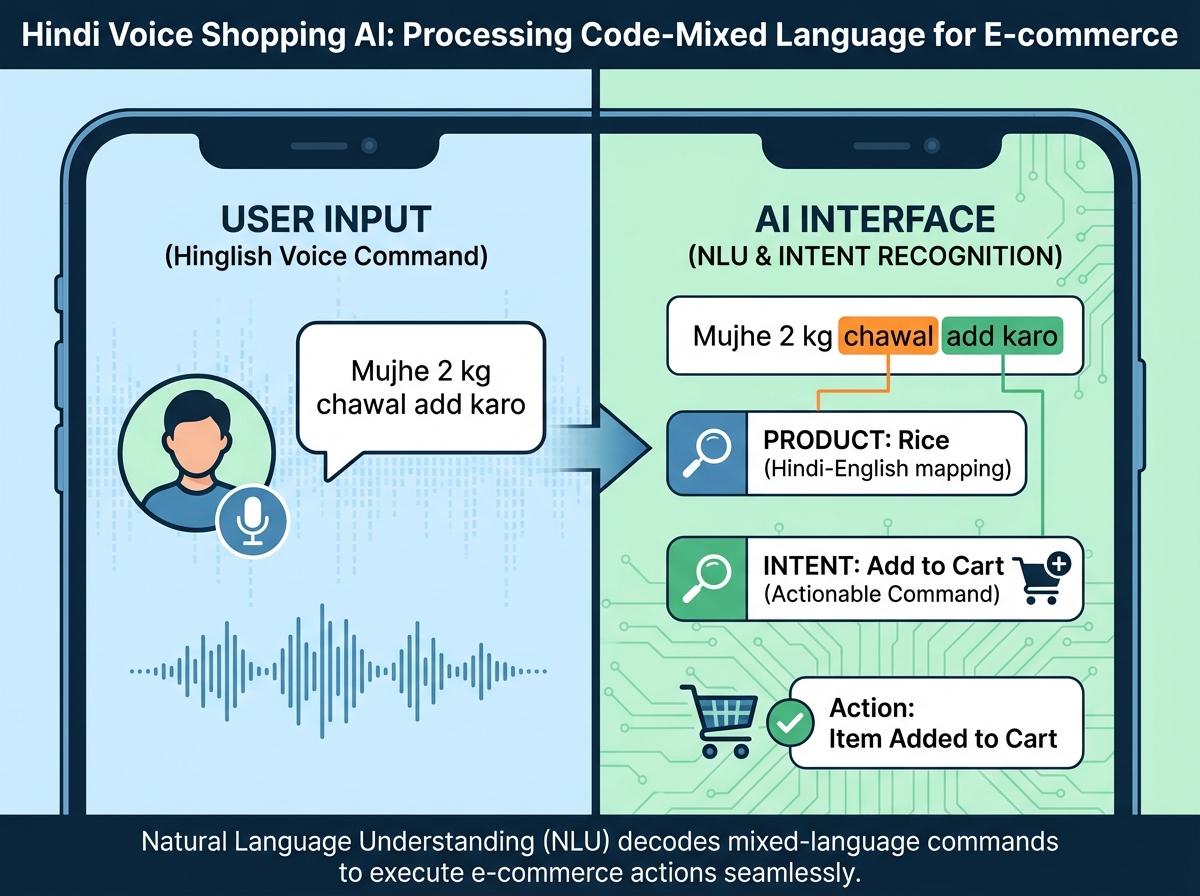
Winning in India requires a granular understanding of linguistic diversity, where a “one-size-fits-all” voice strategy inevitably fails. Hindi voice shopping AI must be engineered to handle the complexities of “Hinglish” and varied regional accents from Rajasthan to Bihar. For instance, a user might say, “Mujhe 2 kg chawal add karo aur best budget phone dikhao under 10k.” The AI must perform precise slot-filling for intents, recognizing that “chawal” (rice) is a grocery item while “phone” triggers an electronics discovery flow, all while maintaining a polite, trust-building persona in Hindi.
In the South, Tamil conversational commerce demands a different approach, focusing on shorter, high-intent utterances and colloquial patterns specific to markets like Chennai or Coimbatore. The lexicon for categories like fashion or mobile recharges must be localized to reflect regional preferences. Furthermore, the system must be resilient enough to handle “Tanglish” (Tamil-English mix) and provide seamless error recovery. If the voice intent is unclear, the system should gracefully transition to a Tamil-language chat interface to prevent user drop-off.
Bengali voice search optimization presents unique challenges, particularly regarding seasonal intents like “Pujo offers” and geographical nuances like “Howrah pickup.” Enterprises must support “Roman Bangla” (Bengali written in English script) for search queries while ensuring that the voice output is in high-quality, natural-sounding Bengali. When the AI’s confidence score for a high-value purchase falls below a certain threshold, the journey should automatically route to a Bengali-speaking advisor for assisted buying. This hybrid model ensures that dialect-specific shopping behavior is respected, leading to higher conversion rates.
Leading players like Flipkart have already demonstrated the viability of this approach by introducing voice search in both Hindi and English for grocery segments. This has set a benchmark for conversational shopping personalization, proving that when users can speak to an app in their native tongue, the psychological barrier to e-commerce vanishes. By 2026, this has evolved into “Agentic Commerce,” where the voice assistant doesn't just search but actively manages the entire shopping lifecycle for the user.
Sources:
- TrueFan AI: Hindi Voice Shopping Optimization
- YourStory: Flipkart introduces voice search in Hindi and English
- Tribune India: Netcore’s E-commerce Agentic Trends Report 2026
Channel coverage and the Natural Language Commerce AI stack for 2026
To achieve comprehensive regional voice commerce penetration, enterprises must deploy a multi-channel coverage model that meets users where they are. While smart speaker regional integration (Alexa, Google Assistant) is valuable for reorders and status checks, the primary vehicle for commerce depth remains the in-app microphone. This allows for the lowest friction in catalog-grounded discovery and secure payment flows. For the segment using feature phones or low-end devices, IVR and telephony systems with “say or press” hybrids remain critical for assisted buying.
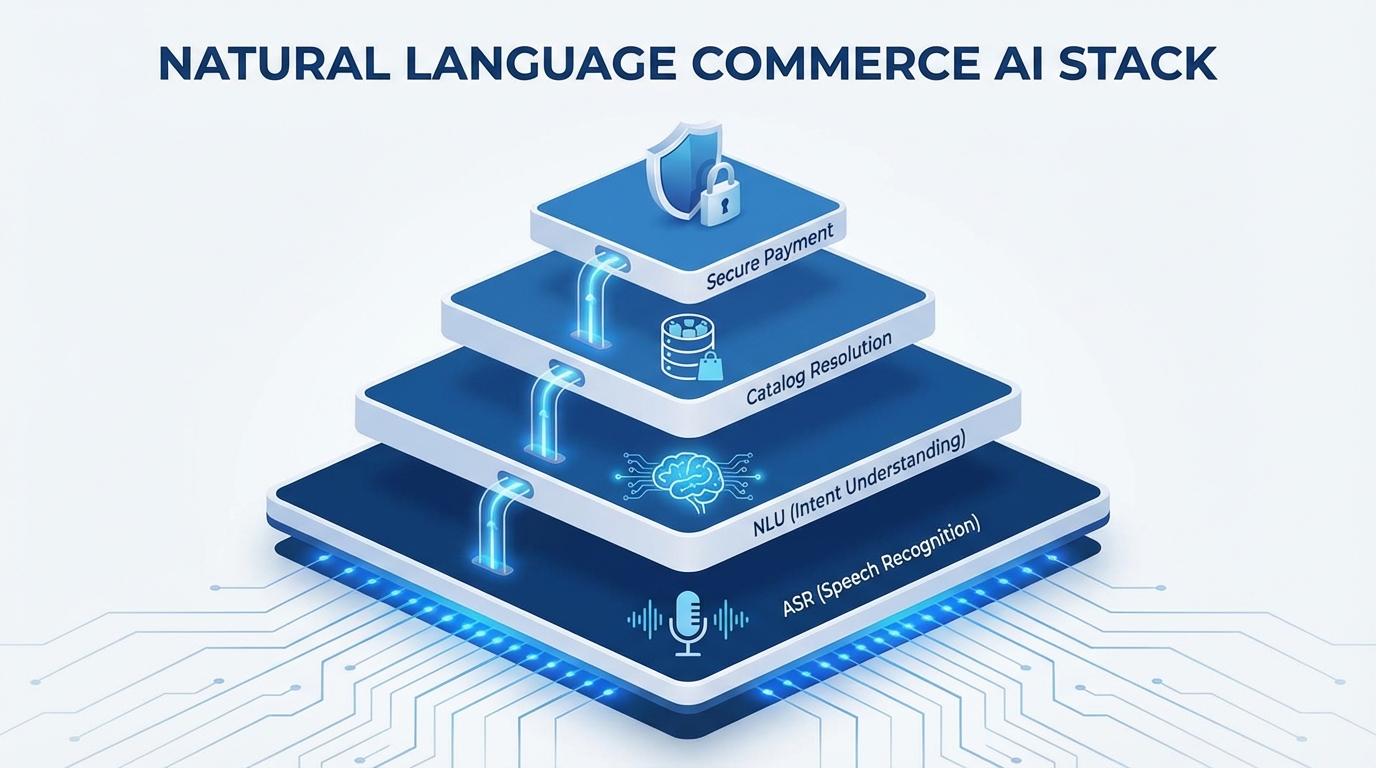
The underlying natural language commerce AI stack for 2026 is composed of several sophisticated layers. First is Automatic Speech Recognition (ASR), which must be dialect-robust and noise-resilient to handle the chaotic acoustic environments of Indian streets. This is followed by Natural Language Understanding (NLU), which interprets intents and entities across code-mixed languages like Hinglish or Benglish. The system then uses Natural Language Generation (NLG) to produce concise, compliant responses that guide the user toward a transaction.
A critical component of this stack is the Catalog and Entity Resolution layer. This grounds the user's spoken words to a live product catalog using fuzzy matching, disambiguating variants like size, color, or weight in real-time. For example, if a user asks for “lal dupatta,” the AI must resolve this to the specific SKU for a red scarf in the inventory. This is then coupled with a payment orchestration layer that supports voice-authenticated checkout with OTP fallback, ensuring a secure yet seamless end-to-end journey.
Finally, the 2026 stack must include robust LLM guardrails and safety protocols. With the implementation of the Digital Personal Data Protection (DPDP) Act, enterprises must ensure data minimization and purpose limitation for all voice recordings. Platforms like TrueFan AI enable enterprises to navigate these complexities by providing secure, compliant environments for generating personalized content. These guardrails prevent hallucinations, filter profanity, and ensure that the AI remains a brand-safe representative of the company across all 175+ supported languages.
Sources:
- Bhashini: Language Tech Stack for India
- MeitY: Digital Personal Data Protection Act 2023
- TrueFan AI: Two-way Conversation AI Video
Personalization engine: Conversational shopping and voice-triggered video offers
In 2026, personalization has moved beyond static recommendations to real-time, context-aware interactions. Conversational shopping personalization now utilizes a user's language preference, geographical location, and past purchase behavior (RFM) to tailor the voice journey. If a user in Lucknow searches for “winter wear,” the AI understands the local climate and suggests appropriate products in a polite, Lucknowi-accented Hindi. This level of detail fosters a sense of familiarity and trust that is essential for winning the Bharat market.
One of the most potent tools in this personalization arsenal is the use of voice-triggered video offers. When a specific voice intent is detected—such as a user asking for the “best mixer grinder under 3k”—the system can automatically generate a shoppable, localized video. This video features a product demo, dynamic pricing, and a clear CTA like “Buy on WhatsApp.” These videos are delivered instantly in-app or via messaging platforms, providing a visual confirmation that complements the voice interaction and significantly boosts conversion rates.
TrueFan AI's 175+ language support and Personalised Celebrity Videos allow brands to take this a step further by having a recognized brand ambassador or celebrity address the user by name in their preferred regional language. This hyper-personalization at scale is delivered through low-latency APIs, ensuring that the video is rendered and served in under 30 seconds. By inserting dynamic visuals like the user's city or the specific SKU they browsed, brands can create a “VIP” experience for every customer in Tier-2 and Tier-3 cities.
The ROI of these AI-driven marketing efforts is substantial. Indian marketers adopting these technologies report a 3.5x higher ROI compared to traditional digital channels. By reallocating budgets toward performance-driven, voice-first channels, enterprises can achieve massive scale while maintaining a low Cost Per Acquisition (CPA). The ability to perform “virtual reshoots” and rapid A/B testing of video scripts without new physical shoots leads to production savings of 70-90%, allowing for unprecedented experimentation in regional markets.
Sources:
Voice SEO in regional languages and the measurement of marketing ROI
To capture organic traffic in a voice-first world, enterprises must master voice SEO regional languages. This involves optimizing content for spoken, question-based queries rather than short text keywords. For instance, instead of targeting “best refrigerator,” brands should optimize for “Sabse accha fridge kaunsa hai?” in Hindi script and Roman transliteration. Implementing Schema.org's FAQPage and Speakable properties is essential for ensuring that brand content is selected as the “featured snippet” for voice assistants.
The measurement of success in this domain requires a specialized framework known as voice assistant marketing ROI. Unlike traditional web analytics, this tracks incremental revenue and Net Present Value (NPV) derived from voice touchpoints. Key Performance Indicators (KPIs) include the Conversion Rate (CR) of voice journeys, Average Order Value (AOV) deltas for voice-assisted buys, and the CAC payback period. Solutions like TrueFan AI demonstrate ROI through their Enterprise Video ROI Metrics Dashboard, which integrates directly with CRM and CDP systems to provide a CFO-ready view of performance.
Attribution in the Indian market is notoriously complex due to the heavy use of WhatsApp and cross-app journeys. Enterprises should use a hybrid of Media Mix Modeling (MMM) and Multi-Touch Attribution (MTA) to accurately credit voice intents and video offer views. By tagging every session join and voice-triggered event, brands can build city-level heatmaps of regional voice commerce penetration. This data allows for precise resource allocation, ensuring that marketing spend is directed toward the languages and regions showing the highest growth potential.
Furthermore, vernacular shopping behavior dictates that trust cues are paramount. This means the measurement stack must also track qualitative metrics like “time-to-checkout” and “deflection to self-serve.” If a voice interface successfully resolves a query that would have otherwise gone to a human agent, the cost-to-serve savings should be factored into the overall ROI. This holistic approach ensures that the voice commerce strategy is viewed not just as a marketing expense, but as a fundamental driver of operational efficiency and customer lifetime value.
Sources:
90-180-365 day execution roadmap for regional voice commerce penetration
Scaling voice commerce vernacular India requires a phased approach that balances rapid experimentation with long-term infrastructure building. The first 90 days should focus on a pilot program targeting 1-2 high-volume categories (e.g., Grocery or CPG) in Hindi and one South Indian language like Tamil. The goal is to establish an ASR/NLU baseline and launch voice-triggered video offers to a controlled cohort. Success in this phase is measured by a 15-30% lift in conversion rates and a Word Error Rate (WER) of less than 8% in Hindi.
In the next 180 days, the focus shifts to scaling. This involves adding Bengali to the language mix and expanding channel coverage to include IVR and selective smart speaker skills. Enterprises should deepen their conversational shopping personalization by integrating real-time inventory and loyalty data into the voice flow. The OKR for this stage is to have 25% of all Tier-2 traffic interacting with voice-first features, with a sustained increase in AOV for those exposed to personalized video content.
By the end of the first year (365 days), the system should be optimized for dialect-specific shopping nuances, such as Awadhi or Coimbatore Tamil. Advanced guardrails should be in place to handle complex multi-turn conversations and predictive offers. At this stage, the enterprise should have a fully functional “regional voice commerce penetration” dashboard that provides real-time insights into performance across every major Indian city. This allows for dynamic budget reallocation based on the evolving linguistic landscape.
Throughout this roadmap, risk and compliance must remain a top priority. Adherence to the DPDP Act is mandatory, requiring clear consent capture and data erasure protocols for all voice interactions. Brands must also conduct regular bias audits to ensure that their natural language commerce AI performs equally well across different genders and regional accents. By building a transparent, secure, and culturally intelligent voice ecosystem, enterprises can secure their position as leaders in the 2026 Indian digital economy.
Sources:
Conclusion
The era of English-centric digital commerce in India has passed. As we move through 2026, the ability to execute a sophisticated voice commerce vernacular India strategy will be the primary differentiator between market leaders and laggards. By integrating advanced natural language commerce AI, optimizing for voice SEO regional languages, and leveraging hyper-personalized tools like voice-triggered video offers, enterprises can finally unlock the massive potential of the 650 million regional users. The roadmap is clear: start with a focused pilot, scale through linguistic depth, and measure every interaction through a rigorous ROI framework to win the heart of Bharat.
Recommended Internal Links
- Master voice SEO regional languages for commerce success
- Conversational shopping AI Hindi: 2026 voice commerce India
- Voice Commerce India 2026: Vernacular Video AI Strategies
- Voice Commerce Personalization India 2026: Growth Playbook
- Tier-2 Festival Commerce Automation: Local Growth Playbook
- Answer Engine Optimization Video 2026: Winning Strategies
- WhatsApp Catalog Video Marketing: Tactics for 2026
Frequently Asked Questions
What is voice commerce vernacular India and why is it critical in 2026?
Voice commerce vernacular India refers to using voice technology for e-commerce in regional languages like Hindi, Tamil, and Bengali. It is critical in 2026 because most of India’s 900M+ internet users are non-English speakers from Tier-2/3 cities who prefer speaking over typing for discovery and checkout.
How do I optimize Hindi voice shopping AI for code-mixing?
Train NLU to recognize Hinglish and mixed tokens, supported by dialect-robust ASR and SKU synonym maps. For example, “2 kg atta add karo” requires entity resolution for “atta” and intent mapping for “add,” plus model tuning for regional accents.
What are the best practices for Bengali voice search optimization?
Support both native script and Roman Bangla; structure content for featured snippets with FAQ schema; cover seasonal and geo-specific intents (e.g., “Pujo offers,” “Howrah pickup”), and provide a fallback to Bengali-speaking advisors for complex journeys.
How does TrueFan AI help measure voice assistant marketing ROI?
TrueFan AI’s Enterprise Video ROI Metrics Dashboard tracks voice journey conversion rate, AOV uplift, and CAC payback. It integrates with CRM/CDP to attribute revenue from voice-triggered, personalized video experiences with CFO-ready reporting.
What is the difference between smart speaker regional integration and in-app voice?
Smart speaker skills (Alexa/Google) are ideal for reorders and home tasks, while in-app voice uses the smartphone mic within the brand app for deep catalog grounding, secure payments, and more seamless shopping—crucial for tier-2 voice adoption.