Real-time interactive AI avatars India 2026: Enterprise playbook for two-way conversation AI video in CX and sales
Estimated reading time: 9 minutes
Key Takeaways
- In 2026, real-time interactive AI avatars set the gold standard for enterprise CX in India, powered by 5G-Advanced and strict DPDP compliance.
- Two-way conversation AI video delivers human-like turn-taking, low-latency responses, and visual empathy that outperform static videos and text chat.
- Platforms like Studio by TrueFan AI, HeyGen, and Tavus offer distinct strengths across Zoom sales, developer embeds, and India localization.
- A robust stack spans WebRTC, LLM + RAG, and DPDP-compliant consent and data minimization to ensure trust and safety.
- Measure success with containment rate, CSAT uplift, p95 latency, and demo-to-opportunity conversion for AI-led Zoom meetings.
The landscape of digital engagement is undergoing a seismic shift. As we navigate through 2026, the era of static, one-way video content is rapidly being replaced by real-time interactive AI avatars India 2026 solutions (real-time interactive AI avatars India). For Indian enterprises, this isn't just a technological upgrade; it is a fundamental reimagining of how brands communicate. With the maturation of 5G-Advanced networks and the stringent enforcement of the Digital Personal Data Protection (DPDP) Act 2023, the infrastructure is finally ready for two-way conversation AI video (two-way conversation AI video) that feels as natural as a human interaction.
Platforms like Studio by TrueFan AI enable enterprises to bridge the gap between automated efficiency and human empathy, providing a scalable way to deliver face-to-face AI conversations across every digital touchpoint. Whether it is a customer service bot that can "see" and "hear" or an AI sales representative joining a Zoom call, the transition from "watching" to "interacting" is the defining trend of the year.
1. The 2026 Landscape: Why Real-Time Interactivity is Non-Negotiable
In 2026, the Indian market is no longer satisfied with chatbots or pre-recorded video snippets. Several key drivers have converged to make real-time interactive AI avatars India 2026 the gold standard for enterprise CX:
- 5G-Advanced Ubiquity: By mid-2026, 5G-Advanced has reached over 85% of Indian urban centers, reducing latency to sub-120ms levels. This technical milestone is critical for WebRTC-based streaming, ensuring that an AI avatar's response doesn't lag, which is essential for maintaining the "illusion of life."
- The Rise of Virtual Influencers: Indian brands have moved beyond traditional celebrity endorsements. According to recent 2026 marketing trends, over 60% of top-tier Indian brands now employ virtual influencers for live commerce and social engagement.
- Multilingual Expectations: With the expansion of digital literacy into Tier-2 and Tier-3 cities, the demand for "Hinglish," Tamil, Bengali, and Marathi support has skyrocketed. Static video cannot adapt to these nuances in real-time; interactive avatars can.
- DPDP Compliance Maturity: The Digital Personal Data Protection Act (2023) is now fully operational. Enterprises are seeking "consent-first" AI platforms that can provide transparent, auditable, and secure interactions.
Defining the New Standard
To understand this playbook, we must define three core pillars:
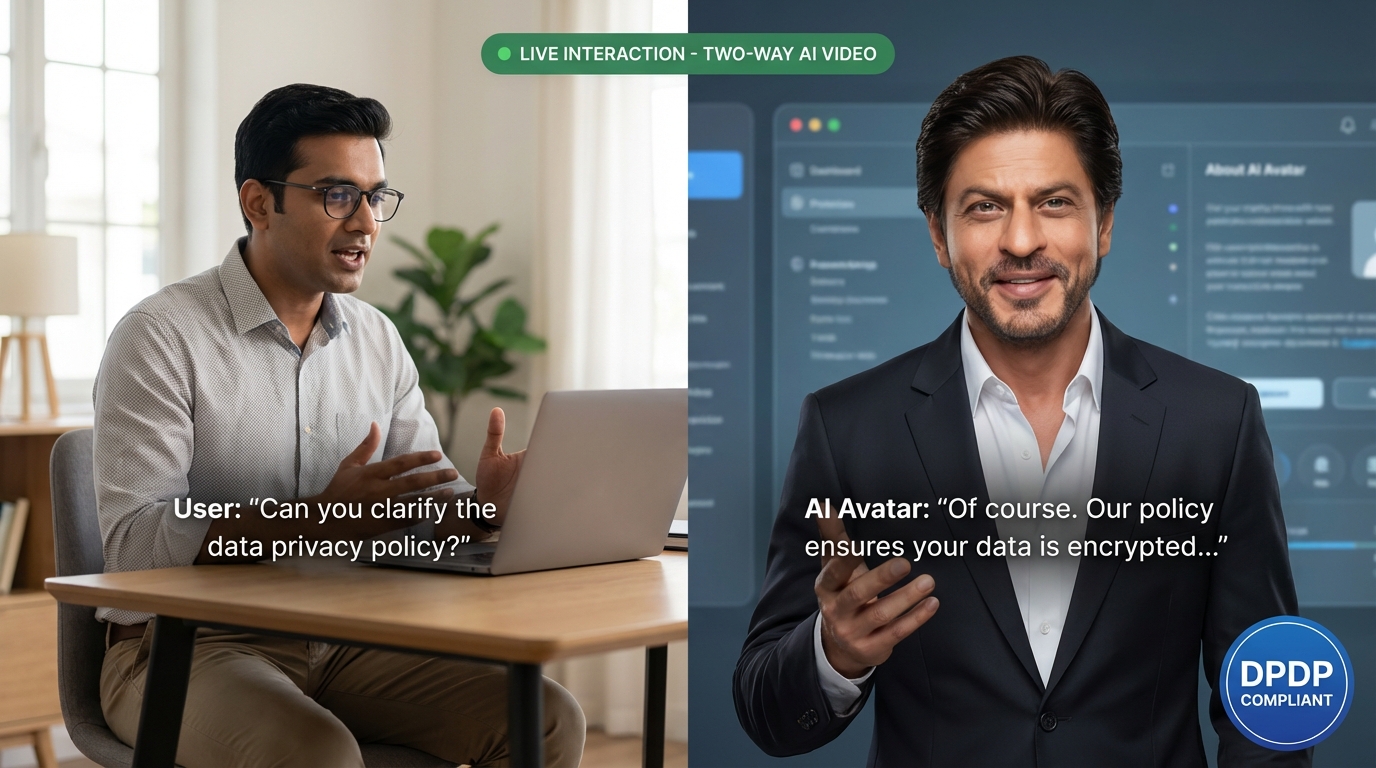
- Two-Way Conversation AI Video: A bidirectional audiovisual interaction where the AI agent listens, processes via an LLM, and responds visually and audibly in real-time, supporting "barge-in" (interruptions) (real-time interactive AI avatars India).
- Interactive Digital Humans Platform: A software ecosystem that renders photorealistic avatars while managing the complex stack of STT (Speech-to-Text), TTS (Text-to-Speech), and WebRTC streaming.
- Conversational Avatar API Integration: The technical bridge connecting the avatar's visual output with enterprise intelligence (CRM, RAG, and Knowledge Bases) (Tavus AI India pricing 2026).
Source: RoyalWays Digital Marketing Trends 2026
2. Platform Landscape: Comparing BHuman Alternatives & Interactive Leaders
When evaluating "BHuman alternatives interactive" for the Indian market, the focus shifts from "personalized video generation" to "real-time conversational capability" (Tavus AI India pricing 2026). Here is how the leading platforms stack up in 2026:
Studio by TrueFan AI
As a leader in the Indian ecosystem, Studio by TrueFan AI offers a unique "Influencer-as-an-Avatar" model. Unlike generic CGI models, these are digital twins of real Indian celebrities and influencers, providing instant brand trust.
- Best For: Enterprise-grade security, DPDP compliance, and high-trust consumer interactions.
- Key Advantage: Studio by TrueFan AI's 175+ language support and AI avatars are specifically tuned for Indian accents and regional dialects, making them ideal for localized CX.
HeyGen LiveAvatar
HeyGen has transitioned its focus toward the HeyGen LiveAvatar implementation (real-time interactive AI avatars India), moving away from older, high-latency interactive flows.
- Features: Low-latency WebRTC streams, session lifecycle management, and a robust SDK.
- Zoom Integration: One of its standout features is the ability to send an interactive avatar directly into AI avatar Zoom meetings (AI avatar Zoom meetings), allowing the AI to act as a participant in live sales calls.
Tavus Conversational Interface (CVI)
Tavus focuses on a developer-first approach with its Tavus conversational interface (Tavus AI India pricing 2026).
- Features: Multimodal React components that allow developers to embed video-first agents into existing web apps with minimal code.
- Intelligence: It excels at connecting to complex back-end RAG (Retrieval-Augmented Generation) indexes for technical support use cases (see also: Tavus vs Synthesia Comparison).
D-ID Agents & Others
- D-ID Agents: Known for their "Agents" platform that combines real-time streaming with built-in RAG capabilities.
- UneeQ & Soul Machines: These remain the "high-end" choices for luxury brands requiring autonomous digital humans with complex emotional modeling.
| Feature | Studio by TrueFan AI | HeyGen LiveAvatar | Tavus CVI | D-ID Agents |
|---|---|---|---|---|
| Primary Focus | Influencer-led Enterprise CX | Sales & Zoom Integration | Developer-first Embeds | RAG-ready Support |
| India Localization | High (Native Support) | Medium | Medium | Medium |
| Compliance | ISO 27001 / DPDP | SOC 2 | SOC 2 | GDPR / SOC 2 |
| Real-time Latency | <150ms | <200ms | <180ms | <250ms |
Source: HeyGen Streaming Avatar SDK Docs
3. Technical Architecture: Conversational Avatar API Integration & DPDP Compliance
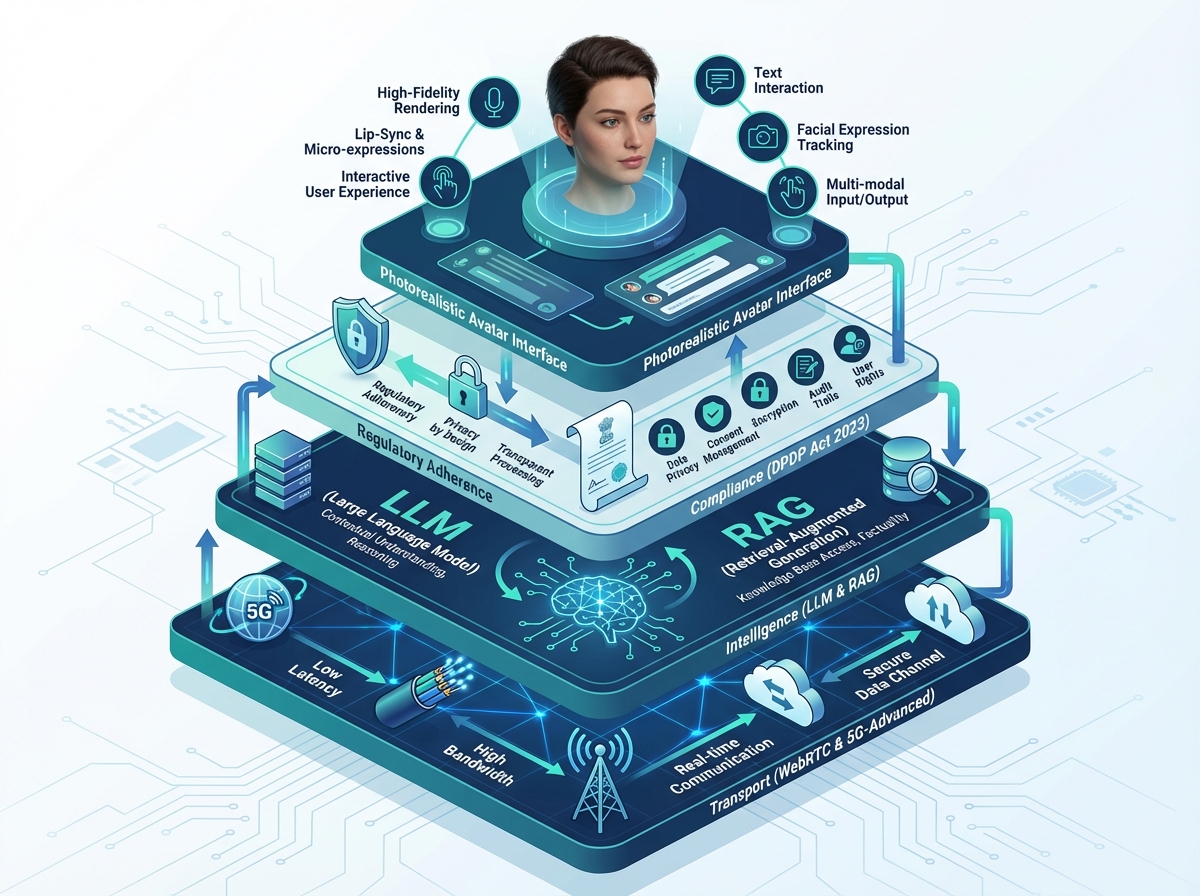
Building a real-time interactive AI avatars India 2026 solution requires a sophisticated four-layer stack. For Indian enterprises, the "Compliance Layer" is now as important as the "Intelligence Layer."
The Front-End & Transport Layer
The foundation is WebRTC (Web Real-Time Communication). In 2026, adaptive bitrate (ABR) is mandatory to handle the network variability between a high-speed Mumbai office and a 4G-dependent user in rural Bihar.
- Voice Activity Detection (VAD): This allows the avatar to stop talking the moment the user interrupts, creating a natural "turn-taking" flow.
- Lip-Sync & Gaze: Modern SDKs now use neural rendering to ensure the avatar maintains "eye contact" with the camera, significantly increasing user engagement.
The Intelligence Layer (LLM + RAG)
The avatar is only as smart as its brain. Enterprises use conversational avatar API integration (Tavus AI India pricing 2026) to connect the avatar to:
- Vector Databases: Housing product manuals and FAQs.
- Action APIs: Allowing the avatar to check order status in a CRM or book a service appointment.
- Guardrails: Essential for preventing "hallucinations" or off-brand remarks.
The Compliance Layer: Navigating the DPDP Act 2023
In 2026, non-compliance with the DPDP Act can result in penalties up to ₹250 crore. Your architecture must include:
- Notice & Consent: Before the camera or mic turns on, a clear notice must be presented in the user's preferred language (out of the 22 scheduled languages).
- Purpose Limitation: The AI must only process data for the specific interaction (e.g., "to help you with your insurance claim").
- Data Minimization: Transcripts should be scrubbed of PII (Personally Identifiable Information) before being stored for training (see: real-time interactive AI avatars India).
Source: Official Digital Personal Data Protection Act 2023
4. Enterprise Use Cases: From Live CX to AI Avatar Zoom Meetings
The transition to face-to-face AI conversations is delivering measurable ROI across three primary enterprise functions.
Live AI Avatar Customer Service
Traditional IVR and text bots often frustrate users. A live AI avatar customer service agent provides visual cues—a smile, a nod, or a concerned expression—that de-escalates tense situations (real-time interactive AI avatars India).
- The Playbook: A customer scans a QR code on a product package. An avatar appears, greets them in their local language, and walks them through the setup process. If the problem is complex, the avatar seamlessly hands off the transcript and video session to a human agent.
- ROI Metric: Enterprises using this flow report a 35% increase in first-contact resolution (FCR) compared to text-only bots.
AI Avatar Zoom Meetings for Sales
Scaling a sales team is expensive. By using AI avatar Zoom meetings, companies can deploy "Digital SDRs" that join discovery calls to handle initial Q&A (AI avatar Zoom meetings).
- The Playbook: A prospect books a demo. Instead of waiting for a human AE, an AI avatar joins the Zoom link instantly. It presents the deck, answers technical questions using RAG, and qualifies the lead.
- Benefit: This ensures 24/7 global coverage without increasing headcount.
Internal Training and IT Helpdesks
For large Indian conglomerates with thousands of employees, real-time video engagement AI is the most effective way to handle internal SOP training.
- The Playbook: An employee needs to reset their VPN or understand the new leave policy. Instead of reading a 50-page PDF, they talk to an internal AI avatar that demonstrates the steps on-screen in real-time.
Source: HeyGen: Sending Interactive Avatars to Zoom
5. Implementation Blueprint: HeyGen LiveAvatar & Tavus CVI Quickstart
Implementing these solutions requires a structured approach. Below are the quickstart paths for the two leading technical frameworks in 2026.
HeyGen LiveAvatar Implementation Path
- Authentication: Secure your API keys and set up your server-side token exchange to protect your credits.
- Session Creation: Use the
new_sessionendpoint to initialize the WebRTC connection. - Consent Capture: Implement a DPDP-compliant "Mic/Camera Access" modal.
- Event Handling: Listen for
task_talkandtask_stopevents. This ensures the avatar reacts instantly when the user starts speaking. - Barge-in Logic: Configure the sensitivity of the voice activity detection to ensure the AI doesn't stop talking due to background noise, but does stop when the user asks a question.
Tavus Conversational Interface (CVI) Path
- Persona Configuration: Select a persona from the Tavus library or upload your brand's custom digital twin (context: Tavus AI India pricing 2026).
- Component Embedding: Use the Tavus React SDK to drop the
<ConversationalVideo />component into your web app. - LLM Orchestration: Connect the component to your back-end (e.g., LangChain or an OpenAI Assistant). Tavus handles the heavy lifting of syncing the audio stream with the video frames (comparison reference: Tavus vs Synthesia Comparison).
- Latency Budgeting: Set your "Time to First Byte" (TTFB) targets. In 2026, any response taking longer than 1.5 seconds is considered a failure in user experience.
Source: Tavus CVI Overview & Components
6. Measuring Success: KPIs, ROI, and the Future of Digital Humans
To justify the investment in an interactive digital humans platform, enterprises must look beyond simple "engagement" metrics (related KPIs guide: real-time interactive AI avatars India).
Key Performance Indicators (KPIs)
- Containment Rate: The percentage of interactions handled entirely by the AI avatar without human intervention.
- CSAT Uplift: The delta in Customer Satisfaction scores between avatar-led sessions and traditional chat sessions.
- Latency p95: Ensuring that 95% of all responses occur within the 150-200ms window.
- Demo-to-Opportunity Conversion: Specifically for AI avatar Zoom meetings, tracking how many AI-led demos result in a qualified sales lead.
The ROI of Empathy
Solutions like Studio by TrueFan AI demonstrate ROI through significantly reduced customer acquisition costs (CAC) and increased lifetime value (LTV). By providing a "human" face to the brand 24/7, companies build deeper emotional connections with their users. In a 2026 study, Indian consumers were 40% more likely to trust a financial recommendation when delivered by a photorealistic AI avatar compared to a text-based prompt.
The 2026+ Outlook
- Omni-channel Persistence: Your "personal" AI assistant will follow you from a brand's website to their WhatsApp, and even into a physical kiosk in a shopping mall, maintaining the context of your previous face-to-face AI conversations.
- Emotional Prosody: AI voices will not just speak; they will detect the user's mood and adjust their tone—offering empathy to a frustrated customer or excitement to a new buyer.
Conclusion
The transition to real-time interactive AI avatars India 2026 is no longer a futuristic concept—it is a current operational requirement. By moving from static content to face-to-face AI conversations, Indian enterprises can solve the "scale vs. empathy" paradox. Whether through AI avatar Zoom meetings or live customer support, the ability to provide dynamic avatar responses India will define the market leaders of the next decade.
Ready to blueprint your 2026 avatar strategy?
Book a TrueFan AI Enterprise Workshop | Request a Live Demo in Hindi/English
Sources & References:
- DPDP Act 2023 Compliance Guide: Meity.gov.in
- HeyGen LiveAvatar Documentation: HeyGen Docs
- Tavus CVI Component Library: Tavus.io
- Indian AI Trends 2026: RoyalWays
- Indic Language AI Breakthroughs: Analytics India Mag
- DPDP Practical FAQ: IDFY 2025 Edition
Recommended Internal Links
- Real-time Interactive AI Avatars India: Live Video Chat — real-time interactive AI avatars India
- Tavus AI India pricing 2026: Alternatives, features, APIs — Tavus AI India pricing 2026
- Tavus vs Synthesia Comparison: Features, Pricing, and 2026 — Tavus vs Synthesia Comparison
Frequently Asked Questions
What is the difference between a standard AI video and two-way conversation AI video?
Standard AI video is a "push" medium—you generate a file and the user watches it. Two-way conversation AI video is a "pull" medium; it is a live, streaming interaction where the AI reacts to the user's voice and visual cues in real-time (primer: real-time interactive AI avatars India).
How does the DPDP Act 2023 affect AI avatar deployment in India?
The Act requires explicit, informed consent before processing personal data. For avatars, this means you must provide a clear notice in the user's language, specify exactly what the data (voice/video) will be used for, and provide an easy way for the user to revoke that consent.
Can an AI avatar really replace a human in a Zoom meeting?
While it doesn't replace the strategic thinking of a human salesperson, it can handle the "discovery" and "FAQ" phases of a call. This allows your human team to focus on closing deals rather than repeating the same product walkthrough ten times a day.
What is the typical latency for an interactive avatar in 2026?
With 5G-Advanced and edge computing, the industry benchmark for dynamic avatar responses India is now between 120ms and 180ms. Anything above 300ms starts to feel unnatural to the user.
How do I choose between HeyGen, Tavus, and Studio by TrueFan AI?
It depends on your use case. If you need deep Zoom integration, HeyGen is excellent. If you are building a custom web app, Tavus is a strong choice. However, Studio by TrueFan AI is the preferred choice for Indian enterprises requiring localized celebrity avatars, 175+ language support, and strict DPDP compliance out of the box (comparison aid: Tavus vs Synthesia Comparison).



