Nano-Moment Marketing Automation 2026: Sub-Second Video Triggers for Instant Decision Influence in India’s Attention Economy
Estimated reading time: 15 minutes
Key Takeaways
- In 2026, India’s attention economy rewards nano-moment strategies that influence decisions within sub-seconds.
- Three-second conversion videos win on Reels and Q-comm by aligning hook, value, and CTA for instant action.
- Success depends on cognitive load optimization and System 1 triggers like scarcity, social proof, and immediacy.
- A robust, GPU-accelerated pipeline enables near real-time rendering and delivery of personalized video assets.
- Attention-weighted KPIs (0–500ms retention, 0–3s CTR) and consent-first data practices are critical for enterprise scale.
The digital landscape in 2026 has transitioned from a battle for minutes to a war over milliseconds. As India’s attention economy reaches a point of total saturation, the traditional “micro-moment” has evolved into something far more granular: the nano-moment. Nano-moment marketing automation 2026 represents the pinnacle of this evolution, utilizing sub-second video triggers instant shopping video triggers to influence consumer behavior before the conscious mind even fully registers the advertisement.
In this hyper-accelerated environment, performance marketing leaders are no longer optimizing for clicks; they are optimizing for pre-attentive processing. Platforms like TrueFan AI enable brands to orchestrate these high-velocity interactions by delivering ultra-short video campaigns that resolve meaning in under 500 milliseconds. This strategic shift is essential for survival in a market where the probability of a user continuing to view a feed-based video halves every 1.5 seconds.
To succeed in 2026, Indian enterprises must master the art of the three-second conversion video. This requires a fundamental restructuring of creative assets, moving away from narrative storytelling toward flash decision triggers. By integrating millisecond marketing optimization into their tech stacks, brands can now trigger personalized video responses to real-time events—such as a sudden rainstorm in Mumbai or a price drop on a saved item—capturing intent and converting it into a transaction within a single breath.
The Neuroscience of Instant Decision Influence and Cognitive Load Optimization
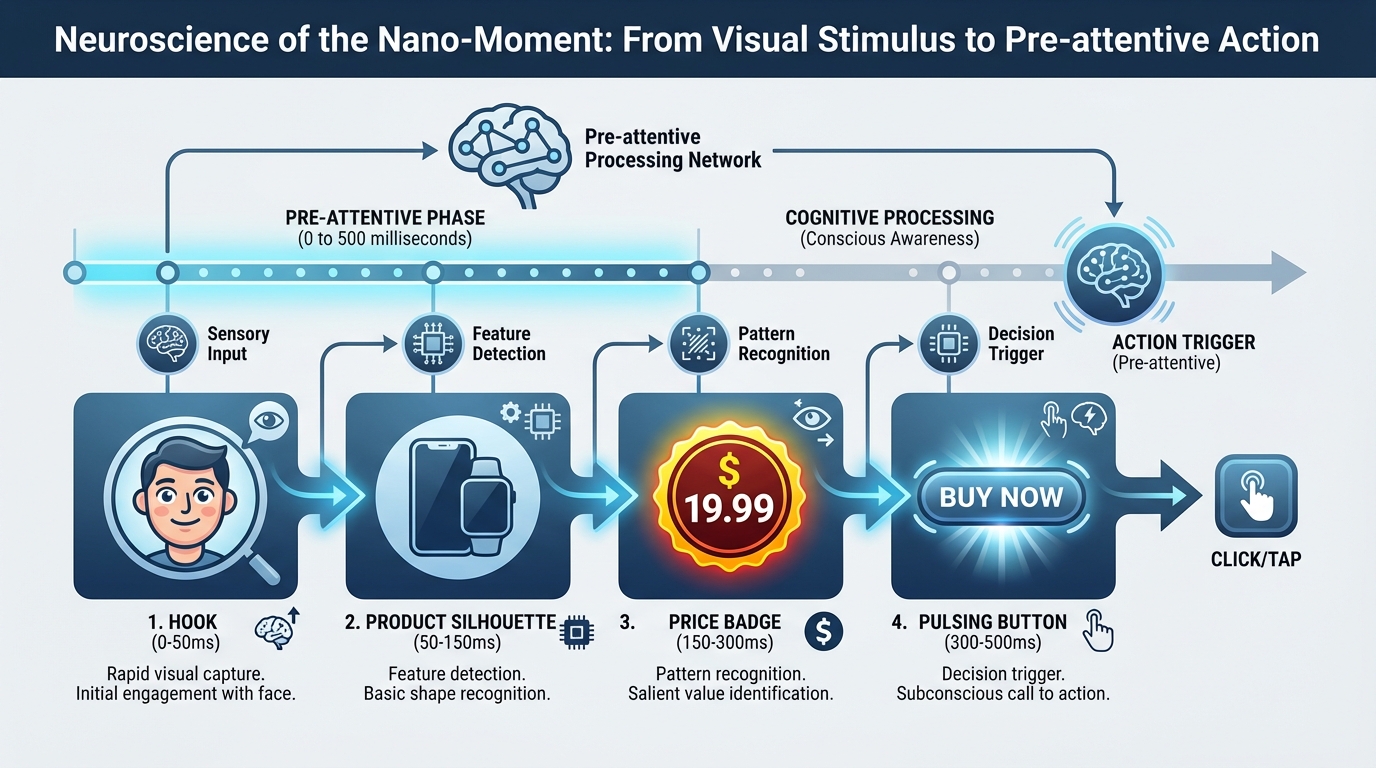
Understanding the neuroscience of the nano-moment is the first step toward achieving instant decision influence. The human brain processes visual information in stages, with the “pre-attentive” phase occurring within the first 200 to 500 milliseconds. During this window, the brain parses visual salience—identifying faces, high-contrast colors, and familiar shapes—before the viewer even decides to “watch” the content.
Cognitive load optimization is the practice of designing creative that respects the limitations of working memory during these brief windows. In 2026, the most effective ultra-short video campaigns limit themselves to one or two novel elements per frame. A cluttered video is a skipped video; therefore, the visual hierarchy must be absolute. The sequence should typically follow a “Face-Product-Price-Action” flow, ensuring the brain can resolve the offer’s meaning without cognitive strain.
Flash decision triggers are the psychological levers used to bypass prolonged deliberation. These include scarcity indicators (a pulsing “Only 4 left” badge), social proof (“23 people in Indiranagar just bought this”), and immediacy cues (a real-time ETA of “8 minutes”). By leveraging System 1 heuristics—the brain's fast, instinctive, and emotional response system—marketers can trigger an “add-to-cart” action before the analytical System 2 can find reasons to delay.
Source: TrueFan Nudge Theory for video
India’s Attention Economy: Quick Commerce Nano-Marketing Playbooks
India’s quick commerce (Q-comm) sector quick commerce video personalization in India has become the primary laboratory for nano-moment marketing automation 2026. With the market hitting a staggering $7 billion valuation and continuing to grow at a 40% CAGR, the competition for “replenishment moments” is fierce. On platforms like Blinkit, Zepto, and Swiggy Instamart (festival marketing 2026), the window to influence a purchase is often less than three seconds as users scroll through search results or category pages.
Quick commerce nano-marketing relies on the perfect alignment of real-time data and creative execution. For instance, a brand selling tea leaves can trigger a sub-second video ad the moment a thunderstorm begins in a specific pin code. This ad doesn't just show the product; it features a steaming cup, a localized weather badge, and a “10-minute delivery” promise. This level of micro-engagement personalization transforms a generic impression into a high-intent commerce event.
The shift from broad impressions to attention-weighted outcomes is now a standard KPI for Indian enterprise marketers. In 2026, success is measured by the “Time-to-Tap”—the duration between the ad appearing and the user initiating an action. Leading brands are moving away from 15-second spots toward three-second conversion videos that function as interactive stickers or “video cards” within the Q-comm app interface, maximizing ROI by reducing the friction between desire and delivery (instant shopping video funnels).
Source: MMA Global India + Publicis Quick Commerce Playbook 2025
Anatomy of Three-Second Conversion Videos for Instagram Reels Micro-Moments
Instagram Reels micro-moments represent the most challenging environment for scroll-stopping personalization. To convert in this space, a video must achieve three distinct goals within 3,000 milliseconds. The first 500ms (Frame 1) must establish the “Hook” through a human face or a high-motion gesture that signals relevance. If the viewer doesn't recognize a need or a familiar face instantly, they will continue the thumb-flick.
The middle segment (500ms to 2,000ms) is dedicated to the “Value Reveal.” This is where millisecond marketing optimization becomes critical. The offer—whether it’s a discount, a unique feature, or a localized benefit—must be presented with high-contrast text and minimal clutter. Captions should be limited to 5–7 words, using strong verbs that drive immediate understanding. Motion grammar, such as a subtle nod or a finger point toward the CTA area, helps guide the viewer’s eye without requiring extra cognitive effort.
The final second (2,000ms to 3,000ms) is the “Action Trigger.” A clear, one-tap affordance—often accompanied by an arrow pulse or a haptic-aligned audio cue—must be present. In 2026, the most successful ultra-short video campaigns on Reels use a 3-beat script: Recognize need, Present benefit, and Tap CTA. This structure ensures that even if the user only watches half the video, the core message and the path to purchase have been communicated.
Source: Think with Google APAC short-form best practices
Source: Storyboard18 “Virality vs meaning”
Millisecond Marketing Optimization: The Technical Architecture of 2026
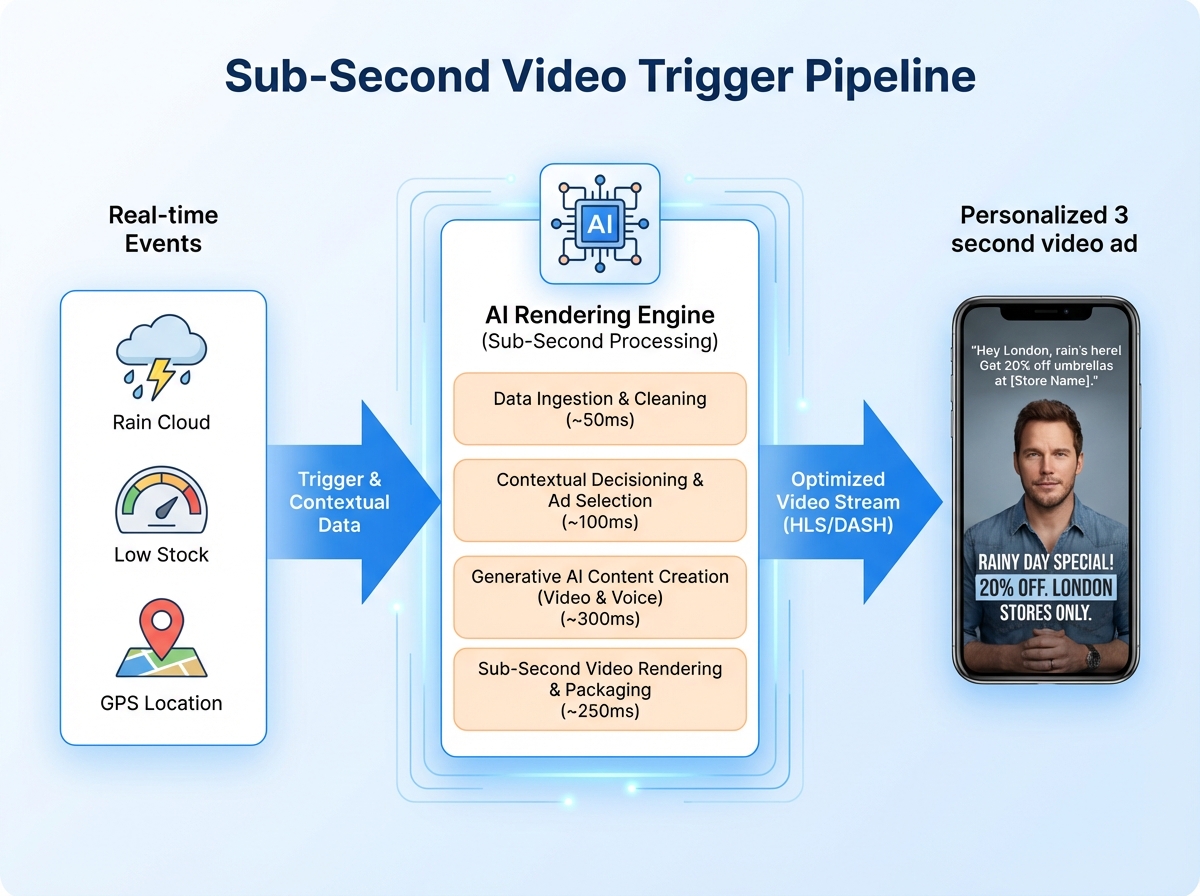
Executing nano-moment marketing automation 2026 at scale requires a sophisticated technical pipeline that can render and deliver assets in near-real time. The architecture begins with an event pipeline that monitors source events such as SKU depletion, weather changes, or user-specific search queries. Once a trigger is detected, a rules engine determines the optimal creative components, including the celebrity face, the language (from a pool of 175+ options), and the specific offer.
Millisecond marketing optimization involves pre-loading “sprites” or visual components like price badges and timers to avoid any latency in the video's appearance. The render pipeline must be GPU-accelerated, with a target of producing a fully personalized video in under 30 seconds (rapid fulfillment personalization strategies) for dispatch via WhatsApp or push notification. For social platforms, this means having pre-baked templates where dynamic fields like “User Name” or “Neighborhood” can be swapped instantly without a full re-render.
Measurement in this sub-second world requires a new set of “Nano KPIs.” Marketers are now tracking 0–500ms retention rates to judge hook effectiveness and 0–3s CTR to measure conversion intent. By unifying platform events with session analytics, enterprises can build an attention-adjusted ROAS (Return on Ad Spend) model. This allows for A/B testing of micro-elements, such as whether a 250ms delay in the price reveal performs better than an immediate display.
Source: TrueFan Enterprise capabilities and APIs
Source: TrueFan blog on 2026 marketing technology budget planning
Micro-Engagement Personalization and Impulse Purchase Automation
The secret to collapsing the deliberation window is micro-engagement personalization. This strategy dictates that a brand should match exactly one high-signal attribute—such as a user’s current city or their last searched product—to one visual slot in a video. This follows the “1:1:1” rule: one variable, one message, one action. Overloading a three-second video with multiple personalized data points actually increases cognitive load and decreases conversion.
Impulse purchase automation takes this a step further by linking real-time inventory and pricing APIs directly to the video creative. If a user in Bandra is looking at a specific pair of sneakers, the automation engine can fire a sub-second video trigger showing those exact sneakers with a “Only 2 left in Bandra” badge. This creates a powerful sense of urgency and local relevance that generic ads cannot replicate.
TrueFan AI's 175+ language support and Personalised Celebrity Videos provide the ultimate tool for this level of personalization. By using a credible celebrity face to deliver a localized, name-personalized message, brands can leverage existing trust to bypass the consumer's natural skepticism. This combination of celebrity authority and hyper-local data creates a “scroll-stopping” effect that is essential for driving high-volume impulse purchases in India’s competitive digital marketplace.
Enterprise-Grade Execution: ROI and Scaling with TrueFan AI
For large-scale enterprises in India, the challenge of nano-moment marketing automation 2026 is not just creativity, but the ability to execute millions of unique interactions simultaneously. Solutions like TrueFan AI demonstrate ROI through their ability to handle massive surges in demand, such as during festive seasons or major sporting events. For example, during a Mother’s Day campaign, Zomato was able to deliver over 354,000 personalized videos in a single day, achieving unprecedented engagement levels.
The ROI of ultra-short video campaigns is often seen in the significant uplift in “Add-to-Basket” rates within the first 15 seconds of a session. By providing a seamless path from a personalized video to a pre-filled cart, brands can eliminate the “drop-off” points that plague traditional marketing funnels. Furthermore, the use of AI-driven “virtual reshoots” allows brands to iterate on their creative hourly, adapting to changing inventory levels or competitor pricing without the need for expensive new production cycles.
Security and compliance are the final pillars of enterprise execution. In 2026, data privacy is paramount, and any automation must be built on a “consent-first” framework. This includes using ISO 27001-certified platforms that ensure PII (Personally Identifiable Information) is minimized and celebrity assets are used within strictly defined windows. By combining this level of security with high-speed rendering and deep analytics, Indian brands can finally master the attention economy.
Source: TrueFan Case Studies (Zomato, Hero MotoCorp)
Source: TrueFan ROI metrics framework
Frequently Asked Questions
What is nano-moment marketing automation 2026 and how does it differ from micro-moments?
Nano-moment marketing automation 2026 is the process of using real-time data to trigger ultra-short, personalized video sequences (typically under 3 seconds) designed for instant action. While micro-moments focus on broader intent-driven stages like “I want to know” or “I want to buy” (which may involve minutes of research), nano-moments target the sub-second pre-attentive phase of the brain to provoke an immediate impulse.
How do sub-second video triggers technically work with enterprise APIs?
Technically, a sub-second video trigger is initiated by a webhook from a brand’s data platform (like a CDP or inventory system). This webhook sends user-specific variables to a rendering engine, such as TrueFan AI, which assembles a pre-designed video template with dynamic elements (name, price, location). The resulting asset is then dispatched via high-speed channels like WhatsApp or integrated directly into a social ad manager for immediate delivery.
What makes three-second conversion videos effective in India’s attention economy?
These videos are effective because they align with the natural decay of digital attention. By delivering a complete message—hook, value, and CTA—within three seconds, brands ensure they reach the viewer before they have the chance to scroll away. In India’s high-density mobile market, this brevity reduces cognitive load and utilizes flash decision triggers like local relevance and scarcity to drive faster checkouts.
How to implement impulse purchase automation for quick commerce nano-marketing?
Implementation requires connecting your quick commerce store’s live inventory and delivery APIs to your marketing automation stack. When a specific condition is met (e.g., a product is back in stock or a user enters a specific geo-fence), the system automatically generates a personalized video showing the product’s current price and the exact delivery time to the user’s location, providing a direct deep link to the checkout page.
Best practices for scroll-stopping personalization on Instagram Reels micro-moments?
The best practices include using a recognizable human face in the first 500ms, maintaining a text density of less than 20% of the frame, and using high-contrast colors for price badges. Additionally, incorporating a 1-beat audio sting at the 300ms mark and a clear directional arrow toward the “Shop Now” button by the 2-second mark significantly increases the likelihood of a conversion.
Source: TrueFan AI Enterprise Solutions
Source: MMA Global India Q-comm Playbook