FY 2026-27 Enterprise Marketing Budget Allocation: The Strategic Playbook for India’s CMOs and CTOs
Estimated reading time: ~12 minutes
Key Takeaways
- Reallocate budgets toward AI-driven personalization and measurable outcomes across the customer lifecycle.
- Sequence the martech stack from data foundations to AI orchestration for scalable impact.
- Adopt enterprise AI video to deliver multilingual, hyper-relevant content that lifts CTR, CR, and LTV.
- Apply rigorous procurement, security, and DPDP compliance criteria to de-risk deployments.
- Model TCO and ROI with sensitivity analyses; execute a phased Q1–Q4 roadmap to scale confidently.
The commencement of the new fiscal year on April 1, 2026, marks a pivotal transition for Indian corporations as they operationalize their FY 2026-27 enterprise marketing budget allocation. Following the strategic signals provided by the Union Budget 2026-27, which emphasized digital sovereignty and advanced AI infrastructure, enterprises are shifting from experimental pilots to full-scale deployment. This period represents the critical window for April 2026 AI marketing investment planning, where leadership must align capital with high-velocity growth drivers.
As organizations finalize their new financial year martech strategy India, the focus has shifted toward platforms that offer verifiable ROI and seamless integration. The current economic landscape, bolstered by India’s positioning as a global digital infrastructure hub, necessitates a disciplined approach to technology spending. Decision-makers are now prioritizing solutions that bridge the gap between massive data repositories and personalized customer experiences.
Platforms like TrueFan AI enable enterprises to bridge this gap by transforming static data into dynamic, high-engagement video content at scale. By aligning fiscal resources with agentic AI capabilities in India, Indian CMOs can ensure their brands remain competitive in an increasingly automated marketplace.
1. FY27 CMO Budget Priorities and Marketing Budget Allocation Best Practices India
Establishing marketing budget allocation best practices India requires a governance-led approach that balances immediate revenue generation with long-term brand equity. For the 2026-27 fiscal cycle, the allocation must reflect the maturity of the Indian digital ecosystem and the increasing sophistication of the domestic consumer. CMOs are moving away from monolithic spending patterns toward a more fluid, outcome-based distribution of resources.
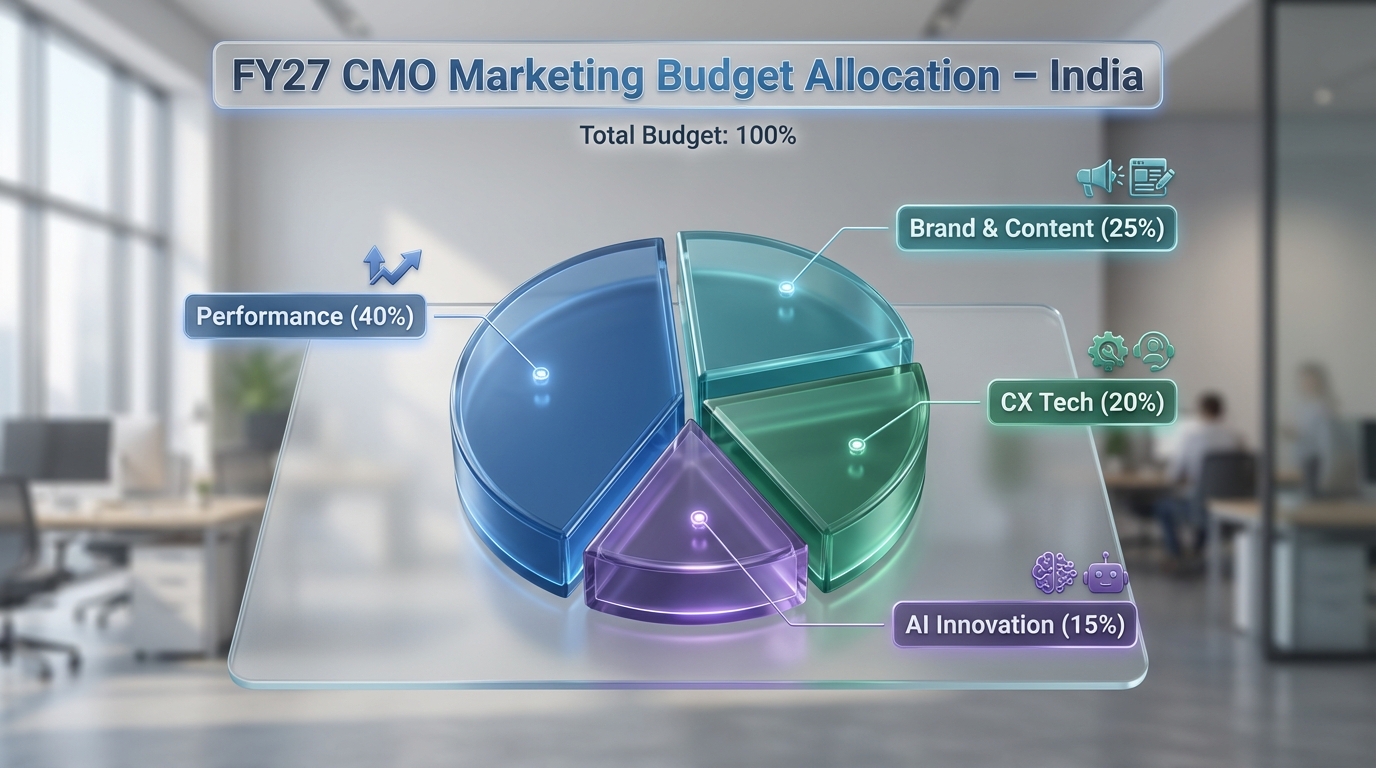
The FY27 CMO budget priorities India are increasingly centered on “efficiency-first” growth, where every rupee spent is mapped to a specific stage of the customer lifecycle. We recommend a strategic split that prioritizes performance and personalization:
- Performance and Demand Generation (35–45%): Focused on high-intent channels and automated lead nurturing.
- Brand and Content, including Video (20–30%): Investing in high-fidelity storytelling and immersive media.
- CX and Personalization Tech (15–25%): Dedicated to FY27 personalised marketing technology spend for real-time engagement.
- Innovation and Agentic AI Pilots (5–10%): Reserved for testing emerging technologies like autonomous marketing agents.
This structured allocation ensures that the core business remains robust while providing the necessary headroom for digital transformation. The emphasis on FY27 personalised marketing technology spend is particularly critical as consumers now expect hyper-relevant interactions across all digital touchpoints. By investing in AI-driven personalization, enterprises can significantly reduce churn and increase the lifetime value of their customer base.
Sources:
- Invest India: India’s Union Budget FY 2026-27 Key Highlights
- MediaBrief: Union Budget 2026 Marketing and Adtech Sector
- ET Edge Insights: Industry Backs India’s Push on AI and Deep Tech
2. Martech Stack Prioritisation April 2026 and Digital Technology Roadmap
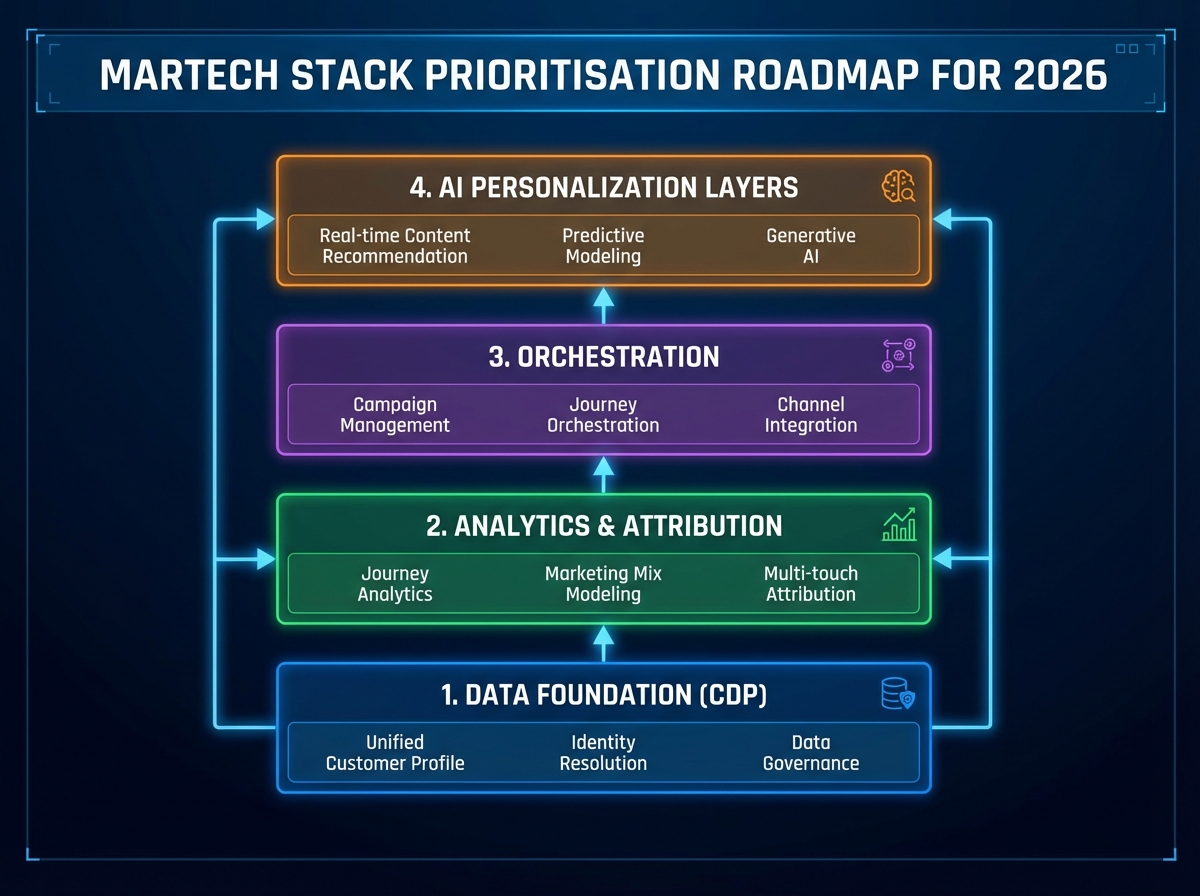
Effective martech stack prioritisation April 2026 involves sequencing investments to ensure that foundational data layers are robust before layering on advanced AI applications. Many enterprises fail by attempting to deploy sophisticated AI without a clean, unified data architecture. The FY27 digital marketing technology roadmap must therefore begin with a comprehensive audit of the existing data ecosystem.
The prioritization sequence for the upcoming fiscal year should follow a logical progression:
- Data Foundation: Strengthening Customer Data Platforms (CDPs) and identity graphs to ensure a “single source of truth.”
- Analytics and Attribution: Implementing hybrid models that combine Marketing Mix Modeling (MMM) with Multi-Touch Attribution (MTA).
- Orchestration: Enhancing journey builders to handle real-time, event-driven triggers across omnichannel environments.
- AI Personalization Layers: Integrating API-first platforms that can consume data from the CDP to generate personalized assets on the fly.
This roadmap facilitates enterprise AI adoption FY 2026-27 by creating a scalable framework for innovation. By focusing on interoperability and webhooks, organizations can ensure that their new investments complement rather than complicate their existing stack. This approach is essential for maintaining agility in a market where consumer preferences shift rapidly.
The integration of April 2026 AI marketing investment planning into the broader corporate strategy ensures that technology is not viewed as a siloed expense. Instead, it becomes a core driver of operational efficiency and customer satisfaction. As India continues to position itself as a global digital infrastructure hub, the ability to scale these technologies will be a key differentiator for leading enterprises.
Sources:
- Economic Times: Positioning India as a Global Digital Infrastructure Hub
- IBEF: Union Budget 2026-27 Overview
3. New Fiscal Year Video Marketing Strategy and Personalization Budget Planning
A comprehensive new fiscal year video marketing strategy must account for the shift from generic broadcast content to hyper-personalized, one-to-one communication. In the Indian context, this requires a deep understanding of regional nuances and linguistic diversity. Enterprise video content investment planning for FY27 should allocate significant resources toward AI-driven video that can be localized and personalized automatically.
The investment thesis for enterprise video personalization budget planning is built on three pillars: reach, relevance, and resonance. By leveraging AI, brands can produce thousands of unique video messages that address individual customer needs, from KYC onboarding in banking to personalized festive greetings in e-commerce. This level of granularity was previously impossible due to the prohibitive costs and time required for traditional production.
TrueFan AI's 175+ language support and Personalised Celebrity Videos provide a unique opportunity for brands to connect with their audience in a deeply personal way. Whether it is a PSU sending bill payment reminders in a local dialect or a telecom giant offering plan upgrades via a celebrity avatar, the impact on engagement is profound. These capabilities allow for “virtual reshoots,” where messaging can be updated in real-time without the need for new production cycles.
The creative economy in India is receiving significant tailwinds from the 2026 budget, which supports the infrastructure needed for high-scale digital content. Enterprises that integrate these advancements into their new fiscal year video marketing strategy will be better positioned to capture the attention of the next billion digital users. The focus must remain on delivering value through relevance, ensuring that every video serves a specific purpose in the customer journey.
Sources:
- exchange4media: India’s 2026 Budget Impacts on Marketing and AI Sectors
- TrueFan AI: Enterprise AI Video Platform Guide
- TrueFan AI: API-first Buyer’s Guide 2026
4. Enterprise AI Video Platform Procurement and API Selection Criteria
Selecting the right partner requires a rigorous set of enterprise AI video platform procurement criteria to mitigate technical and regulatory risks. For Indian enterprises, especially those in regulated sectors like BFSI and healthcare, compliance is non-negotiable. The AI personalization platform selection criteria must prioritize security certifications, data residency, and alignment with the Digital Personal Data Protection (DPDP) Act 2023.
A robust personalised video SaaS evaluation guide should weigh the following factors:
- Security and Compliance (30%): ISO 27001 certification, SOC 2 Type II controls, and DPDP Act alignment.
- API and Integration (25%): Availability of SDKs, event-driven architecture, and pre-built connectors for major CRMs.
- Scalability and Performance (20%): Ability to handle millions of renders with sub-30 second latency.
- ROI Potential (15%): Proven track record of lifting conversion rates and reducing customer acquisition costs.
- Vendor Stability (10%): Financial health, support infrastructure, and industry recognition.
Furthermore, an AI video API enterprise procurement checklist is essential for technical teams to evaluate the interoperability of the solution. This checklist should verify the platform's ability to handle PII minimization through tokenization and its support for secure authentication protocols like OAuth 2.0 and mTLS. Observability is another critical factor; the platform must provide centralized logging and clear SLA commitments for uptime and rendering speed.
As enterprises navigate the complexities of the DPDP Act, the “compliance-by-design” philosophy becomes paramount. This involves ensuring that consent management is integrated into the video generation workflow, allowing for lawful data processing and easy revocation of consent by the data principal. Vendors who can demonstrate this level of maturity will be the preferred partners for large-scale enterprise deployments.
Sources:
- PRS India: Digital Personal Data Protection Bill 2023
- RSM India: DPDP Act 2023 Compliance Checklist
- TrueFan AI: Security Comparison (SOC 2 Type II, ISO 27001)
5. AI Video SaaS Total Cost of Ownership and ROI Framework FY27
Understanding the AI video SaaS total cost of ownership (TCO) is vital for CFOs to approve large-scale marketing investments. TCO encompasses all direct and indirect costs associated with the platform, including licensing, compute, storage, and the engineering effort required for integration. A transparent TCO model allows for better financial planning and prevents “hidden” costs from eroding the project's profitability.
An illustrative TCO breakdown for a typical enterprise deployment might look like this:
- Licenses and Subscription: 30–45% of the total cost.
- Compute, Storage, and CDN: 20–35%, depending on video volume and resolution.
- Integration and Automation: 10–20% for engineering and workflow setup.
- Compliance and Security: 5–10% for audits, VAPT, and DPDP readiness.
- Support and Change Management: 5–10% for training and internal adoption.
To justify this expenditure, organizations must develop a robust AI video marketing ROI framework FY27. This framework should link specific uplift levers—such as Click-Through Rates (CTR), Conversion Rates (CR), and Average Order Value (AOV)—to incremental contribution margin. For instance, a 20% increase in CTR on a million-person email campaign can lead to a significant revenue lift that far outweighs the cost of the personalized video units.
Solutions like TrueFan AI demonstrate ROI through measurable improvements in customer engagement and retention across the entire lifecycle. By automating the creation of personalized content, these platforms reduce the cost per asset while increasing its effectiveness. A well-constructed ROI model will also include sensitivity analysis to account for different market conditions, ensuring that the investment remains viable even under conservative growth scenarios.
Sources:
6. Q1 FY27 Technology Investment Decisions and Deployment Roadmap
The first quarter of the fiscal year is the most critical period for Q1 FY27 technology investment decisions. This is when the strategic planning of the previous months is translated into signed contracts and project kick-offs. For the CTO, this involves a deep dive into the technical feasibility and security posture of the shortlisted vendors. FY27 CTO marketing technology decisions will increasingly focus on API reliability, latency SLAs, and the vendor's operational maturity.
A phased FY27 digital marketing technology roadmap provides a clear path from procurement to full-scale optimization:
- Q1 (April–June): Selection and Assurance. Finalize vendor shortlists, conduct security due diligence, and run small-scale Proof of Concepts (POCs) on high-impact customer journeys.
- Q2 (July–September): Pilot to Production. Operationalize the chosen platform, integrate it with the CRM/CDP, and establish governance workflows for content moderation.
- Q3 (October–December): Scale and Expand. Roll out personalized video across multiple channels (WhatsApp, Email, App) and introduce multilingual support for festive campaigns.
- Q4 (January–March): Optimize and Renew. Conduct a comprehensive ROI audit, optimize creative messaging based on performance data, and plan for budget expansion in FY28.
This phased approach minimizes risk by allowing the organization to learn and adapt at each stage. It also ensures that the marketing team can demonstrate quick wins to the executive leadership, building momentum for the broader digital transformation initiative. By the end of the fiscal year, the enterprise should have a fully integrated, AI-driven personalization engine that is a core part of its competitive advantage.
The success of this roadmap depends on close collaboration between the CMO, CTO, and CFO. Each stakeholder brings a unique perspective—marketing focuses on CX and growth, technology on stability and security, and finance on TCO and ROI. When these three functions are aligned, the enterprise can execute its FY 2026-27 enterprise marketing budget allocation with confidence and precision.
Sources:
7. Enterprise AI Adoption Risk Controls and FAQ
As enterprise AI adoption FY 2026-27 accelerates, organizations must implement stringent risk controls to protect their brand and their customers. This involves more than just technical security; it requires a comprehensive governance framework for synthetic media and AI-generated content. The AI personalization platform selection criteria must include a thorough evaluation of the vendor's ethical guidelines and content moderation capabilities.
Key risk mitigation strategies include:
- Content Integrity: Using digital watermarking and blockchain-based verification to ensure the authenticity of AI-generated videos.
- Consent Governance: Maintaining a clear audit trail of celebrity and user consent for the use of their likeness or data.
- Model Guardrails: Implementing automated checks to prevent the generation of offensive, political, or non-compliant content.
- DPDP Compliance: Ensuring all data processing activities are transparent, purpose-limited, and respect the rights of the data principal.
By addressing these risks proactively, enterprises can build trust with their customers and avoid the legal and reputational pitfalls associated with AI. The goal is to create a “safe-by-design” marketing ecosystem where innovation and compliance go hand in hand. This approach not only protects the organization but also enhances the overall quality of the customer experience.
Frequently Asked Questions (FAQ)
For detailed answers, see the consolidated FAQ section at the end of this article.
Sources:
- TrueFan AI: Enterprise AI Video Platform 2024
- TrueFan AI: AI Video Platform Security Comparison
- PRS India: Union Budget Analysis 2026-27
Conclusion
The FY 2026-27 enterprise marketing budget allocation represents a strategic opportunity for Indian brands to redefine their relationship with customers through AI-driven personalization. By following a disciplined FY27 digital marketing technology roadmap and adhering to rigorous procurement standards, CMOs and CTOs can build a martech stack that is both innovative and resilient. The focus must remain on creating value through relevance, ensuring that every digital interaction is an opportunity to build trust and drive growth.
As enterprise AI adoption FY 2026-27 continues to mature, the winners will be those who can balance the speed of innovation with the necessity of compliance. By investing in secure, API-first platforms, Indian enterprises can capture the full potential of the digital economy and set new benchmarks for marketing excellence on the global stage. Now is the time to move from planning to execution, securing the technology and partnerships that will define the next era of customer engagement.
Recommended Internal Links
- Enterprise AI Video Platform: Real-Time API for Scale
- Enterprise AI Video Platform: Secure, Scalable Solutions
- Enterprise AI Video Platform: Secure, Scalable, API-First
- Enterprise AI Video Platform India: Drive Video ROI
- Agentic AI Marketing Strategies for Multi-Agent Workflows
- Agentic AI Marketing in India: Enterprise Video ROI
Frequently Asked Questions
How should FY 2026-27 enterprise marketing budget allocation shift for AI video and personalization in India?
Enterprises should transition from generic content spending to a model where 15–25% of the martech budget is dedicated to AI-driven personalization. This shift enables multilingual, hyper-relevant engagement that lifts CTR, conversion, and retention versus broadcast-only methods.
What are the enterprise AI video platform procurement criteria for regulated sectors and PSUs?
Prioritize ISO 27001 and SOC 2 Type II certifications, strict DPDP Act compliance, and India data residency. Ensure SSO/SCIM for secure access, robust audit logs, and enterprise-grade observability across rendering and delivery pipelines.
How do you build an AI video marketing ROI framework for FY27 and estimate payback within 12 months?
Map baseline KPIs (CTR, CR, AOV, churn) to cost drivers, project conservative uplifts (e.g., +20% CTR), and translate gains into contribution margin. Most enterprises can reach payback in 6–10 months with phased deployment and continuous optimization.
What belongs in an AI video API enterprise procurement checklist for India (DPDP-ready)?
Require event-driven architecture, PII tokenization, OAuth 2.0 and mTLS, consent propagation, sub-30s render SLAs at scale, 99.9%+ uptime, centralized logging, and clear DPA/SCCs aligned to DPDP and sectoral guidelines.
How does TrueFan AI ensure security and compliance for large-scale enterprise deployments?
TrueFan AI maintains ISO 27001 and SOC 2 Type II, supports DPDP-aligned processing, and offers secure APIs with role-based access, SSO/SCIM, content moderation workflows, and detailed audit trails to meet enterprise and regulatory standards.
How should a FY27 digital marketing technology roadmap be structured starting April 2026?
Follow a phased plan: Q1 selection and security due diligence; Q2 pilot-to-production with governance; Q3 scale across channels and languages; Q4 ROI audit and renewal to fund FY28 expansion.