
The CTO’s Guide to an Enterprise AI Video API: Real-Time Personalization, CRM Integrations, and Omnichannel Scale
Estimated reading time: ~12 minutes
Key Takeaways
- Enterprise-grade security demands ISO 27001, SOC 2 Type II, DPDP alignment, and zero-trust controls across data, people, and processes.
- REST API personalization should include idempotency, webhook-first events, signed URLs, and cloud-agnostic GPU orchestration for reliability and scale.
- CRM-native automation with Salesforce and HubSpot unlocks ROI via OAuth-secured activities, property mapping, and robust error handling.
- Omnichannel delivery over WhatsApp at India scale requires approved templates, CDN optimization, localization, and compliant data residency.
- FinOps-driven performance targets p95 < 30s, GPU bin-packing, regional pinning, and proactive SRE metrics to sustain profitable growth.
In the rapidly evolving landscape of 2026, the adoption of an enterprise AI video API has transitioned from a competitive advantage to a core architectural necessity for global organizations. As digital fatigue reaches its zenith, the ability to deliver hyper-personalized, programmatically generated video content at the point of interaction is the new benchmark for engagement.
For technical leadership—CTOs, VPs of Engineering, and Solution Architects—the challenge is no longer just about “making a video.” It is about architecting a secure, API-first ecosystem that exposes robust REST endpoints to generate and distribute content across a composable martech architecture. This guide provides the technical framework required to evaluate, integrate, and scale these systems while maintaining rigorous enterprise controls.
The market drivers in 2026 are clear. We are seeing a massive surge in agentic automation where autonomous AI agents now handle 85% of enterprise testing and operational workflows. In high-growth markets like India, the convergence of the Digital Personal Data Protection (DPDP) Act and the dominance of WhatsApp as a primary B2C channel has created a unique demand for localized, compliant, and real-time video intelligence.
1. Enterprise Evaluation Criteria: Security, Compliance, and Scale
When evaluating an enterprise AI video API, the technical buyer must look beyond simple rendering capabilities. The primary focus must be on the platform's ability to operate within a zero-trust environment while adhering to global and regional data mandates.
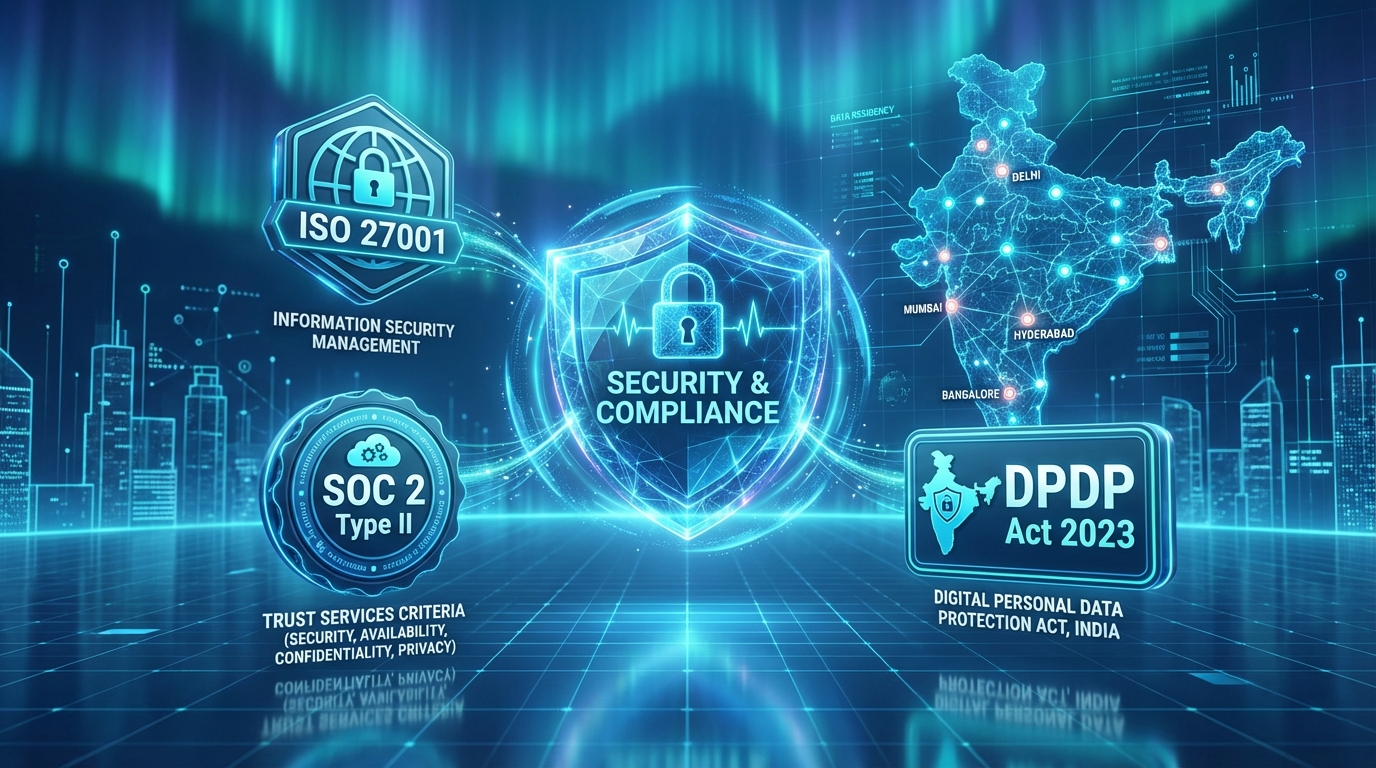
An ISO 27001 certified platform is the baseline. This certification ensures that the Information Security Management System (ISMS) covers the entire scope of people, processes, and technology. For the CTO, this means verifiable risk treatment plans, a clear Statement of Applicability (SoA), and rigorous controls over how data is handled. Complementing this, a SOC 2 compliant video solution (Type II) provides the necessary audit trails for security, availability, and confidentiality, ensuring that change management and least-privilege access are not just policies, but enforced realities.
In the Indian context, the DPDP Act 2023 has fundamentally altered the data residency landscape. Any scalable personalized video SaaS must now provide granular controls for lawful basis, consent records, and purpose limitation. With MeitY moving closer to enforcing strict cross-border transfer restrictions, the ability to pin data processing to specific regions is critical. Your API provider must offer a vendor Data Processing Agreement (DPA) that aligns with these evolving rules.
Reliability is the next pillar. Enterprise-grade solutions must target 99.9%+ uptime with deterministic retry semantics and multi-region failover. From a performance engineering perspective, this requires a composable martech architecture where the video API functions as a high-throughput microservice, capable of handling burst demands—such as millions of videos for a single festive campaign—without degrading p95 latency.
Sources:
- Videonetics: Top 6 Trends in AI Industry in 2026
- Analytics India Magazine: 85% of Enterprises Run Autonomous AI Agents
- Mondaq: India Moves Closer to Enforcing DPDP Act
2. Architecture Deep-Dive: REST API Personalization and GPU Infrastructure
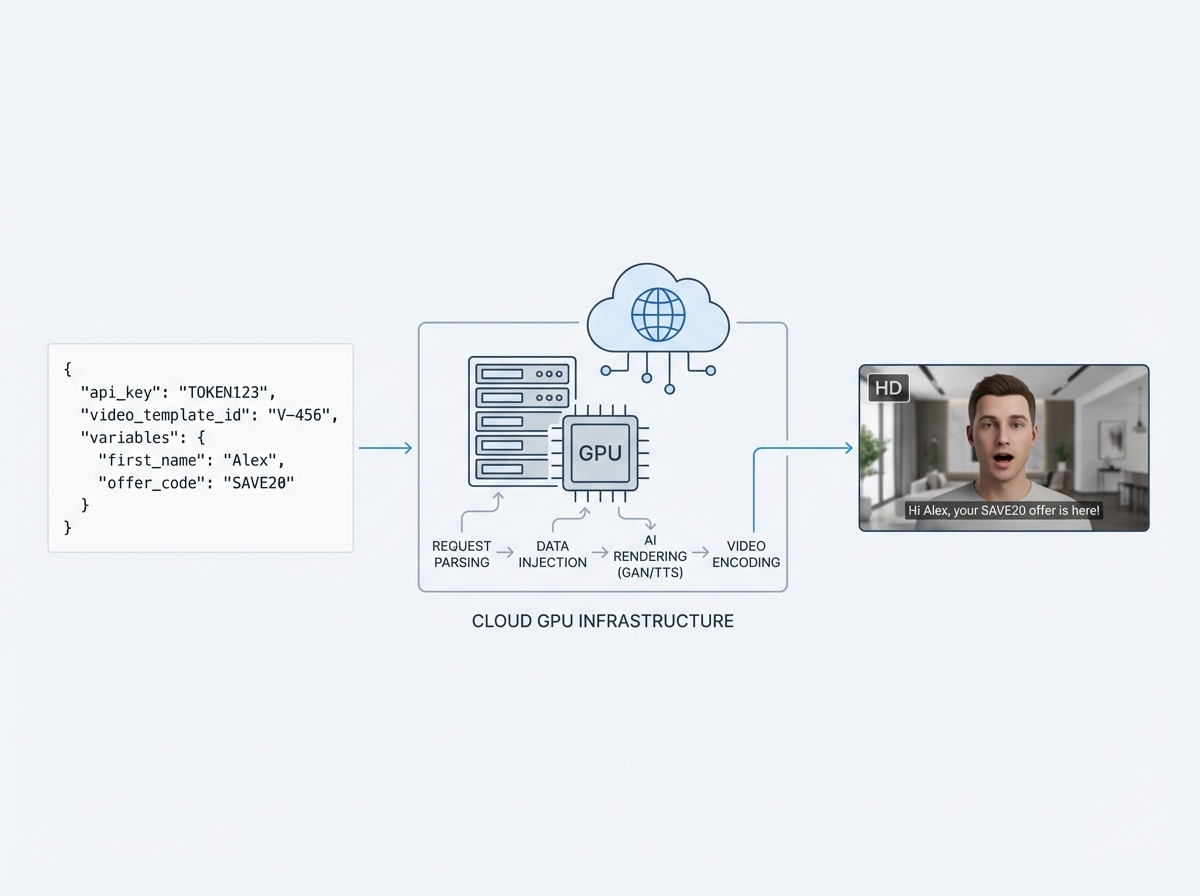
The core of a modern video strategy lies in REST API video personalization. This involves a sophisticated set of endpoints that allow developers to submit personalization variables into pre-approved templates. A typical payload schema includes template_id, user_id, and dynamic variables like first_name or offer_code, alongside callback_url for asynchronous processing.
A real-time video generation API must support both synchronous and asynchronous patterns. While small, fast renders can be handled synchronously, heavier enterprise workloads require a queue-backed job system. This is where cloud-agnostic GPU infrastructure becomes vital. By deploying across AWS, Azure, or GCP, enterprises avoid vendor lock-in and can leverage GPU bin-packing and node auto-scaling to optimize costs.
Technical teams should prioritize APIs that offer:
- Idempotency Keys: To prevent duplicate renders during network retries.
- Signed URL Fetch: For secure delivery of assets via CDNs with a defined Time-to-Live (TTL).
- Webhook-First Design: To ensure event-driven integration with downstream systems like CRMs or messaging gateways.
Latency budgets are a critical KPI. In 2026, the industry standard for a real-time video generation API is a p95 render time of under 30 seconds for standard personalization. Achieving this requires warm pools for models and templates, ensuring that the GPU cold-start problem does not impact the user experience. Furthermore, observability must be baked in, using OpenTelemetry traces and structured logs to monitor queue depth and GPU utilization in real-time.
Sources:
3. CRM Integration Blueprints: Salesforce and HubSpot Automation
Integrating an enterprise AI video API into your CRM is the most effective way to drive ROI. For Salesforce video integration, the architecture typically involves using Data Cloud segments or Marketing Cloud Personalization triggers. When a user hits a specific milestone, an Event API call is made to the video platform.
The technical implementation often utilizes a Custom Activity within Salesforce Journey Builder. This activity handles the OAuth 2.0 handshake, maps Contact fields to video variables, and manages the writeback of the generated asset URL to the Contact record or Content Builder. This ensures that the personalized video is ready for the next node in the journey, whether it’s an email or a push notification.
For HubSpot AI video automation, the pattern shifts toward the Media Bridge and Workflow custom code actions. Developers can write Node.js scripts within a HubSpot Workflow to call the REST API video personalization endpoint. The resulting video URL is then stored as a custom contact property, which can be dynamically inserted into HubSpot marketing emails or WhatsApp messages.
Key considerations for CRM integrations include:
- PII Minimization: Only send the minimum required data fields to the API.
- Rate-Limit Awareness: Implement client-side throttling to respect both CRM and Video API limits.
- Error Handling: Use dead-letter queues (DLQs) to capture failed renders and trigger fallback creative content.
By treating the video generator as a marketing automation video API, enterprises can move away from static templates to dynamic, data-driven storytelling that updates in real-time based on the customer's latest lifecycle stage.
4. Omnichannel Delivery: WhatsApp Business API and India-Scale Reach
In the Indian market, the WhatsApp Business API video delivery is the gold standard for engagement. Research from 2025 indicates that online video and WhatsApp lead digital budgets due to their high performance in B2C outreach. However, delivering video at scale over WhatsApp requires a nuanced understanding of media handling and template approvals.
A successful WhatsApp Business API video strategy involves pre-approving media message templates with dynamic variables. The hosting strategy is paramount; using CDN-signed URLs with specific bitrates and codecs (typically H.264/AAC) ensures compatibility across the diverse range of mobile devices in the Indian ecosystem.
Orchestration is equally important. Enterprises must manage throughput to avoid hitting Meta’s rate limits while ensuring a consistent experience across failover channels like RCS or Email. If a video render fails or a WhatsApp message isn't delivered, the system should automatically fall back to a high-quality static image or an SMS with a shortened link, maintaining the integrity of the offer code.
Furthermore, the scalable personalized video SaaS must handle localization. In a country with 22 official languages, the ability to generate video in 175+ languages with accurate lip-sync and voice retention is a non-negotiable requirement for 2026. This level of contextualization is what solves the “strikingly weak” performance of generic online video advertising often cited in market research.
Sources:
- Ipsos: The State of Digital Marketing in India 2025
- ETBrandEquity: Online Video Advertising Performance Study
5. Performance Engineering, FinOps, and Scale Economics
Scaling an enterprise AI video API to millions of users requires a shift from traditional web engineering to performance engineering focused on GPU economics. The “FinOps” of AI video involves calculating the GPU hours per 1,000 renders and optimizing cache hit rates for template compilation.
A cloud-agnostic GPU infrastructure allows for sophisticated cost-governance. By utilizing spot instances for non-critical batch renders and reserved instances for real-time video generation API calls, CTOs can significantly reduce the TCO. Admission control and shaping policies are also essential to prevent a single “viral” campaign from exhausting the entire organization's error budget or rate limits.
Global distribution and data residency are the final pieces of the scale puzzle. Region pinning ensures that a user in Mumbai has their video processed in a local data center, satisfying DPDP Act requirements and reducing latency. Multi-tenant isolation at the infrastructure level ensures that data from different business units or clients never co-mingles, providing an additional layer of security.
Key metrics for SRE teams to monitor include:
- p95 Latency per Region: To ensure consistent performance globally.
- GPU Saturation: To trigger auto-scaling events before bottlenecks occur.
- Webhook Failure Rate: To identify integration issues with CRMs or messaging gateways.
By focusing on these engineering disciplines, organizations can ensure that their scalable personalized video SaaS remains both performant and profitable as volumes grow into the millions.
6. The TrueFan AI Advantage: A Build vs. Buy Framework
When deciding whether to build an in-house solution or partner with a provider, the decision framework must account for more than just development time. It must include the ongoing costs of maintaining a cloud-agnostic GPU infrastructure, the complexity of global compliance, and the speed of innovation in AI models.
Platforms like TrueFan AI enable enterprises to bypass the heavy lifting of infrastructure management. By providing a battle-tested enterprise AI video API, they allow technical teams to focus on integration and customer experience rather than GPU orchestration. TrueFan AI's 175+ language support and Personalised Celebrity Videos offer a level of creative depth that is difficult to replicate in-house without significant R&D investment.
Solutions like TrueFan AI demonstrate ROI through their ability to handle India-scale campaigns—such as generating 354,000 personalized videos in a single day. Their ISO 27001 certified platform and SOC 2 compliant video solution status provide the necessary trust for enterprise-wide deployment.
The “buy” side of the equation offers:
- Time-to-Value: Integration in weeks rather than years of R&D.
- Compliance Out-of-the-Box: DPDP and SOC 2 readiness.
- Advanced Features: AI editing, virtual reshoots, and multilingual lip-sync.
In a composable martech architecture, the video API should be a plug-and-play component that enhances your existing Salesforce or HubSpot stack. TrueFan AI provides the connectors and documentation required to make this a reality, ensuring that your marketing automation video API is as robust as your core database.
Technical Blueprint: REST API Personalization Example
For developers looking to get started, here is a representative curl command for initiating a render job:
curl -X POST https://api.truefan.ai/v1/templates/tpl_8829/render \
  -H "Authorization: Bearer ${API_KEY}" \
  -H "Content-Type: application/json" \
  -H "Idempotency-Key: campaign_2026_user_99" \
  -d '{
    "variables": {
      "first_name": "Arjun",
      "offer_code": "FESTIVE20",
      "locale": "hi-IN"
    },
    "callback_url": "https://crm.enterprise.com/webhooks/video-ready",
    "metadata": {
      "journey_id": "sales_nurture_01",
      "user_id": "user_99482"
    }
  }'
This request triggers an asynchronous render. Once complete, the callback_url will receive a POST request containing the output_url and job_id, allowing your CRM to proceed with the WhatsApp Business API video send.
Summary of Compliance and Security Standards
| Standard | Scope | Enterprise Benefit |
|---|---|---|
| ISO 27001 | Information Security Management | Verifiable risk management and operational security. |
| SOC 2 Type II | Security, Availability, Confidentiality | Independent audit of internal controls and data handling. |
| DPDP Act 2023 | Indian Data Protection | Compliance with local residency and consent mandates. |
| TLS 1.2+ / AES-256 | Data Encryption | Protection of PII in transit and at rest. |
Recommended Internal Links
- Enterprise AI Video API: Scalable, Secure Personalization
- Enterprise AI Video API Platform: Secure, Scalable Personalization
Frequently Asked Questions
What are typical p50/p95 latency ranges for the real-time video generation API?
In a production-grade environment, p50 latency for a 15-second personalized video is typically under 12 seconds, while p95 latency is targeted at under 30 seconds. We recommend client-side timeouts be set to 45–60 seconds for synchronous calls, with a fallback to a webhook-based asynchronous pattern for anything exceeding that threshold.
How does TrueFan AI handle rate limits and backoff policies?
TrueFan AI utilizes a token-bucket algorithm for rate limiting. When limits are exceeded, the API returns a 429 Too Many Requests status code with a Retry-After header. Implement an exponential backoff policy with jitter on the client side to handle these instances gracefully.
What data residency options are available for India-first deployments?
To comply with the DPDP Act, dedicated processing regions within India ensure that PII and video assets are processed and stored locally. Cross-border transfer assessments are available for global organizations that require data to be mirrored in other jurisdictions.
Which Salesforce primitives are supported for integration?
The platform supports Salesforce Journey Builder via Custom Activities, the Marketing Cloud Event API for real-time triggers, and Data Cloud for segment-based batch processing. Reference payloads and Apex middleware samples are available in the technical documentation.
How are secrets and encryption managed within the platform?
All secrets are managed using hardware security modules (HSM) and cloud-native KMS. Data is encrypted in transit using TLS 1.2+ and at rest using AES-256. Audit logs capture every instance of data access, providing a clear trail for security and compliance teams.
Can the API handle multilingual content for the Indian market?
Yes, the enterprise AI video API supports 175+ languages, including advanced lip-syncing technology that aligns speaker mouth movements with translated audio for a natural, high-quality user experience across regional dialects.



