Safe AI video tools data privacy India 2026: secure video editing apps India 2026 and privacy-first alternatives after the CapCut ban
Key Takeaways
- DPDP enforcement in 2026 makes data residency, consent, and biometric safety non-negotiable for AI video tools.
- Seek platforms that guarantee no model training by default, maintain SOC 2/ISO 27001, and publish sub-processor transparency.
- For Indian enterprises, India/APAC server locations and options like BYOK and confidential computing are key differentiators.
- Post-CapCut, safe alternatives prioritize auditability, RBAC/SSO, and traceable watermarking for compliance-sensitive sectors.
- Studio by TrueFan AI stands out for India-focused data sovereignty and a consent-first avatar model.
AI video platform security comparison, data handling policies, and server locations for Indian creators and enterprises
Navigating the landscape of safe AI video tools data privacy India 2026 has become a critical priority for creators and enterprises alike following the full enforcement of the Digital Personal Data Protection (DPDP) Act and the continued ban on high-risk applications. As we move through 2026, the demand for secure video editing apps India 2026 is no longer just about creative features; it is about ensuring that every frame of generated content adheres to stringent data residency and biometric privacy standards.
The shift toward privacy-first AI video platforms is driven by a stark reality: according to recent 2026 industry data, nearly 90% of users express significant concerns regarding how their personal data—especially biometric data like voice and facial features—is processed by AI video generators. For Indian organizations, the stakes are even higher, with the DPDP Act imposing substantial penalties for non-compliance. This guide provides a transparent, evidence-backed comparison of the safest AI video tools available in 2026, focusing on data handling, server locations, and enterprise-grade security.
1. India’s 2026 Privacy Landscape for Data Privacy AI Video Generators India
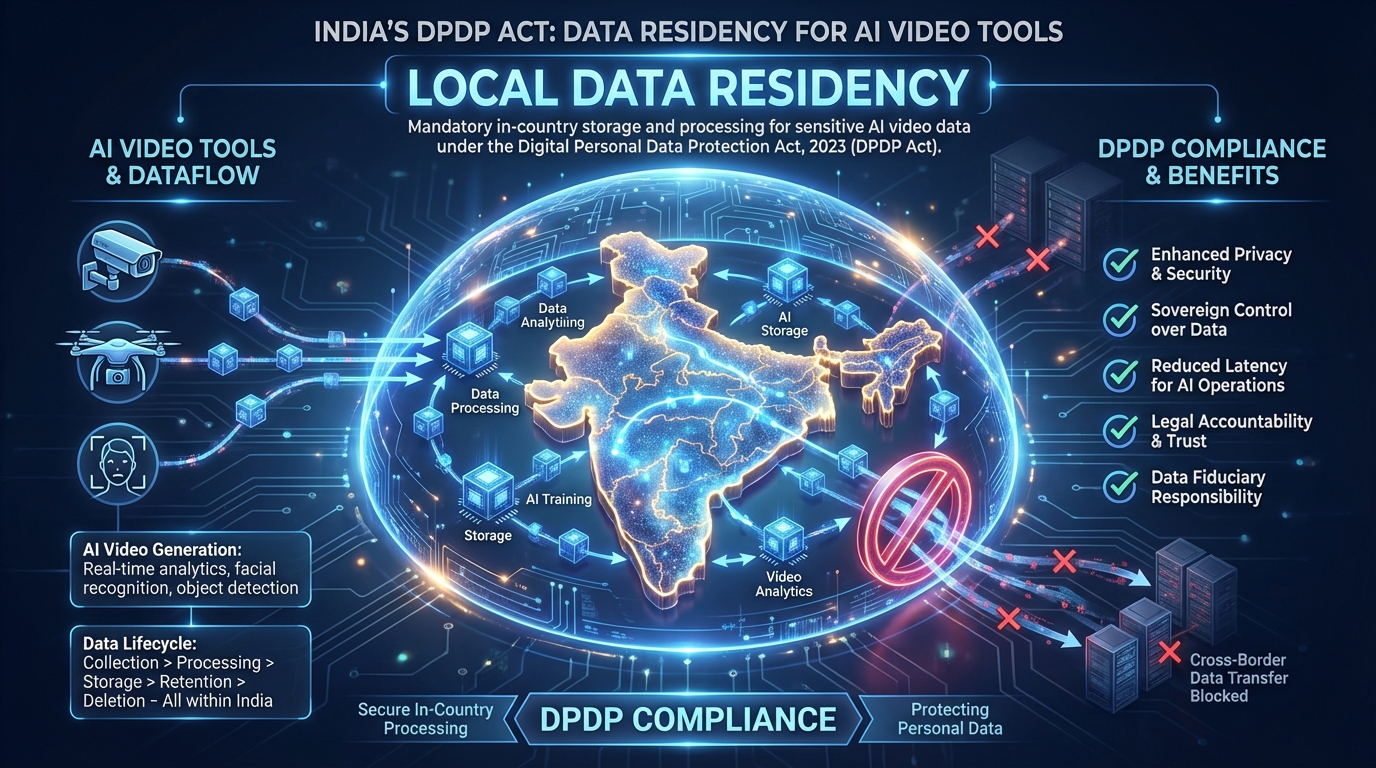
The regulatory environment in India has undergone a seismic shift. By 2026, the Digital Personal Data Protection (DPDP) Act, 2023, and its subsequent 2025 Rules have moved from transition to full-scale enforcement. For any organization utilizing data privacy AI video generators India, understanding these rules is the first step toward compliance.
The DPDP Act and Video Data
Under the current framework, identifiable video content is classified as personal data. The core principles of the Act—consent, purpose limitation, and data minimization—apply directly to how AI models are trained and how user-generated videos are stored. In 2026, the “Right to be Forgotten” has become a technical challenge for AI vendors; users now have the right to demand the erasure of their data, which includes ensuring their biometric likeness is not retained in a model's weights. See AI voice cloning for Indian accents.
Cross-Border Transfer and Trusted Destinations
India's 2026 cross-border transfer framework utilizes a “trusted geography” approach. While data can be transferred for processing, it must be necessary and protected by contractual safeguards. For high-risk AI processing, such as facial analysis or deepfake generation, the government has increased scrutiny. This makes GDPR compliant video tools India particularly attractive, as the alignment between GDPR and DPDP allows for smoother legal transitions for Indian firms with European exposure.
2026 Market Trends and Statistics
- Data Residency Priority: 92% of Indian enterprises now prioritize local data residency or “trusted” APAC server locations for AI workloads to mitigate regulatory risks.
- ROI of Privacy: Organizations that invested in privacy-first AI tools reported a 22.26% higher ROI on their content marketing efforts in 2026, attributed to increased consumer trust and reduced legal friction.
- Enforcement Momentum: The Data Protection Board of India has projected that non-compliance fines in the digital media sector could reach ₹250 crore by the end of 2026, emphasizing the need for data protection AI content creation strategies.
Source: PrivacyWorld: India DPDP Rules 2025.
Source: Levo.ai: DPDP 2025/2026 Handbook.
Source: Economic Times: Privacy-Driven AI Growth.
2. Post-CapCut Risks & Identifying Safe Alternatives after CapCut Ban
The 2020 ban on Chinese applications, including CapCut, was a watershed moment for Indian digital sovereignty. The primary concern was the lack of transparency regarding data harvesting and the potential for unauthorized access by foreign entities. In 2026, the search for safe alternatives after CapCut ban has led creators toward vendors who offer auditable privacy controls and non-Chinese ownership.
Why the Ban Persists
The security risks associated with certain legacy apps involve “black box” data handling. Many of these apps lacked clear disclosures on where data was stored and whether user content was being used to train proprietary models without explicit consent. For an Indian enterprise, using a banned or high-risk app is not just a security flaw; it is a violation of national security protocols.
Defining “Safe” in 2026
A safe alternative is defined by its transparency. Platforms like Studio by TrueFan AI enable creators to generate high-quality content while maintaining a “walled garden” approach to data (brand guideline enforcement). To be considered a safe alternative in 2026, a tool must provide:
- No Training by Default: A guarantee that user data and uploaded assets are not used to train the platform's global AI models.
- SOC 2 Type II & ISO 27001: Independent attestations that the vendor follows industry-standard security practices.
- Transparent Sub-processors: A public registry of every third party that handles data, including their geographic location.
Source: Moneycontrol: List of Banned Apps in India.
Source: TrueFan AI: Decentralized Video AI India.
3. Privacy-First AI Video Standards: The 2026 Non-Negotiables
What does it actually mean to be a “privacy-first” platform? In 2026, the definition has matured beyond simple encryption. It now encompasses the entire lifecycle of the data, from the moment a script is typed to the final rendering of the video.
AI Video Tool Data Handling Policies
The most critical non-negotiable is the handling of biometric data. Under DPDP, facial and voice data are sensitive. Privacy-first platforms implement AI video tool data handling policies that include:
- Granular Consent: Explicit opt-ins for every use of a person's likeness.
- Model Isolation: Ensuring that if a custom avatar is trained for a brand, that model is isolated from other customers.
- Hard Deletion: When a user deletes a project, the data must be scrubbed from all backups and sub-processor environments within a defined SLA (typically 30 days).
Technical Safeguards: Encryption and Edge Processing
Encryption is the baseline. In 2026, we look for TLS 1.3 for data in transit and AES-256 for data at rest. However, the cutting edge of secure AI video creation platforms involves:
- Confidential Computing: Processing AI inference in Secure Enclaves (TEEs) where even the cloud provider cannot see the data.
- Edge Processing: Performing tasks like face blurring or initial rendering locally on the user's device to minimize the amount of data sent to the cloud (edge computing for video production).
- BYOK (Bring Your Own Key): Allowing enterprises to manage their own encryption keys, ensuring the vendor cannot decrypt their content without permission.
Data Residency and Server Locations
For Indian firms, AI video platform server locations are a dealbreaker. Platforms that offer India-based regions (e.g., AWS Mumbai or Azure Central India) or nearby “trusted” hubs like Singapore are preferred. This reduces latency and ensures that data remains within a jurisdiction that respects Indian legal requests (video production infrastructure).
Source: PrivacyEngine: India-EU Privacy & AI Regulation 2026.
Source: TrustArc: 2026 Data Privacy Landscape Strategic Roadmap.
4. Comparative Analysis: Top AI Video Tools & Data Residency
Choosing the right tool requires an AI video platform security comparison that looks past the marketing gloss. Below is an analysis of how leading platforms stack up in the 2026 Indian market.
Adobe Express & Premiere (Firefly AI)
Adobe remains a titan of data protection AI content creation. Their “Content Authenticity Initiative” provides a digital paper trail for AI-generated content.
- Privacy Posture: High. Adobe does not train Firefly on customer content.
- Compliance: GDPR and DPDP ready; SOC 2 Type II certified.
- Server Locations: Global, with strong regional options.
Canva (Magic Media)
Canva has evolved into a robust enterprise tool.
- Privacy Posture: Strong. Offers enterprise-grade controls and an “AI Trust Center.”
- Data Handling: Users can opt-out of data training.
- Compliance: ISO 27001 and SOC 2.
Synthesia
The leader in AI avatars for corporate training.
- Privacy Posture: Very High. Focuses on “Ethical AI” with strict moderation.
- Security: SSO/SAML, RBAC, and audit logs are standard for enterprise tiers.
- Residency: Primarily US/EU; check for specific APAC availability.
Studio by TrueFan AI
A standout for the Indian market, particularly for those seeking secure AI video creation platforms with a local focus. Studio by TrueFan AI's 175+ language support and AI avatars are built on a foundation of licensed content, ensuring no unauthorized deepfakes are generated (multimodal AI video creation 2026).
- Privacy Posture: Consent-first model. All avatars are either fictional or fully licensed with legal documentation.
- Security: ISO 27001 and SOC 2 certified.
- Differentiator: Cloud-agnostic GPU backend that allows for flexible regional processing, making it a top choice for Indian enterprises concerned about data sovereignty.
Comparison Matrix: AI Video Data Security Analysis 2026
| Feature | Adobe Express | Synthesia | Studio by TrueFan AI | HeyGen |
|---|---|---|---|---|
| DPDP/GDPR Ready | Yes | Yes | Yes | Yes |
| Training Default | Opt-out / No | No | No | Opt-out |
| Server Locations | Global / India | US / EU | India / APAC | US |
| Certifications | SOC 2 / ISO | SOC 2 / ISO | SOC 2 / ISO | SOC 2 |
| Identity (SSO) | Yes | Yes | Yes (Enterprise) | Yes |
| Watermarking | Yes | Yes | Yes (Traceable) | Yes |
Source: Adobe Trust Center.
Source: Synthesia Security.
Source: TrueFan AI Product Studio.

5. Enterprise-Grade Security for High-Stakes Sectors (BFSI & Healthcare)
For sectors like banking, financial services, and healthcare, the requirements for enterprise-grade security AI video India go far beyond what a solo creator might need. In these industries, a data breach isn't just a PR nightmare; it's a regulatory catastrophe.
Identity and Access Management (IAM)
Enterprises require seamless integration with their existing security stacks. This includes:
- SSO (Single Sign-On): Using SAML or OIDC to ensure that only authorized employees can access the video generation platform.
- SCIM (System for Cross-domain Identity Management): Automating the provisioning and de-provisioning of users as they join or leave the company.
- RBAC (Role-Based Access Control): Ensuring that a junior designer can create a video, but only a compliance officer can approve it for export.
Auditability and Traceability
In 2026, every AI-generated video must be traceable. High-security platforms provide (MLOps video production infrastructure):
- Detailed Audit Logs: A record of who generated what, when, and using which script.
- Invisible Watermarking: Embedding metadata into the video file that identifies the source and the user, even if the visible watermark is cropped out.
- Content Moderation: Real-time filters that prevent the generation of prohibited content (e.g., financial advice from an unauthorized avatar).
Case Study: AI Video in Indian Banking
In 2026, a leading Indian private bank utilized a privacy-first AI video platform to generate personalized internal training videos. By using a tool with India-based server locations and SSO integration, they reduced their Data Protection Impact Assessment (DPIA) timeline by 40% and ensured that sensitive internal policies never left the “trusted” network.
Source: MoFo: Data & Privacy Predictions for 2026.
Source: Coalfire: 2026 Compliance Outlook.
6. Buyer’s Checklist & Future Outlook for 2026
As the technology evolves, staying ahead of the curve requires a proactive approach to privacy policy AI video tools comparison. The following checklist serves as a guide for any organization evaluating a new vendor in 2026.
The 2026 AI Video Security Checklist
- Compliance: Does the vendor provide a Data Processing Addendum (DPA) that specifically mentions the Indian DPDP Act?
- Training Policies: Is there a written guarantee that your data will not be used to train their “base” models?
- Data Residency: Can the vendor commit to storing and processing data within India or a “trusted” APAC region?
- Biometric Safety: How does the vendor handle voice and facial data? Is there a clear consent log for every avatar used?
- Security Certifications: Are the SOC 2 Type II and ISO 27001 reports current (within the last 12 months)?
- Deletion SLAs: Does the platform offer a “hard delete” feature with a confirmation log?
The ROI of Secure Video Editing Apps India 2026
Investing in secure tools is not just a cost center. Solutions like Studio by TrueFan AI demonstrate ROI through reduced customer acquisition costs and the ability to scale content production without increasing the legal risk profile. In 2026, the efficiency gains from AI video—often reducing production time from weeks to minutes—are only sustainable if the underlying platform is legally sound (MLOps for video production).
Looking Ahead: 2027 and Beyond
The future of AI video in India will likely see a move toward “Decentralized AI.” This involves processing more data on the edge and using blockchain-based ledgers to track content provenance. Organizations that adopt these privacy-first habits today will be the leaders of the digital economy tomorrow (decentralized video AI in India).
Source: Vidhi Centre: Cross-Border Data Transfers in India.
Source: DigWatch: AI Tools in India’s Legal Workflows 2026.
Summary of Key 2026 Statistics
- 75% of marketers now use AI for media creation, up from 45% in 2024.
- 90% of consumers are concerned about the security of AI-generated video content.
- 22.26% higher ROI for companies using privacy-certified AI tools.
- ₹250 crore projected fines for digital media non-compliance in India by end of 2026.
- 92% of Indian enterprises mandate data residency for AI video workloads.
Conclusion
By prioritizing safe AI video tools data privacy India 2026, organizations can harness the power of generative AI while protecting their most valuable asset: trust. Whether you are a solo creator or a multinational enterprise, the choice of a secure video editing app India 2026—with strong data residency, transparent processing, and enterprise-grade controls—will define your success in the new digital age. Platforms like Studio by TrueFan AI illustrate how consent-first design and India/APAC data options create both compliance confidence and operational speed.
Frequently Asked Questions
FAQs: Navigating Data Privacy in AI Video Generation
Is CapCut safe to use in India in 2026?
No. CapCut remains on the list of banned applications in India due to ongoing concerns regarding data security and its ties to foreign entities. Using it for business purposes can lead to compliance violations under the DPDP Act.
What is a DPIA, and do I need one for AI video?
A Data Protection Impact Assessment (DPIA) is a process used to identify and mitigate privacy risks. In 2026, Indian regulators often require a DPIA for “high-risk” processing, which includes the use of AI to generate biometric-based video content.
Can I use AI video tools if my data must stay in India?
Yes, but you must choose a vendor that offers India-specific data residency. Look for platforms that utilize AWS Mumbai or Azure India regions and have a DPA that guarantees data will not leave the country (edge computing for video production).
How do I know if an AI avatar is “ethical”?
An ethical AI avatar is one where the original person (the “digital twin”) has given explicit, documented consent for their likeness to be used. The platform should also have strict moderation to prevent the avatar from being used to spread misinformation (brand guideline enforcement).
Are there any Indian-made safe AI video tools?
Yes. Studio by TrueFan AI is a prime example of a platform built with the Indian regulatory landscape in mind. It offers a consent-first model, ISO 27001 certification, and a cloud-agnostic backend that supports the data sovereignty needs of Indian enterprises (decentralized video AI India).
What happens if an AI video tool has a data breach?
Under the DPDP Act, the “Data Fiduciary” (the company using the tool) and the “Data Processor” (the tool vendor) must notify the Data Protection Board and affected individuals within a specific timeframe (often 72 hours). Choosing a vendor with a strong incident response history is vital.