Edge AI video processing India: A 2026 enterprise playbook for private, on‑prem, and offline video AI
Key Takeaways
- 2026 is the inflection point for edge AI video processing in India, driven by DPDP compliance and the need for low-latency video intelligence.
- Enterprises should adopt on-premise and edge hybrid architectures to minimize data transfer, ensure data localization, and improve resiliency.
- Privacy-first AI with on-device redaction and secure edge practices (TEE, SBOM, signed containers) is mandatory for regulated workloads.
- By late 2026, on-device video generation and offline AI avatar rendering become practical with NPU-based edge hardware.
- Platforms like Studio by TrueFan AI help scale compliant, personalized video production within enterprise governance.
In the rapidly evolving landscape of 2026, edge AI video processing India has transitioned from a niche experimental technology to a fundamental pillar of enterprise security and operational efficiency. As Indian organizations navigate the complexities of the Digital Personal Data Protection (DPDP) Act 2023, the demand for localized, high-performance, and privacy-compliant video solutions has reached a fever pitch. For CISOs and DPOs, the challenge is no longer just about “if” they should implement AI, but “how” to do so without compromising data sovereignty or incurring the prohibitive latencies of cloud-only architectures.
This playbook serves as a strategic roadmap for Indian enterprises aiming to deploy robust video AI at the edge. We will explore why the shift to on-premise infrastructure is mandatory for compliance, how to achieve latency-free video processing, and what the 2026 horizon holds for on-device video generation.
Executive Summary
- The Pivot to Edge: Indian enterprises are moving away from cloud-centric video processing to mitigate privacy risks under the DPDP Act and to achieve millisecond-level latency. The India edge computing market is projected to reach ~USD 8.3B by 2032, growing at a 29% CAGR (Source: PS Market Research).
- Architecture for 2026: Success requires a hybrid approach—leveraging on-premise AI video infrastructure for sensitive data while utilizing edge computing video production for real-time field operations.
- The Compliance Mandate: With full DPDP enforcement looming by May 2027, 2026 is the critical year for implementing privacy-first AI video creation and secure video generation edge AI.
1. The 2026 India Market Pulse: Why Edge is Non-Negotiable
The Indian market in 2026 is defined by a “local-first” compute philosophy. Driven by the massive expansion of smart cities, high-tech manufacturing, and a digitized BFSI sector, the volume of video data generated at the source has outpaced the capacity of traditional WAN backhauls.
The Economic and Technical Drivers
The shift toward edge AI video processing India is fueled by three primary factors:
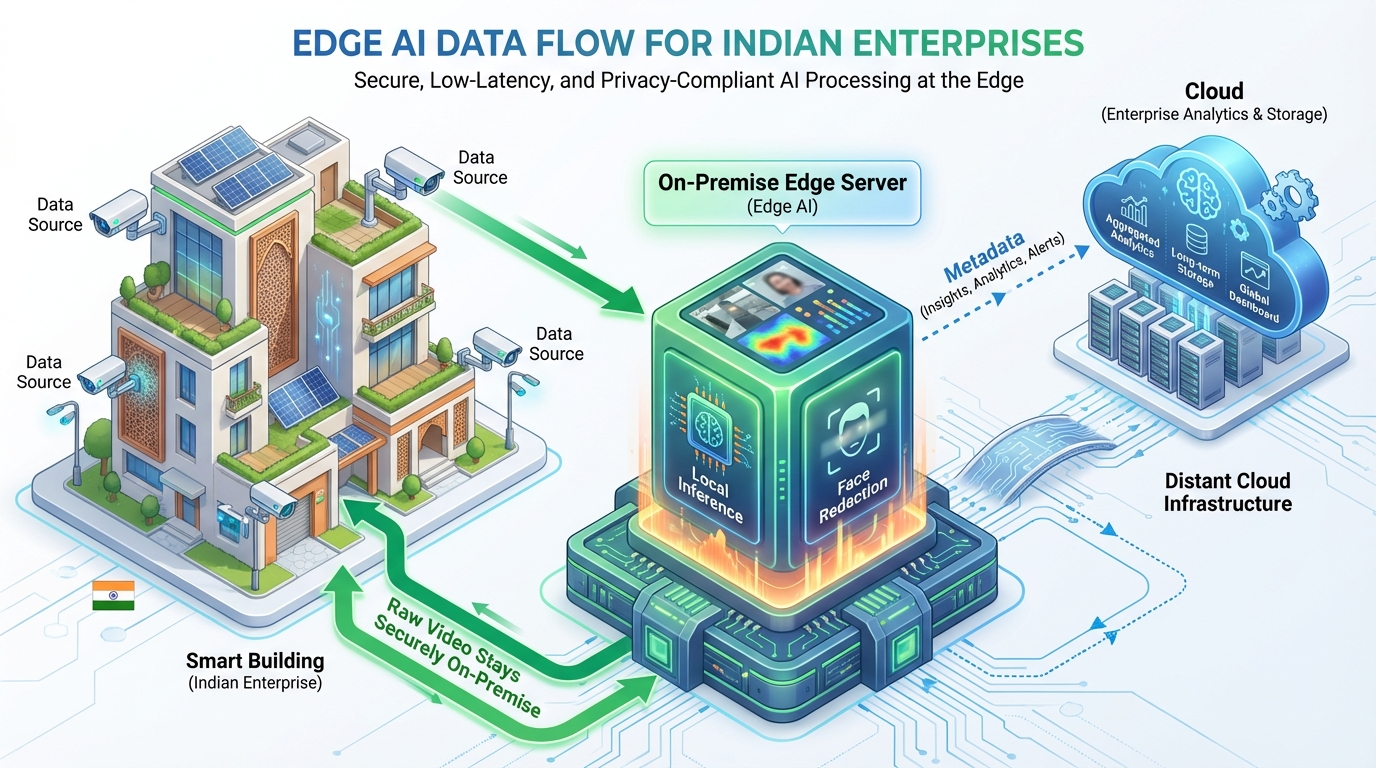
- Bandwidth Economics: Sending 4K video streams from hundreds of cameras to a central cloud is no longer financially viable. Edge processing reduces backhaul costs by up to 80% by only transmitting metadata or “events of interest.”
- Hardware Maturation: The 2026 hardware cycle has introduced specialized Neural Processing Units (NPUs) and AI-optimized chips into standard cameras and NVRs. These chips provide the TOPS (Tera Operations Per Second) necessary for complex inference without the power draw of traditional GPUs (Source: Electronics For You).
- Resiliency: In a landscape where 100% uptime is expected, dependency on cloud connectivity is a liability. Edge-native systems ensure that security protocols and generative workflows remain functional even during network blackouts.
2026 Statistics at a Glance
- Market Valuation: The India AI edge computing market is seeing unprecedented growth as enterprises prioritize “sovereign AI” (Source: 6Wresearch).
- Adoption Rates: Over 65% of Indian Tier-1 enterprises have initiated “Edge-First” mandates for all new video surveillance and production projects as of early 2026.
- Compliance Pressure: 100% of regulated entities in India are now required to provide “Data Localization Proof” for biometric and sensitive video data under the latest DPDP Rules.
2. The DPDP Act 2023: Navigating the Regulatory Lens
The Digital Personal Data Protection (DPDP) Act 2023 has fundamentally changed how video data is treated in India. Under this law, any video feed that can identify an individual is considered personal data. This has immediate implications for surveillance, marketing, and internal communications.
Mapping Video AI to DPDP Requirements
To achieve privacy-compliant video generation and processing, enterprises must align their technical stacks with the following pillars:
- Consent and Legitimate Use: Every AI-generated video or processed feed must have a clear legal basis. Whether it is employee training or customer engagement, the “Consent Manager” framework must be integrated into the video pipeline.
- Purpose Limitation: Video data captured for “Security” cannot be repurposed for “Marketing Analytics” without explicit fresh consent. Edge architectures facilitate this by “locking” data within specific local silos.
- Data Minimization: This is where edge AI shines. By performing on-device redaction (blurring faces or masking license plates) before the data ever hits a network, organizations can prove they are only “processing what is necessary.”
- Right to Erasure: If a “Data Principal” (an individual) requests their data be deleted, an edge-based system with localized storage makes it significantly easier to locate and purge specific records compared to a sprawling cloud data lake.
The Role of DPIA (Data Protection Impact Assessment)
For high-risk video AI—such as facial recognition in public spaces or AI-driven behavioral analysis—the DPDP Act necessitates a DPIA. Organizations must document the risks and the technical safeguards in place, such as TEE (Trusted Execution Environments) and encrypted local storage (Source: MeitY DPDP Act).
3. Reference Architectures: On-Premise vs. Edge vs. Decentralized
Building a future-proof stack requires understanding the nuances between different deployment models. In 2026, the “one-size-fits-all” cloud model has been replaced by specialized architectures.
On-premise AI video infrastructure for regulated workloads
For sectors like BFSI, healthcare, and government, on-premise AI video infrastructure is the gold standard. This involves a private data center or a branch-level stack where data never leaves the enterprise-controlled network. Explore a deep dive in our guide on on‑premise AI video infrastructure.
- The Stack: AI-enabled cameras (like those from Indian ecosystem leaders such as CP PLUS) feed into local NVRs equipped with edge GPUs.
- The Benefit: Total control over the “Data Residency” requirements of the DPDP Act.
- The Workflow: Raw video → Local Inference (Detection/Redaction) → Encrypted Local Storage → Metadata-only export to central dashboards.
Edge computing video production for real-time field ops
When millisecond decisions are required—such as in automated manufacturing or autonomous logistics—edge computing video production is essential. See the practical guide to edge computing video production.
- Latency Budget: To achieve latency-free video processing, the end-to-end delay from capture to action must be sub-200ms.
- Offline-First Design: These systems are designed to operate in “Air-Gapped” modes, syncing with the central cloud only when a secure, high-bandwidth connection is available.
When to consider decentralized video AI India (Caveats)
While decentralized video AI India—which pools compute across various nodes—is gaining traction for cost-effective rendering, it comes with significant caveats for enterprises.
- The Risk: Governance and auditability are harder to maintain in a decentralized model.
- The Use Case: Best suited for non-sensitive synthetic data generation or creative media production where PII (Personally Identifiable Information) is not involved.
4. Capability Deep Dive: Privacy and Latency
To outperform competitors in 2026, your video AI strategy must go beyond simple “detection.” It must incorporate advanced privacy and performance features.
Privacy-First AI Video Creation
Privacy-first AI video creation involves architecting the system to protect identity by default. Learn how brand governance supports this in our article on brand guideline enforcement.
- On-Device Redaction: Modern edge boxes can now perform real-time face blurring and PII masking at the source.
- Privacy-Preserving Embeddings: Instead of storing raw video, systems store mathematical “embeddings” that allow for search and retrieval without ever keeping a recognizable image of the person.
- Platforms like Studio by TrueFan AI enable organizations to generate high-quality, compliant content while maintaining strict control over the underlying assets and user data.
Secure Video Generation Edge AI
Security at the edge is a multi-layered challenge. A secure video generation edge AI framework must include:
- TEE-Backed Key Management: Using hardware-level secure enclaves to store encryption keys.
- SBOM (Software Bill of Materials): Maintaining a transparent inventory of all software components to mitigate supply-chain attacks.
- Signed Containers: Ensuring that only verified AI models and applications can run on the edge hardware.
Latency-Free Video Processing
Achieving latency-free video processing is the primary technical hurdle for real-time applications.
- KPIs to Watch: Detection latency (time to identify an object), alert time-to-operator, and frame drop rates under thermal throttling.
- Optimization: Using techniques like model quantization (converting models to INT8) and pruning to ensure they run efficiently on low-power edge hardware.
5. The 2026 Horizon: On-Device Video Generation and Offline Avatars
The most significant shift in 2026 is the move from “Video Analytics” (understanding what is in a video) to “Video Generation” (creating new video content) at the edge.
On-device video generation 2026 readiness
By late 2026, the hardware in high-end NVRs and edge servers will be capable of on-device video generation 2026. For multimodal creation readiness, see our piece on multimodal AI video creation. This allows for:
- Real-time Summarization: Generating a 30-second video summary of an 8-hour shift locally.
- Dynamic Overlays: Creating personalized instructional videos for factory workers based on real-time sensor data.
- Compute Economics: Shifting generation to the edge avoids the high “GPU-as-a-Service” costs associated with cloud providers (Source: Daffodil 2026 GenAI Trends).
Advanced Use Case: Offline AI Avatar Rendering
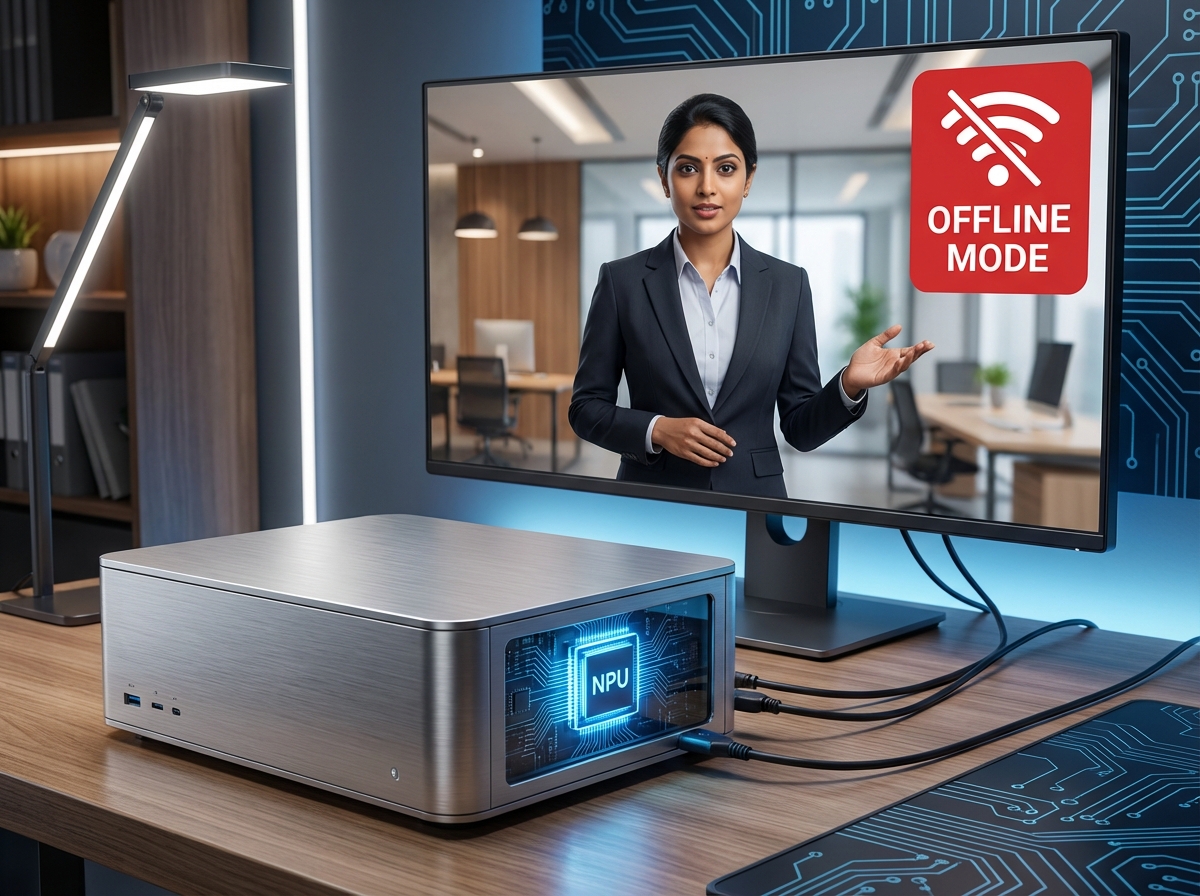
For many Indian enterprises operating in remote areas or high-security zones, offline AI avatar rendering is a game-changer. Read more about AI voice cloning and Indian accents.
- The Need: Internal communications, safety training, and SOP updates often need to be delivered in local languages in areas with poor connectivity.
- The Solution: Pre-provisioning licensed AI avatars and voice models onto edge devices. This allows for the generation of “talking head” videos without an internet connection.
- Governance: Studio by TrueFan AI's 175+ language support and AI avatars provide a blueprint for how these models can be governed. By using licensed digital twins of real influencers or company spokespeople, organizations avoid the ethical and legal pitfalls of “unauthorized deepfakes.”
6. Implementation Strategy: Tools and Integration
Building a local AI video stack requires a careful selection of hardware and software that can play well within the Indian ecosystem.
Local AI video processing tools
Your 2026 toolkit should include: see also the practical guide to edge computing video production.
- Hardware: AI NVRs from vendors like CP PLUS, which offer built-in behavioral analysis and facial recognition at the edge (Source: CP PLUS News).
- Orchestration: Lightweight Kubernetes (k3s) for managing AI containers across a fleet of edge devices.
- Governance: Policy engines that automatically enforce DPDP retention periods (e.g., auto-deleting video after 30 days unless flagged).
Integrating TrueFan Enterprise for Compliant Workflows
For organizations looking to scale their video production while remaining compliant, solutions like Studio by TrueFan AI demonstrate ROI through their ability to automate personalized video generation at scale without the overhead of a traditional production house. For brand safety and moderation, see brand guideline enforcement.
- API-Driven Pipelines: Use the New Request API to trigger video generation from local events (e.g., a “Safety Milestone” reached in a factory triggers a personalized congratulatory video from the CEO’s AI avatar).
- Walled Garden Governance: Ensure all generated content is watermarked and stored in enterprise-controlled environments, aligning perfectly with DPDP’s security-by-design mandates.
Build vs. Buy: The 2026 Evaluation Checklist
| Feature | Requirement for Edge AI Video |
|---|---|
| Data Localization | Must support 100% on-prem or private VPC deployment in India. |
| Security | E2E encryption, TEE support, and signed containers. |
| Compliance | DPDP-aligned consent logs and auto-retention policies. |
| Performance | Sub-500ms latency for generative tasks; sub-50ms for analytics. |
| Hardware | Compatibility with NPU-based edge boxes (CP PLUS, NVIDIA Jetson, etc.). |
7. Conclusion: The Path Forward
As we move through 2026, the convergence of edge AI video processing India and the DPDP Act has created a new standard for enterprise operations. Organizations that embrace on-premise AI video infrastructure and privacy-compliant video generation will not only avoid the heavy penalties of non-compliance but will also gain a significant competitive advantage through faster, more resilient, and more personalized video workflows.
The future of video is local, private, and real-time. By investing in on-device video generation 2026 capabilities today, Indian enterprises can ensure they are ready for the next decade of AI-driven transformation.
Frequently Asked Questions
How does the DPDP Act 2023 affect existing CCTV installations in India?
Existing installations must now be mapped to a “Legal Basis” for processing. If the video is used for anything beyond basic security (like analytics or marketing), explicit consent or a documented legitimate use case is required. Edge processing helps by minimizing the data that needs to be “protected” through on-device redaction.
Can I run generative AI video models on standard edge hardware?
In 2026, “standard” edge hardware has evolved. While older NVRs may struggle, new AI-optimized NVRs and edge servers with dedicated NPUs are specifically designed to handle localized video generation and offline AI avatar rendering.
What are the primary benefits of “Privacy-First” video creation?
Beyond compliance, it builds trust with employees and customers. By using privacy-first AI video creation techniques like face-swapping with licensed avatars or real-time blurring, you ensure that PII is never at risk of a breach.
Is it possible to generate AI videos without an internet connection?
Yes. Through offline AI avatar rendering, models are pre-loaded onto local hardware. Studio by TrueFan AI's 175+ language support and AI avatars can be integrated into such workflows (subject to enterprise architecture review) to ensure that high-quality, multilingual video generation remains possible even in air-gapped environments.
What is the “Year of Compliance” for Indian enterprises?
2026 is widely considered the “Year of Compliance” as it is the final full year before the May 2027 deadline for full DPDP Act enforcement. Enterprises are currently rushing to audit their video pipelines and move sensitive workloads to the edge.
Sources:
- India Edge Computing Market Growth: PS Market Research
- DPDP Act 2023 Official Text: MeitY
- 2026 Tech Trends & Edge Chips: Electronics For You
- Generative AI Trends 2026: Daffodil Software
- Indian Edge AI Ecosystem: CP PLUS World
- Cyber Security Outlook 2025-2026: DSCI
Recommended Internal Links
- On‑premise AI video infrastructure and MLOps — Deep dive on building on‑premise AI video infrastructure and MLOps for enterprise video pipelines in India.
- Edge computing video production — Practical guide to edge computing video production, privacy-first workflows, and low‑latency processing.
- Brand safety, moderation, and compliance automation — DPDP/ASCI alignment for AI video.
- Multimodal AI video creation 2026 — On‑device generation readiness for 2026.
- AI voice cloning for Indian accents — Offline AI avatar rendering and localized training content.