Win April–May with Summer Vacation Advance Booking 2026: AI-Personalized Playbooks for Family Travel
Estimated reading time: ~11 minutes
Key Takeaways
- Lock in peak-season revenue by launching early-bird, tiered discounts and clear price-lock guarantees.
- Drive conversions with AI-personalized family packages tailored to child age, origin city, and multi-generational needs.
- Run parallel campaigns for domestic hill stations and short-haul international destinations with localized messaging.
- Use mobile-first, silent-optimized videos and automation to trigger timely offers and ancillary cross-sells.
- Measure impact via advance booking rate, lead-time delta, and ROI dashboards; ensure compliance and scale readiness.
The window for securing peak-season revenue is narrowing as the April–May booking surge approaches. For Indian travel enterprises, the race for summer vacation advance booking 2026 has officially begun, driven by a consumer base that is increasingly proactive yet price-sensitive. High-growth travel brands are moving beyond generic discounting to embrace data-driven, AI-personalized video campaigns that convert intent into confirmed itineraries. Explore the TrueFan AI blog on quick‑commerce video personalization in India.
This playbook outlines how revenue and growth marketers can leverage automation and personalization to dominate the 2026 summer season. By focusing on early bird incentives and hyper-localized content, agencies can mitigate the “booking stress” prevalent in the Indian market. We will explore the strategic integration of video assets and automated orchestration to ensure your family packages are the first choice for travelers this year.
Why This Matters Now: The 2026 Market Context
- Price Mitigation: Booking early is the primary defense against the projected 2026 peak-season price surges on domestic and international flights.
- Booking Stress: A majority of Indian travelers report significant anxiety regarding volatile prices, leading them to start planning as early as January.
- Cool Escapes: Demand for domestic hill stations like Kashmir, Manali, and Munnar remains at an all-time high for the April–May window.
- Experiential Shifts: The “endorphin economy” is driving families toward “hyper playgrounds” and kid-first amenities in resort selections.
Section 1: The April–May Revenue Race—Why Summer Vacation Advance Booking 2026 is the Critical Yield Lever
In the travel industry, yield management is a game of timing and precision. For the 2026 season, the summer vacation advance booking 2026 cycle is the most significant opportunity to stabilize RevPAR (Revenue Per Available Room) and RASM (Revenue per Available Seat Mile). By securing commitments in the April–May window, enterprises can effectively manage inventory before the chaotic last-minute rush.
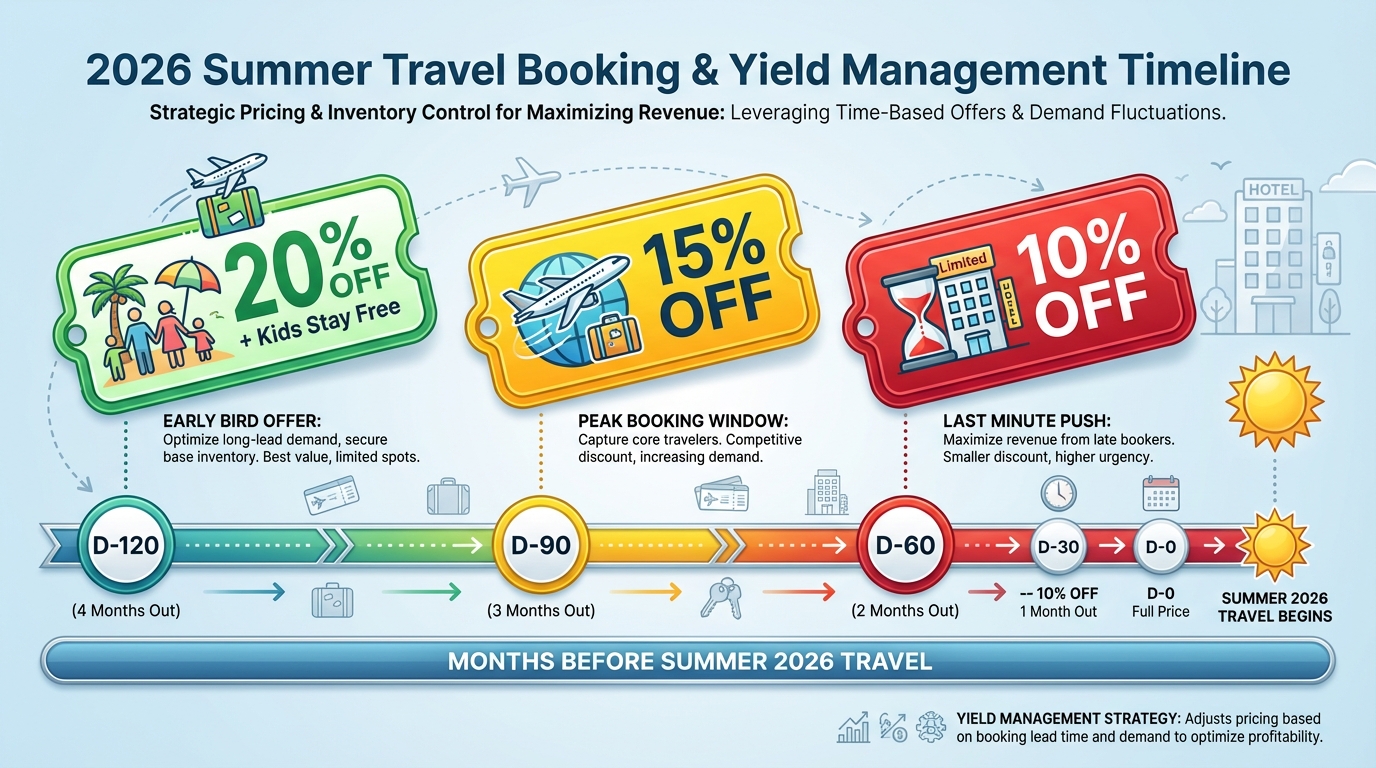
The lead-time pricing curve in India has become steeper, with fare buckets in aviation and Best Available Rate (BAR) strategies in hospitality shifting rapidly. High-authority data suggests that early booking significantly lowers exposure to peak-season price spikes, a fact that marketers must communicate clearly to their audience. Implementing early bird travel discounts that are tiered—such as D-120, D-90, and D-60 structures—allows brands to reward early commitment while maintaining healthy margins.
Furthermore, the psychological aspect of “booking stress” among Indian travelers cannot be ignored. Recent reports indicate that the volatility of travel costs has pushed consumers to seek certainty through early planning. By offering price-lock guarantees and flexible cancellation policies during the early booking phase, brands can alleviate this stress and build long-term trust.
Sources:
- Save Big on Summer Flights to India by Booking Early in 2026 — Travel and Tour World
- Indians Plan Exciting Travels in 2026 Amid Booking Stress — Times of India
Section 2: Segmenting the Modern Indian Family: Scaling Family Travel Package Personalization
The “one-size-fits-all” approach to travel marketing is obsolete in an era of hyper-personalization. To capture the 2026 family market, enterprises must master family travel package personalization by tailoring offers to specific household dynamics. This involves segmenting audiences based on children's ages, origin cities, and even multi-generational requirements.
Platforms like TrueFan AI enable travel brands to generate thousands of personalized video messages that address these specific segments at scale. For instance, a family with toddlers requires different messaging—focusing on stroller access and kids-eat-free plans—compared to a family with teenagers looking for adventure sports and high-speed Wi-Fi. Personalizing the creative assets to reflect these nuances significantly increases the relevance of the offer and the likelihood of conversion.
Child-friendly destination marketing should be a cornerstone of your 2026 strategy. Highlighting safety badges, lifeguard certifications, and supervised kids' clubs provides the “peace of mind” that parents prioritize. When these features are presented through personalized video content, the emotional connection to the brand is strengthened, moving the needle from “considering” to “booking.”
Multi-generational travel is another burgeoning segment for 2026. Offers that include adjoining rooms, wheelchair-accessible itineraries, and dietary accommodations (such as Jain or specialized vegetarian meals) cater to the extended Indian family. By bundling these into comprehensive family resort packages, brands can increase the average booking value while providing superior convenience to the traveler.
Sources:
Section 3: Destination Dynamics: Domestic Tourism Offers India vs. International Travel Deals Summer
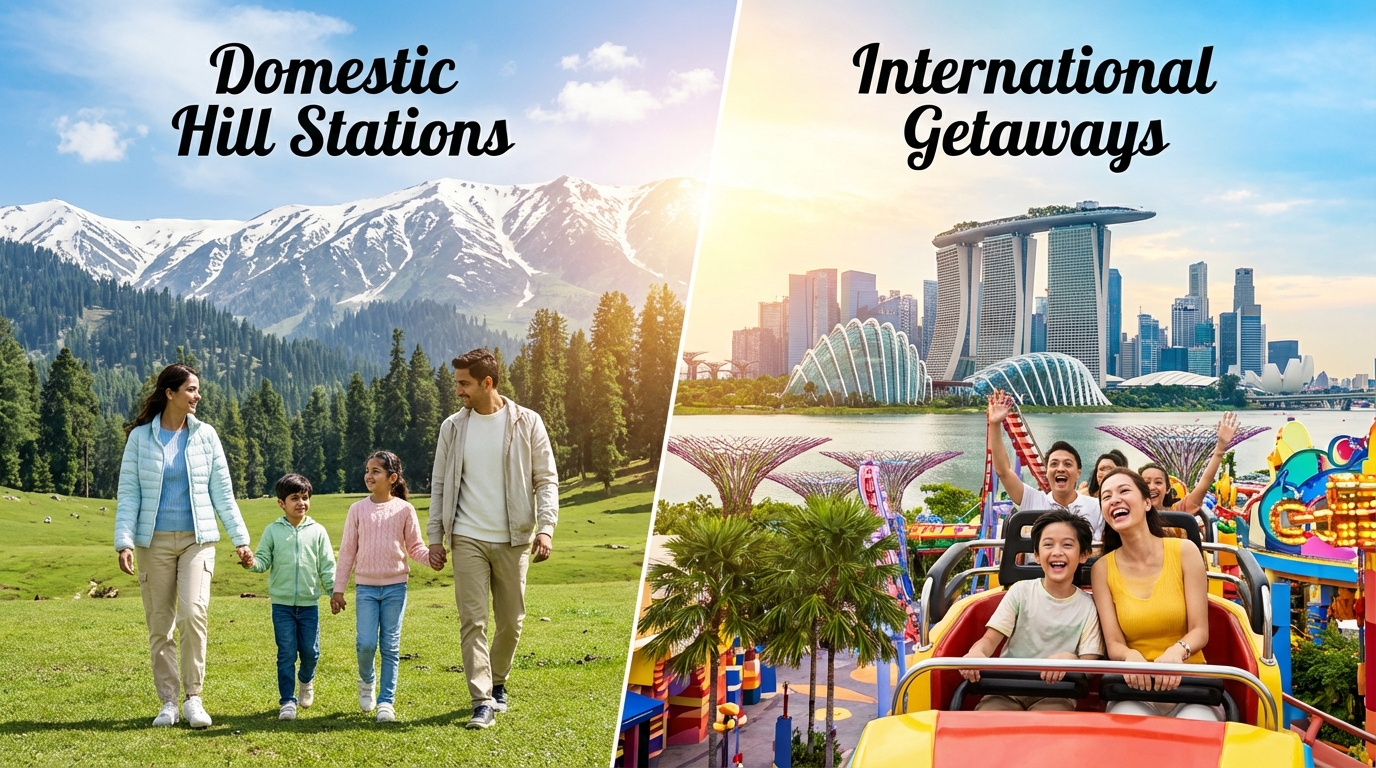
The 2026 travel landscape is split between the cooling comfort of domestic hill stations and the aspirational pull of short-haul international destinations. To maximize revenue, marketers must run parallel hill station booking campaigns and international promotions. Each requires a distinct messaging strategy rooted in local preferences and operational realities.
For domestic travel, the focus remains on “beating the heat.” Destinations like Kashmir (Gulmarg and Pahalgam), Himachal Pradesh (Manali and Shimla), and Kerala (Munnar) are perennial favorites. Domestic tourism offers India should emphasize ease of access, such as luxury Volvo transfers or direct rail connectivity, alongside altitude-based cooling benefits. Highlighting specific family-friendly activities, like shikara rides or tea plantation tours, adds a layer of experiential value to the package.
On the international front, international travel deals summer are dominated by visa-easy or visa-free destinations like Singapore, Dubai, and Thailand. For these markets, the value proposition should center on “all-inclusive” bundles that cover flights, hotels, and major attractions like Universal Studios or indoor theme parks. Given the early planning trend, brands should also provide proactive guidance on visa appointment windows to reduce traveler anxiety.
Localization is the final piece of the destination puzzle. Regional-language creatives in Hindi, Tamil, Bengali, and Marathi ensure that the message resonates across India's diverse geography. Utilizing WhatsApp-first sharing strategies allows these localized offers to spread organically within family groups, which are the primary decision-making units for summer vacations.
Sources:
- MakeMyTrip: Best Places to Visit in May
- Navbharat Tourism: Best Hill Stations in India for Summer Holidays
- Booking.com: 2026 Must-Visit Places
Section 4: The Visual Decision Engine: School Holiday Planning Videos and Cross-Sell Automation
In 2026, video is the primary medium for travel discovery and decision-making. School holiday planning videos serve as a visual itinerary, providing families with a clear picture of their potential vacation in under 30 seconds. These videos should be mobile-first, silent-optimized, and packed with essential data points like daily budgets, travel times, and “book by” timers for early bird discounts.
TrueFan AI's 175+ language support and Personalised Celebrity Videos allow brands to create these assets with unprecedented scale and authenticity. Imagine a video where a celebrity or a trusted brand ambassador addresses a parent by name, suggesting a specific 4-day Manali itinerary based on their previous search history. This level of intimacy in advertising is what differentiates market leaders from the rest of the field. Learn more in this TrueFan AI blog on live commerce personalization in India (2026).
Beyond the primary booking, video is a powerful tool for ancillary monetization. Travel insurance cross-sell videos can be triggered immediately after a flight or hotel selection. These short, contextual explainers highlight the importance of coverage for adventure sports in Himachal or medical emergencies in Singapore. By including a direct QR code or deep link within the video, brands can see a significant uptick in insurance attach rates.
Creative specifications for these videos must be rigorous. A 9:16 aspect ratio is essential for Reels and WhatsApp, while burnt-in captions ensure the message is delivered even when the sound is off. The first six seconds are critical; they must feature high-impact visuals of kid-friendly amenities, such as infinity pools or interactive play zones, to hook the viewer immediately.
Sources:
- TrueFan AI: Enterprise Video ROI Metrics Dashboard (2026)
- TrueFan AI: 2026 Marketing Technology Budget Planning
- TrueFan AI: 2026 Digital Transformation Budget Planning
Section 5: Orchestrating the Journey: Vacation Planning Automation with Enterprise AI Video
The true power of modern travel marketing lies in vacation planning automation. This involves setting up event-triggered journeys that respond to user signals in real-time. Whether a user abandons a cart, searches for a specific destination multiple times, or hits a new loyalty tier, the system should automatically generate and deliver a personalized video offer.
Effective automation relies on the strategic use of tokens and triggers. Tokens like the user's name, preferred departure airport, and children's ages allow the AI to “write” a custom script for each video. Triggers such as a “price drop” alert or a “hotel almost sold out” warning create the necessary urgency to drive a booking. This level of responsiveness ensures that the brand remains top-of-mind throughout the traveler's decision-making journey.
Travel loyalty rewards activation is another critical component of the automated journey. For 2026, loyalty programs should move beyond simple point accumulation. See how post‑purchase loyalty automation works in India (2024). Automated videos can inform Silver or Gold tier members of exclusive “early access” to summer packages or bonus point multipliers for bookings made before March 31st. This not only drives immediate revenue but also reinforces the value of the loyalty program. Explore loyalty program gamification strategies (2026).
WhatsApp remains the dominant channel for travel execution in India. Understand WhatsApp Business commerce automation (2026). WhatsApp catalog videos, which allow users to browse and book within the app, have proven highly effective for high-intent categories. Learn about WhatsApp catalog video marketing. By integrating these into an automated workflow, travel enterprises can provide a seamless, friction-free booking experience that meets the customer exactly where they are.
Sources:
Section 6: Measuring Success and Compliance: ROI Frameworks for Summer Vacation Advance Booking 2026
To justify the investment in AI and automation, travel brands must adhere to a strict measurement framework. The primary KPIs for a summer vacation advance booking 2026 campaign include the advance booking rate, the average lead time delta, and the incremental revenue generated compared to a holdout group. Monitoring the “attach rate” for ancillaries like insurance and room upgrades is also vital for understanding total customer value.
Solutions like TrueFan AI demonstrate ROI through detailed creative- and cohort-level performance dashboards. These tools allow marketers to see exactly which video hooks are driving the most conversions and which segments are responding best to specific early bird travel discounts. This data-driven approach enables continuous optimization, ensuring that marketing spend is always directed toward the highest-performing assets. See the TrueFan AI blog on quick‑commerce video personalization in India.
Compliance and trust are non-negotiable in the 2026 landscape. As synthetic media becomes more prevalent, enterprise-grade governance is required. This includes deepfake watermarking and clear disclosure of AI-generated content to maintain transparency with the consumer. Brands must ensure that all celebrity likenesses are used with explicit consent and that data privacy standards like ISO 27001 are strictly followed.
Finally, scale readiness is essential for the April–May peak. Operations teams must be equipped to handle bulk variant generation and multi-language QA without compromising on quality. By using pre-approved brand kits and live inventory feeds, enterprises can ensure that every personalized video sent is accurate, compliant, and ready to convert.
Sources:
- Deepfake Watermarking Requirements — India (TrueFan AI)
- Enterprise Video ROI Metrics Dashboard — TrueFan AI
Frequently Asked Questions
How early should I start the summer vacation advance booking 2026 campaign?
For the 2026 season, campaigns should ideally launch in late January or early February. This aligns with the period when Indian travelers begin experiencing “booking stress” and start searching for value. Starting early allows you to capture the high-intent “early bird” segment before competitors saturate the market in March.
What are the most effective early bird travel discounts for families?
Tiered discounts are most effective. A “D-120” (120 days before travel) offer might include a 20% discount plus a “kids-stay-free” perk. As the departure date approaches, the discount reduces (e.g., 15% at D-90), creating a natural incentive for travelers to commit as early as possible to secure the best value.
How does vacation planning automation improve conversion rates?
Automation ensures that no lead is left cold. By triggering a personalized video the moment a user shows interest—such as searching for “family resort packages”—you provide immediate, relevant information that answers their specific questions. This reduces the friction in the decision-making process and significantly increases the likelihood of a confirmed booking.
Can TrueFan AI help with regional language marketing for summer 2026?
Yes, TrueFan AI supports over 175 languages with advanced lip-sync and voice retention capabilities. This allows travel brands to create localized campaigns in Hindi, Marathi, Tamil, and other regional languages, ensuring that the marketing message is culturally and linguistically resonant across different Indian states.
What should be included in travel insurance cross-sell videos?
These videos should be short (10–15 seconds) and highly contextual. They should mention the specific risks associated with the chosen destination—such as adventure sport injuries in the mountains or lost baggage on international flights. Including a clear “Add to Trip” button or QR code makes the purchase seamless for the customer.
Why is child-friendly destination marketing so critical for 2026?
Modern parents prioritize safety and engagement for their children above almost all other factors. Highlighting specific amenities like “certified lifeguards,” “stroller-friendly paths,” and “nutritional kids' menus” through visual media builds the trust necessary for a high-value family booking. It moves the conversation from price to the quality of the family experience.