Enterprise AI video platform: The CTO’s guide to APIs, Salesforce/HubSpot integrations, WhatsApp automation, and compliance
Estimated reading time: ~18 minutes
Key Takeaways
- Choose an API-first enterprise AI video platform with robust SDKs, SLAs, and observability for scale.
- Prioritize security and compliance (ISO 27001, SOC 2), consent-first governance, and data residency options.
- Integrate deeply with Salesforce and HubSpot to trigger personalized videos and write back view-state for attribution.
- Leverage WhatsApp Business API for rich media delivery, failover paths, and signed URLs to protect PII.
- Adopt cloud-agnostic GPU infrastructure and real-time rendering to support high-velocity campaigns.
The modern digital landscape demands hyper-personalization at a scale previously thought impossible. For the Chief Technology Officer (CTO), selecting an enterprise AI video platform is no longer about finding a creative tool, but about architecting a robust, API-first communication stack. Platforms like TrueFan AI enable organizations to bridge the gap between static data and dynamic, emotionally resonant video content through programmatic automation.
By 2026, it is projected that over 85% of enterprise-level customer interactions will involve some form of AI-driven synthetic media. This shift necessitates a move away from simple video editors toward a scalable personalized video SaaS that prioritizes security, interoperability, and low-latency rendering. This guide provides a technical evaluation framework for integrating these capabilities into your existing enterprise architecture.
Enterprise AI video platform: Evaluation framework for CTOs
An enterprise AI video platform is fundamentally different from consumer-grade video tools. While SMB editors focus on manual UI-based manipulation, an enterprise stack is defined by its API-first nature, compliance readiness, and ability to deliver at massive scale. It functions as a headless engine that transforms CRM data into high-fidelity video assets via secure REST endpoints.
The core requirement for any enterprise-grade solution is a consent-first architecture. In the current regulatory environment, using celebrity or brand likeness requires rigorous contract management and digital rights governance. TrueFan AI's 175+ language support and Personalised Celebrity Videos demonstrate how global brands can maintain local relevance while adhering to strict brand safety and moderation protocols.
For a CTO, the evaluation must extend beyond the "wow factor" of AI generation. You must assess the platform's ability to provide Service Level Agreements (SLAs), comprehensive Software Development Kits (SDKs), and deep observability. A scalable personalized video SaaS must offer under 30-second render times to support real-time customer journeys, ensuring that the video is ready the moment a user triggers a workflow.
Sources:
The AI video API for business: Core design and developer experience
A robust AI video API for business must prioritize developer experience (DX) to ensure rapid deployment and maintainability. The foundation of this experience is a well-documented REST API video personalization suite that supports OAuth2 or JWT-based authentication. Least-privilege access control is mandatory, ensuring that API keys are scoped to specific environments or template sets.
Idempotency is a critical feature for high-scale video generation. When POSTing to a /v1/videos endpoint, the inclusion of an Idempotency-Key prevents duplicate renders during network retries or system timeouts. This is essential when managing large-scale batch campaigns where a single duplicate could result in thousands of dollars in wasted compute resources or redundant customer messages.
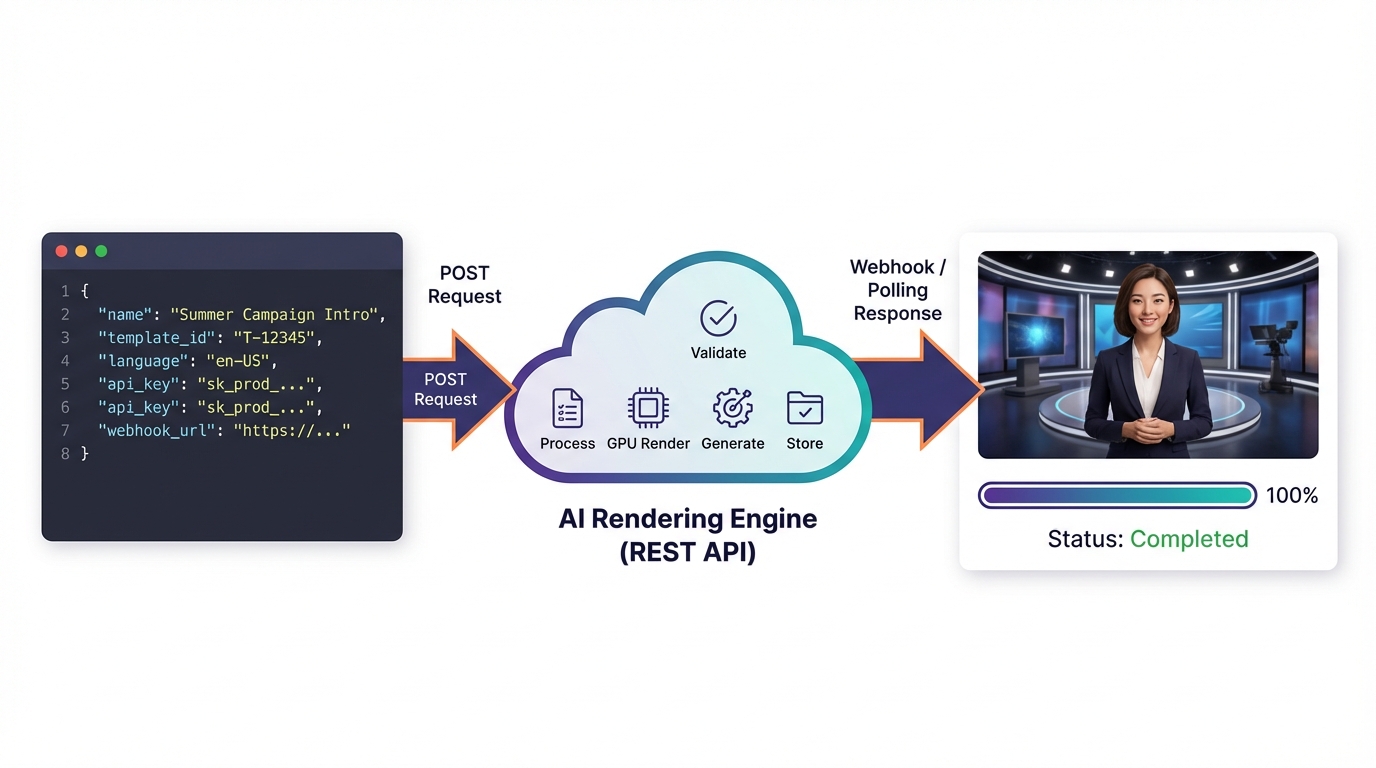
The real-time video generation API should offer a comprehensive set of endpoints for template management and lifecycle tracking. Developers need the ability to register templates with dynamic slots for text, images, and audio. Once a render is initiated, the system should support both polling and webhook-based notifications to inform the consuming application when the mp4_url or hls_url is ready for delivery.
Webhooks must be designed for resilience, utilizing exponential backoff for delivery failures and HMAC signatures for origin verification. This ensures that your internal systems only process legitimate events from the video platform. By 2026, the standard for enterprise APIs will include mandatory structured logging and correlation IDs that persist across the entire generation pipeline, from the initial request to the final CDN delivery.
Sources:
CRM connectivity: Salesforce video integration and HubSpot AI video automation
Integrating video into your CRM is the primary driver of ROI for most enterprise implementations. A Salesforce video integration allows marketing and sales teams to trigger personalized videos directly from Lead or Contact record changes. This is typically achieved through Apex callouts or Salesforce Flows that send a payload to the video API whenever a specific criteria—such as a high-value lead score—is met.
Within Salesforce, the architecture should utilize Custom Objects or Platform Events to handle the asynchronous nature of video rendering. Once the video is generated, a webhook writes the unique Video_URL__c back to the record. This allows for seamless delivery through Salesforce-connected channels like Pardot or Marketing Cloud, ensuring that the personalized asset is available exactly when the automated email or SMS is dispatched.
For organizations utilizing HubSpot AI video automation, the integration is often more streamlined through the use of Custom Workflow Actions. By mapping HubSpot personalization tokens—such as {{contact.firstname}} or {{deal.amount}}—directly to the video template slots, teams can create sophisticated re-engagement loops. For example, a "Cart Abandonment" workflow can automatically generate a video featuring a personalized offer, significantly increasing the likelihood of conversion.
Attribution is the final piece of the CRM puzzle. Every video generated should include UTM parameters and unique tracking IDs that sync back to the CRM. This allows CTOs to report on the direct impact of video personalization on pipeline velocity and deal closure rates. In 2026, advanced integrations will also support "view-state" writebacks, triggering follow-up tasks in the CRM the moment a prospect watches more than 75% of a personalized video.
Sources:
- Salesforce Developer Guide: Apex Callouts
- HubSpot API Reference: Workflows
- WebEngage: WhatsApp Rich Media Support
Messaging at scale with WhatsApp Business API video
In regions like India and Southeast Asia, the WhatsApp Business API video delivery pattern is the most effective channel for engagement. WhatsApp Business Commerce Automation 2026 Delivering high-quality video via WhatsApp requires strict adherence to media specifications and template governance. Video headers must be H.264 encoded, and for maximum compatibility across Android and iOS devices, developers should avoid "High" profile settings with B-frames.
The delivery architecture involves a multi-step process: generating the video, hosting it on a secure CDN, and then passing the media URL to a Business Solution Provider (BSP) like Gupshup. The WhatsApp Cloud API has simplified this onboarding process significantly, and by 2026, we expect near-instantaneous template approval through AI-assisted moderation. This allows for "moment-marketing" where videos are created and sent within minutes of a cultural or sporting event. Conversational Cricket Commerce India Playbook
A marketing automation video API can orchestrate these journeys by branching logic based on user behavior. If a user does not have WhatsApp, the system can failover to SMS with a link to a personalized landing page. Using tools like WebEngage, enterprises can manage these omnichannel journeys, ensuring that the personalized video reaches the user on their preferred platform while maintaining a single view of the customer.
Security in WhatsApp delivery is paramount, especially when handling PII. Enterprises should utilize signed URLs with short Time-to-Live (TTL) values to ensure that video content is only accessible to the intended recipient. Furthermore, data residency requirements in India may necessitate using BSPs that offer local data processing to remain compliant with the Digital Personal Data Protection (DPDP) Act.
Sources:
- Meta for Developers: WhatsApp Video Messages
- Gupshup WhatsApp API Guide
- WebEngage: Omnichannel WhatsApp Engagement
Security, compliance, and governance for enterprises
For a CTO, the security posture of a vendor is often the deciding factor. An ISO 27001 certified platform provides the necessary assurance that the vendor has a robust Information Security Management System (ISMS) in place. This certification covers everything from physical data center security to the software development lifecycle, ensuring that your customer data is handled with the highest level of care.
In addition to ISO standards, a SOC 2 compliant video solution is essential for verifying that the platform meets the Trust Services Criteria for security, availability, and confidentiality. SOC 2 Type II reports provide a historical look at how controls have performed over time, giving procurement teams the confidence needed to clear the vendor for enterprise-wide use. This includes rigorous audit logs, change management processes, and incident response drills.
Data privacy is another critical pillar of governance. The platform must support PII minimization through hashing and tokenization, ensuring that sensitive customer data is never stored in plain text. Solutions like TrueFan AI demonstrate ROI through their commitment to these standards, offering regional data residency options in India and the EU to satisfy local regulatory requirements. This is particularly important for industries like banking and healthcare, where data sovereignty is non-negotiable.
Content integrity and brand safety are the final components of the governance framework. The platform should include built-in moderation layers to prevent the generation of offensive or off-brand content. A consent-first model for all AI-generated assets ensures that the organization is protected from legal risks associated with synthetic media. By 2026, automated "digital watermarking" will likely become a standard feature to verify the authenticity and origin of AI-generated enterprise video.
Sources:
Architecture and deployment: Cloud-agnostic GPU infrastructure
The underlying infrastructure of an enterprise AI video platform must be designed for extreme elasticity. A cloud-agnostic GPU infrastructure allows the platform to scale render workers across multiple cloud providers (AWS, GCP, Azure) to avoid vendor lock-in and ensure high availability. This architecture utilizes Kubernetes for orchestration, allowing the system to spin up thousands of GPU-enabled nodes in response to campaign spikes.
Observability is the heartbeat of this infrastructure. CTOs should look for platforms that provide real-time metrics on render latency (p50/p95), error rates by category, and queue depths. Tracing should be implemented across the entire stack, allowing for the rapid identification of bottlenecks, whether they occur in the AI model inference stage or the final video encoding process.
Deployment models should be flexible to meet varying security requirements. While a shared cloud environment is suitable for many, some enterprises may require a customer-dedicated VPC or even a private cloud deployment. This allows for private networking via VPC peering and the use of customer-managed encryption keys (KMS), providing an additional layer of control over the data lifecycle.
By 2026, the focus will shift toward "Edge Rendering," where portions of the video personalization happen closer to the user to further reduce latency. A forward-thinking cloud-agnostic GPU infrastructure will be prepared to transition to these distributed models, ensuring that the enterprise remains at the cutting edge of performance. This technical agility is what separates a long-term strategic partner from a temporary point solution.
Sources:
Implementation blueprint, ROI, and FAQ
A successful implementation follows a structured 30-60-90 day POC plan. In the first 30 days, focus on a single high-impact use case, such as a Salesforce video integration for new lead welcomes. By day 60, expand to include multi-language support and A/B testing of script lines. By day 90, the focus should shift to hardening the integration for full-scale production, including security reviews and SLA finalization.
The ROI of personalized video is often realized through a dramatic reduction in Customer Acquisition Cost (CAC) and an increase in Customer Lifetime Value (LTV). For example, Zomato’s Mother’s Day campaign delivered 354,000 personalized videos in a single day, resulting in massive viral engagement. Similarly, Hero MotoCorp used personalized greetings to drive 2.4 million interactions, demonstrating the power of 1:1 communication at a national scale.
Conclusion
Selecting the right enterprise AI video platform is a strategic decision that impacts every facet of the customer journey. By prioritizing an API-first approach, robust security certifications like ISO 27001 and SOC 2, and seamless CRM integrations, CTOs can build a communication engine that is both powerful and resilient. As we move into 2026, the ability to deliver personalized, high-fidelity video at the speed of thought will be the hallmark of the digitally mature enterprise.
Sources:
The 2026 Opportunity for Conversational Commerce India 2026
The Indian retail landscape in 2026 is defined by a “messaging-first” consumer psychology. According to recent Bain & Meta “Win with Conversations” reports, generative AI-powered conversational commerce has moved from a niche experiment to the primary driver of digital sales. Brands are no longer just “sending alerts”; they are retooling their entire engagement strategy around messaging at scale to meet the expectations of a sophisticated, mobile-native population.
The maturity of India’s digital public infrastructure has reached a critical tipping point. In December 2025, the National Payments Corporation of India (NPCI) recorded over 21.6 billion UPI transactions, signaling that the friction for in-chat payments has effectively vanished. For brands, this means the entire funnel—from product discovery via a short-form video to final settlement—can now occur within a single WhatsApp thread.
Video has emerged as the essential medium for this transition. Personalized, short-form videos delivered inside WhatsApp boost attention spans and conversion rates significantly compared to plain text or static images. As we navigate 2026, the trendlines favor richer media, multilingual personalization, and results-oriented automation that prioritizes task completion over simple broadcast reach.
Source: Bain & Meta: Win with Conversations Report 2024/2025
Source: NPCI UPI Product Statistics (Dec 2025 Volume)
Source: WhatsApp Business India Resource Hub
Defining the Scope of WhatsApp Business API Video Automation
To master this playbook, one must first distinguish between the standard WhatsApp Business App and the WhatsApp Business API. The API is a programmatic interface (Cloud API or partner BSP) designed for scale, compliance, and deep integration. It allows businesses to send approved templated messages, manage 24-hour service windows, and utilize interactive components like buttons and list menus that are not available in the consumer-facing app.
WhatsApp Business API video automation refers to the end-to-end system that programmatically generates, personalizes, and delivers video assets via these templates. This system is triggered by specific catalog events, user behaviors, or lifecycle milestones. By 2026, this automation has evolved to include the orchestration of complex payment flows and post-purchase support, all powered by visual builders and AI-driven response logic.
The strategic advantage of video inside messaging is its ability to contextualize products and humanize offers instantly. In high-velocity categories like beauty, fashion, and electronics, a 10-second video explainer can demonstrate value more effectively than a thousand-word product description. Current 2026 trends emphasize that automation must be non-intrusive and focused on utility—such as cart recovery or reorder reminders—rather than generic spam.
Source: WhatsApp Automation Trends 2026
Source: Visual Builders and AI Integration for WhatsApp
Designing WhatsApp Payment Integration Campaigns for the Indian Market
The “India WhatsApp Commerce Stack” is a multi-layered architecture that integrates messaging, catalog data, and the UPI payment rail. At the messaging layer, brands must navigate the three primary template types: marketing, utility, and authentication. For video automation, marketing templates are the primary vehicle, supporting rich media attachments and interactive CTA buttons that drive the user toward a transaction.
The payments layer is where the most significant 2026 innovations reside. Successful WhatsApp payment integration campaigns now utilize two primary modes:
- UPI Intent/Deep Links: These links (format:
upi://pay?pa=<VPA>&pn=<name>&am=<amount>&cu=INR&tn=<order_id>) allow the user to open their preferred UPI app (GPay, PhonePe, Paytm) directly from the WhatsApp chat. - Gateway Deep Integration: For more complex transactions involving credit cards or EMI, brands use webhook-based reconciliation to push payment status updates back to the user via utility templates.
The data layer serves as the brain of the operation, pulling segments from CRMs or CDPs based on Recency, Frequency, and Monetary (RFM) metrics. This allows for the delivery of videos that are not only personalized by name but also by language preference (Hindi, Hinglish, or regional dialects) and city-specific availability. Governance is equally critical; brands must maintain strict opt-in management and frequency caps to ensure high template quality scores and avoid being flagged by the platform.
Source: NPCI UPI Technical Specifications
Source: WhatsApp Business Messaging Service Expectations
Source: Regional Language Automation for India
High-Conversion Blueprints: Chat-to-Purchase Video Funnels
The most effective revenue driver in 2026 is the chat-to-purchase video funnels. WhatsApp Catalog Video Marketing: Automation Strategies This journey typically begins with a trigger, such as a Click-to-WhatsApp (CTWA) ad or a QR code on physical packaging. The first touchpoint is a marketing template featuring a 10-15 second video showcasing top picks tailored to the user’s browsing history. WhatsApp Catalog Video Marketing: Tactics for 2026 Platforms like TrueFan AI enable brands to generate these SKU-specific videos in real-time, ensuring the content is always relevant to the individual viewer.
Once the user engages, the funnel moves into guided selection. Instead of sending a static link to a website, the brand sends a list message of products. Upon selection, the system responds with a personalized video variant that might mention the user's name or city, followed by “Add to Cart” and “Pay via UPI” buttons. This seamless transition from discovery to payment reduces drop-off rates by keeping the user within the familiar WhatsApp interface.
Beyond the initial sale, the journey continues with WhatsApp order tracking videos. For complex products, such as electronics or furniture, brands send a personalized assembly or “what to expect” video once the order is shipped. This proactive utility messaging reduces support tickets and increases customer satisfaction. Post-purchase cross-sell videos, sent 7-10 days after delivery, further capitalize on the established trust to drive repeat purchases.
Source: WhatsApp Marketing Strategies 2026
Source: WATI WhatsApp API Market Expansion Tips
Scaling Business Messaging Personalization with AI and Regional Languages
In the 2026 Indian market, business messaging personalization is no longer optional; it is the baseline. This involves tailoring content, media, and CTAs to the individual’s profile and language preference. See regional language video SEO for deeper strategies. Conversational AI shopping videos take this a step further by using generative AI to assemble scenes and overlays from catalog attributes on the fly. This allows a brand to speak to a customer in Hinglish in Mumbai while simultaneously addressing a customer in Kannada in Bengaluru, all using the same core campaign logic.
TrueFan AI's 175+ language support and Personalised Celebrity Videos allow enterprise brands to maintain a consistent brand voice across these diverse locales. By integrating celebrity or brand ambassador-led variants, companies can create a sense of exclusivity and trust that static messages cannot replicate. This level of personalization is particularly effective for broadcast list personalization strategies, where segments are divided by AOV, city clusters, and past purchase behavior.
The technical execution of this personalization relies on a robust event bus. When a user browses a specific SKU on a website but doesn't buy, a webhook triggers the media generation engine. Within seconds, a personalized video featuring that exact SKU is rendered and sent to the user's WhatsApp. This “always-on” personalization ensures that every message sent is high-value, reducing the risk of the user opting out of future communications.
Source: India-Specific Language Guidance for WhatsApp
Source: 2026 Tooling and AI Response Integration
Optimization and WhatsApp Commerce ROI Tracking
To justify the investment in video automation, brands must implement rigorous WhatsApp commerce ROI tracking. This goes beyond simple open rates. In 2026, the focus is on funnel reporting: view-to-click, click-to-cart, and cart-to-paid metrics. By breaking down these cohorts by language, city, and SKU, marketers can identify exactly which creative variants are driving the highest incremental ROAS. Guide to Conversational Cricket Shopping on WhatsApp
Solutions like TrueFan AI demonstrate ROI through detailed dashboards that track engagement and conversion lifts at the video-render level. These insight loops allow brands to A/B test different elements of their video strategy, such as:
- Video Length: Comparing 8-second “hooks” against 15-second “explainers.”
- Visual Overlays: Testing the impact of price badges vs. limited-time offer countdowns.
- CTA Phrasing: Evaluating “Buy Now” vs. “Pay with UPI” for different demographic segments.
Attribution remains a challenge in a multi-channel world, but 2026 standards involve using control vs. exposed groups and geo-split testing to measure the true lift provided by WhatsApp chat flows. When integrated into the overall Marketing Mix Model (MMM), the data from WhatsApp provides a clear picture of how conversational commerce contributes to the bottom line, often showing a significantly lower cost-per-paid-chat compared to traditional social media advertising.
Source: Bain & Meta: Generative AI and Conversational Outcomes
Source: WhatsApp Business ROI Benchmarks
Implementation Roadmap and Messaging App Video Marketing FAQ
Executing a 90-day roadmap to value requires a phased approach. In the first 30 days, brands should focus on standing up the stack—integrating catalog feeds, CRM data, and UPI payment gateways. The middle 30 days are dedicated to scaling marketing motions, such as launching WhatsApp catalog video marketing for seasonal collections and refining broadcast list personalization strategies. The final 30 days focus on community expansion, including WhatsApp group marketing automation and always-on WhatsApp status marketing videos.
Compliance and risk control are the foundations of this roadmap. Brands must ensure that opt-in capture is transparent and stored securely. In India, this often means providing opt-in flows in multiple languages. Template approvals must be managed carefully to avoid policy violations, particularly when using video in marketing templates. By 2026, automated QA processes are essential to ensure that name pronunciations and culturally sensitive phrasing are accurate across all regional variants.
Optimizing UPI Business Account Activation and QR Code Merchant Onboarding
The journey toward digital maturity begins with UPI Business account activation best-practice playbooks, a process that must be distilled into a “friction-to-flow” framework. This involves the end-to-end creation of a merchant’s Virtual Private Address (VPA), completion of Aadhaar-based eKYC, and the linking of a settlement bank account. In 2026, the gold standard for activation involves 30–60 second vernacular video micro-journeys that explain the benefits of the account, guide the user through document capture, and demonstrate the first successful P2M transaction.
Parallel to account activation is the acceleration of QR code merchant onboarding. Merchants must understand the strategic difference between static and dynamic QR codes. A static QR is a fixed code where the customer enters the amount, ideal for micro-merchants with low transaction complexity. Conversely, a dynamic QR is generated per bill with the amount auto-populated, which drastically reduces manual entry errors and simplifies reconciliation for high-volume businesses.
A successful onboarding playbook at scale involves segmenting merchants by region, language, and business type. Shipping physical QR kits—including standees and stickers—must be accompanied by digital “safety and fraud prevention” videos. These videos should be geo-personalized for local dialects and familiar business contexts to build trust. By automating the explanation of settlement cycles (T+1 or T+2) and refund processes, banks can ensure that the merchant feels supported from day one.
Source: NPCI UPI – Product page
Source: NPCI UPI Brand Guidelines
Source: IBEF: Retail and Digital Payments Context
Scaling Merchant Education Automation and GST Compliance
Merchant education automation is the engine that drives long-term digital retention. It involves the behavior-triggered delivery of short, multilingual video lessons that guide MSMEs through usage, compliance, and growth. A structured drip sequence is essential: the first week focuses on basic business payment solution videos, while subsequent weeks introduce more complex topics like payment gateway onboarding for those moving into e-commerce.
A significant hurdle for many MSMEs is navigating the complexities of GST. GST compliance video guides are now a mandatory component of any merchant support ecosystem. These guides should cover e-invoicing basics, the GSTR-1 and 3B filing calendar, and common errors that lead to penalties. By providing these insights in a vernacular-first format, financial institutions can position themselves as partners in the merchant's business growth rather than just service providers.
TrueFan AI's 175+ language support and Personalised Celebrity Videos can be integrated into these educational drips to increase engagement rates. For instance, a video might feature a dynamic overlay of the merchant’s name and their specific GST due date, creating a sense of urgency and personal relevance. This level of automation ensures that even the smallest merchant in a Tier 3 city receives the same quality of financial education as a large enterprise in a metro area.
Source: ET Edge Insights: MSME Trends 2025–2026
Source: IBEF: Introduction to Digital Payments
Driving Growth through MSME Loan Personalization and Credit Line Offers
The ultimate value proposition for digital payment adoption is the access it provides to formal credit. MSME loan personalization utilizes GST turnover, UPI inflow patterns, and seasonal transaction data to tailor credit offers to the specific needs of a business. Instead of generic loan advertisements, 2026 strategies focus on presenting pre-approved MSME credit line offers with one-click “Accept".
Personalization mechanics involve showing real-time EMI simulations and dynamic interest rates based on the merchant's risk profile. A personalized video might say, “Based on your ₹5 Lakh monthly UPI turnover, you are eligible for a ₹10 Lakh credit line at 12% p.a.” This direct correlation between their digital activity and their creditworthiness is a powerful incentive for continued digital adoption.
Furthermore, the shift toward collateral-free options and co-lending pathways requires clear communication regarding disbursal and repayment. Small business growth videos should explain how drawing from a credit line works in practice, using real-world examples of inventory stocking or equipment purchase. By demystifying the lending process through data-driven video, lenders can significantly increase their drawdown rates and reduce the cost of acquisition.
Source: Inc42: Lending Landscapes 2026
Source: Decentro: Fintech Trends 2026
Source: IBEF: Banking Industry Trends
Enabling Digital Commerce via Invoicing and Payment Gateway Onboarding
As MSMEs mature, their needs evolve from simple face-to-face collections to more sophisticated digital commerce. Digital invoice marketing becomes a vital tool, allowing merchants to embed UPI links or QR codes directly into their invoices. This automates the collection process and provides a clear audit trail for reconciliation. Video guides can walk a merchant through generating their first invoice and sharing it via WhatsApp or SMS, highlighting the speed of settlement compared to traditional methods.
For MSMEs expanding into online sales via platforms like Shopify or WooCommerce, payment gateway onboarding videos are essential. These videos should simplify technical tasks such as installing plugins, managing API keys, and moving from a sandbox environment to a live production state. Explaining PCI DSS basics and the nuances of tokenization in simple language helps build the merchant's confidence in the security of their online operations.
The integration of “invisible payments" into these workflows means that the merchant often doesn't see the complexity of the underlying technology. However, they must understand the outcome: faster payments, lower dispute rates, and better cash flow management. By providing a library of business payment solution videos, fintechs can ensure that their merchants are equipped to handle the transition from offline to O2O (Offline-to-Online) commerce seamlessly.
Source: PwC India Payments Handbook 2021–2026
Source: IBEF: Digital payments in India – a US$10 trillion opportunity
Maximizing Merchant Retention Automation and Lifecycle ROI
The final pillar of a robust 2026 strategy is merchant retention automation. Churn in the MSME sector is often driven by a lack of engagement or unresolved technical friction. Behavior-triggered video nudges can intervene at critical moments—for example, if a merchant hasn't scanned a QR code in 14 days, an automated video can suggest “3 ways to get your first 50 scans this week.”
Solutions like TrueFan AI demonstrate ROI through their ability to render these personalized videos in sub-30 seconds, allowing for real-time delivery across WhatsApp, SMS, and in-app banners. This immediacy is crucial for re-engaging dormant merchants or pushing time-sensitive credit offers. By tracking KPIs such as the 90-day active rate and the average scans per merchant, growth teams can iterate on their content strategy using virtual reshoots to update messaging without the need for expensive production cycles.
Implementation requires a sophisticated data architecture that connects merchant profiles, transaction velocity, and KYC stages to a centralized video engine. This ensures that every communication is relevant, timely, and culturally appropriate. In the competitive landscape of 2026, the winners will be those who can provide a “human-plus” experience at a digital-only cost, leveraging AI to scale empathy and education across millions of small businesses.
Source: M2P: 10 Banking and Fintech Trends for 2026 and beyond
Source: Decentro: Fintech Trends 2026
Recommended Internal Links
Frequently Asked Questions
What is an enterprise AI video platform?
An enterprise AI video platform is an API-driven stack designed to generate and deliver personalized video content at scale. Unlike consumer tools, it features robust security (ISO 27001, SOC 2), CRM integrations, and high-performance rendering SLAs.
How does the real-time video generation API handle high traffic?
The API utilizes a cloud-agnostic GPU infrastructure with auto-scaling capabilities. It employs intelligent queuing and load balancing to ensure that render times remain consistent even during massive campaign bursts.
Can we integrate this with our existing HubSpot AI video automation?
Yes, most enterprise platforms offer native connectors or flexible webhooks that allow HubSpot workflows to trigger video generation using contact properties as dynamic data inputs.
How does TrueFan AI handle data residency and privacy?
TrueFan AI provides flexible data residency options, including localized processing in India to comply with DPDP regulations. The platform is built on a “privacy-by-design” principle, ensuring all PII is handled according to global enterprise standards.
What are the technical requirements for WhatsApp Business API video?
Videos must typically be H.264 encoded with a maximum file size of 16MB. The delivery is orchestrated via a BSP, where the REST API video personalization engine provides the hosted media URL for the WhatsApp message template.
What is WhatsApp Business API video automation and how is it different from the WhatsApp Business app?
The API is a programmatic tool for large-scale, automated communication, whereas the app is designed for manual use by small businesses. Automation enables real-time video generation and integrations with catalogs, CRMs, and payment systems like UPI.
Can we send videos inside marketing templates and still stay compliant with WhatsApp policies?
Yes. WhatsApp allows video attachments in marketing templates as long as the content adheres to their commerce and business policies. Each template must be pre-approved by Meta before it can be sent to users.
How do UPI deep links work in WhatsApp?
UPI deep links are URLs that, when clicked, open a UPI-enabled app on the user’s phone with parameters such as VPA, amount, and order ID pre-filled, enabling a fast and accurate transaction.
How do we support Hindi/Hinglish/regional languages at scale without quality loss?
Use an event-driven pipeline feeding a video generation engine with language, city, and SKU context. Pre-approve template variants and leverage AI translation with human QA for high-impact regions.
How does TrueFan AI help with WhatsApp commerce ROI tracking?
TrueFan AI provides analytics that track the user journey from the initial message through payment confirmation, enabling precise ROI calculation at the video-render level.
What are realistic CTR/CVR benchmarks for video-led WhatsApp campaigns in India?
Results vary by category, but video-led campaigns typically see CTRs 2–3x higher than text-only messages, with chat-to-purchase CVRs often exceeding 15% for highly personalized offers.
What permissions and opt-ins are required to send marketing videos on WhatsApp?
Users must explicitly opt in to receive business messages. Capture and store opt-in records, provide clear unsubscribe options, and ensure all templates are pre-approved by Meta.
What are the recommended video specs for WhatsApp marketing templates?
Use MP4/H.264 with AAC audio, aspect ratios 1:1 or 9:16, file size under ~16–20 MB, and durations of 8–15 seconds. Include captions for accessibility.
How do I track ROI for chat-to-purchase flows end-to-end?
Implement funnel analytics (view-to-click, click-to-cart, cart-to-paid), add UTM parameters, and run control vs. exposed or geo-split tests to attribute incremental lift to WhatsApp.
Are UPI deep links safe to use inside WhatsApp?
Yes, when generated server-side with validated order details and secured via webhook-confirmed callbacks before fulfillment. Educate users on fraud safety and verification.