AI Video Prompt Engineering Masterclass 2026: Advanced Cinematic Prompts for Sora 2, Google Veo 3.1, Kling 2.6, and Runway Gen 4.5 (India Edition)
Estimated reading time: 11 minutes
Key Takeaways
- 2026 marks a shift from vibes-based prompts to Technical Orchestration with precise cinematic controls.
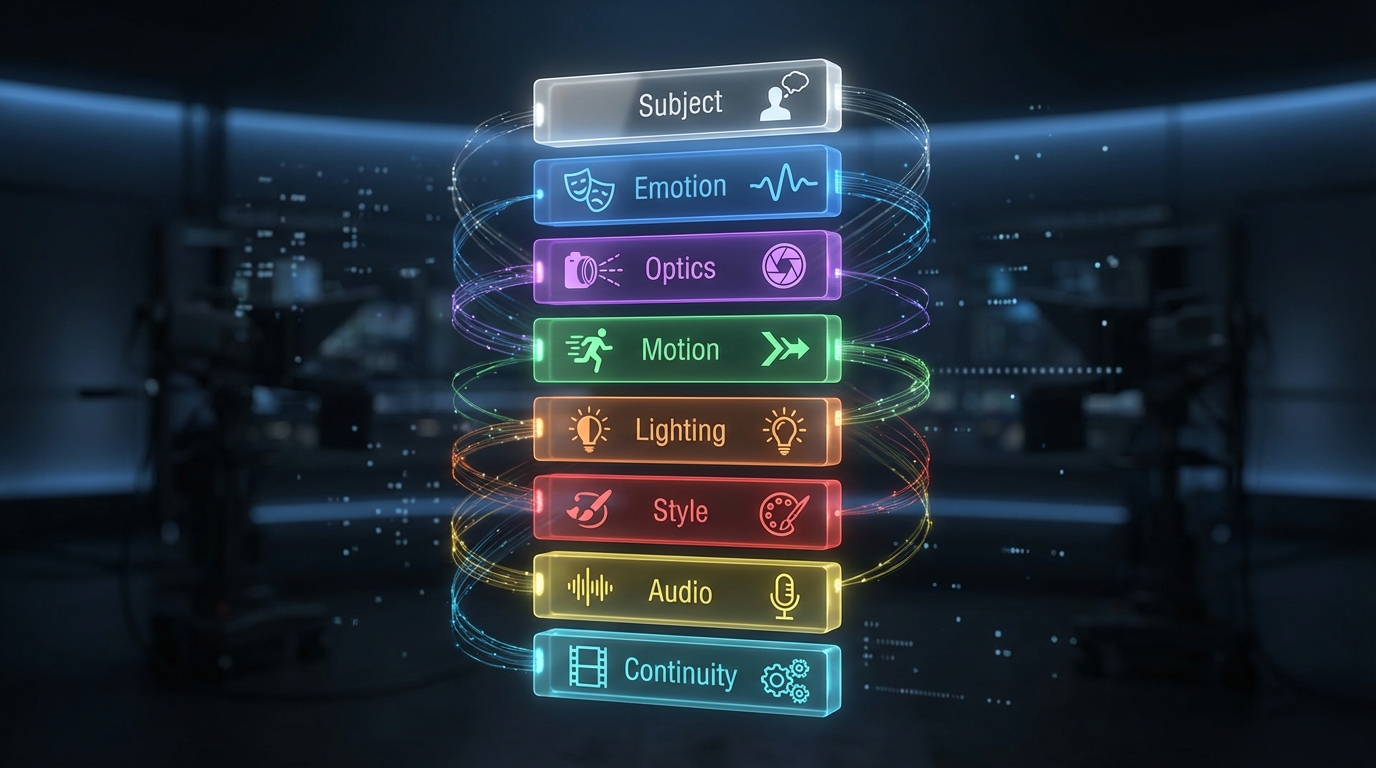
- Master the eight control layers—subject, emotion, optics, motion, lighting, style, audio, continuity—for predictable results.
- Prompt chaining and seed locking ensure multi-shot continuity and eliminate the “AI look.”
- Tailor prompts to platforms like Sora 2, Google Veo 3.1, Kling 2.6, and Runway Gen 4.5 to exploit model strengths.
- Scale production with Studio by TrueFan AI for multilingual, on-brand video at enterprise velocity.
The landscape of digital storytelling has undergone a seismic shift, making this AI video prompt engineering masterclass 2026 essential for any creator or brand looking to dominate the visual economy. In 2026, the era of “guessing” what an AI model will produce is over. We have entered the age of technical orchestration—a discipline where specified cinematic, technical, and narrative constraints guide text-to-video models like Sora 2 and Google Veo 3.1 to produce predictable, Hollywood-grade footage. For Indian YouTubers, agency creative directors, and D2C brands, mastering these text to video prompt techniques is no longer optional; it is the primary competitive advantage in a market where India’s generative AI video sector is projected to hit $1.2 billion by the end of this year.
This guide serves as your definitive cinematic AI video prompts guide, moving beyond simple aesthetic descriptors into the realm of shot grammar, continuity tokens, and motion physics. Whether you are building a product demo for a Bangalore-based startup or a cinematic B-roll for a Mumbai production house, the following playbooks and our generative video prompt library will provide the technical blueprint for success.
1. The 2026 Shift: From Aesthetic Prompting to Technical Orchestration
In 2026, the industry has moved away from “vibes-based” prompting. We now use “Technical Orchestration,” a method of composing prompts with eight distinct control layers. This shift is driven by the need for reliability in commercial workflows. According to recent 2026 industry data, 84% of Indian D2C brands now utilize AI-generated B-roll for social commerce, but only those using technical orchestration achieve a “re-shoot rate” of less than 5%.
The Eight Control Layers of 2026 Prompting
To master AI video prompt engineering 2026, you must control:
- Subject/Scene: The core entity and its environment.
- Emotion Arc: Explicit emotional tokens (e.g., “anticipation to relief”).
- Optics: Lens choice, focal length, and aperture (e.g., “35mm anamorphic, f/2.8”).
- Camera Motion: Precise vectors (e.g., “dolly-in at 0.5m/s”).
- Lighting Stack: Key, fill, and rim lighting with specific color temperatures (e.g., “5600K key, 3200K rim”).
- Style/Look: Film emulation and color grading (e.g., “Kodak Portra 400 aesthetic”).
- Audio/Mood: Cues for integrated generative audio.
- Continuity Anchors: Seeds, palettes, and wardrobe tokens to ensure multi-shot stability.
This orchestration is vital because of the computational cost and time involved. For instance, OpenAI’s Sora 2 currently takes approximately 12 minutes to generate 1 minute of high-fidelity video on an NVIDIA H100 cluster. In the Indian context, where agency margins are tight, “getting it right the first time” through context engineering generative video is a financial imperative.
Source: TrueFan AI Blog — India-focused cinematic prompting trends.
Source: Analytics India Magazine — Sora performance and render expectations.
2. Foundations: Advanced Text-to-Video Prompt Techniques & Cinematic Grammar
To excel in this advanced prompting masterclass India, one must speak the language of a Director of Photography (DP). The models of 2026, particularly Google Veo 3.1 and Runway Gen 4.5, have been trained on vast datasets of professional cinematography, meaning they respond better to technical jargon than flowery adjectives.
Optics and Framing
In 2026, we no longer just say “close up.” We specify the glass.
- Isolation: “85mm prime, f/1.4, shallow depth of field” isolates a product or face against a creamy bokeh.
- Context: “24mm wide-angle, deep focus, f/11” ensures the entire Mumbai skyline is sharp behind the subject.
- Blocking: Use directives like “rule of thirds alignment” or “negative space on the right for H1 text overlay” to prepare your video for editors.
Emotion Control Prompts AI Video
A major content gap in previous years was the lack of micro-expression control. In 2026, we use “Emotion Tokens.” Instead of “happy person,” use: “Subject exhibits a micro-smile, eye glint, and relaxed brows; transition from restrained excitement to pure satisfaction at 0:04.” This level of detail is what separates amateur content from professional-grade storytelling.
Context Engineering for the Indian Market
Context engineering generative video involves embedding cultural and regional signals. For an Indian audience, this means specifying:
- Lighting: “Warm amber glow of Diwali diyas, 2700K color temp, soft bokeh.”
- Locale: “Backdrop of Bandra-Worli Sea Link, evening haze, cinematic teal-orange grade.”
- Localization: “Include Hindi lower-third text ‘नया भारत’ in Montserrat Bold, 10% opacity.”
By using these best prompts for AI video 2026, creators can ensure their content resonates locally while maintaining global production standards.
Source: YourStory India — Google Veo 3.1 capabilities and cinematography.
Source: TrueFan AI Blog — Cinematic control layers.
3. Narrative Mastery: Multi-Shot Continuity and Prompt Chaining
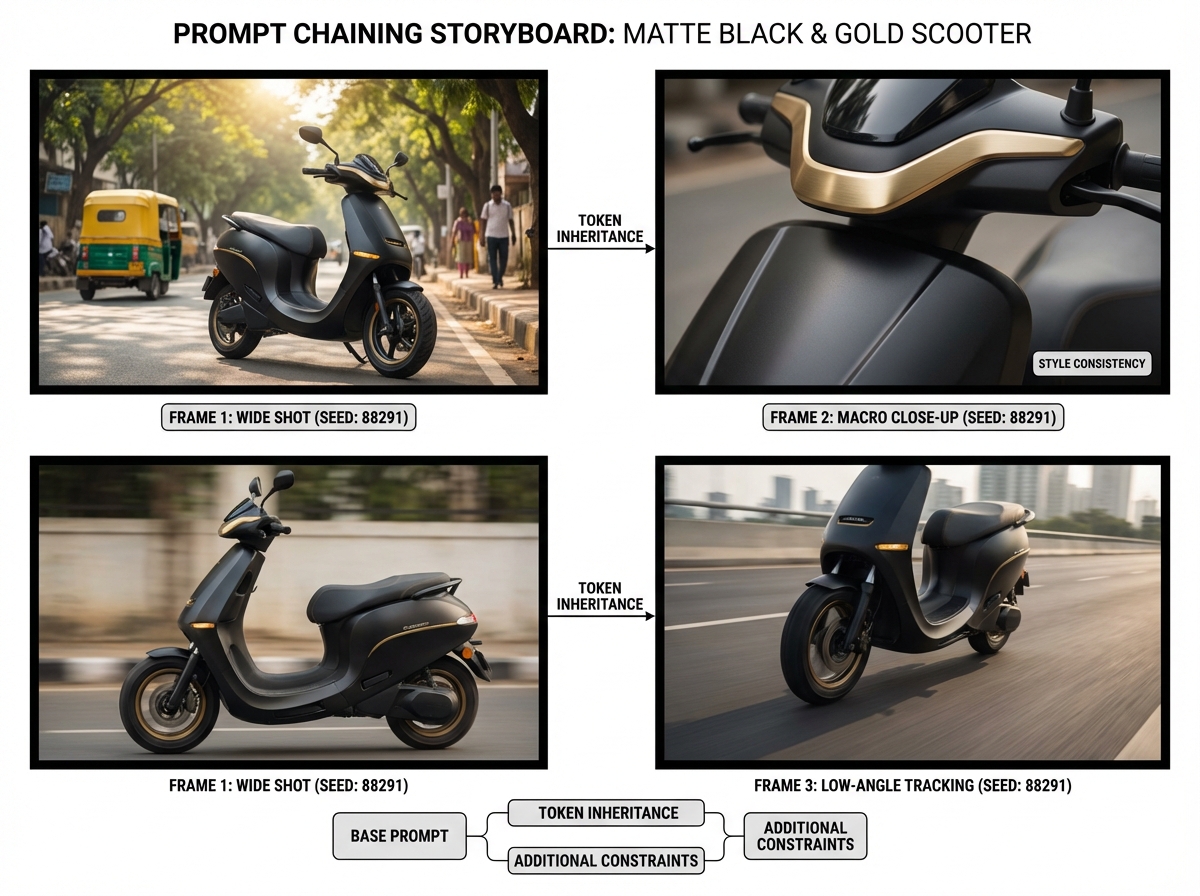
The biggest hurdle in AI video has always been consistency. Prompt chaining video generation is the 2026 solution to this problem. This technique involves creating a sequence of shots where each prompt “inherits” tokens from the previous one to maintain a cohesive look.
The Multi-Shot Video Prompt Engineering Workflow
- The Anchor Shot: Generate your “Hero” shot first. Extract the Seed ID and the specific descriptors for the subject (e.g., “Subject: Matte black electric scooter, gold trim, Seed: 88291”).
- Token Inheritance: Every subsequent prompt must include the Anchor Tokens. If the scooter is matte black in Shot 1, Shot 2 (the close-up) must specify “matte black texture, gold trim” to prevent the AI from “hallucinating” a glossy finish.
- Motion Vectoring: Ensure camera movement is logical. If Shot 1 is a “dolly-in,” Shot 2 should not be a “fast whip-pan” unless it’s a stylistic choice. Consistent motion vectors (e.g., always moving left-to-right) create a professional flow.
Prompt Chaining Example (3-Shot Sequence)
- Shot 1 (Establish): “Wide shot of a modern Bangalore cafe, morning sunlight 5000K, 35mm, static tripod. Subject: Woman in a cream linen saree drinking coffee. Seed: 1024.”
- Shot 2 (Detail): “Macro shot of the coffee cup, steam wisps, 100mm macro, f/2.8. Maintain morning sunlight 5000K, cream linen saree visible in blurred foreground. Seed: 1024.”
- Shot 3 (Action): “Medium shot of the woman smiling, eye glint, 50mm, slow pan right. Maintain cream linen saree, Bangalore cafe background. Seed: 1024.”
This method of multi-shot video prompt engineering ensures that the “AI look”—where characters or objects change slightly between cuts—is completely eliminated.
Source: TrueFan AI Blog — Agentic and multi-step prompting workflows.
4. Platform Playbooks: Sora 2, Veo 3.1, Kling 2.6, and Runway Gen 4.5
Each AI model in 2026 has a “personality.” To get the most out of your cinematic AI video prompts guide, you must tailor your language to the specific platform.
Sora 2 Prompt Optimization Guide
- Strength: Fluidity and “Inertia.”
- Pro-Tip: Use physics-based descriptors. “Realistic liquid viscosity,” “cloth simulation with wind resistance,” or “180-degree filmic motion blur.”
- India Template: “Cinematic tracking shot of a Royal Enfield on the Manali highway, realistic tire-tread displacement, mountain mist physics, 35mm anamorphic, Seed: 552.” Reference
Google Veo 3.1 Prompt Templates India
- Strength: Adherence to camera directions.
- India Template: “Tabletop macro of a gold jewelry set, 100mm, slow orbit 15 deg/sec, soft rim light 3000K, reflective black acrylic base. Emotion: Luxury and Elegance.”
- Note: Veo 3.1 has seen massive adoption in India due to its cloud availability. Reference
Kling AI 2.6 Best Prompts
- Strength: Human-centric realism.
- Pro-Tip: Use “Negative Prompts” to avoid the “waxy” look. “Negative: plastic skin, rubbery motion, ghosting.”
- India Template: “Close-up of a chef’s hands kneading dough in a Delhi street food stall, 60fps slow motion, steam particles, natural daylight, high texture detail.”
Runway Gen 4.5 Prompt Guide
- Strength: Control and Reference Frames.
- Pro-Tip: Use “Frame-safe” tokens. “Keep center 40% clear for logo,” or “Match cut on motion vector from Shot A.”
- India Template: “D2C skincare product reveal, whip-pan transition, teal-orange grade, 9:16 aspect ratio for Instagram Reels, professional video prompts India.” Reference
Source: Analytics India Magazine — Google Veo on Vertex AI.
Source: Analytics India Magazine — Market competition and Sora release context.
5. The India-Ready Generative Video Prompt Library
To accelerate your workflow, we have compiled a generative video prompt library specifically tuned for the Indian market. These are “copy-paste” blocks that you can modify for your specific brand needs. Studio by TrueFan AI’s 175+ language support and AI avatars allow for the seamless integration of these cinematic prompts into global campaigns, ensuring that your high-quality B-roll is matched with equally high-quality localized narration.
Category: D2C Product Hero (Tech/Gadgets)
Prompt: “Studio-lit macro tabletop shot of [Smartphone/Watch], 50mm prime f/1.8 bokeh, soft rim light, slow dolly-in 0.2 m/s, reflective acrylic base, Hindi lower-third (‘नया अपग्रेड’), subtle sitar-electronica score, modern DTC aesthetic. Emotion: Curiosity to Satisfaction. Seed: 42. Negative: messy background, jitter, aliasing.”
Category: Beauty & Lifestyle (Skincare/Fashion)
Prompt: “Extreme close-up of [Subject] applying serum, skin-safe lighting 3:1 ratio, 100mm macro, gentle pan. Tamil VO hook, warm amber grade, 60fps. Texture: realistic skin pores, no waxy sheen. Seed: 901.”
Category: Food & Beverage (Restaurant/Delivery)
Prompt: “Hot steam wisps rising from a plate of Biryani, 60fps slow motion, Telugu captions, rich saturation, natural wood texture, 35mm. Lighting: 5600K key with 3200K backlight for steam definition. Seed: 773.”
Category: Festival & Seasonal (Diwali/Eid/Onam)
Prompt: “Cinematic bokeh of Diwali lamps in a modern Indian living room, family warmth, 85mm f/1.2, golden hour grade, slow tracking shot. Continuity: Maroon and gold color palette. Seed: 110.”
By using this generative video prompt library, creators can reduce their iteration time by up to 60%, allowing more time for creative strategy and less time on technical troubleshooting.
6. Enterprise Scaling: Operationalizing Prompts with Studio by TrueFan AI
While mastering individual prompts is essential for creators, enterprises need a way to scale this output across thousands of variants. This is where the transition from “prompting” to “production” happens. Platforms like Studio by TrueFan AI enable creators to bridge the gap between AI-generated B-roll and localized, high-conversion marketing assets. Learn more in our multimodal AI video creation 2026 guide.
The ROI of AI Video Orchestration
In 2026, the metric for success isn’t just “how good it looks,” but “how fast it converts.” Solutions like Studio by TrueFan AI demonstrate ROI through a 70% reduction in production time while maintaining 4K output quality. For an Indian enterprise, this means:
- Multilingual Scaling: Taking a single cinematic B-roll generated via Sora 2 and using Studio by TrueFan AI to overlay 175+ different languages with perfect lip-sync.
- Avatar Integration: Combining your custom-prompted backgrounds with licensed virtual human avatars who act as brand spokespersons.
- Governance: Ensuring every video generated follows brand-safe guidelines, includes mandatory watermarking, and adheres to ISO 27001 standards.
Workflow Integration
- Ideation: Use our advanced prompting masterclass India techniques to storyboard.
- Generation: Use Sora 2 or Veo 3.1 for the cinematic “Hero” footage.
- Localization: Import the footage into Studio by TrueFan AI.
- Personalization: Use APIs to generate 5,000 unique versions of the video, each addressing a customer by name in their regional language (Marathi, Bengali, Kannada, etc.).
- Distribution: Deploy via WhatsApp API or social channels directly from the platform.
7. Expert FAQs & The Future of AI Cinematography
As we conclude this AI video prompt engineering masterclass 2026, it is important to address the practical blockers that still face creators today.
Conclusion
The era of AI video is no longer about the “magic” of generation; it is about the “precision” of engineering. By mastering technical orchestration, prompt chaining, and the specific playbooks for Sora, Veo, Kling, and Runway, Indian creators can now produce content that rivals global cinema.
Ready to take your production to the next level? Download our full generative video prompt library and start operationalizing your creative vision today. For enterprises looking to scale, book a demo with TrueFan AI to see how our Studio can transform your cinematic prompts into a global localized powerhouse.
Frequently Asked Questions
How do I maintain character consistency across multiple shots?
Consistency is achieved through “Seed Locking” and “Continuity Tokens.” Always use the same Seed ID for a sequence and describe the subject using identical keywords (e.g., “blue linen shirt, silver watch”) in every prompt. Reference frames are also essential in 2026 models to “guide” the AI on the subject’s appearance.
How can I scale these prompts for a multilingual audience?
Use Studio by TrueFan AI to take a single prompt-generated video and localize it into 175+ languages with perfect lip-sync. This lets you craft one cinematic prompt and let the platform handle high-quality regional variations for the Indian market. Learn more in our multimodal AI video creation 2026 workflow.
What is the best way to handle AI artifacts like warped hands or flickering?
Use a strong “Negative Prompt” stack: “Negative: warped anatomy, flickering lights, floating objects, low resolution, motion blur (unless specified), rubbery skin.” Generating at 60fps and downsampling to 24fps in post can also smooth minor motion jitters.
How do I calculate render budgets for large campaigns?
Plan for roughly 12–15 minutes of render time per 60 seconds of video on high-tier models like Sora 2. For urgent projects, Google Veo 3.1 on Vertex AI offers “Turbo” modes that reduce this to under 3 minutes, with a modest trade-off in temporal complexity.
Is prompt engineering still a viable career in 2026?
Absolutely. Demand for technical directors who understand multi-shot video prompt engineering and context engineering generative video has surged in India. Brands need experts who can guarantee a specific “look and feel,” not just cool AI clips.