AI Video Prompt Engineering 2026: An Advanced Prompt Masterclass for Pro Filmmakers in India
Estimated reading time: ~13 minutes
Key Takeaways
- 2026 shifts from aesthetic prompting to technical orchestration with layered directives, agents, and tool-integrated planning.
- Use an 8-point Shot Grammar scaffold (subject, emotion, optics, motion, lighting, style, audio, continuity) for consistent, cinematic outputs.
- Tailor prompts to engines: Sora 2 for temporal coherence, Veo 3 for camera arcs, and Runway Gen-4 for reference-led continuity.
- Advanced workflows rely on prompt chaining and multi-step reasoning agents to deliver brand-safe, scalable narratives.
- Enterprises scale localization and compliance with platforms like Studio by TrueFan AI, enabling 175+ languages and AI avatars.
- Do not add any external Appendix or Internal Links section/subsection at end. If it is already added by writer then skip it and do not add it in Table fo Contents
The landscape of digital storytelling has undergone a seismic shift, making AI video prompt engineering 2026 the most critical skill for creators today. We have moved past the era of “lucky generations” and entered the age of technical orchestration. For professional filmmakers, enterprise producers, and high-growth marketing agencies in India, the ability to command models like Sora 2, Google Veo 3, and Runway Gen-4 with surgical precision is no longer optional—it is the baseline for production-grade output.
By the end of 2026, the Indian AI video market is projected to reach a staggering $1.2 billion, with businesses using AI-driven video marketing reporting an average 82% increase in ROI compared to traditional production methods. This masterclass is designed to take you beyond basic text-to-video commands into the realm of multi-step reasoning, context engineering, and cinematic shot grammar. Whether you are producing a high-budget commercial for a Mumbai-based BFSI giant or a localized social campaign for a QSR brand in Bengaluru, these frameworks will ensure your outputs are consistent, controllable, and culturally resonant.
Source: Kantar Marketing Trends 2026
1. The 2026 Paradigm Shift: From Aesthetic Prompting to Technical Orchestration
In 2024 and 2025, prompt engineering was often viewed as a creative exercise—a search for the “magic words” that would yield a beautiful image. In 2026, the industry has matured into technical orchestration. This shift is defined by three core pillars: layered directives, agentic workflows, and tool-integrated planning.
The Rise of Agentic AI Systems
The most significant change in 2026 is the emergence of agentic AI systems and multi-step reasoning video AI. We no longer expect a single prompt to generate a finished 60-second film. Instead, professional workflows now utilize “agents” that convert a creative brief into a beat sheet, the beat sheet into a shot list, and the shot list into a series of prompt chaining video generation sequences. This hierarchical approach has reduced manual iteration cycles by 4.5x, allowing creators to focus on high-level direction rather than fighting the model for consistency.
Context Engineering and Reliability
Reliability at scale is now achieved through context engineering video creation. This involves providing the AI with persistent “Style Bibles” and “Brand LUTs” via Model Context Protocol (MCP) or Retrieval-Augmented Generation (RAG). By grounding the AI in specific brand constraints—such as the exact hex codes for a Diwali campaign or the specific architectural style of a South Indian temple—creators ensure that every generated frame adheres to the project's visual identity.
The Indian Landscape: Access and Localization
India has become a primary battleground for AI video dominance. With Google Veo 3's full rollout in India and Sora 2’s enhanced support for regional nuances, Indian creators now have access to tools that understand the specific textures of the monsoon, the complex lighting of sodium-vapor street lamps in Kolkata, and the micro-expressions required for a respectful Hindi-language customer service avatar. Platforms like Studio by TrueFan AI enable these creators to bridge the gap between global technology and local cultural resonance, providing the infrastructure needed to scale these advanced prompting techniques across 175+ languages.
2. Cinematic AI Video Prompts: The Universal Shot Grammar Framework
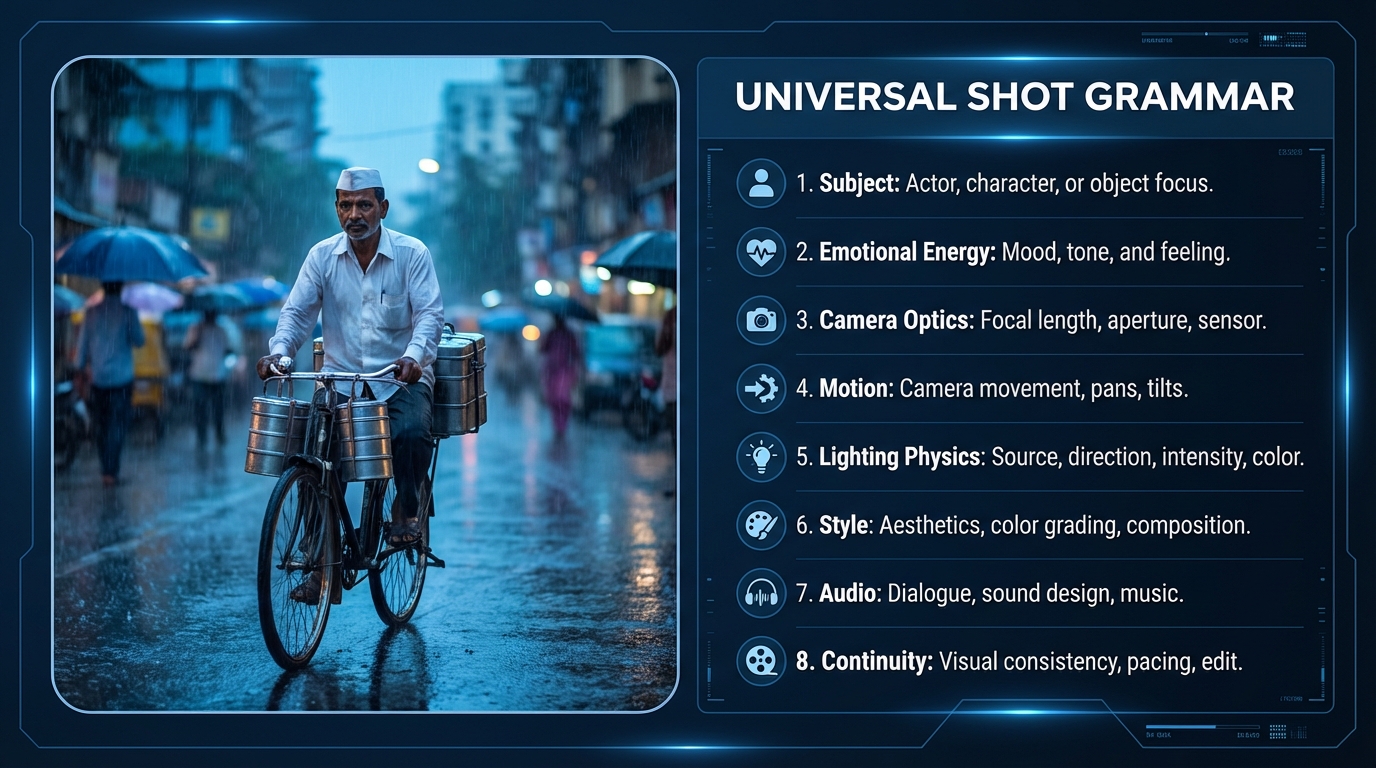
To achieve pro-grade results, you must speak the language of the camera. The “Shot Grammar” framework is a structured, production-ready scaffold that translates traditional film logic into directives that 2026 models obey. Use this 8-point scaffold for every prompt:
- Subject and Action: Define the “who” and the specific, physics-based behavior.
- Emotional Energy: Specify the target performance (e.g., “micro-expressions of relief,” “pacing with nervous energy”).
- Camera Optics: Define the lens (35mm anamorphic, 85mm prime), depth of field, and focus racks.
- Motion: Specify camera moves (dolly-in, crane shot, parallax) and subject blocking.
- Lighting Physics: Define the key, fill, and rim lights, color temperature (3200K vs 5600K), and volumetrics (fog, dust motes).
- Style and Color Science: Reference specific film stocks (Kodak 2383) or LUTs (Teal-and-Orange).
- Audio Targets: Define the ambient bed, foley cues, and on-beat transitions.
- Continuity Constraints: Lock in wardrobe, props, and time-of-day tokens.
The “Dabbawala” Example
The Prompt: “A Mumbai Dabbawala [subject] cycles through monsoon-soaked lanes [scene] at blue hour; 35mm anamorphic lens with shallow DoF [optics]; slow dolly-in with slight parallax [motion]; sodium-vapor rim lighting + soft key 5600K [lighting]; documentary realism style, light drizzle foley with bicycle bell chime [audio]; wearing a white Gandhi topi and Nehru jacket [continuity].”
By using this structured approach, you provide the AI with the necessary constraints to maintain physics and temporal logic. This is the foundation of the best prompts text to video for professional use.
Source: Mastering AI Video: Complete 2026 Prompt Engineering Guide - Vidwave
3. Platform Deep Dives: Sora 2, Veo 3, and Runway Gen-4
Each major platform in 2026 has a unique “latent personality.” To master AI video prompt engineering 2026, you must tailor your prompts to the specific strengths of each engine.
Sora 2 Prompt Optimization Guide: Temporal Coherence
Sora 2 is the industry leader in temporal consistency and complex physics. It excels at maintaining the identity of an object across long durations.
- Optimization Tip: Use “Shot Stacks.” Instead of one long prompt, use a sequence of temporal beats (Beat 1: Subject enters; Beat 2: Subject reacts; Beat 3: Subject exits).
- India Context: Perfect for short-form social narrative ads where a character needs to move through a crowded market without their face or clothing changing.
- Key Phrase: “Maintain fluid dynamics of the silk saree as the character turns; lock seed for wardrobe consistency.”
Google Veo 3 Prompt Templates: Camera Arcs and Native Audio
Veo 3 is optimized for dynamic camera movement and integrated audio-visual synchronization.
- Template Block: [Camera Arc] + [Subject Blocking] + [Audio Cue].
- Example: “Camera arcs 180-degrees around a Lucknow artisan; footsteps on stone floor synced to the visual beat; 2.39:1 aspect ratio.”
- India Context: Use Veo 3 for high-energy retail promos where the camera needs to “dance” with the product.
Runway Gen 4 Prompting Techniques: Reference-Led Continuity
Runway Gen-4 has doubled down on “Reference Matrices.” It is the best tool for creators who have a specific “Look Bible” or mood board.
- Technique: Use Image-to-Video (I2V) with a 6-still reference matrix. Provide the AI with a key color palette, a wardrobe reference, and a lighting ratio still.
- India Context: Ideal for corporate BFSI explainers where the “brand look” (e.g., specific shades of blue and gold) must be non-negotiable across 50 different video assets.
Source: Google brings Veo 3 to India - Analytics India Magazine
4. Kling AI 2.6 & Emotion Control: The Art of Avatar Realism
In 2026, the “Uncanny Valley” has been bridged through emotion control prompts avatars. Kling AI 2.6 has emerged as the specialist for high-fidelity human performance, particularly for presenter-led content.
Directing Micro-Expressions
Professional prompting now involves directing the AI avatar like a human actor. You are no longer just asking for a “happy person”; you are specifying the activation of the orbicularis oculi (the muscles around the eyes) to create a genuine Duchenne smile.
- The Performance Prompt: “Presenter maintains a confident gaze; subtle brow knit at the 4-second mark to emphasize the problem; relax shoulders and deliver a warm cheek-raise smile during the solution reveal.”
Bilingual Delivery and Cultural Nuance
For the Indian market, Kling 2.6 allows for unprecedented control over regional accents via AI voice cloning for Indian accents and gestures.
- Bilingual Sync: “Deliver the line in Hindi, then repeat in English; maintain identical lip timing; retain the subtle head-tilt common in South Indian professional address; auto-generate Marathi subtitles.”
Studio by TrueFan AI's 175+ language support and AI avatars leverage these advanced Kling-style capabilities, allowing brands to take a single master performance and localize it for every state in India without losing the emotional “soul” of the delivery. This is essential for building trust in sectors like rural banking or healthcare, where the “human touch” is paramount.
5. Advanced Orchestration: Prompt Chaining and Multi-Step Reasoning
The most sophisticated creators in 2026 do not write prompts; they build systems. This involves prompt chaining video generation and the use of multi-step reasoning video AI.
The Chaining Workflow
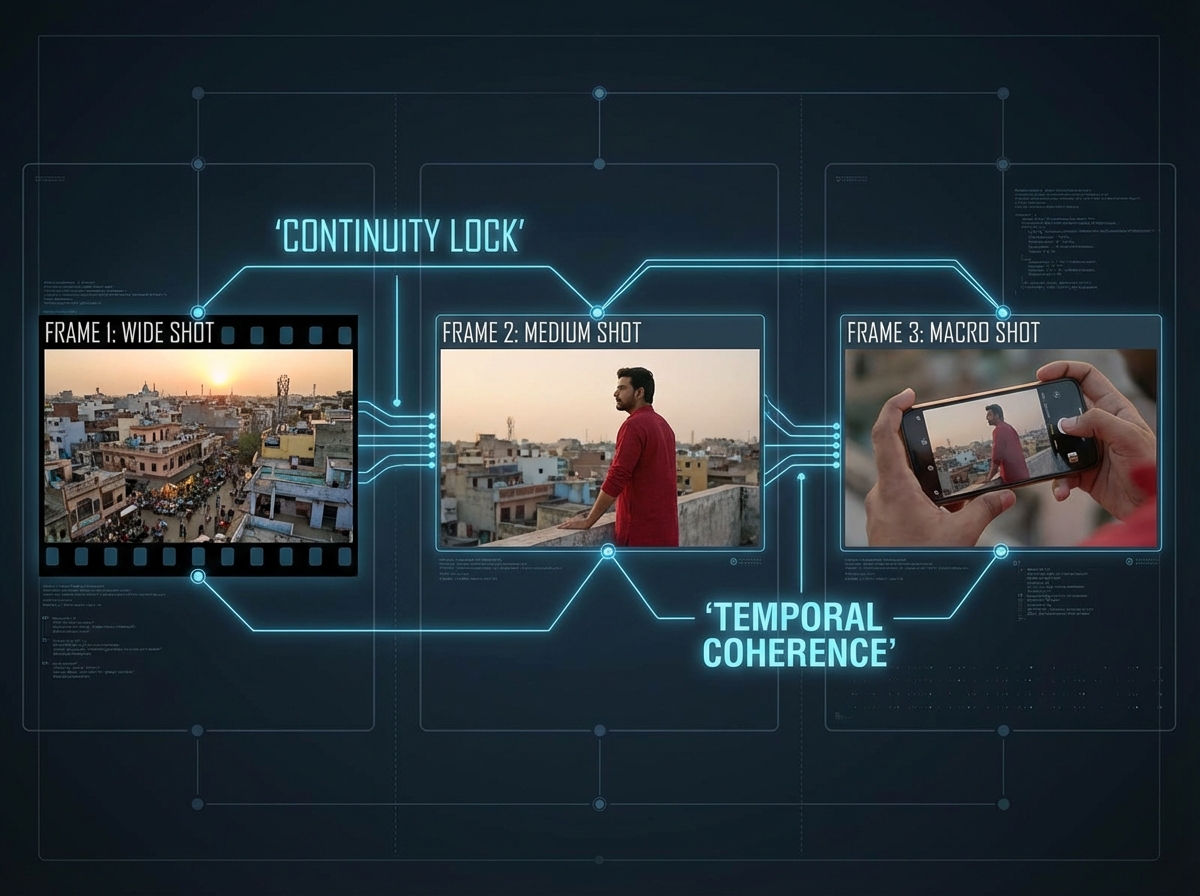
Prompt chaining is the process of breaking a narrative into logical beats and ensuring that the output of “Shot A” informs the parameters of “Shot B.”
- The Global Constant: Define a “Continuity Lock Sheet” (e.g., “Time: 6:00 PM; Weather: Pre-monsoon haze; Wardrobe: Red cotton Kurta”).
- The Shot Sequence:
- Shot 1 (Establishing): Wide shot of a Delhi rooftop; 24mm; drone-style descent.
- Shot 2 (Medium): Character in Red Kurta looks at the horizon; 50mm; match lighting from Shot 1.
- Shot 3 (Macro): Close-up of hands holding a phone; match skin tone and lighting.
Multi-Step Reasoning Agents
Multi-step reasoning AI acts as a “Digital Director.” You provide a high-level brief (e.g., “Create a 15-second ad for a new UPI app feature”), and the AI reasons through the steps:
- Step 1 (Planner): Drafts a script based on the target audience (Gen Z in urban India).
- Step 2 (Director): Converts the script into a shot list with specific lens and motion directives.
- Step 3 (QA Agent): Evaluates the generated clips for physics errors or brand violations.
This agentic approach ensures that the final video isn't just a series of pretty pictures, but a coherent narrative that follows the rules of visual storytelling.
6. Context Engineering & Enterprise Production with Studio by TrueFan AI
For large-scale enterprises, the challenge isn't making one great video—it’s making ten thousand personalized ones. This is where context engineering video creation meets industrial-scale infrastructure.
The Enterprise Style Bible
In 2026, enterprise teams use “Context Packs” that are automatically injected into every prompt. These packs include:
- Visual Grounding: RAG-retrieved images of the actual product or office location.
- Legal Compliance: Mandatory disclaimers for BFSI or healthcare ads, formatted correctly for regional languages.
- Cultural Guardrails: Ensuring that festive motifs (like Diwali diyas or Holi colors) are used respectfully and accurately according to regional traditions.
Scaling with Studio by TrueFan AI
Solutions like Studio by TrueFan AI demonstrate ROI through their ability to orchestrate these complex variables into a seamless, browser-based workflow. By centralizing prompt libraries and providing a “walled garden” for brand safety, the platform allows marketing teams to:
- Automate Personalization: Generate thousands of videos where the avatar addresses the customer by name and mentions their local city.
- Ensure Compliance: Real-time filters prevent the generation of off-brand or non-compliant content, a critical requirement for the regulated Indian market.
- Rapid Deployment: With 30-second render times and direct WhatsApp API integration, a campaign can go from “Prompt Idea” to “Customer Inbox” in minutes.
By integrating advanced prompt masterclass India techniques with a robust platform, enterprises can finally achieve the “Segment of One” marketing dream without the “Segment of One” price tag.
7. The 2026 Pro Toolkit: FAQ & Implementation Checklist
To wrap up this masterclass, we have compiled the most frequently asked questions from professional creators transitioning to 2026 workflows.
Frequently Asked Questions
Q1: How do I prevent “identity drift” in characters across different shots?
Identity drift is best managed through “Seed Locking” and “Token Anchoring.” In your Sora 2 prompt optimization guide, always include a highly specific string of physical descriptors (e.g., “scar on left cheekbone,” “vintage silver watch with cracked glass”) and reuse these exact tokens in every shot. If the platform supports it, use the same seed number for the entire sequence.
Q2: What is the best way to handle lip-sync for Indian regional languages?
Lip-sync in 2026 is syllable-timed. When prompting for languages like Tamil or Bengali, ensure your script includes phonetic pauses. Studio by TrueFan AI handles this automatically by using professional voice-cloning models that are natively trained on the rhythmic structures of 175+ languages, ensuring the mouth movements match the specific phonemes of the regional dialect.
Q3: Can I use AI to generate the prompts themselves?
Yes, this is the core of multi-step reasoning video AI. You should use a “Director Agent” (a specialized LLM) to expand your creative brief into the “Shot Grammar” scaffold. Never write a raw prompt from scratch for a professional project; always use a reasoning agent to ensure all technical constraints (optics, lighting, motion) are included.
Q4: How do I ensure my AI videos don't look “too digital” or “plastic”?
The “plastic” look usually comes from a lack of physics-based lighting and texture. Add tokens for “micro-imperfections,” “lens flare,” “film grain,” and “volumetric dust.” Specifically, directing the AI to use a “soft key light at 5600K” rather than “bright lighting” will create more natural skin tones.
Q5: What are the legal implications of using AI avatars in India?
The Ad Standards Council of India (ASCI) requires clear disclosure for AI-generated content. Furthermore, you must ensure you have the rights to the likenesses used. This is why professional teams prefer licensed libraries. For instance, Studio by TrueFan AI uses a consent-first model with real influencers as AI avatars, ensuring 100% legal compliance and ethical peace of mind for brand campaigns.
The 2026 Implementation Checklist
- [ ] Define the Context: Is the Style Bible and RAG pack loaded?
- [ ] Select the Engine: Sora 2 for physics? Veo 3 for audio? Gen-4 for style?
- [ ] Apply the Scaffold: Does the prompt cover all 8 points of the Shot Grammar?
- [ ] Orchestrate the Chain: Are the continuity tokens consistent across the beat sheet?
- [ ] Direct the Emotion: Are micro-expressions and gaze behaviors specified?
- [ ] QA the Output: Check for temporal consistency and regional cultural accuracy.
The future of filmmaking in India is not about replacing the director; it is about giving the director a more powerful baton. By mastering AI video prompt engineering 2026, you are not just generating clips—you are architecting experiences.
Source: Hyscaler Insights: Prompt Engineering Best Practices
Conclusion
AI video in 2026 rewards precision, not luck. By adopting Shot Grammar scaffolds, platform-specific tactics, and agentic prompt-chaining workflows—then operationalizing them with enterprise context packs and Studio by TrueFan AI—Indian creators can deliver consistent, localized, and legally compliant stories at scale. Master the orchestration, and your outputs will match the ambition of your brief.
Frequently Asked Questions
How do I choose between Sora 2, Veo 3, and Runway Gen-4 for a project?
Use Sora 2 for long temporal coherence and physics, Veo 3 for dynamic camera arcs and audio sync, and Runway Gen-4 when you need strict visual continuity from reference matrices or brand look-bibles.
What’s the quickest way to localize a single master video for multiple Indian languages?
Create a master performance, lock continuity tokens, and localize VO/subtitles via Studio by TrueFan AI with region-specific accents and on-brand disclaimers using context packs.
How can I enforce brand safety and legal compliance at scale?
Centralize prompts, LUTs, and disclaimers in an enterprise “Style Bible,” enforce QA agents for physics/brand checks, and deploy real-time policy filters within platforms like Studio by TrueFan AI.
What are the most common prompt mistakes that cause “digital” visuals?
Vague lighting and optics. Specify key/fill/rim ratios, color temperatures, lens types, and micro-imperfections (grain, dust, lens flare) to restore naturalism.
How do I maintain continuity across multi-shot sequences?
Define a Continuity Lock Sheet (time, weather, wardrobe), reuse precise descriptor tokens, and lock seeds where supported. Chain outputs so Shot B consumes parameters from Shot A.



