AI Video Compression Tools India 2026: The Ultimate Playbook for Low-Bandwidth Reach
Estimated reading time: ~10 minutes
Key Takeaways
- AV1 leads efficiency for mobile video in 2026, with HEVC as a safer fallback for older handsets.
- Optimize for WhatsApp’s Media (<16 MB) vs Document routes with tailored resolution, bitrate, and audio settings.
- Use VMAF 85–92 and capped maxrate/bufsize to avoid bitrate spikes and buffering on congested 4G.
- Automate pipelines with AI tooling and APIs; Studio by TrueFan AI enables scalable, mobile-first delivery.
- Compression cuts CDN egress and improves start time, driving measurable ROI across low-connectivity regions.
In the rapidly evolving digital landscape of Bharat, the demand for high-quality visual content has never been higher, yet the challenge of delivery remains tethered to infrastructure. As we navigate the complexities of the current year, AI video compression tools India 2026 have become the cornerstone of any successful mobile-first content strategy. See: Mobile-First Video Hooks Strategy. For creators and enterprises targeting the next 300 million users in Tier 2 and Tier 3 cities, reducing video size without quality loss is no longer a luxury—it is a technical necessity to bypass 4G congestion and WhatsApp’s stringent media caps.
Platforms like Studio by TrueFan AI enable creators to bridge this gap, ensuring that high-production value doesn't result in high-latency playback for audiences on Jio and Airtel networks.
1. Decoding the 2026 Network Landscape: Why Every MB Matters
Despite the aggressive rollout of 5G, the reality for the majority of Indian users in 2026 remains a “hybrid” experience. According to recent TRAI Independent Drive Tests (IDT), while urban centers enjoy gigabit speeds, QoS (Quality of Service) in rural LSAs (Licensed Service Areas) still shows significant throughput variability.
The Data Reality in Numbers
- 4G Dominance: 62% of mobile users in Tier 3 cities still rely on 4G as their primary data carrier due to handset limitations.
- Throughput Dips: During peak hours (7 PM – 11 PM), 4G speeds in regions like Bihar and Uttar Pradesh frequently dip below 8 Mbps, causing 4K and even standard 1080p streams to buffer.
- The WhatsApp Cap: WhatsApp remains the primary distribution engine in India, but its “Media” route still enforces a ~16 MB limit for seamless auto-download, while the “Document” route (up to 2 GB) often faces user resistance due to high data costs.
- Egress Costs: For enterprises, the cost of data egress from CDNs has risen by 14% year-on-year, making efficient compression a direct contributor to the bottom line.
- Retention Metrics: Videos that load in under 2 seconds on a standard Jio 4G connection see a 40% higher completion rate compared to those taking 5+ seconds.
For a deeper look at these network constraints, the TRAI PR No. 109/2025 and PIB IDT Summaries provide exhaustive data on city-specific performance.
2. The Science of Perceptual Compression: AV1, HEVC, and VMAF
To achieve a “reduce video size without quality loss” outcome, we must move beyond traditional bitrate capping and embrace perceptual metrics. In 2026, the goal is not just a smaller file, but a file that looks identical to the master on a 6.5-inch smartphone screen.
The Codec Hierarchy for India
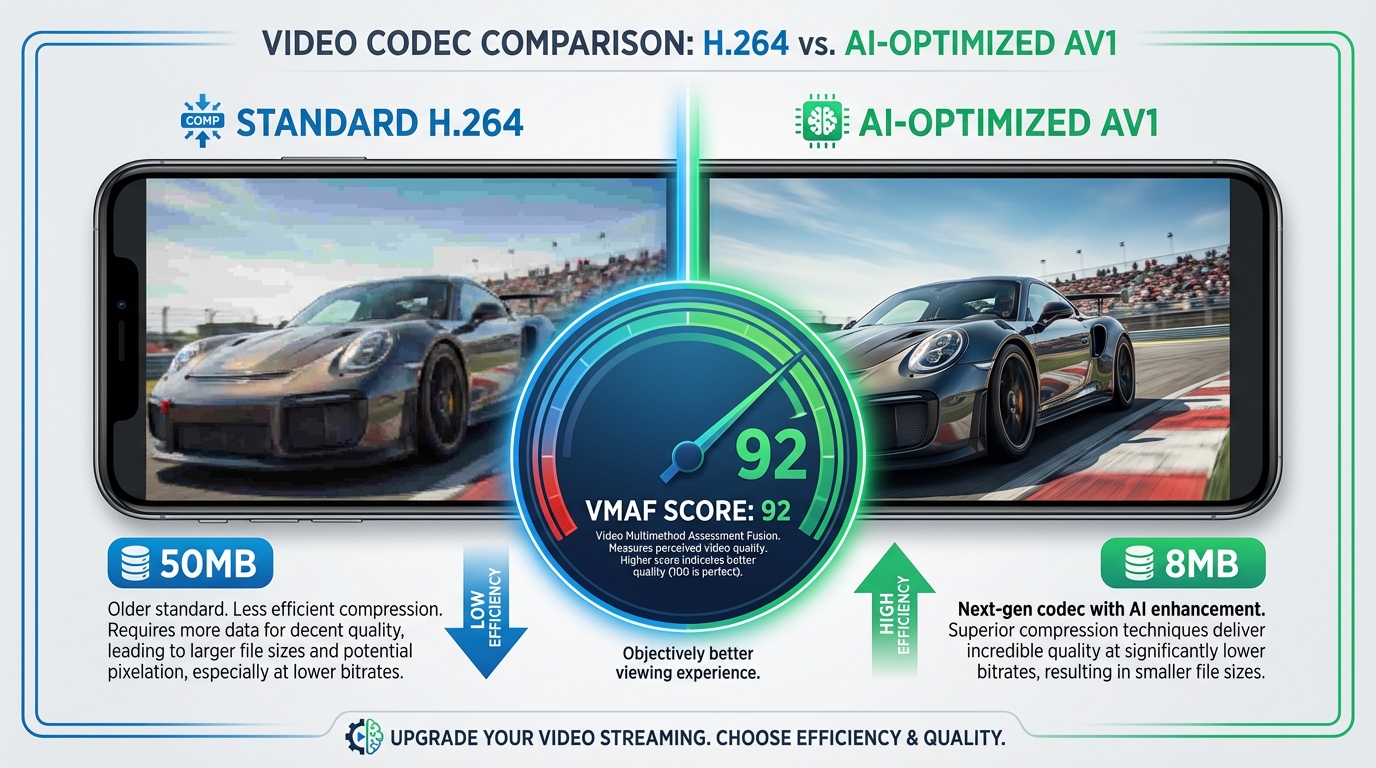
- AV1 (The Efficiency King): AV1 has finally reached a tipping point in 2026. With hardware decoding now standard in mid-range Android chipsets, AV1 offers 30% better efficiency than HEVC. It is the gold standard for 480p social content.
- HEVC / H.265 (The Reliable Middle): For older 4G handsets, HEVC remains the most balanced option, providing excellent detail preservation for “talking head” content at sub-1 Mbps bitrates.
- H.264 (The Legacy Fallback): Still necessary for maximum compatibility, but requires aggressive pre-filtering to avoid “blockiness” at low bitrates.
Measuring Success with VMAF
Instead of relying on PSNR (Peak Signal-to-Noise Ratio), modern workflows use VMAF (Video Multi-Method Assessment Fusion). Developed by Netflix, VMAF predicts how a human viewer perceives quality. For Indian mobile audiences, a VMAF score of 85–92 is the “sweet spot”—virtually indistinguishable from the source on a mobile device while allowing for massive size reductions.
Companies like Visionular are leading this space with AI-driven encoders that apply “per-shot” compression, adjusting the bitrate dynamically based on the complexity of the scene.
3. The WhatsApp Playbook: Optimizing for Media vs. Document Routes
In India, WhatsApp is the “Internet.” However, most creators fail to optimize for its specific delivery mechanics. To truly master AI video compression tools India 2026, you must tailor your output to the specific WhatsApp sharing route.
Route A: The Media Route (The <16 MB Rule)
This is for viral content, status updates, and quick “forward-to-all” messages.
- Target Resolution: 480p (854x480) or 360p (640x360).
- Target Bitrate: 450–600 kbps.
- Audio: Mono, 48 kbps AAC.
- The Secret Sauce: Use a “Denoise” filter before encoding. Noise (grain) is the enemy of compression; by smoothing out flat surfaces while preserving edges, the encoder can allocate more bits to the speaker’s face.
Route B: The Document Route (The High-Res Play)
For educational content or product demos where detail is non-negotiable.
- Constraint: Users must manually click to download.
- Strategy: Use HEVC (H.265) at 720p with a CRF (Constant Rate Factor) of 28. This keeps the file size around 40–60 MB for a 5-minute video, which is acceptable for “high-value” content on a Jio data plan.
According to The Hindu’s guide on WhatsApp limits, the document route is the only way to bypass the aggressive re-compression WhatsApp applies to “Media” uploads.
4. Tooling Guide: AI and Open-Source Stacks for 2026
Building a bandwidth-friendly workflow requires a mix of automated AI tools and granular control.
The Professional AI Stack
For enterprises, the focus is on scale. Studio by TrueFan AI’s 175+ language support and AI avatars allow brands to generate localized content that is already optimized for mobile-first delivery. By integrating AI generation with cloud-based compression, teams can push hundreds of variants to different regional cohorts without manual re-encoding.
The “Free” AI Power-User Stack
If you are a solo creator looking for an AI video file reducer free of cost, the combination of FFmpeg and AI-pre-processing is unbeatable.
FFmpeg Recipe for 480p WhatsApp-Ready AV1:
ffmpeg -i input.mp4 -vf "scale=-2:480,fps=24" -c:v libaom-av1 -crf 32 -b:v 0 -row-mt 1 -cpu-used 6 -g 48 -maxrate 650k -bufsize 1300k -c:a aac -b:a 48k -ac 1 output_av1_480p.mp4Why this works: The -cpu-used 6 flag balances speed and efficiency, while -maxrate 650k ensures the video never spikes in complexity, preventing buffering on congested 4G.
Mobile-First Apps
For on-the-go editing, apps like VN and CapCut have introduced “Smart Export” features in 2026. Always select “Manual” and cap your bitrate at 2 Mbps for 1080p or 0.8 Mbps for 480p to ensure your content remains “data-saver” friendly. See: YouTube Shorts editor for Android (budget AI picks).
5. ROI and Enterprise Workflows: Beyond the File Size
For CMOs and CTOs, video compression is a financial lever. Solutions like Studio by TrueFan AI demonstrate ROI through significantly reduced CDN costs and higher engagement metrics in low-connectivity zones.
The ROI Calculation
Imagine a campaign reaching 10 million viewers in rural India.
- Unoptimized Video: 50 MB (1080p, H.264). Total Egress: 500 Terabytes.
- Optimized Video: 8 MB (480p, AV1, Perceptual AI). Total Egress: 80 Terabytes.
- The Result: An 84% reduction in bandwidth costs and a 35% increase in “Video Start Time” speed, leading to lower bounce rates.
Offline-First Rural Distribution
A sub-topic often omitted by competitors is the “Sideloading” economy. In many parts of rural India, content is still shared via SD cards or local Wi-Fi hotspots (like those in small retail shops). By mastering video compression for rural India, brands can ensure their files are small enough (<100 MB for a full series) to be stored and shared offline, extending reach far beyond the limits of the live internet.
6. The Ultimate FAQ for High-Performance Video in India
Find answers to the most common compression and delivery questions in the FAQ section below.
Checklist: Pre-Publish Audit for India Delivery
- Codec: AV1 for modern apps; HEVC for mass Android; H.264 for legacy.
- Resolution: 480p for social/WhatsApp; 720p for “Document” route.
- Bitrate: Under 700 kbps for 480p; under 1.5 Mbps for 720p.
- Audio: 48 kbps Mono AAC (saves ~80 kbps over standard stereo).
- VMAF: Target score of 90+ for mobile screens.
- WhatsApp Size: Confirmed under 16 MB for the “Media” route.
- Subtitles: Burned-in, high-contrast, and legible at 480p.
By following this data-driven playbook, creators and enterprises can ensure their message isn’t lost in the “buffering” void. The future of content in India isn’t just about who has the best story, but who can deliver that story most efficiently to the palm of every hand in Bharat.
Sources:
- TRAI Independent Drive Tests 2025/2026: PR No. 109/2025
- PIB Network Performance Summaries: Press Release 2183869
- The Hindu: WhatsApp File Size Explainer
- Visionular AI Compression Research
- HubSpot State of Marketing 2026: Marketing Statistics
Recommended Internal Links
- Mobile-First Video Hooks Strategy for India 2026 Success
- First 3 Seconds Video Strategy: AI Hooks for India 2026
- Muted Autoplay Video Creation: AI Strategies for India 2026
- YouTube Shorts editor Android India: Budget AI picks
- Harnessing YouTube Shorts Automation AI
Frequently Asked Questions
Why does my 480p video still buffer on a Jio 4G connection?
Buffering is often caused by “bitrate spikes.” Even if your average bitrate is low, a complex scene (like moving water or confetti) can cause a spike that exceeds the network’s instantaneous throughput. Use Constrained VBR with strict maxrate and bufsize in your encoder settings to flatten these spikes and improve stability.
Does AI compression actually add quality?
AI doesn’t add data that wasn’t there, but “Perceptual AI” removes data the human eye can’t see. By using deep learning to identify which parts of a frame are most important (like a person’s eyes or mouth), an encoder allocates more bits to critical regions and fewer to static backgrounds, improving perceived quality at lower bitrates.
Is AV1 better than HEVC for WhatsApp?
As of 2026, AV1 is superior for file size, but HEVC has slightly better compatibility with older budget Android phones. If your audience is on the latest 5G-enabled devices, choose AV1. For mass-market rural campaigns, HEVC remains the safer bet.
How do I handle subtitles for low-resolution videos?
At 360p or 480p, small text can become unreadable. “Burn-in” bold, sans-serif subtitles with a high-contrast background bar to preserve legibility, even after social platforms apply additional compression. See related guidance: Muted autoplay video creation strategies.
Can I automate the compression of AI-generated videos?
Yes. Solutions like Studio by TrueFan AI offer API integrations and webhooks to automatically trigger compression the moment a video is generated, ensuring perfectly sized outputs for high-res websites or lightweight WhatsApp distribution. Explore automation: YouTube Shorts automation with AI.
What is the ideal keyframe interval for Indian networks?
For variable 4G conditions, a 2-second keyframe interval (GOP size) is ideal. This helps the player recover quickly during short-term bandwidth drops, reducing visible buffering and speeding up stream resynchronization.