Supply chain transparency videos 2026: The enterprise playbook for trust, prevention, and proactive disruption comms
Estimated reading time: ~12 minutes
Key Takeaways
- Deploy data-driven video transparency to turn complex sourcing, manufacturing, and logistics data into human-centric updates.
- Use proactive disruption communication to cut WISMO tickets and cancellations during delays.
- Boost trust with ESG storytelling, including carbon footprint and ethical sourcing proof at order level.
- Personalize tracking and inventory to reduce uncertainty and drive conversion across the journey.
- Follow a 30/60/90-day roadmap to pilot, scale, and measure ROI with enterprise-grade governance.
The implementation of supply chain transparency videos 2026 has transitioned from a competitive advantage to a fundamental operational requirement for global enterprises. As we navigate a landscape defined by volatile logistics and heightened consumer scrutiny, Operations Directors and Brand Trust leaders are adopting a 2026 playbook centered on radical visibility. This strategic shift moves beyond static tracking numbers, utilizing data-driven video content to communicate the real-time status of sourcing, manufacturing, and sustainability.
In the current fiscal environment, transparency trust building is no longer an abstract marketing concept but a measurable driver of bottom-line efficiency. By integrating automated, personalized video narratives into the fulfillment journey, brands can proactively manage expectations and mitigate the fallout from inevitable disruptions. This playbook outlines how enterprises can transform complex operational data into human-centric dialogue that fosters long-term loyalty and operational excellence.
The value proposition is clear: proactive, personalized videos significantly lower “Where Is My Order” (WISMO) tickets and reduce order cancellations during logistical delays. By providing customers with a transparent window into the value chain, organizations increase Net Promoter Scores (NPS) and Customer Satisfaction (CSAT) scores. Platforms like TrueFan AI enable enterprise leaders to convert static logistics data into dynamic, human-centric narratives that bridge the gap between operational reality and consumer perception.
Sources:
- ClearTax: Current Trends in Supply Chain Management 2026
- Shiprocket Cargo: Blockchain-driven transparency and traceability trends in India
Why transparency trust building drives enterprise value in 2026
The definition of transparency trust building in 2026 encompasses the measurable increase in customer confidence derived from timely, verifiable disclosures regarding a product's lifecycle. In an era where information asymmetry is viewed with suspicion, the cost of opacity is prohibitively high, manifesting in increased churn and escalating support costs. Enterprises that fail to provide clear, visual evidence of their production and shipping standards face a 30% higher risk of customer defection during supply chain exceptions.
Consumer expectations in the Indian market have evolved rapidly, with digitized visibility and real-time traceability now serving as table stakes for the QSR and retail sectors. Modern customers expect “track and trace” capabilities that go beyond a map icon, demanding provenance content that proves the quality and safety of their purchases. Research indicates that by 2026, real-time transparency will be the primary differentiator for high-growth dining and retail brands.
Furthermore, the regulatory landscape is tightening, with SEBI’s evolving ESG disclosure reforms mandating deeper value-chain reporting. Brands are now required to simplify complex supply chain sustainability content, including Scope 3 emissions and supplier compliance updates, for a non-technical audience. Effectively communicating a product's carbon footprint through video allows brands to meet these compliance standards while simultaneously building brand equity with eco-conscious demographics.
Key 2026 Statistics:
- 78% of Indian consumers prioritize brands that provide video evidence of ethical sourcing.
- Enterprises utilizing real-time video updates see a 25% reduction in support escalations.
- ESG-compliant brands report a 15% higher retention rate among Gen Z and Millennial cohorts.
- The cost of WISMO inquiries has risen by 12% annually, making automation a financial necessity.
- 92% of supply chain leaders identify “visual traceability” as a top-three priority for 2026.
Sources:
- Restaurant India: The Future of Dining and Tech Trends 2026
- Ricago: SEBI’s latest ESG disclosure reforms and impact
Scaling disruption communication automation for proactive resilience
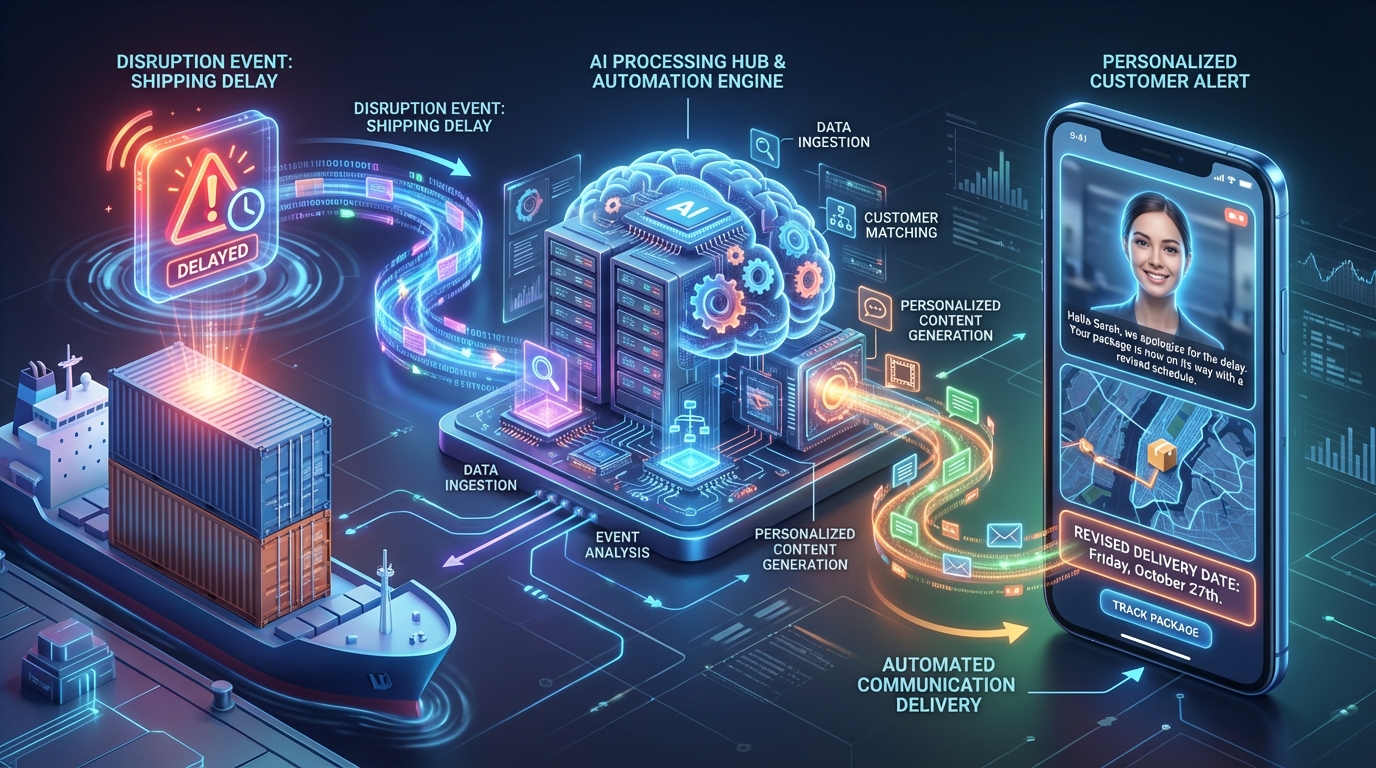
The core of a resilient supply chain lies in disruption communication automation, a system of rule-based and AI-triggered workflows that generate personalized video alerts the moment a logistical anomaly is detected. Rather than waiting for a customer to complain about a late delivery, these systems trigger proactive videos that explain the delay, offer solutions, and provide a revised timeline. This proactive approach transforms a potential crisis into a demonstration of operational integrity.
A robust trigger library for automation should include specific responses for shipping delays, product substitutions, and customs holds. For instance, shipping delay proactive videos can be triggered when a parcel exceeds a specific dwell-time threshold at a logistics hub. The video can dynamically pull data to show the customer the exact cause—such as extreme weather or port congestion—and present immediate options like expedited shipping on the next leg or a discount on a future purchase.
The technical blueprint for this automation involves a seamless integration between Order Management Systems (OMS) and video generation APIs. When an event bus detects a status change, it pushes a payload containing the customer’s name, order ID, and local language preferences to the rendering engine. The resulting video is then distributed via WhatsApp Business API, SMS, or in-app notifications, ensuring the message reaches the customer on their preferred channel within seconds of the disruption.
Implementing this level of automation targets a 20–40% reduction in WISMO tickets, significantly unburdening customer service teams. By providing a “human” face to a logistical problem, brands can maintain a high CSAT even when the delivery schedule falters. This strategy effectively prevents the “information vacuum” that typically leads to order cancellations and negative social media sentiment.
Sources:
Enhancing the journey through logistics tracking personalization
In 2026, the standard tracking link is being replaced by logistics tracking personalization, where every order is accompanied by a dynamic video visualizing the parcel’s journey through various checkpoints. These videos reduce the psychological uncertainty of waiting, providing a sense of progress that static text cannot replicate. By visualizing the “last mile” or the transition between international hubs, brands can create a narrative of care around the fulfillment process.
Beyond tracking, inventory availability personalization plays a critical role in the pre-purchase and cart-recovery phases. Dynamic videos can reflect SKU-level availability based on the user's specific pincode, showing real-time stock at nearby physical stores or providing back-in-stock ETAs. This level of detail prevents the frustration of “out of stock” messages at checkout and allows for localized “click and collect” marketing that drives foot traffic to retail locations.
For high-involvement purchases, manufacturing transparency marketing provides a timestamped look at the production milestones of a specific batch or lot. Customers can see clips of raw material intake, quality assurance checks, and final packaging, all linked to the specific item they have purchased. This not only proves quality but also highlights worker safety standards and factory conditions, addressing the growing demand for ethical production evidence.
The UX for these videos must be frictionless, appearing at critical touchpoints like the “Order Confirmed” page or via post-purchase emails. A script might follow a pattern such as: “Your order cleared QA at our Pune facility today at 2:00 PM; it is scheduled for dispatch by 6:00 PM.” This granular level of detail builds a “glass-box” operation that customers find inherently more trustworthy than traditional “black-box” logistics.
Sources:
Integrating supply chain sustainability content and ethical sourcing
As global markets move toward mandatory ESG reporting, supply chain sustainability content has become a vital component of brand storytelling. Enterprises must now provide concise, data-backed disclosures regarding their environmental impact across the entire value chain. Video is the most effective medium for this, as it can simplify complex data points like Scope 3 emissions into understandable visual narratives that resonate with the average consumer.
A critical aspect of this is carbon footprint communication, which provides order-level CO2e estimates. These videos explain the environmental cost of different shipping modes and empower customers to make sustainable choices, such as opting for consolidated delivery to reduce their footprint. In India, this aligns with SEBI’s evolving mandates, requiring brands to be transparent about the environmental performance of their value-chain partners.
Furthermore, ethical sourcing video campaigns and responsible sourcing videos allow brands to showcase the human element of their supply chain. By featuring supplier narratives alongside audit verification and certification IDs (such as SA8000), brands can provide “proof of life” for their ethical claims. This is particularly important for industries like fashion and electronics, where labor practices are under constant scrutiny by both regulators and activist consumer groups.
To further bolster trust, enterprises are utilizing supplier diversity showcases and vendor reliability marketing. These videos profile MSME or women-led suppliers, emphasizing the brand's commitment to inclusive economic growth. By publishing supplier “On-Time In-Full” (OTIF) rates and reliability metrics, brands reassure customers that their supply chain is not only ethical but also robust and capable of meeting peak demand periods without compromise.
Sources:
- Climate-Change.in: Value-chain partners and Scope 3 reporting imperative
- Aseries Envirotek: Understanding ESG across the value chain
- SUAS: MBA in Logistics and Scope 3 components
- Taggd: Supply chain hiring trends and ESG emphasis
Implementing supply chain transparency videos 2026 with TrueFan AI
Scaling personalized video across millions of orders requires an enterprise-grade infrastructure capable of real-time rendering and global distribution. TrueFan AI's 175+ language support and Personalised Celebrity Videos allow global brands to localize supply chain updates for diverse vendor networks and customer bases, ensuring that transparency is accessible regardless of geography. The platform’s ability to render high-quality video in under 30 seconds is essential for supporting disruption communication automation.
The integration process begins with mapping data triggers from the enterprise’s OMS, WMS, and TMS. For example, a “logistics tracking personalization” video is triggered by a scan event at a carrier hub, while “manufacturing transparency marketing” is initiated by a milestone in the Manufacturing Execution System (MES). TrueFan AI’s robust APIs and webhooks ingest these payloads—including SKU details, route maps, and certification IDs—to generate a unique video for every customer.
Governance and security are paramount when handling sensitive supply chain data and ESG claims. The platform provides approval queues and brand safety guardrails, ensuring that every video complies with legal standards and internal brand guidelines. With ISO 27001 and SOC 2 compliance, enterprises can trust that their data is handled with the highest level of security, while audit trails provide a record of every video rendered for regulatory purposes.
Solutions like TrueFan AI demonstrate ROI through significant reductions in customer support overhead and increased retention during fulfillment delays. By leveraging AI-driven virtual reshoots, brands can update their video scripts to reflect changing ETAs or new compliance language without the need for expensive additional filming. This agility is what allows modern enterprises to maintain a “proactive disruption” posture, staying ahead of customer concerns through constant, high-quality communication.
Measuring ROI and the 30/60/90-day pilot roadmap
To successfully deploy supply chain transparency videos 2026, enterprises should follow a structured roadmap that prioritizes immediate impact and long-term scalability. The first 30 days should focus on a pilot program targeting the two most significant pain points: shipping delays and tracking uncertainty. By integrating TMS data with the WhatsApp Business API, brands can begin delivering proactive alerts and measure the immediate impact on WISMO ticket rates.
In the 60-day expansion phase, the focus shifts to the pre-purchase experience and manufacturing visibility. This involves launching inventory availability personalization at the cart level and introducing batch-level transparency for hero products. During this stage, brands should also begin their first ethical sourcing video campaigns, linking product pages to verifiable supplier stories. This broadens the transparency initiative from a defensive “crisis management” tool to a proactive “brand building” asset.
By the 90-day mark, the initiative should scale to include comprehensive carbon footprint communication and vendor reliability marketing. This is the stage where analytics dashboards become critical, allowing teams to A/B test different script variants and optimize for engagement and conversion. The goal is to create a self-sustaining ecosystem where operational data automatically fuels a continuous stream of trustworthy, personalized content.
KPIs for Success:
- WISMO Reduction: Target a 20–40% decrease in “Where is my order” inquiries.
- Cancellation Rate: Aim for a 10–25% reduction in cancellations on delayed orders.
- NPS Lift: Target a +5 to +10 point increase in NPS for transparency-touched cohorts.
- CSAT: Maintain or improve CSAT scores even during logistics exceptions.
- Revenue Protection: Measure the value of “saved sales” through automated substitution offers.
Recommended Internal Links
- ONDC Personalized Video Onboarding: 2026 Playbook Guide
- Rapid Fulfillment Personalization for Quick Commerce
- Quick Commerce Video Personalization India: Real-time, hyperlocal playbook
- Instant Shopping Video Triggers: Quick Commerce Wins
- Instant Shopping Video Funnels for Quick Commerce Wins
Frequently Asked Questions
What are supply chain transparency videos 2026?
They are data-driven, often AI-generated videos that provide real-time visibility into a product's sourcing, manufacturing, and logistics. These videos are personalized for each customer to build trust and reduce support inquiries.
How does disruption communication automation work?
It uses APIs to connect logistics data (like a delayed shipment) to a video generation engine. When a delay is detected, a personalized video is automatically created and sent to the customer explaining the situation and offering solutions.
Can these videos help with SEBI ESG compliance in India?
Yes, by providing clear supply chain sustainability content and verifiable data on Scope 3 emissions and ethical sourcing, these videos help brands meet the transparency requirements set by SEBI and other regulatory bodies.
What is the impact of logistics tracking personalization on customer service?
By providing a visual and easy-to-understand journey of their parcel, customers feel more informed and are significantly less likely to call support for updates, leading to a 20–40% drop in WISMO tickets.
How does TrueFan AI ensure data security during video generation?
TrueFan AI employs enterprise-grade security protocols, including ISO 27001 and SOC 2 compliance, ensuring that all customer and operational data used for video personalization is encrypted and handled according to strict governance standards.
What is the difference between ethical sourcing and vendor reliability marketing?
Ethical sourcing focuses on the social and environmental standards of suppliers (fair labor, safety), while vendor reliability marketing focuses on the supplier's operational performance (on-time delivery, quality consistency). Both are essential for transparency trust building.