Subscription Fatigue Prevention Q1 2026: Retain More Members
Estimated reading time: ~12 minutes
Key Takeaways
- Shift from discounts to Value-Proof with AI-personalized ROI videos and outcome-based messaging.
- Start renewals early (T-90/T-60/T-30) with automated orchestration and procurement-ready packets.
- Use predictive health scores and risk-based playbooks to drive anti-churn interventions.
- Offer consolidation roadmaps that replace multiple tools and align with CFO objectives.
- Reduce involuntary churn via India-ready payment rails (UPI AutoPay) and smart dunning.
As we enter the first quarter of 2026, the subscription economy has reached a critical inflection point where “growth at all costs” has been replaced by “retention through realized value.” For enterprise leaders, Q1 represents the most audit-heavy renewal window of the fiscal year, characterized by procurement teams aggressively pushing for vendor consolidation and CFOs scrutinizing every line item for redundant functionality.
Subscription fatigue prevention Q1 2026 is no longer just a customer success initiative; it is a strategic imperative for survival in a market where the global subscription economy is projected to reach $1.2 trillion by 2030. In India, the stakes are even higher, with recent studies indicating a churn risk as high as 40%, driven by extreme price sensitivity and a surge in digital service overlap.
To navigate this landscape, organizations must move beyond generic discount offers and default to a “Value-Proof” model. This playbook outlines how to leverage AI-driven personalization, automated renewal orchestration, and data-backed ROI demonstrations to secure your revenue base and turn renewal season into an expansion opportunity.
Sources:
The Value-Proof Framework for renewal season engagement automation
The core of subscription fatigue prevention Q1 2026 lies in a proactive, multi-touch framework that begins 90 days before the AMC renewal automation 2026. This framework shifts the conversation from “cost of service” to “outcomes achieved,” ensuring that by the time a procurement officer reviews the contract, the value is already indisputable.
Renewal season engagement automation allows teams to scale this high-touch approach across thousands of accounts without increasing headcount. By integrating product telemetry with automated communication workflows, you can deliver role-specific benefit reminders that resonate with both the end-user and the executive decision-maker.
The framework operates on three pillars: Value Proof over discounting, Personalization over broadcast, and CFO/Procurement readiness. Instead of waiting for a cancellation notice, the system triggers a sequence of “value milestones” that remind the customer why they invested in the first place.
Platforms like TrueFan AI enable enterprises to transform static usage data into compelling, celebrity-led video narratives that humanize the renewal process. By automating these touchpoints, companies can ensure that every account receives a personalized ROI walkthrough that addresses their specific business challenges and successes.
Sources:
Hyper-Personalized Content via subscription value reinforcement videos
The most effective way to combat subscription fatigue is to visually demonstrate the impact your solution has had on the customer’s business. Subscription value reinforcement videos serve as a “year-in-review” for the account, mapping specific product usage to tangible business outcomes like hours saved, projects completed, or revenue generated.
These videos should be dynamically generated using real-time account data to ensure 100% accuracy and relevance. For instance, a video for a marketing head might highlight the 20% increase in campaign conversion rates achieved through your platform, while a video for a RevOps lead might focus on the 30% reduction in lead-to-close time.
Beyond simple metrics, usage insight demonstration videos can render live dashboards directly within the video frame. This visual evidence makes it difficult for procurement teams to argue that the tool is “under-utilized” or “non-essential” during their Q1 budget audits.
To further build advocacy, organizations should implement usage milestone celebrations. When an account hits a significant threshold—such as their 1,000th project or 10,000th user—an automated celebration video can be triggered, reinforcing the partnership and encouraging internal sharing among stakeholders.
TrueFan AI's 175+ language support voice sync accuracy comparison guide and Personalised Celebrity Videos allow these reinforcement messages to be delivered in the local language of the decision-maker, significantly increasing emotional resonance. This is particularly effective in the Indian market, where regional language content drives 3x higher engagement than English-only communications.
Sources:
Data-Driven Tactics for anti-churn personalization campaigns
Preventing churn in Q1 2026 requires a surgical approach to customer health, moving away from “one-size-fits-all” retention emails. Anti-churn personalization campaigns use risk-scoring models to identify accounts with low adoption or declining engagement long before the renewal date.
Once a risk is identified, the system should trigger feature discovery automation. These are micro-demo videos tailored to the specific features the customer is not using but would benefit from based on their industry cohort. By educating the user on untapped value, you increase the “stickiness” of the product.
Member-exclusive benefit reminders also play a crucial role in perceived value. Many enterprise subscriptions include “hidden” perks like premium support, training credits, or early access to beta features that often go unused; highlighting these can shift the perception from “expensive tool” to “valuable partnership.”
For high-value accounts, loyalty reward announcement videos can be used to offer tenure-based perks. Whether it is a complimentary seat expansion for 30 days or a dedicated success workshop, these rewards create a “reciprocity loop” that makes the customer more likely to renew.
Finally, retention incentive personalization ensures that any discounts or credits offered are tied to specific growth behaviors. Instead of a flat 10% discount, offer a “training credit” or “integration setup” that solves a technical hurdle, ensuring the customer remains successful and committed to the platform.
Sources:
Strategic Consolidation and subscription consolidation offers
In the current economic climate, “tool sprawl” is the primary enemy of retention. CFOs are looking to consolidate their tech stacks, often choosing the “platform” over the “point solution.” To survive this, you must position your service as the central hub through subscription consolidation offers.
These offers involve auditing the customer’s existing stack and demonstrating how your platform can replace 2-3 other tools they are currently paying for. By presenting a “consolidate and save” roadmap, you align yourself with the CFO’s goals rather than fighting against them.
Bundled value communication is essential here. Use side-by-side comparison videos to show the cost and efficiency benefits of your enterprise bundle versus a fragmented stack. In India, this strategy has been highly successful for telecom giants like Airtel and Jio, who have mitigated churn by bundling OTT services into a single, high-value subscription.
Solutions like TrueFan AI demonstrate ROI through their ability to integrate these complex consolidation messages into easy-to-digest, personalized video formats. This ensures that the “math” behind the consolidation is understood by all stakeholders, from the IT manager to the procurement lead.
Furthermore, subscription optimization recommendations should be proactive. If an account is over-licensed, suggesting a “right-sizing” plan before they ask for it builds immense trust. This transparency reduces the likelihood of a total cancellation and positions you as a long-term strategic partner rather than a predatory vendor.
Sources:
Orchestration and subscription audit defense strategies
The final stage of the renewal process is the “Audit Defense.” In Q1 2026, procurement teams are using AI-powered tools to analyze vendor performance and negotiate harder than ever. To win, you must provide them with a pre-packaged subscription audit defense strategies kit B2B procurement cycle acceleration 2026.
This kit should include an executive summary video, a detailed ROI model, and a compliance/security appendix. By providing the procurement team with everything they need to approve the renewal, you remove the friction that often leads to delays or “last-minute” discount demands.
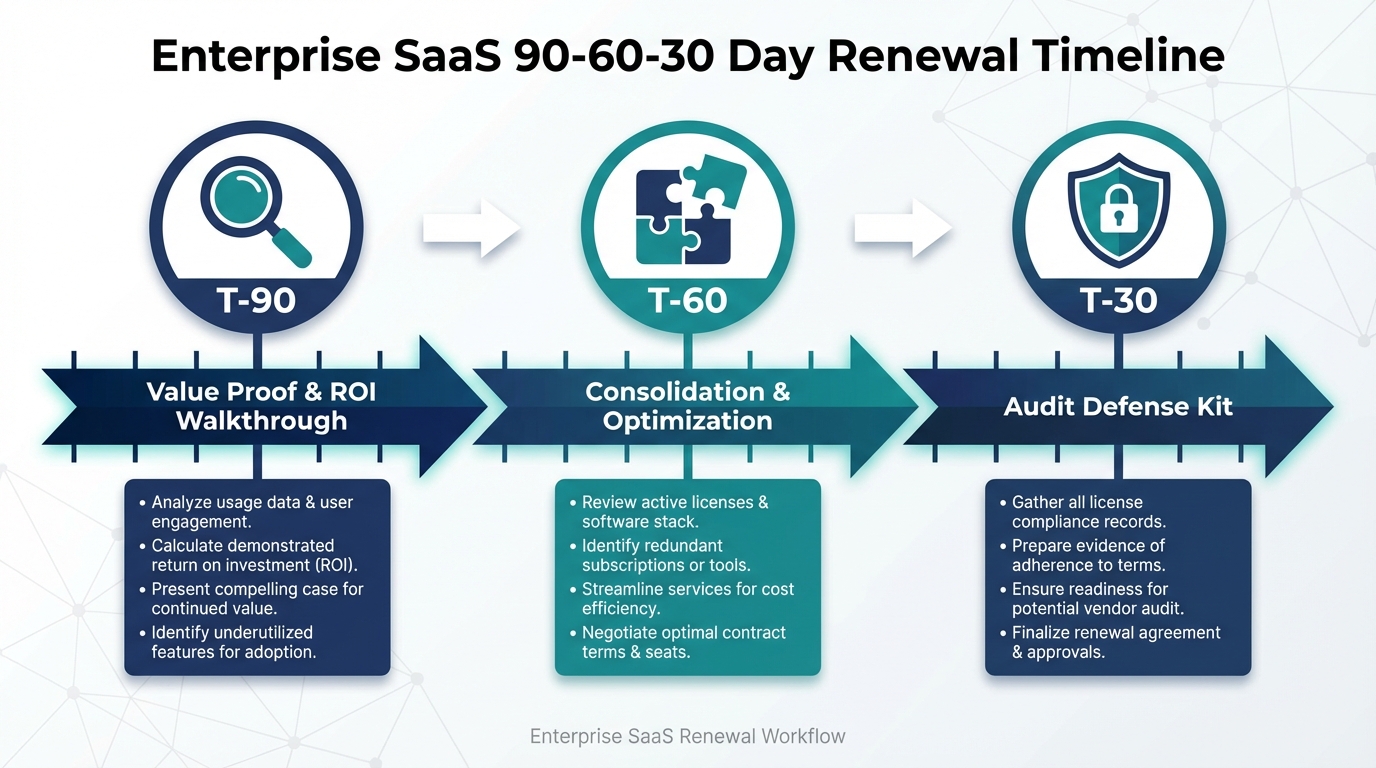
The orchestration of this defense must be timed perfectly. A T-90/T-60/T-30 cadence ensures that the value is reinforced gradually. At T-90, focus on the ROI walkthrough; at T-60, present the optimization and consolidation options; and at T-30, deliver the final audit-ready packet AMC renewal automation April 2026.
Enterprise execution also requires strict adherence to security and compliance standards. Ensure that all renewal communications are delivered via secure, watermarked microsites that track engagement. Knowing exactly when a CFO has watched your ROI video gives your sales team the “signal” they need to reach out and close the deal.
By automating this entire sequence, you ensure a consistent, high-quality renewal experience for every customer, regardless of their contract size. This level of professional orchestration is what separates market leaders from those who fall victim to subscription fatigue.
Sources:
Conclusion and ROI calculator personalized content
Winning the Q1 2026 renewal season requires a fundamental shift from reactive support to proactive value demonstration. By implementing the 14 tactics outlined in this playbook—from subscription value reinforcement videos to strategic consolidation offers—organizations can effectively immunize their customer base against subscription fatigue.
The future of retention is personalized, automated, and data-driven. Those who can prove their ROI in a way that is both visually compelling and procurement-ready will not only survive the Q1 audit surge but will find themselves in a position to expand their footprint within their most valuable accounts.
Frequently Asked Questions (FAQ)
1. What is the primary cause of subscription fatigue in 2026?
Subscription fatigue in 2026 is primarily driven by “tool sprawl” and the increasing scrutiny of ROI by procurement teams. As businesses manage dozens of SaaS subscriptions, the cognitive and financial load leads to “consolidation bias,” where users prefer all-in-one platforms over specialized point solutions. In India, price sensitivity and the rise of bundled telco-OTT offers have further accelerated this trend.
2. How does renewal season engagement automation help reduce churn?
Automation ensures that every customer receives a consistent, data-backed value reminder at the critical T-90, T-60, and T-30 day marks. By removing the manual effort of pulling usage reports and sending emails, teams can focus on high-level strategy while the system handles the “proof of value” delivery at scale.
3. Why are ROI calculator personalized content pieces so effective for procurement?
Procurement teams are tasked with quantifying the value of every dollar spent. A personalized ROI video walkthrough takes complex telemetry data and translates it into the specific financial metrics (NPV, payback period, cost-avoidance) that procurement and CFOs use to make renewal decisions.
4. Can AI-personalized videos really impact enterprise renewal rates?
Yes. Data from 2025 and 2026 shows that personalized video content achieves up to 3x higher engagement than traditional text-based reports. When a customer sees their own data reflected in a high-quality video, the perceived value of the partnership increases significantly. TrueFan AI has seen enterprise clients reduce churn by up to 50% by using these personalized narratives.
5. What should be included in a “Subscription Audit Defense” packet?
A comprehensive audit defense packet should include an executive summary video (90 seconds), a realized ROI dashboard, a list of “next-year” value milestones, and a security/compliance certificate (ISO 27001/SOC 2). This provides procurement with a “ready-to-approve” file that minimizes negotiation friction.
Sources:
Predictive Retention Modeling and Customer Health Score Interventions
The foundation of any successful renewal season lies in predictive retention modeling, a suite of statistical and machine learning techniques designed to estimate the probability of an account renewing. By analyzing features such as usage frequency, depth of feature adoption, and executive engagement, these models allow teams to identify “at-risk” accounts months before the contract expires. This proactive identification is the only way to manage the volume of renewals typical of the Q1 window.
A sophisticated customer health score serves as the primary trigger for these automated interventions. This score should be a weighted composite index, typically ranging from 0 to 100, that maps four critical dimensions: adoption (MAUs and feature breadth), value realization (attainment of business outcomes), relationship signals (QBR attendance and executive sentiment), and friction (support ticket severity and billing risks). When a health score falls below a predefined threshold, the automation engine must immediately launch a specific playbook.
For example, a decline in session frequency or feature depth should trigger predictive churn prevention videos and in-app guides that highlight underutilized modules. If the system detects stalled activation or interrupted onboarding, it should automate a CSM-led intervention paired with a personalized “how-to” video. These interventions are not generic; they are data-driven responses to specific friction points identified by the model.
In an era where lifecycle automation is becoming the “operating system” for retention, leaders should leverage cross-lifecycle insights to tailor the renewal path per cohort (see post-purchase loyalty automation).
Continuous experimentation is vital for renewal season ROI optimization. Revenue teams should A/B test different intervention types—such as comparing a standard email nudge against a personalized video—to determine which playbooks yield the highest retention uplift. By progressively routing only the most effective plays through the automation engine, organizations can maximize their resource allocation during the busy Q1 period.
Sources:
Subscription Value Reinforcement Campaigns: Proving ROI Pre-Renewal
To secure a renewal in 2026, you must prove value long before the negotiation begins. Subscription value reinforcement campaigns are proactive communication cadences designed to demonstrate ROI through quarterly impact summaries and milestone reels. Waiting until the 30-day renewal window to discuss value is a recipe for churn; instead, the most successful firms begin this process 90 days out.
These campaigns should include ROI recap videos personalized to each account’s specific objectives, highlighting usage milestones and uptime performance. For economic buyers, such as CFOs, the focus must be on realized savings and cost avoidance. For technical buyers, the content should emphasize reliability, SLA performance, and compliance achievements like SOC 2 or ISO 27001. Personalized videos are especially effective to translate KPIs into executive-ready narratives.
Executive outcome summaries are particularly effective when delivered as 60–90 second personalized videos. These assets should be tailored per persona, addressing the unique pain points of the CTO, CFO, or VP of Operations. By providing industry benchmark snippets and social proof within these videos, you de-risk the renewal for stakeholders who may be looking to consolidate their tech stack.
The 2026 lifecycle strategy dictates that value visibility must be year-round, but it reaches a crescendo in the pre-renewal phase. Automation allows for the creation of these “value proof” assets at scale, ensuring that every account, regardless of size, receives a personalized justification for their continued investment. This rigor, often seen in high-end MSP models, is now a requirement for enterprise SaaS.
Sources:
Annual Contract Renewal Strategies: Navigating the 2026 Procurement Landscape
In 2026, procurement teams are using AI to forecast vendor underutilization and gain leverage in negotiations. To counter this, your annual contract renewal strategies must involve starting negotiations much earlier—often 120 to 180 days before expiration. Early engagement allows you to offer early-bird incentives and expansion bundles that lock in revenue before the customer’s procurement team can build a case for downsizing B2B procurement cycle acceleration 2026.
Offer structures are evolving to include multi-year commitments paired with loyalty reward renewal offers. These rewards might include price protection against inflation, access to premium support tiers, or additional seat licenses at no extra cost. By framing the renewal as a partnership expansion rather than a simple transaction, you shift the conversation away from line-item costs.
When faced with potential downsizes, a robust subscription downgrades prevention playbook is essential. Instead of accepting a full cancellation, automation can trigger “save paths” such as temporary tier shifts or seat-ramp schedules. These flexible paths protect the core ARR while providing the customer with the financial breathing room they may require during a tight fiscal quarter.
Finance trends for 2026 emphasize pricing agility and flexible revenue tooling. This means your contract structures should be capable of evolving mid-term to reflect the customer's changing needs. By using automation to monitor contract health and trigger expansion opportunities when usage hits 80%, you turn the renewal process into a continuous growth engine rather than a once-a-year hurdle.
Sources:
Renewal Negotiation Personalized Videos: Persona-Led Engagement at Scale
The most effective way to cut through the noise of a crowded Q1 inbox is through renewal negotiation personalized videos. These videos are not generic marketing assets; they are persona-led communications that address the specific metrics and concerns of different stakeholders. A CFO needs to hear about Total Cost of Ownership (TCO) and payback periods, while a VP of Users wants to see workflow time saved and feature utilization.
TrueFan AI's 175+ language support and Personalised Celebrity Videos allow enterprises to bridge the gap between cold automated emails and high-touch executive outreach. Learn more in this overview of AI celebrity video marketing in India. By using API triggers from your CRM, you can generate these videos the moment an account enters the renewal window. The videos should be short—45 to 90 seconds—and include a dynamic renewal deadline countdown video to create a subtle sense of urgency.
Each video should feature a clear, clickable Call to Action (CTA) such as “Lock in your rate” or “Schedule executive review.” For the CTO, the script might focus on roadmap alignment and advanced governance features. For the CFO, the focus shifts to price-lock guarantees and discount guardrails. This level of personalization ensures that every stakeholder feels the vendor understands their specific business outcomes.
Furthermore, the technical execution of these videos must be flawless. Using virtual reshoots to update offer lines without needing new filming sessions allows for rapid iteration. When delivered via high-engagement channels like WhatsApp (especially in the Indian market), these personalized assets see significantly higher watch-through rates than traditional PDF proposals or text-based emails January 2026 insurance renewal automation.
Sources:
Involuntary Churn Reduction Strategies: Optimizing India-Ready Payment Rails
A significant portion of Q1 churn is often involuntary, caused by payment failures rather than a desire to cancel. Involuntary churn reduction strategies must focus on the technical friction of the renewal process, such as expired cards, mandate issues, and network errors. In the Indian market, this requires a deep integration with local payment rails like UPI AutoPay to ensure seamless recurring transactions.
Smart dunning sequences are the first line of defense against involuntary churn. See related work on BNPL default prevention campaigns. These sequences should use multichannel reminders—email, SMS, and WhatsApp—to notify customers of failed payments and provide secure links to update their billing details. In India, merchants reporting the highest success rates are those who have optimized their mandate adoption, often seeing 8–15% lower churn as a result.
Tools like Razorpay Subscriptions provide the necessary infrastructure for recurring billing automation in India, offering extensive UPI AutoPay coverage. Similarly, Chargebee’s Smart Dunning features allow for configurable retries and workflows that are specifically designed to recover revenue from failed renewals. By automating the “grace period” and retry logic, businesses can recover a substantial amount of ARR that would otherwise be lost to technicalities.
To further reduce friction, organizations should implement card updater journeys that automatically refresh expired card details behind the scenes. When combined with renewal season ROI optimization data, these payment recovery efforts provide a clear, measurable impact on the bottom line. Protecting revenue from involuntary churn is often the “low-hanging fruit” of a Q1 retention strategy.
Sources:
Renewal Season ROI Optimization: Testing, Budgeting, and Execution
To ensure your Q1 2026 subscription renewal automation is delivering maximum value, you must implement a rigorous renewal season ROI optimization framework (see 2026 digital transformation budget planning). This involves comparing treatment cohorts (those receiving automated, personalized interventions) against control groups across metrics like renewal rate, expansion revenue, and CAC payback. Without this data, it is impossible to justify the budget for advanced automation tools.
Test designs should be granular, varying the channel (email vs. WhatsApp), the asset type (video vs. text), and the offer (usage-based incentive vs. loyalty reward). For instance, you might find that subscription upgrade pathways are more effective when triggered by a specific usage threshold rather than a time-based milestone. Using Minimum Detectable Effect (MDE) calculations ensures that your test results are statistically significant before you scale them.
Budget allocation for Q1 should be agile, shifting spend toward the playbooks that demonstrate the highest ROI each week. If personalized videos are driving a 10% higher renewal rate in the mid-market segment, the system should automatically increase the volume of those assets. Solutions like TrueFan AI demonstrate ROI through these measurable uplifts in renewal rates and the prevention of high-value account churn.
Finally, the execution blueprint must prioritize data security and compliance. As procurement teams become more sensitive to data privacy in 2026, ensuring your automation stack is SOC 2 and ISO 27001 compliant is a competitive advantage. By integrating your CRM segments with your video and payment APIs, you create a seamless, secure, and highly profitable renewal engine that operates at scale.
Sources:
Conclusion
The Q1 2026 renewal season presents both a significant risk and a massive opportunity for SaaS organizations. By moving beyond manual spreadsheets and generic email blasts toward a sophisticated Q1 2026 subscription renewal automation strategy, leaders can ensure their ARR remains resilient. The combination of predictive retention modeling, persona-led video engagement, and optimized payment rails creates a formidable defense against churn.
As procurement cycles become more complex and budgets tighter, the ability to prove value through subscription value reinforcement campaigns will be the deciding factor in vendor retention. Organizations that invest in these automated, data-driven playbooks today will not only protect their current revenue but also unlock significant contract expansion opportunities for the year ahead. Now is the time to audit your renewal stack and prepare for the 2026 landscape.
Frequently Asked Questions
What is the primary benefit of Q1 2026 subscription renewal automation?
The primary benefit is the ability to protect ARR at scale by using data-driven triggers to launch personalized interventions. This ensures that high-risk accounts are addressed immediately, while high-value accounts receive the executive-level attention required to secure multi-year renewals during the busiest quarter of the year.
How do personalized videos impact renewal rates?
Personalized videos significantly increase engagement and trust by demonstrating a deep understanding of the customer's specific ROI. By addressing stakeholders by name and citing their unique usage data, these videos cut through inbox clutter and make the renewal justification much easier for procurement teams to approve.
How can I reduce involuntary churn in the Indian market?
Reducing involuntary churn in India requires adopting local payment innovations like UPI AutoPay and implementing smart dunning sequences. Tools like Razorpay and Chargebee allow for automated retries and seamless mandate management, which can reduce technical churn by up to 15%.
What metrics should I track for renewal season ROI optimization?
Key metrics include the on-time renewal rate, net expansion revenue, downgrade prevention rate, and the recovery rate of failed payments. You should also track leading indicators like video view-through rates and CTA click rates to calibrate your playbooks in real-time.
How does TrueFan AI integrate with existing CRM systems for renewal automation?
TrueFan AI integrates via robust APIs and webhooks with major CRM and CS platforms like Salesforce, HubSpot, and Gainsight. This allows for the automatic generation and distribution of personalized videos based on health score changes or renewal milestones, ensuring a seamless workflow for Revenue Operations teams.
Frequently Asked Questions
What triggers subscription fatigue in 2026 and how can companies counter it?
Subscription fatigue is driven by tool sprawl, overlapping functionality, and stricter ROI scrutiny by CFOs and procurement teams. Counter it with a Value-Proof model: AI-personalized ROI videos, consolidation roadmaps that replace redundant tools, and early, automated T-90/T-60/T-30 renewal orchestration.
How early should renewal orchestration start in Q1 and what cadence works?
Begin 90 days before expiration with a T-90/T-60/T-30 cadence. Lead with ROI walkthroughs at T-90, optimization and consolidation options at T-60, and a complete audit-ready packet at T-30 to minimize friction and last-minute discount demands.
Do personalized ROI videos materially improve renewal rates?
Yes. Personalized videos using real account telemetry routinely deliver 2–3x higher engagement than text assets and help quantify outcomes (savings, payback, cost avoidance) in CFO-ready terms, improving renewal rates and expansion.
How can consolidation offers reduce churn without heavy discounting?
Audit the customer’s stack and present a “consolidate and save” plan that replaces 2–3 tools. This aligns with CFO objectives, clarifies TCO, and reframes the conversation from price to platform value—often avoiding blanket discounts.
What tactics reduce involuntary churn in India during renewals?
Adopt UPI AutoPay, deploy smart dunning across email/SMS/WhatsApp, and enable card updater flows. Platforms like Razorpay Subscriptions and Chargebee Smart Dunning recover failed payments and cut technical churn by 8–15%.