
Sentiment-Driven Crisis Prevention 2026: How India’s Enterprises Use AI Video to Rescue At‑Risk Customers Before They Churn
Estimated reading time: 12 minutes
Key Takeaways
- Indian enterprises are shifting from reactive support to sentiment-driven, predictive prevention to reduce churn.
- At-risk customer identification platforms unify multi-channel signals to trigger timely, empathy-led interventions.
- Personalized recovery videos in regional languages deliver rapid reassurance and measurable uplift in CSAT and retention.
- DPDP-compliant, privacy-by-design operations with model governance and security controls are essential for scale.
- A 30-day pilot can prove ROI with uplift modeling, sentiment delta tracking, and human-in-the-loop guardrails.
Sentiment-driven crisis prevention 2026 is the strategic practice of continuously detecting dissatisfaction signals across support, social, and product channels to launch empathy-driven, preventive interventions—often via personalized video—to resolve issues before they escalate. In the high-stakes Indian enterprise landscape, this proactive approach allows brands to neutralize churn risks at scale while maintaining strict compliance with evolving data mandates. By integrating predictive dissatisfaction management into the core customer journey, organizations are transforming reactive support centers into proactive value-preservation hubs.
In 2026, the cost of customer acquisition in India has surged by 45% across the BFSI and E-commerce sectors, making retention the primary driver of profitability. Enterprises can no longer afford to wait for a formal complaint to reach their helpdesk; they must identify the “silent churners” who exhibit subtle signs of frustration long before they hit the ‘cancel’ button. Utilizing an at-risk customer identification platform powered by AI sentiment analysis marketing automation, leading firms are now deploying proactive customer rescue videos India to humanize their brand and restore trust in real-time.
What is “sentiment-driven crisis prevention 2026” and why it matters now
Sentiment-driven crisis prevention 2026 represents a paradigm shift from traditional reactive service models to a cross-channel, predictive framework. This methodology transforms the customer experience by continuously measuring sentiment and emotion across support tickets, chat logs, social media mentions, and transaction events. By scoring escalation risk in real-time, enterprises can trigger preemptive outreach—such as empathy-driven video responses—that defuse complaints before they become public PR crises or permanent churn events.
The Indian context in 2026 demands this level of sophistication due to several converging factors: the full enforcement of the Digital Personal Data Protection (DPDP) Act, the rise of a multilingual user base, and the dominance of WhatsApp-first engagement. Indian consumers now expect near real-time, hyper-personalized, and compliant outreach that acknowledges their specific grievances in their preferred language. Reactive systems are inherently too slow for this environment, often reaching the customer only after the emotional “point of no return” has passed.
Research indicates that social listening acts as a critical early warning system for crisis prevention, allowing brands to catch negative sentiment before it hits the mainstream. Furthermore, the State of CX India 2025 report highlights that AI and automation maturity have become the key differentiators for market leaders. According to the EY–NASSCOM AI Adoption Index, Indian enterprises are increasingly using AI to elevate customer experience and reduce operational costs, with sentiment-driven models leading the charge in 2026.
Source: Konnect Insights
Source: NASSCOM
Source: EY India
The anatomy of an at-risk customer identification platform
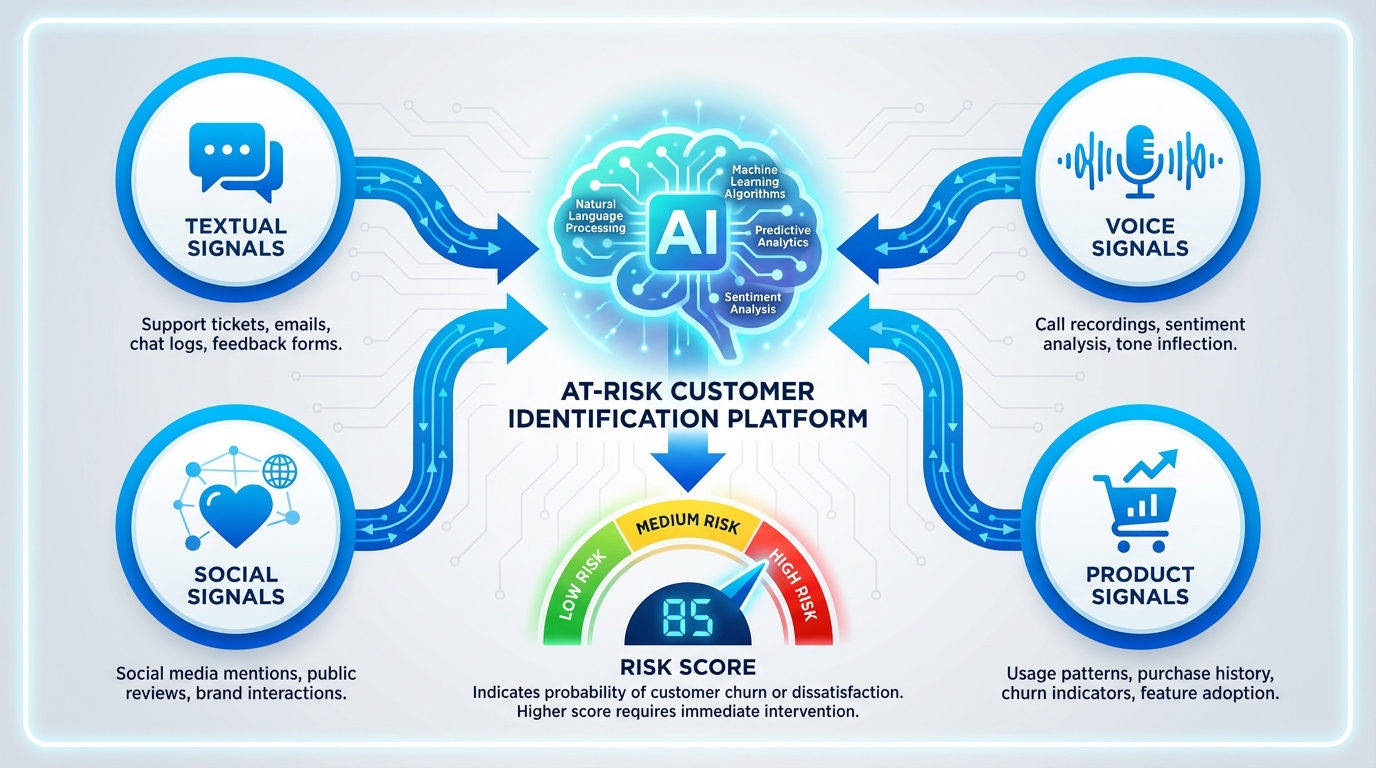
An at-risk customer identification platform is a sophisticated system that ingests multi-channel interactions and behavioral events to apply AI sentiment analysis marketing automation. By synthesizing disparate data points, the platform generates a dynamic risk score for every customer, allowing the marketing and support teams to prioritize interventions based on the severity of the dissatisfaction. This platform serves as the “brain” of the crisis prevention strategy, ensuring that every outreach is data-backed and contextually relevant.
To be effective in 2026, the platform must model a diverse array of signals:
- Textual Signals: Analyzing support tickets, chat transcripts, emails, and app reviews for keywords indicating frustration or intent to leave.
- Voice Signals: Processing call center audio to detect agitation cues, pitch changes, and specific sentiment labels through automated transcription.
- Social and Community Signals: Monitoring mentions, comments, and complaint hashtags, particularly from high-reach users or influencers.
- Product and Transactional Signals: Tracking failed payments, repeated delivery delays, “rage-clicks” on specific features, or a sudden drop in usage frequency.
- Relationship Context: Factoring in customer tenure, lifetime value (LTV), prior complaint history, and current SLA breaches.
The signal processing layer must be capable of handling the nuances of Indian languages, including sarcasm, negation, and code-switching (e.g., Hinglish). Advanced customer mood detection marketing relies on entity-level sentiment analysis, which identifies whether a customer is unhappy with a specific product feature or the overall service quality. By tracking the conversation-level trajectory—whether a user’s mood is improving or worsening over time—the platform can predict the likelihood of an escalation with over 90% accuracy.
Source: Haptik AI
Source: Haptik Products
Predictive dissatisfaction management: from detection to action
Predictive dissatisfaction management is the operational bridge between identifying a risk and executing a resolution. It involves setting up negative sentiment mitigation strategies that categorize customers into tiers based on their risk score. For instance, a Tier-1 “irritation” might trigger an automated coaching tip for the customer or a small loyalty credit, while a Tier-2 “frustration” triggers proactive support video outreach. Tier-3 “escalation risks” are immediately routed to a senior human advocate for high-touch intervention.
The triggers for these actions are defined by specific thresholds, such as an SLA breach being detected or a customer contacting support more than three times within a 72-hour window. To ensure these interventions do not become intrusive, enterprises implement safety guardrails like cool-off timers and suppression lists. This ensures that a customer who has already received a rescue video isn’t bombarded with further automated messages, maintaining the “empathy” in empathy-driven video responses.
In 2026, the most effective interventions are those that provide immediate, tangible value. A proactive support video outreach might include a personalized explanation of why a delivery was delayed, followed by a direct link to reschedule or a QR code for an instant refund. By providing these options within the video interface, brands reduce the effort required from the customer to resolve the issue, which is a primary driver of satisfaction score improvement automation.
Preventive service recovery videos and proactive customer rescue videos India
In the Indian market, video has emerged as the most powerful medium for service recovery due to its ability to convey a humanized tone-of-voice and provide clear explainability. Preventive service recovery videos bridge the gap between a cold, automated email and an expensive human phone call. These videos are particularly effective in a multilingual environment where visual cues and regional dialects can provide the reassurance that text-only communication lacks.
Platforms like TrueFan AI enable enterprises to bridge the gap between detection and resolution by deploying high-fidelity, personalized video messages in real-time. TrueFan AI’s 175+ language support and Personalised Celebrity Videos provide the cultural resonance required to de-escalate tensions across India’s diverse demographic landscape. These emotional intelligence video campaigns follow a strict script structure:
- Validation: Acknowledging the specific issue and the customer’s feelings.
- Diagnosis: Providing a concise explanation of the root cause.
- Remedy: Offering a concrete solution or “make-good” (e.g., a fee waiver).
- Reassurance: Confirming that the brand is committed to the customer’s long-term success.
The measurement loop for these videos is rigorous. Enterprises track watch-through rates, CTA clicks, and the subsequent shift in sentiment. By comparing the post-video CSAT (Customer Satisfaction Score) of the intervention group against a control group, brands can quantify the exact “uplift” provided by the video. This data is then fed back into the at-risk customer identification platform to refine future risk scoring and intervention triggers.
Source: TrueFan AI
Source: TrueFan AI Featured Snippets
Source: TrueFan AI Blog
Complaint prevention automation India: process and compliance blueprint
Executing complaint prevention automation India requires a robust legal and ethical framework, particularly under the DPDP Act 2023. Enterprises must ensure that the processing of customer sentiment and the delivery of personalized videos are based on a lawful basis, with clear consent artifacts. This involves providing customers with transparent notices about how their data is used to improve their experience and offering easy-to-use revocation flows.
Model governance is another critical pillar. AI models used for sentiment detection must be regularly tested for bias across different Indian dialects and demographics to prevent “false negatives” where a genuine crisis is missed. Furthermore, high-risk contexts—such as those involving regulatory issues or medical emergencies—must have a mandatory human-in-the-loop policy. This ensures that while automation handles the bulk of the “frustration” cases, the most sensitive issues receive the nuanced care they require.
Security controls are non-negotiable for enterprise-scale deployments. All data used for personalization must be encrypted in transit and at rest, with strict access controls and audit logs. Retention policies must be strictly aligned with DPDP mandates, ensuring that personal data is not stored longer than necessary for the specified purpose of service recovery. By building these privacy-by-design principles into the architecture, Indian enterprises can scale their crisis prevention efforts without incurring regulatory risk.
Source: MeitY Gazette PDF
Architecture reference: integrating TrueFan AI at enterprise scale
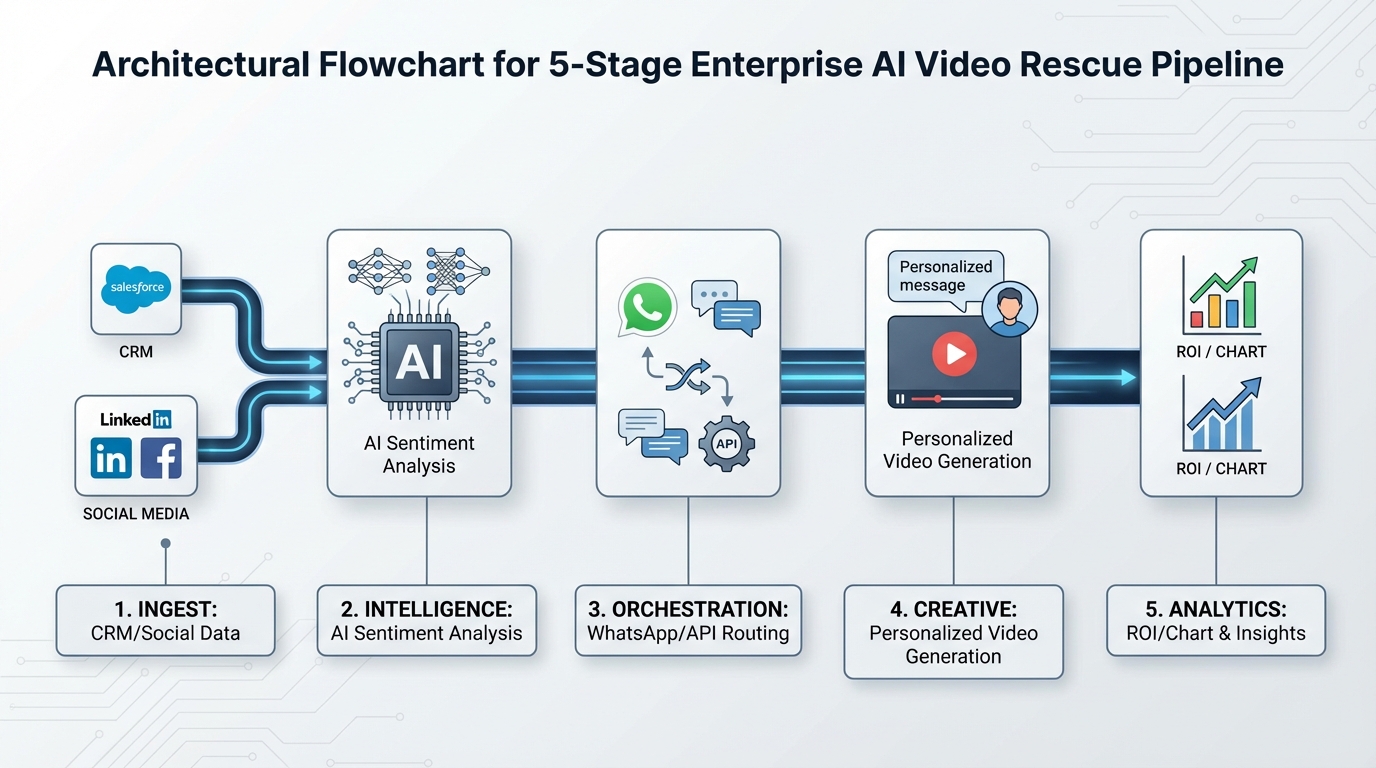
Integrating a sentiment-driven crisis prevention 2026 strategy requires a seamless flow of data between the brand’s existing stack and the video generation engine. The architecture begins with the Ingest Layer, which pulls data from CRM systems (like Salesforce or Zoho), ticketing platforms (Zendesk/Freshdesk), and social listening tools. This data is then passed to the Intelligence Layer, where sentiment classification and risk scoring occur.
Once a high-risk event is identified, the Orchestration Layer determines the best channel for delivery—typically WhatsApp Business API or an in-app inbox in the Indian market. The Creative Layer then uses AI video templates to generate a personalized message. Solutions like TrueFan AI demonstrate ROI through their ability to render these hyper-personalized videos in under 30 seconds, ensuring the intervention reaches the customer while the issue is still “top of mind.”
The final component is the Analytics Layer, which tracks emotional engagement tracking India. This includes monitoring how long a user watched the video and whether they interacted with the embedded CTAs, such as “Schedule a Callback” or “Accept Refund.” By analyzing these metrics at a cohort level, enterprises can perform uplift modeling to prove the financial impact of their crisis prevention strategy, comparing the LTV of rescued customers against those who did not receive an intervention.
Source: TrueFan AI Infrastructure
Source: TrueFan AI Security
Real-world playbooks by industry (India)
BFSI (Banking, Financial Services, and Insurance)
In the financial sector, anxiety is the primary driver of dissatisfaction. Triggers include credit card declines, KYC friction, or false-positive fraud alerts. A preventive service recovery video in this context would feature a professional avatar acknowledging the security concern, explaining the steps taken to protect the account, and providing a direct link to verify the transaction. This reduces the load on phone banking while maintaining a high trust factor.
Source: TrueFan Video KYC Avatar Workflows
Telecommunications
Telcos often face localized sentiment spikes due to network outages or billing discrepancies. By using proactive support video outreach, a telco can send a localized video (e.g., in Marathi for a Mumbai outage) to affected users before they call the helpline. The video can offer a 2GB data bonus as a gesture of goodwill, effectively turning a negative event into a loyalty-building moment.
E-commerce and Logistics
Late deliveries and return friction are the “silent killers” of e-commerce retention. When a delivery delay is predicted by the logistics engine, an automated empathy-driven video response can be sent to the customer. The video explains the reason for the delay (e.g., weather in North India) and provides an interactive button to “Track Live” or “Get 10% Off Next Order,” preventing the customer from reaching out to support.
Source: TrueFan Micro-Influencer Automation
Emotional intelligence video campaigns: scripting and creative system
The success of proactive customer rescue videos India depends heavily on the creative execution. A “one-size-fits-all” video will be perceived as spam; therefore, a personalization matrix is essential. This matrix maps specific variables—such as the customer’s name, the specific product they purchased, and their preferred language—to different segments of the video script.
A high-performing script for 2026 typically follows this 60-second blueprint:
- 0–5s: Personal greeting and empathetic acknowledgment of the specific friction point.
- 5–20s: Concise diagnosis of the issue to show the customer they have been “heard.”
- 20–35s: Tailored resolution steps (e.g., “Your refund has been initiated and will reflect in 2 hours”).
- 35–45s: The “Make-Good”—a value-add that compensates for the inconvenience.
- 45–60s: Clear CTA and a closing note of reassurance from a virtual brand ambassador.
Enterprises use “virtual reshoots” to iterate on these scripts without needing new production cycles. If data shows that customers are dropping off at the 30-second mark, the brand can quickly swap the “Remedy” section for a more compelling offer. This level of satisfaction score improvement automation ensures that the creative content is always optimized for maximum emotional impact and retention.
Measurement and “satisfaction score improvement automation”
In 2026, CX leaders are moving away from static NPS surveys toward satisfaction score improvement automation. This involves creating automated loops where a dip in sentiment triggers an intervention, and the success of that intervention is measured by the subsequent “sentiment delta.” If the customer’s mood does not improve after the first video, the system can automatically escalate the case to a human supervisor, ensuring no customer falls through the cracks.
Key metrics for this framework include:
- Leading Indicators: Sentiment shift (pre- vs. post-video), video watch-through rate, and CTA engagement.
- Lagging Indicators: CSAT/NPS uplift in the affected cohort, reduction in repeat contact rates, and a measurable reduction in churn.
- Financial Metrics: Cost per “save” (the cost of the video intervention vs. the LTV of the rescued customer) and the reduction in credit note issuance.
By using matched-control cohorts, enterprises can attribute specific revenue gains to their sentiment-driven crisis prevention 2026 strategy. For example, a leading Indian retailer might find that customers who received a rescue video had a 15% higher repeat purchase rate over the following 90 days compared to those who only received a standard apology email.
Source: Haptik Analytics
Source: EY-NASSCOM AI Index
30-day enterprise pilot plan (India)
Implementing a full-scale at-risk customer identification platform can seem daunting, but a 30-day pilot can demonstrate immediate ROI.
- Week 1: Scope and Consent: Identify the top two high-friction journeys (e.g., failed payments or delivery delays). Draft DPDP-compliant consent language and establish the channel strategy (WhatsApp is highly recommended for the Indian market).
- Week 2: Integrations and Templates: Connect your CRM and social listening tools to the video engine via APIs. Create 2–3 video templates with language variants (English, Hindi, and one regional language).
- Week 3: Soft Launch and Guardrails: Deploy the system to 10–20% of the at-risk traffic. Monitor the sentiment delta and ensure that the human-in-the-loop escalation triggers are functioning correctly.
- Week 4: Scale and Report: Expand the rollout to 50–100% of the target segments. Compile an executive summary highlighting the CSAT uplift, churn reduction, and a full compliance audit log for the legal team.
Conclusion
The era of reactive customer service is ending. In 2026, the most successful Indian enterprises are those that treat customer dissatisfaction as a data signal to be acted upon, rather than a problem to be buried. By combining an at-risk customer identification platform with the humanizing power of proactive customer rescue videos India, brands can turn potential crises into opportunities for deep loyalty. Solutions like TrueFan AI demonstrate ROI through these precise, empathy-driven interventions, ensuring that every at-risk customer feels seen, heard, and valued. As DPDP mandates and consumer expectations continue to evolve, the shift toward sentiment-driven crisis prevention 2026 is no longer a luxury—it is a strategic imperative for any organization committed to long-term growth in the Indian market.
Frequently Asked Questions
How does sentiment-driven crisis prevention 2026 differ from traditional customer support?
Traditional support is reactive—it waits for the customer to complain. Sentiment-driven prevention is proactive; it uses AI to detect dissatisfaction signals (like “rage-clicking” or negative social mentions) and intervenes with a personalized solution before the customer even reaches out to the helpdesk.
Is using AI video for service recovery compliant with India’s DPDP Act?
Yes, provided the enterprise follows privacy-by-design principles. This includes obtaining explicit consent for data processing, providing clear notices, and ensuring data minimization. TrueFan AI ensures compliance by utilizing a consent-first model and maintaining rigorous ISO 27001 and SOC 2 security standards.
What is the typical ROI of a proactive customer rescue videos India campaign?
Enterprises typically see a 25–40% reduction in formal complaint rates and a 10–20 point uplift in CSAT scores for high-friction journeys. Additionally, the cost of an automated video intervention is significantly lower than the cost of a human agent handling a complex escalation.
Can these videos be delivered in regional Indian languages?
Absolutely. In 2026, multilingual support is a requirement, not an option. Modern platforms support over 175 languages and dialects, allowing brands to communicate with customers in their native tongue, which significantly enhances the “empathy” factor of the outreach.
How long does it take to generate a personalized rescue video?
For enterprise-scale operations, latency is critical. Leading solutions can render a hyper-personalized video—complete with the customer’s name, specific issue details, and a tailored offer—in under 30 seconds, allowing for near-instantaneous delivery via WhatsApp or SMS.



