AI Overviews optimization 2026: Enterprise AEO, zero‑click SEO, and video-first strategies for India
Estimated reading time: ~14 minutes
Key Takeaways
- Shift from clicks to Answer Engine Optimization (AEO) to win citations in AI Overviews and conversational search.
- Adopt a video-first strategy with chaptered clips, transcripts, and schema to secure “Position Zero.”
- Localize for India with Hindi/Tamil voice-first content, SSML-friendly scripts, and hreflang tags.
- Build trust with E‑E‑A‑T, verifiable experts, and rigorous citation hygiene across text, video, and voice.
- Measure success via AI inclusion rates and citation share, not just CTR, using zero-click dashboards.
AI Overviews optimization 2026 is the #1 enterprise SEO objective in India as AI Mode/Overviews and answer engines shift discovery from clicks to direct answers. In a landscape where 69% of search queries now result in zero-click outcomes, Indian enterprises must pivot from traditional traffic-chasing to Answer Engine Optimization (AEO). This strategic shift ensures that your brand remains the authoritative source cited within Google’s AI-generated summaries and Bing’s conversational interfaces.
The evolution of search in 2026 has rendered the “blue link” secondary to the “AI citation.” Google has confirmed that while AI features rely on existing SEO best practices, the criteria for inclusion have shifted toward entity-based authority and multi-modal relevance. India, highlighted as a leading AI Mode market, presents a unique challenge: optimizing for a multilingual, voice-first population that increasingly bypasses traditional websites for instant, AI-curated answers.
The Paradigm Shift: AEO vs SEO vs GEO for Enterprise (answer engine optimization India)
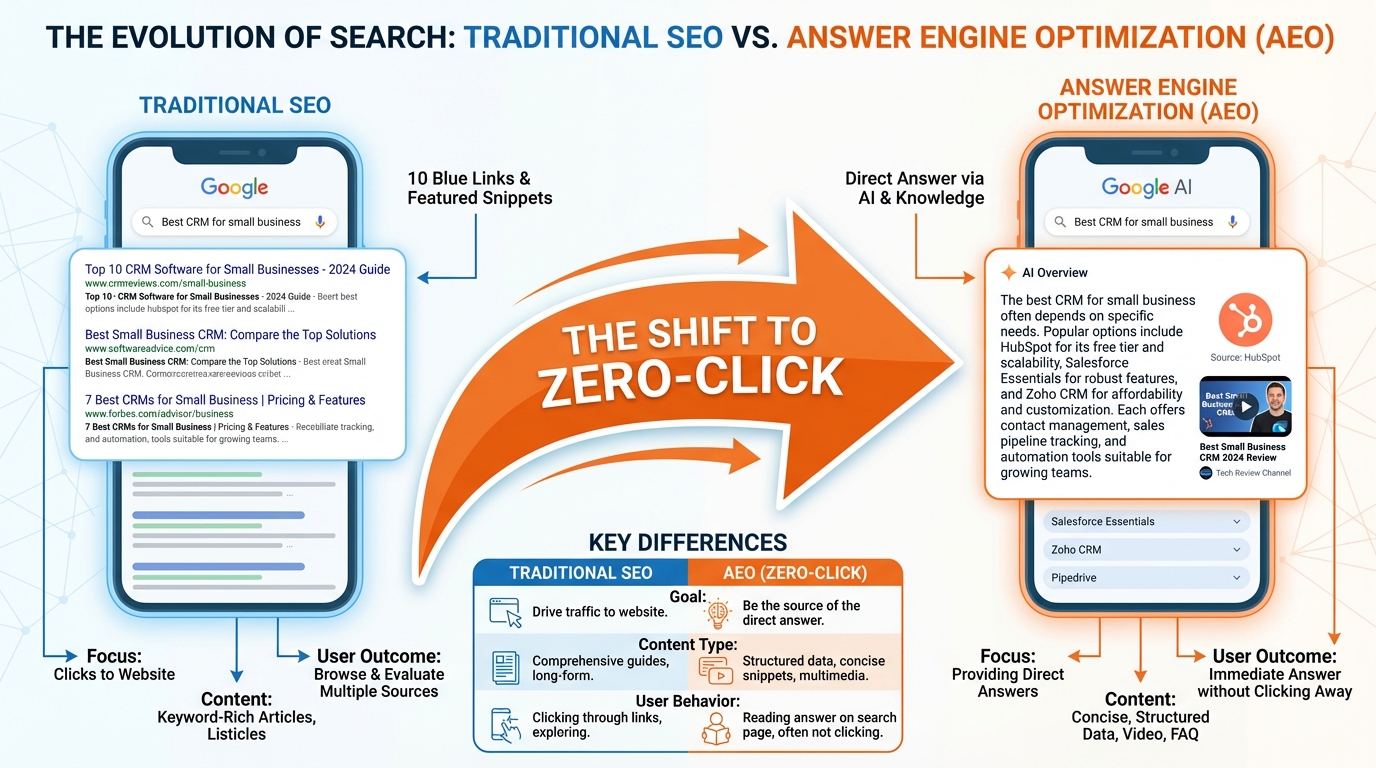
Answer engine optimization India has emerged as the critical bridge between traditional search visibility and the new generative reality. While SEO focuses on ranking pages, AEO focuses on structuring content so AI systems—including Google AI Mode, Bing Copilot, and voice assistants—can parse, quote, and cite your brand’s specific answers. This requires a transition from keyword-centric copywriting to entity-first planning, where content is designed as a series of verifiable facts and direct solutions.
Generative Engine Optimization (GEO) extends this further by emphasizing multi-modal context, ensuring your brand appears in text, video, and voice summaries simultaneously. In 2026, winning visibility means being cited inside the answer unit, a feat achieved through source consensus and high-density information. Platforms like TrueFan AI enable enterprises to produce hyper-personalized video content at scale, ensuring that these AI systems have rich, authoritative media to cite alongside text-based answers.
The shift to natural language processing SEO means aligning content with how users actually speak. In the Indian context, this involves accounting for conversational nuances, Hinglish/Tanglish phrasing, and the “who/what/why/how” structure that AI models prefer for extraction. By 2026, 80% of keywords that trigger AI Overviews fall into the “zero-click” category, meaning your success is measured by citation share and brand impressions rather than traditional click-through rates.
Sources:
Video as the New “Position Zero” in 2026 (featured snippet video content)
Featured snippet video content has become the primary real estate for enterprise visibility in 2026. Google’s AI Overviews now frequently excerpt 30–120 second video clips to answer complex “how-to” or “what-is” queries directly on the SERP. To capture this “Position Zero,” enterprises must implement semantic search video optimization, which involves creating chaptered explainers that mirror the FAQ structure of the target query.
The technical execution of this strategy relies on precise chaptering for extraction. By using Clip and SeekToAction schema, brands can define “jumpable moments” that AI engines use to satisfy user intent without the user ever leaving the search results page. TrueFan AI's 175+ language support and Personalised Celebrity Videos allow brands to dominate vernacular AI Overviews by providing high-authority, localized video snippets that are perfectly synced for regional extraction.
Furthermore, Bing Chat video SEO has gained significant traction in India, where Microsoft’s Copilot summarizes mixed media to provide comprehensive answers. Ensuring your video content is hosted on reliably crawled properties like YouTube and your own site, supported by entity-tagged transcripts, is essential. In 2026, a video without a timestamped, keyword-rich transcript is invisible to the answer engines that now govern the Indian digital landscape.
Sources:
India-First Localization Blueprint (voice search optimization Hindi Tamil)
Voice search optimization Hindi Tamil is no longer an optional add-on; it is the core of the Indian enterprise AEO strategy. With the Bhashini initiative accelerating vernacular digital access, search intent in India has shifted toward colloquial, voice-driven queries like “kaise karu” or “enna nalla irukku.” See voice commerce trends in vernacular India. To rank in these conversational AI results, content must be scripted for these specific intents, using SSML-friendly phrasing that voice assistants can easily synthesize.
The complexity of the Indian market requires a multilingual UX that goes beyond simple translation. Enterprises must provide Hindi and Tamil captions, dubbed tracks that retain original voice timbre, and hreflang tags for hi-IN and ta-IN. Solutions like TrueFan AI demonstrate ROI through increased citation share and engagement in zero-click environments by automating the production of these localized video variants with perfect lip-sync and regional accuracy.
Optimizing for Google SGE optimization India also requires a focus on regional entity prioritization. This means including local examples, India-specific compliance references, and vernacular product nicknames within your content. By 2026, 45% of AI Overviews in India feature video citations, and the majority of these are triggered by voice queries in regional languages, making hyper-localization the primary driver of brand authority.
Sources:
- Bhashini Official Initiative
- Voice Commerce Vernacular India 2026
- Regional Language Search Disruption
Technical Foundations and E‑E‑A‑T (schema markup video implementation)
A robust schema markup video implementation is the technical bedrock of AI Overviews optimization 2026. Beyond the standard VideoObject, enterprises must leverage FAQPage and HowTo schema to provide the structured data that AI models crave for extraction. This technical stack ensures that your content is not just crawled, but understood as a definitive answer to a specific user problem, increasing the likelihood of a citation.
E-E-A-T video authority building has become the primary differentiator in a world flooded with AI-generated fluff. Search engines in 2026 prioritize content that features on-camera experts with verifiable credentials, LinkedIn affiliations, and first-hand demonstrations. Citation hygiene is equally critical; embedding links to Indian regulatory bodies or government portals signals to AI engines that your content is grounded in source consensus and factual accuracy.
To maintain these signals, a consistent publishing cadence is required. Weekly micro-answers—consisting of a short video, a transcript, and FAQ schema—keep your “freshness” signal high, which is a key factor for inclusion in Google’s AI Mode. By 2026, the “last updated” timestamp has become a critical trust signal, as AI engines are programmed to favor the most current data points in rapidly evolving sectors like finance, healthcare, and technology.
Sources:
Measurement and Governance for Zero‑Click Programs (zero-click SEO strategies)
Zero-click SEO strategies require a fundamental rethinking of traditional KPIs. In 2026, the success of an enterprise SEO program is measured by AI Overviews inclusion rates and citation share rather than raw traffic. Monitoring how often your brand is cited as the primary source in Google AI Mode or Bing Copilot provides a more accurate picture of market influence in an era where only 19% of users click through to cited sources.
Governance of these programs involves rigorous editorial QA to ensure model-citation consistency. Your brand’s answers must be consistent across text, video, and voice channels to build the “entity consensus” that AI engines use to determine authority. This includes validating schema accuracy and ensuring that Hindi and Tamil localizations are culturally and linguistically precise, leveraging frameworks like Bhashini for speech accuracy.
Dashboards must now separate “click” versus “no-click” tracks, allowing SEO leaders to demonstrate the value of brand impressions within AI summaries. By tracking entity coverage and video rich result impressions, enterprises can justify the investment in AEO content strategy 2026. This data-driven approach ensures that even as traditional CTR declines, the brand’s footprint in the AI-driven discovery layer continues to expand.
Sources:
90‑Day Enterprise Activation Plan (AEO content strategy 2026)
Operationalizing an AEO content strategy 2026 requires a phased approach that prioritizes entity mapping and video-first localization. In the first 30 days, enterprises should audit their existing video library for chaptering opportunities and build an entity graph that links products to regional Indian terms. This foundational work ensures that the technical infrastructure is ready to support the extraction needs of AI Overviews.
Between days 31 and 60, the focus shifts to scaling “answer packs”—short, direct video Q&As with Hindi and Tamil variants. Implementing VideoObject and Clip schema during this phase is crucial for capturing featured snippets. By day 90, the program should move into a governance phase, where AI inclusion rates are monitored weekly and content is refreshed bi-weekly to maintain the freshness signals required for AI Mode dominance.
This 90-day plan also involves integrating expert bios and E-E-A-T overlays into all video content. By standardizing the editorial QA process for vernacular accuracy and schema validation, enterprises can ensure a high citation share across both Google and Bing. This systematic approach transforms SEO from a reactive traffic-generation tactic into a proactive brand authority strategy designed for the AI-first world of 2026.
Sources:
Conclusion
The transition to AI Overviews optimization 2026 represents the most significant shift in digital discovery since the inception of the search engine. For Indian enterprises, the path to visibility no longer leads through the traditional click-through funnel but through the citation layer of AI-generated answers. By operationalizing a video-first AEO strategy that prioritizes vernacular accuracy and technical schema, brands can maintain authority in a zero-click world.
Winning in 2026 requires a blend of deep technical expertise and hyper-local content execution. As AI Mode becomes the primary interface for millions of Indian users, the ability to provide instant, authoritative, and localized answers will define market leadership. Enterprises that fail to adapt to these Answer Engine Optimization standards risk becoming invisible in the very summaries that now define the user experience.
Operationalize your AI Overviews optimization 2026 today with a video-first AEO strategy. Invite a TrueFan AI demo for schema-ready, multilingual, personalized video workflows that scale AEO content strategy 2026 across Hindi/Tamil and beyond. Ensure your brand is not just a link on a page, but the definitive answer in the AI-driven future.
Frequently Asked Questions
AI Overviews optimization 2026: What matters for India enterprises?
For Indian enterprises, the priority is winning citations within AI-generated summaries through Answer Engine Optimization (AEO). This involves structuring content as direct, factual answers and leveraging video-first schema to capture “Position Zero.” Google confirms that while AI features are new, they rely on technical SEO foundations like schema and E‑E‑A‑T.
How to implement schema markup video implementation for Hindi/Tamil videos?
Effective implementation requires using the VideoObject schema with specific name, description, and thumbnailUrl properties localized for hi-IN and ta-IN. Additionally, Clip or SeekToAction schema must be used to define jumpable segments, allowing AI engines to extract specific answers from your vernacular videos for use in AI Overviews.
What is answer engine optimization India and how is it different from SEO?
SEO focuses on ranking pages for keywords to drive clicks, whereas answer engine optimization India focuses on structuring content to be cited as a direct answer by AI models. AEO prioritizes entity-based authority and concise Q&A formatting, aiming for visibility in zero-click environments where the AI provides the answer directly to the user.
How to do voice search optimization Hindi Tamil for product how‑tos?
Voice optimization requires scripting for colloquial, conversational intents using regional phrasing (e.g., Hinglish). Content should be structured with short, 40–60 word direct answers at the top of sections, supported by Bhashini-compatible transcripts. This ensures that voice assistants can accurately parse and read your content in response to regional queries.
How does TrueFan AI help with AEO and featured snippet video content?
TrueFan AI enables enterprises to scale AEO by generating hyper-personalized, schema-ready videos in 175+ languages. By providing high-authority video snippets with perfect lip-sync and regional accuracy, TrueFan AI helps brands dominate featured snippets and AI Overviews, ensuring they are the primary source cited in conversational search results.