
AI video agritech farmer education India 2026: The Strategic Blueprint for Scale
Estimated reading time: 10 minutes
Key Takeaways
- India’s 2026 agritech inflection point is driven by vernacular-first adoption, AI video, and widespread rural connectivity.
- High-impact formats—from crop advisories to scheme explainers—convert complex guidance into actionable, localized videos.
- A scalable pipeline blends data triggers, AI rendering, and SME guardrails to ensure speed and accuracy.
- Distribution must be WhatsApp-first with low-bandwidth optimization and cross-platform discovery via YouTube Shorts.
- Compliance with the DPDP Act and clear measurement via WTR, CTR, and practice adoption are essential for ROI.
The landscape of Indian agriculture is undergoing a seismic shift as we enter 2026. The convergence of high-speed rural connectivity, vernacular-first digital adoption, and generative AI has created a unique inflection point for AI video agritech farmer education India 2026. With over 900 million active internet users in India—of which more than 55% reside in rural areas—the traditional methods of agricultural extension are being replaced by hyper-personalized, automated video content.
For AgriTech startups, Krishi Vigyan Kendras (KVKs), and Farmer Producer Organizations (FPOs), the challenge is no longer just about having the right data; it is about communicating that data in a way that is accessible, trustworthy, and actionable. Platforms like Studio by TrueFan AI enable these organizations to transform complex agronomic advice into engaging, localized videos that farmers can consume on the go.
1. The 2026 Inflection Point: Why AI Video is the New Standard for Indian Agritech
By 2026, the "digital divide" has effectively shifted from a lack of access to a lack of relevant, localized content. According to the IAMAI–Kantar 2024 baseline, rural India’s internet growth has consistently outpaced urban centers, with a 2026 projection suggesting that 75% of agritech startups will have fully integrated AI-driven video solutions into their farmer-facing platforms.
The shift toward AI video agritech India 2026 is driven by three primary factors:
- Comprehension over Literacy: In regions with varying literacy rates, video content ensures that critical farming techniques are understood through visual demonstration rather than text-heavy manuals.
- The WhatsApp Economy: WhatsApp remains the primary operating system for rural India. Short-form video is the most shared and consumed media type within these community clusters.
- Scale and Speed: Traditional video production is too slow for the volatile nature of farming. AI allows for the generation of weather-based advisories in minutes, not weeks.
As Satya Nadella remarked at the WEF, the deployment of AI at the "edge"—where it meets the end-user—is the true measure of its success. In the context of rural India video content AI, this means moving beyond R&D and into the hands of 150 million farming households.
Source: IAMAI–Kantar Internet in India 2024 | IndiaAI: The Future of Farming
2. High-Impact Content Formats: From Crop Advisories to Scheme Explainers
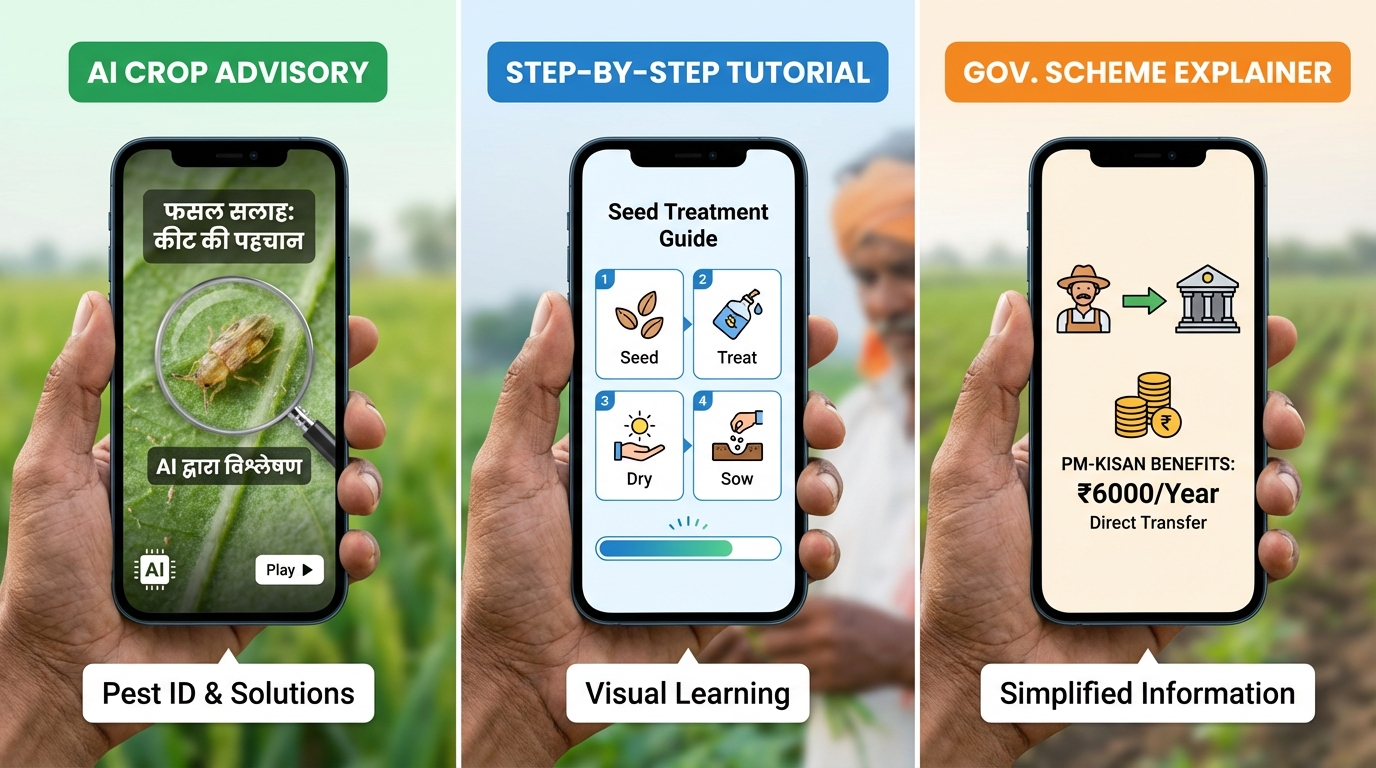
To drive real behavioral change, agritech leaders must move beyond generic content. The 2026 strategy focuses on five core video formats designed for maximum farmer engagement:
Farmer Education Videos AI
These are short, 30–120 second clips that focus on a single agronomic concept. Whether it’s demonstrating the correct way to treat seeds or explaining the mechanics of a new irrigation system, farmer education videos AI provide a visual "how-to" that reduces the margin for error.
Agricultural Tutorial Videos AI Hindi & Regional
Language is the greatest barrier to adoption. By producing agricultural tutorial videos AI Hindi and other regional variants, organizations can speak to farmers in their mother tongue. These tutorials often use step-by-step sequences with simple voiceovers and on-screen Devanagari or regional script text to anchor the learning.
Crop Advisory Videos AI Regional
These are time-sensitive videos triggered by external data. If a pest outbreak is detected in a specific district, a crop advisory videos AI regional alert can be generated and distributed within hours. These videos include region-specific visuals and callouts for local weather variability.
Farmer Scheme Explainer AI
Navigating government subsidies like PM-Kisan or PMFBY can be daunting. A farmer scheme explainer AI simplifies eligibility criteria, required documents, and application deadlines. These videos act as a bridge between policy and the people, often including a call-to-action (CTA) for a regional help center. See public awareness video automation for more context.
Agricultural Extension Videos AI (Quality + Trust)
Trust is the currency of the rural economy. Agricultural extension videos AI are created in collaboration with Subject Matter Experts (SMEs) from KVKs or agricultural universities. By mapping content to the ICAR "Package of Practices," these videos ensure that the advice is not only localized but scientifically sound.
Source: ICAR Communication Policy and Strategy | Kisan Sarathi Platform
3. The Localization Blueprint: Navigating Dialects and Cultural Nuances
Localization in 2026 goes far beyond simple translation. It involves a deep understanding of cultural metaphors, local units of measurement (like bigha vs. acre), and regional personas.
- Dialect Precision: A farmer in Western Uttar Pradesh speaks a different dialect than one in Eastern UP. Vernacular agritech videos AI must account for these nuances to build rapport.
- Voice Personas: Choosing the right "voice" is critical. In many rural communities, an older, authoritative male voice might be preferred for technical advice, while a younger female voice might be more effective for nutritional or scheme-related content.
- Visual Context: If a video is about wheat farming in Punjab, the background visuals should reflect the local landscape, machinery, and traditional attire to ensure the farmer feels the content is "for them."
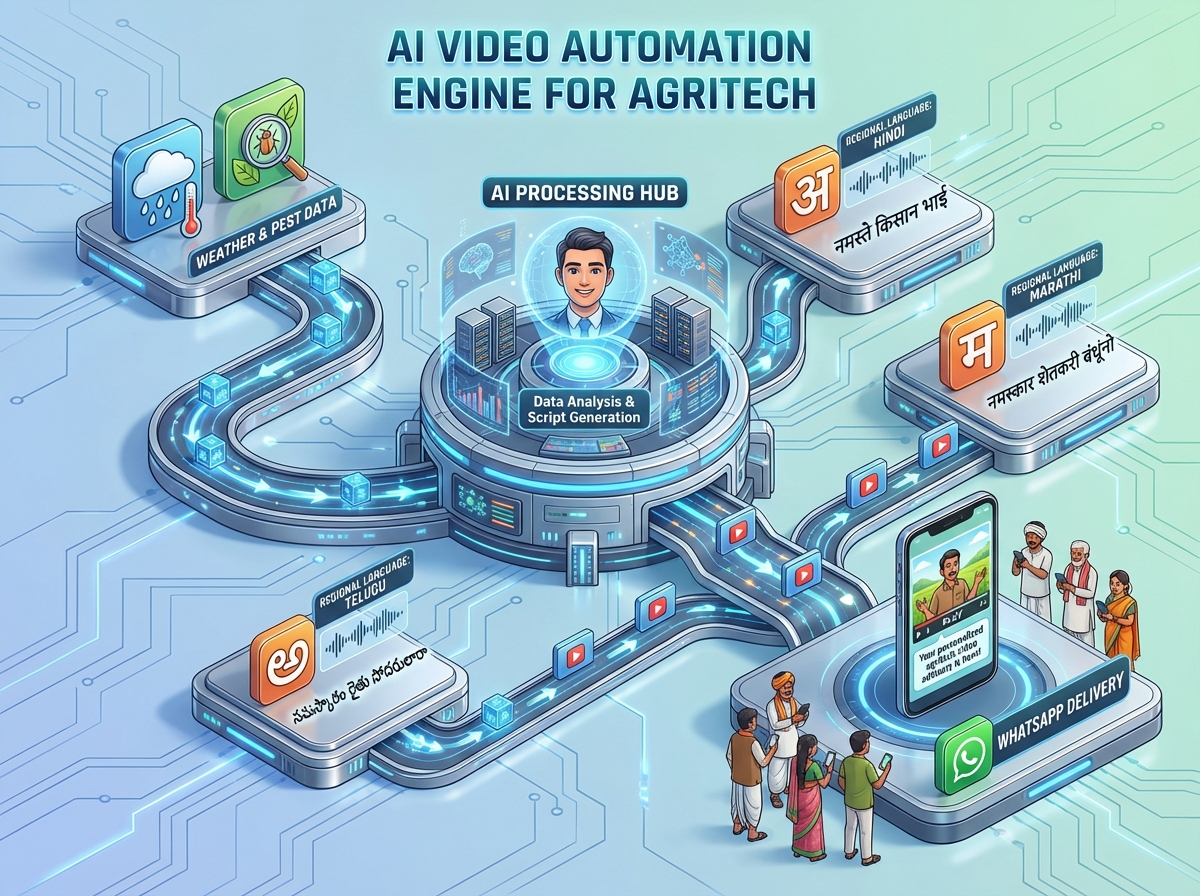
Studio by TrueFan AI's 175+ language support and AI avatars allow agritech firms to create these hyper-localized variants at a fraction of the cost of traditional filming. This capability is essential for reaching the "Next Billion Users" who primarily consume content in non-English formats. Learn more about real-time interactive AI avatars in India.
Source: Cropin: 7 Agri-Tech Trends for 2026
4. Building the Automation Engine: Scaling with APIs and SME Guardrails
To achieve the scale required for krishi video content AI India, organizations must build an automated production pipeline. This isn't just about making videos; it’s about making the right videos at the right time.
The Workflow Blueprint:
- Data Triggers: Integrate with IMD weather feeds, district-level pest surveillance, and crop calendars.
- Template Engine: Use pre-approved master scripts and visual layouts.
- AI Rendering: Automatically generate video variants across multiple languages and dialects using a kisan video content creator AI.
- SME Review Loop: Before distribution, a scientist or extension officer reviews the video for agronomic accuracy.
- Automated Distribution: Push the final MP4 to segmented WhatsApp lists or YouTube Shorts.
Farming tips video automation allows a single agritech team to manage advisories for dozens of crops across hundreds of districts simultaneously. This level of operationalization is what separates the leaders from the laggards in the 2026 market. Explore multi-location video automation tools to support this scale.
5. Distribution Strategy: WhatsApp-First and Low-Bandwidth Optimization
In the context of agriculture video WhatsApp India, distribution is as important as production. Farmers often operate in low-bandwidth environments with limited data plans. Learn about WhatsApp Business video for kirana use cases as a parallel.
- WhatsApp Segmentation: Don't blast the same video to everyone. Segment your lists by crop, district, and even the current growth stage of the plant.
- Compression is Key: Videos should be optimized for mobile viewing, typically under 2MB for direct WhatsApp sharing or 360p for low-bandwidth areas.
- The "First Frame" Rule: The first frame of the video should act as a summary card, showing the topic and the key takeaway in the local language.
- Cross-Platform Synergy: While WhatsApp is for retention, YouTube Shorts is for discovery. Use rural India video content AI to populate a YouTube channel that serves as a permanent archive of farming knowledge. See YouTube Shorts automation with AI for tactics.
Source: ATARI Hyderabad: WhatsApp Advisory Precedents | KVK Kolhapur Advisory Services
6. Compliance & Governance: Navigating the DPDP Act 2023 in Rural India
As agritech firms collect more data to personalize their krishi video content AI India, they must adhere to the Digital Personal Data Protection (DPDP) Act of 2023. This is a critical content gap often missed by competitors.
- Informed Consent: Farmers must give clear, specific consent before their data (name, location, crop type) is used for video personalization. This consent should be captured in their local language.
- Purpose Limitation: Data collected for weather advisories cannot be used for unrelated marketing without additional consent.
- Grievance Redressal: Every video or distribution channel must provide a clear way for the farmer to opt-out or contact a grievance officer.
- Accuracy and Accountability: Given that agricultural advice impacts livelihoods, there must be a clear audit trail of who approved the agronomic content and when it was published.
Solutions like Studio by TrueFan AI demonstrate ROI through not just engagement, but also by providing the security and governance frameworks (like SOC 2 and ISO 27001) necessary to handle sensitive rural data at scale.
Source: PRS India: DPDP Act Summary | MeitY: Official DPDP Act Gazette
7. Measurement, ROI, and the 90-Day Rollout Playbook
How do you measure the success of an agri startup video marketing campaign? It goes beyond "views."
Key Performance Indicators (KPIs):
- Watch-Through Rate: Are farmers watching the full tutorial or dropping off?
- Actionable CTR: How many farmers called the helpline or applied for a scheme after watching the video?
- Practice Adoption: Use field surveys to validate if the techniques shown in the videos are being implemented on the ground.
- Shareability: A high "forward" rate on WhatsApp indicates that the content is trusted by the community.
The 90-Day Rollout Plan:
- Weeks 1-4: Identify your Ideal Customer Profile (ICP), set up DPDP-compliant consent flows, and design your first 10 master templates.
- Weeks 5-8: Integrate APIs for weather and pest data. Launch a pilot with 1,000 farmers in one district using rural education AI videos.
- Weeks 9-12: Analyze the pilot data, refine the voice/dialect based on feedback, and scale to 10,000+ farmers across multiple crops.
Conclusion: The Future of Agri-Extension
The future of AI video agritech farmer education India 2026 is not just about technology; it’s about empowerment. By delivering the right knowledge, in the right language, at the right time, we can significantly improve crop yields, reduce input costs, and enhance the livelihoods of millions of Indian farmers.
The tools are ready. The connectivity is there. The only question is: how quickly will your organization adapt to the new visual standard of agricultural extension?
Frequently Asked Questions
How much does it cost to produce AI videos for farmers at scale?
The cost typically depends on the volume and the level of personalization. Most platforms offer tiered pricing. For example, a "Growth" tier might support 120 minutes of HD video per month, which could translate to 240 short advisories. At scale, the cost per video is significantly lower than traditional production, often by as much as 90%.
Can AI videos handle complex agricultural dialects like Bundeli or Marwari?
Yes. Modern AI video platforms use advanced text-to-speech engines that support hundreds of languages and regional dialects. By working with local SMEs to refine the scripts, you can ensure the AI captures the specific linguistic nuances of a district.
How do we ensure the agricultural advice is accurate?
Accuracy is maintained through a "Human-in-the-Loop" system. While the AI generates the video, the script and the final output must be reviewed and signed off by an agricultural scientist or a KVK expert. Every video should also include a date stamp and a reference to the official source of the advice.
Is it possible to integrate these videos with our existing WhatsApp Business API?
Absolutely. Most enterprise-grade AI video tools provide webhooks and APIs that allow you to push generated videos directly into your CRM or WhatsApp marketing automation pipeline. This ensures that the agriculture video WhatsApp India strategy is seamless. Learn more via this guide on WhatsApp Business video for kirana.
How does Studio by TrueFan AI handle data security and farmer privacy?
Studio by TrueFan AI's 175+ language support and AI avatars are backed by enterprise-grade security, including ISO 27001 and SOC 2 certifications. The platform follows a consent-first model, ensuring that all content generation and distribution comply with the latest DPDP regulations in India.
Can we use our own KVK trainers as AI avatars?
Yes. Many organizations choose to create "Digital Twins" of their most trusted extension officers. This maintains the face-to-face trust that farmers have built over years while allowing the officer to "speak" to thousands of farmers simultaneously in multiple languages.



