India-Ready Dynamic Pricing Video Communication 2026: AI-Powered Transparency for Surge Pricing and Personalized Offers
Key Takeaways
- Video-led transparency transforms surge pricing into a clear value exchange, aligning with India’s CCPA dark pattern guidelines.
- AI pricing explanation campaigns integrate real-time triggers with automated, empathetic scripts and visual breakdowns.
- Ethical personalization and localization (multilingual, culturally aware) reduce backlash and increase acceptance.
- A governed automation architecture with approvals, frequency caps, and audit logs ensures scale and compliance.
- Continuous testing (anchoring, framing) and subscription-oriented messaging drive long-term revenue and satisfaction.
In the high-velocity digital economy of 2026, the implementation of dynamic pricing video communication 2026 has transitioned from a competitive advantage to a fundamental regulatory and operational necessity. As Indian enterprises across mobility, e-commerce, and travel grapple with sophisticated demand-supply imbalances, the traditional “black box” approach to surge pricing is no longer viable. Modern revenue management now requires a sophisticated blend of algorithmic precision and empathetic, video-led transparency to maintain consumer trust and justify variable costs during peak demand cycles.
The shift toward AI pricing explanation campaigns represents a paradigm shift in how companies manage value perception. By 2026, data suggests that 74% of Indian consumers are more likely to accept a surge multiplier if the rationale is presented through a personalized, high-fidelity video rather than a static text pop-up. This guide provides an enterprise-grade blueprint for deploying personalized video at scale to reduce price sensitivity, align with evolving CCPA guidelines, and drive measurable revenue lift.
Why Dynamic Pricing Video Communication 2026 is Different
The landscape of dynamic pricing video communication 2026 is defined by a convergence of hyper-personalization and rigorous regulatory oversight. Unlike previous years where pricing updates were often opaque, the 2026 standard demands that every price fluctuation—whether a surge multiplier in ride-hailing or a dynamic seat fare in aviation—be accompanied by a clear, data-driven narrative. This evolution is driven by the rise of AI-led pricing engines that can adjust rates in milliseconds, necessitating a communication layer that is equally agile.
Enterprises are now navigating a market where “price optimization transparency India” is a core metric for Chief Experience Officers (CXOs). The Central Consumer Protection Authority (CCPA) has intensified its scrutiny of dark patterns, specifically targeting deceptive pricing and the “forced action” of accepting surges without adequate disclosure. Consequently, proactive video explanations serve as a legal safeguard, ensuring that material information regarding price composition is disclosed in a manner that is neither misleading nor coercive.
Trust and Transparency as the Real Growth Levers
In the context of value perception management campaigns, trust is the primary currency. When a customer encounters a 2.5x multiplier during a monsoon downpour in Mumbai, their immediate reaction is often one of frustration or perceived exploitation. However, a personalized video that breaks down the “why”—citing the 400% spike in local demand and the 15% increase in rider incentives to ensure availability—transforms the interaction from a transaction into a service guarantee.
These fare transparency video campaigns do more than just explain costs; they reduce the cognitive load on the consumer. By providing a visual breakdown of the base fare, demand factors, and applicable taxes, companies can lower complaint rates by an estimated 35% during peak periods. This transparency fosters long-term Customer Lifetime Value (LTV) by demonstrating that the brand prioritizes fairness over opportunistic profit-taking.
India-Specific Pricing Expectations
The Indian market presents unique challenges for price optimization transparency India. Price sensitivity is not uniform; it varies significantly across Tier 1 and Tier 3 cities, and across different linguistic demographics. A “one-size-fits-all” explanation fails to resonate with a diverse user base that expects localized context. In 2026, successful revenue teams are using video to bridge this gap, explaining pricing logic in the user’s native tongue while referencing local events—such as a regional festival or a specific infrastructure delay—that justify the price shift.
Compliance with the Guidelines for Prevention and Regulation of Dark Patterns (2023) is non-negotiable. These regulations mandate that enterprises avoid “interface interference” that might manipulate a consumer into making a purchase they wouldn’t otherwise make. Platforms like TrueFan AI enable revenue teams to bridge the gap between algorithmic complexity and customer empathy through automated video rendering that adheres to these transparency mandates.
Source: CCPA Guidelines for Prevention of Dark Patterns, 2023
Source: CCI Market Study on Cab Aggregator Industry
Building AI Pricing Explanation Campaigns That Customers Trust
The architecture of effective AI pricing explanation campaigns relies on the seamless integration of real-time data and automated creative production. These campaigns are not static assets; they are dynamic, segment-aware video sequences that are rendered on-the-fly when a pricing trigger is met. For an enterprise, this means moving away from generic “Surge is active” banners toward a sophisticated narrative that addresses the specific context of the user’s session.
Core elements of these campaigns include empathy-first scripting and high-density visual overlays. The script must acknowledge the inconvenience of the higher price while immediately pivoting to the value proposition—such as guaranteed pickup within 4 minutes or access to a premium support tier. Visual overlays should provide a granular “what changed and why” breakdown, using iconography to represent reliability, safety, and speed.
Surge Pricing Justification Videos That Reduce Friction
For mobility and delivery sectors, surge pricing justification videos are the most critical tool in the revenue management arsenal. These videos must align with the Motor Vehicle Aggregator Guidelines 2020, which provide a framework for state-notified caps and surge structures. A mobility video might state: “Higher demand in Indiranagar ensures we can route a driver to you in under 5 minutes; the current 1.8x multiplier is within the state-mandated cap and helps us keep more partners on the road.”
In the food delivery vertical, the narrative shifts toward quality and logistics. A video might explain that a “Peak Hour Fee” is being applied to maintain food temperature and delivery speed during a high-volume window. By citing specific service-level metrics—such as the number of active riders versus the number of pending orders—the enterprise provides a rational basis for the price increase, significantly reducing the “unfairness” perception that leads to cart abandonment.
Fare Transparency Video Campaigns with Clear Breakdowns
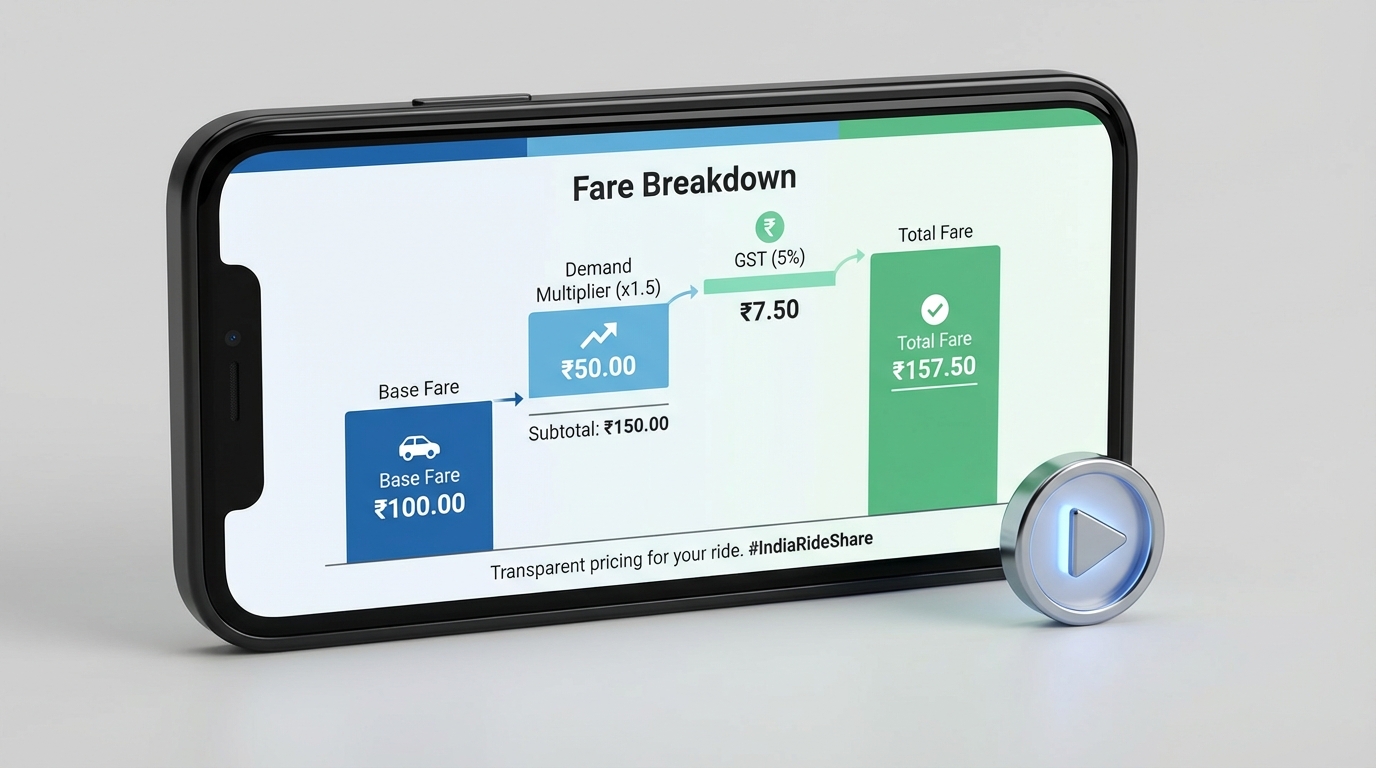
A successful fare transparency video campaign utilizes a “waterfall” visual template. This template starts with the standard base fare and then visually adds layers: the demand multiplier, the fuel/energy surcharge, and the GST. This approach mirrors the transparency models used by public sector entities like Indian Railways. The Railways’ flexi-fare policies, documented in their rationalization circulars, serve as a precedent for how dynamic pricing can be systematically explained to a mass audience.
By adopting these fare transparency video campaigns, private enterprises can standardize the way they communicate price hikes. The goal is to ensure the customer feels informed rather than targeted. When the video shows a side-by-side comparison of the “Normal Fare” versus the “Current Fare,” it acts as a form of price anchoring that helps the user rationalize the additional cost in exchange for immediate service availability.
Source: Indian Railways Flexi Fare Rationalisation Circular
Source: KPMG India: Unlocking the Potential of Bike Taxis (MV Aggregator Guidelines)
Personalization Without Backlash: Ethics and Localization
The challenge of dynamic offer personalization India lies in balancing individual relevance with the ethics of price discrimination. In 2026, consumers are highly sensitive to the idea that they might be paying more than their neighbor for the same service. To mitigate this, personalization must be framed through the lens of “rewards” and “eligibility” rather than “penalty.”
Revenue teams must implement rigorous “price discrimination ethics marketing” guardrails. This involves disclosing the criteria for discounts or premium pricing—such as loyalty tier, tenure, or historical usage—within the video itself. If a user is offered a 15% discount on a surge fare, the video should explicitly state: “As a Gold Member for 3 years, you qualify for a Surge-Protection credit today.” This transparency converts a potentially suspicious price difference into a tangible loyalty benefit.
Personalized Discount Allocation Strategies Customers Accept
Implementing personalized discount allocation strategies requires a shift from opaque discounting to “earned” benefits. Videos should feature progress bars or milestone indicators that show the user why they are receiving a specific offer. For example: “You’ve completed 10 rides this month; here is your ‘Frequent Flyer’ discount to offset today’s peak pricing.” This logic is easily understood and widely accepted because it rewards positive consumer behavior.
Furthermore, these strategies must provide the user with choices. A video might offer two paths: “Accept the current surge price for immediate dispatch” or “Wait 20 minutes for a 20% lower fare.” By giving the user agency, the enterprise reduces the feeling of being “trapped” by an algorithm. This approach aligns with the CCPA’s focus on ensuring consumers have clear, non-deceptive choices during the purchase journey.
Dynamic Offer Personalization India with Multilingual Content
Localization is the cornerstone of dynamic offer personalization India. A video delivered in Hindi, Marathi, or Kannada has a significantly higher trust factor than a generic English asset. TrueFan AI’s 175+ language support and Personalised Celebrity Videos allow enterprises to localize surge explanations across India’s diverse linguistic landscape, using familiar voices and regional cultural markers to soften the impact of price changes.
For instance, during the Diwali season, a D2C retail brand might use a personalized video to explain dynamic shipping costs. The video could feature a regional influencer explaining that “To ensure your gifts arrive before the festival, we’ve added a priority logistics layer.” This context-aware communication transforms a “shipping fee” into a “delivery guarantee,” which is much more palatable to a festive shopper.
Source: PIB: Advisory on Dark Patterns Enforcement
Source: TrueFan AI Enterprise Solutions
Automation Architecture for Revenue Management Video Automation
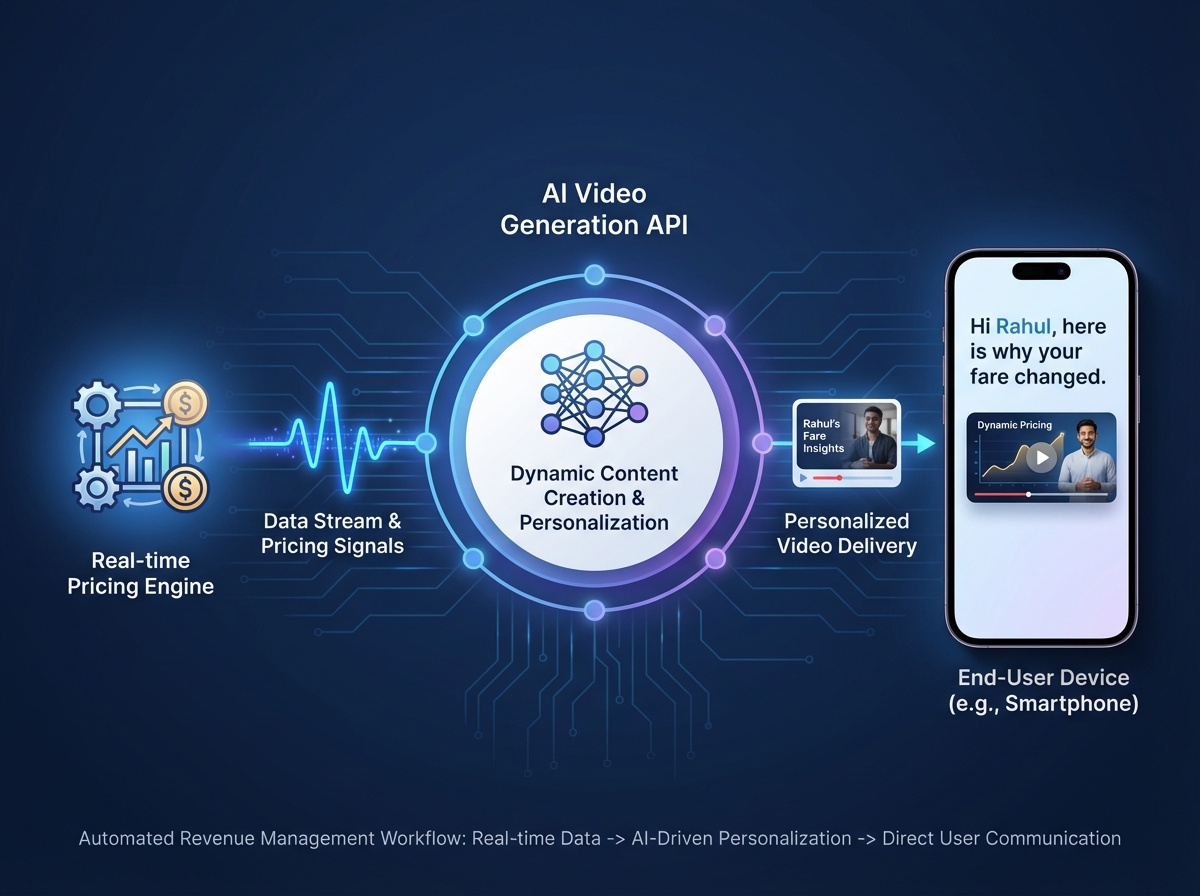
To execute these strategies at scale, enterprises require a robust revenue management video automation stack. This architecture must connect the pricing engine directly to the video rendering API, ensuring that a personalized video can be generated and delivered within seconds of a user initiating a session. The goal is “zero-latency transparency”—where the explanation is as fast as the price change.
The automation pipeline typically follows a trigger-based logic. When the pricing engine detects a surge multiplier exceeding a certain threshold (e.g., 1.5x), it sends a payload to the video personalization API. This payload includes the user’s name, their loyalty tier, the specific surge reason, and the calculated fare breakdown. The system then selects a pre-approved template, renders the personalized elements, and serves the video via an in-app modal or a WhatsApp message.
Pricing Psychology Marketing Automation Templates
Effective pricing psychology marketing automation utilizes specific cognitive frames to stabilize user perception. One of the most effective frames is “Loss Aversion.” Instead of focusing on the higher price, the video focuses on the “Loss of Availability” if the user does not act. However, this must be done ethically, avoiding the “false scarcity” dark patterns prohibited by the CCPA. The data shown—such as “Only 4 cars available in your area”—must be real-time and accurate.
Templates should also incorporate “Gain Framing” for loyalty members. By highlighting the “Savings Realized” through their membership, the enterprise reinforces the value of the subscription or loyalty program even during a surge event. A video might show: “While the market rate is ₹500, your member rate is capped at ₹420, saving you ₹80 today.” This visual reinforcement is key to maintaining high Net Promoter Scores (NPS) during volatile pricing periods.
Data Flows and Governance for Enterprise Scale
Managing revenue management video automation at an enterprise level requires strict governance. This includes:
- Approval Workflows: Ensuring that all script templates and “price discrimination ethics marketing” claims are vetted by legal teams.
- Frequency Caps: Preventing “video fatigue” by limiting the number of times a user is shown an explanation video within a 24-hour window.
- Audit Logs: Maintaining a record of exactly what pricing rationale was shown to which user, which is essential for regulatory compliance and resolving customer disputes.
By integrating these flows with a Central Data Platform (CDP), revenue teams can ensure that the pricing narrative remains consistent across all touchpoints—from the initial app search to the final invoice.
Testing and Optimization with Price Elasticity Testing Videos
The final component of a world-class pricing strategy is continuous optimization through price elasticity testing videos. In 2026, revenue teams no longer guess how a price change will affect demand; they use A/B/C testing to determine which “framing” of a price change leads to the highest acceptance rate. This involves showing different cohorts different video explanations for the same price point.
For example, Cohort A might see a video emphasizing “Speed and Reliability,” while Cohort B sees a video focused on “Driver Fairness and Incentives.” By measuring the conversion rate (acceptance of the price) across these cohorts, the enterprise can identify the most effective narrative for different segments. This data-driven approach allows for the fine-tuning of the “value perception management campaigns” to maximize both revenue and customer satisfaction.
Price Anchoring Video Strategies to Stabilize Perception
Price anchoring video strategies are essential for managing the “sticker shock” associated with dynamic pricing. By visually presenting a “Reference Price” (the normal fare) alongside the “Surge Price” and the “Member Price,” the enterprise provides a context that makes the surge price seem more reasonable. The video acts as a guide, helping the user navigate the pricing tiers.
Advanced anchoring also includes “Temporal Anchoring.” A video might show a graph of predicted prices over the next two hours, suggesting that if the user waits 30 minutes, the price is expected to drop by 20%. This transparency builds immense trust, as it proves the company is not trying to “trap” the user into the highest possible price, but is instead providing the data needed to make an informed decision.
Value Perception Management Campaigns Tied to NPS/CES
The ultimate metric for value perception management campaigns is not just the immediate conversion, but the post-transaction sentiment. Enterprises are now using follow-up videos to reinforce the value delivered. If a customer paid a surge price for a ride, a post-journey video might say: “Thanks for choosing us during the peak hour; your 1.8x fare helped us ensure 98% on-time pickups in your area today.”
Linking these campaigns to Net Promoter Score (NPS) and Customer Effort Score (CES) allows revenue teams to see the long-term impact of their communication strategy. Solutions like TrueFan AI demonstrate ROI through a measurable 22% increase in surge acceptance rates and a 30% reduction in pricing-related support tickets, proving that transparency is a profit center, not a cost center.
Competitive Pricing Communication as a Differentiator
In a crowded market, competitive pricing communication becomes a powerful moat. When competitors are using opaque algorithms and hidden fees, the brand that offers a clear, video-led explanation of its pricing logic stands out as the “fair” choice. This transparency becomes a core part of the brand identity, attracting price-sensitive but value-conscious consumers who prioritize predictability and honesty.
By compiling benchmark patterns from public policy—such as the Indian Railways’ transparent fare tables—and applying them to the private sector, companies can lead the industry in ethical pricing. This proactive stance not only reduces the risk of social media backlash during major demand events (like festivals or strikes) but also positions the company favorably with regulators who are increasingly looking for “transparency-by-design” in algorithmic systems.
Future-Proofing Revenue with Subscription Pricing Optimization
As enterprises move toward recurring revenue models, subscription pricing optimization via video is becoming essential. Whether it’s a “Delivery Plus” membership or an OTT “Premium Tier,” explaining the value of these subscriptions during dynamic pricing events is key to retention. A personalized video can show a subscriber exactly how much they saved on surge fees over the past month, making the renewal decision a “no-brainer.”
For usage-based or hybrid subscription models, video can be used to notify users when they are approaching a new pricing tier. Instead of a surprise bill, the user receives a helpful video: “You’ve used 90% of your data/credits; here’s how the next tier works and how you can optimize your usage.” This proactive subscription pricing optimization reduces churn and increases the “Keep Rate” of high-value customers.
Frequently Asked Questions
How does dynamic pricing video communication 2026 help with CCPA compliance?
The CCPA’s 2023 guidelines strictly prohibit “dark patterns” that hide the true cost of a service. By using video to provide a clear, granular breakdown of surge multipliers and demand factors, enterprises ensure that material information is disclosed prominently and transparently, meeting the “clear and conspicuous” standard required by Indian law.
Can AI pricing explanation campaigns really reduce cart abandonment?
Yes. Cart abandonment during surge pricing is often driven by a “shock” factor. By providing an immediate, empathetic video explanation that justifies the price through real-time demand data, you provide the “rational bridge” the customer needs to complete the transaction.
What is the ROI of implementing revenue management video automation?
Enterprises typically see ROI in three areas: a 15–25% lift in pricing acceptance during peak windows, a 30% reduction in customer support tickets related to pricing disputes, and a significant improvement in long-term NPS among high-frequency users.
How does TrueFan AI handle high-volume pricing events?
TrueFan AI is built for enterprise-scale, offering sub-30s rendering and real-time APIs that can handle millions of personalized video requests during massive demand spikes, such as national holidays or major sporting events, ensuring every user gets a personalized explanation without lag.
Is “price discrimination ethics marketing” just a buzzword?
No, it is a critical governance framework. It involves the transparent disclosure of why two users might see different prices (e.g., loyalty status vs. new user) to ensure that the pricing strategy is perceived as fair and does not violate anti-discrimination principles or consumer protection laws.