
Post-purchase customer lifecycle optimization with predictive video: the enterprise playbook for CLV growth in 2026
Estimated reading time: ~10 minutes
Key Takeaways
- Predictive video triggers turn real-time signals into timely, personalized messages that lift CLV and retention.
- Video-first onboarding and support compress time-to-value, outperforming static content in comprehension and conversion.
- Modular personalization at scale uses a Master + Dynamic Scenes system with deep data fields for thousands of variants.
- Orchestration and compliance require consent gates, frequency caps, and QA aligned to India’s DPDP Act.
- 90-day rollout proves value fast: pilot high-impact journeys, then scale to reorders, milestones, and localization.
In the hyper-competitive landscape of 2026, retention marketing and customer success teams have shifted their focus from generic outreach to high-precision interventions. Post-purchase customer lifecycle optimization is now the primary growth lever for enterprise brands, defined as the systematic application of behavioral data, predictive modeling, and personalized video to maximize customer lifetime value (CLV) after the initial transaction. By delivering automated, video-first experiences at critical journey milestones, brands can drastically reduce time-to-value (TTV) and secure long-term loyalty.
The mandate for modern enterprises is clear: static communication is no longer sufficient to capture attention in a fragmented digital ecosystem. As customer acquisition costs (CAC) continue to escalate, the ability to optimize the post-purchase journey through automated video triggers has become a competitive necessity. This playbook outlines how to leverage predictive signals and video personalization to transform the customer lifecycle into a continuous engine for revenue and advocacy.
What is post-purchase customer lifecycle optimization (and why video now)
Post-purchase customer lifecycle optimization represents a fundamental shift from reactive support to proactive engagement. In 2026, the success of an enterprise is measured by its ability to drive onboarding completion, feature adoption, and reorder cadence through intelligent orchestration. Video has emerged as the superior medium for this optimization because it compresses complex instructions into high-retention micro-stories that outperform static text by over 300% in comprehension and conversion.
In the Indian market, this shift is accelerated by the dominance of WhatsApp as a primary marketing channel. Recent data indicates that WhatsApp usage for retail and eCommerce has more than doubled year-over-year, making it the critical delivery mechanism for video-led retention strategies. For BFSI and telecom sectors, modernizing engagement through automated journeys is no longer optional but a core requirement for maintaining market share.
The technical rationale for video-first optimization lies in its ability to feel 1:1 without the prohibitive costs of manual production. By using dynamic data fields—such as a customer’s name, specific plan, or local language—brands can deliver hyper-relevant content that resonates deeply. This level of personalization ensures that every post-purchase touchpoint adds measurable value, moving the needle on NPS and incremental CLV per cohort.
Sources:
- MoEngage: Omnichannel Marketing Statistics 2026
- Netcore Cloud: Customer Engagement in Banking Trends
Predictive video trigger automation for enterprise teams
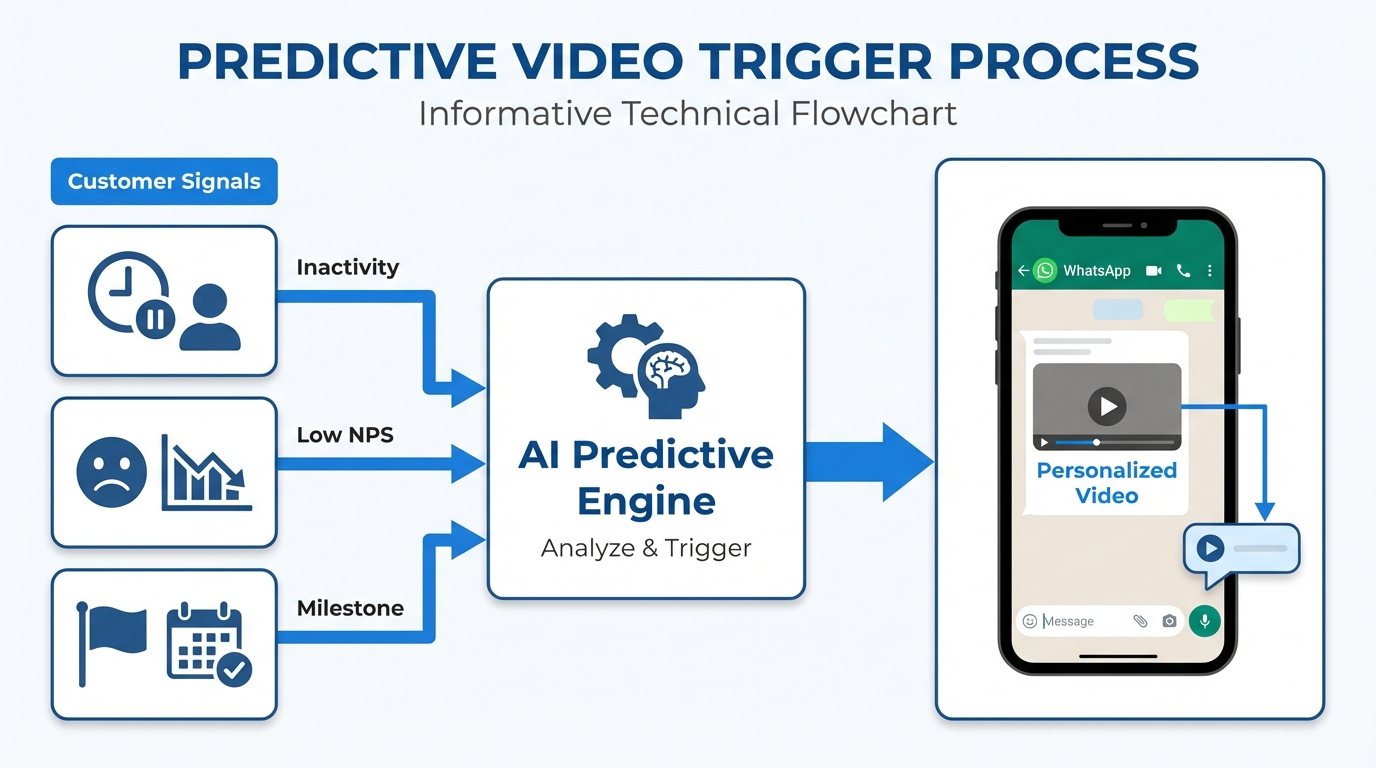
Predictive video trigger automation is the technical backbone of a high-performing retention strategy. This system monitors real-time and historical signals—including event telemetry, sentiment analysis, and payment risk—to predict specific customer needs. Once a threshold is met, the system automatically triggers a personalized video delivered via the customer’s preferred channel, such as WhatsApp, email, or in-app messaging.
Platforms like TrueFan AI enable enterprises to execute this at scale by integrating directly with existing CDP and CRM infrastructures. The trigger taxonomy is generally divided into risk-based and opportunity-based signals. Risk signals include inactivity windows (e.g., 7 or 14 days of silence), feature abandonment, or early churn indicators like a sudden drop in DAU/WAU ratios. Opportunity signals focus on milestone tenure, high-propensity cross-sell scores, or renewal readiness.
To maintain relevance, the latency between a trigger event and video delivery must be minimal. In 2026, enterprise standards require sub-60-second response times to ensure the message reaches the user while the context is still fresh. Advanced solutions utilize cloud-agnostic GPU farms and real-time APIs to achieve these speeds, ensuring that a “payment failure” video or a “milestone celebration” reaches the user exactly when it matters most.
Sources:
Lifecycle marketing video personalization foundations (that actually scale)
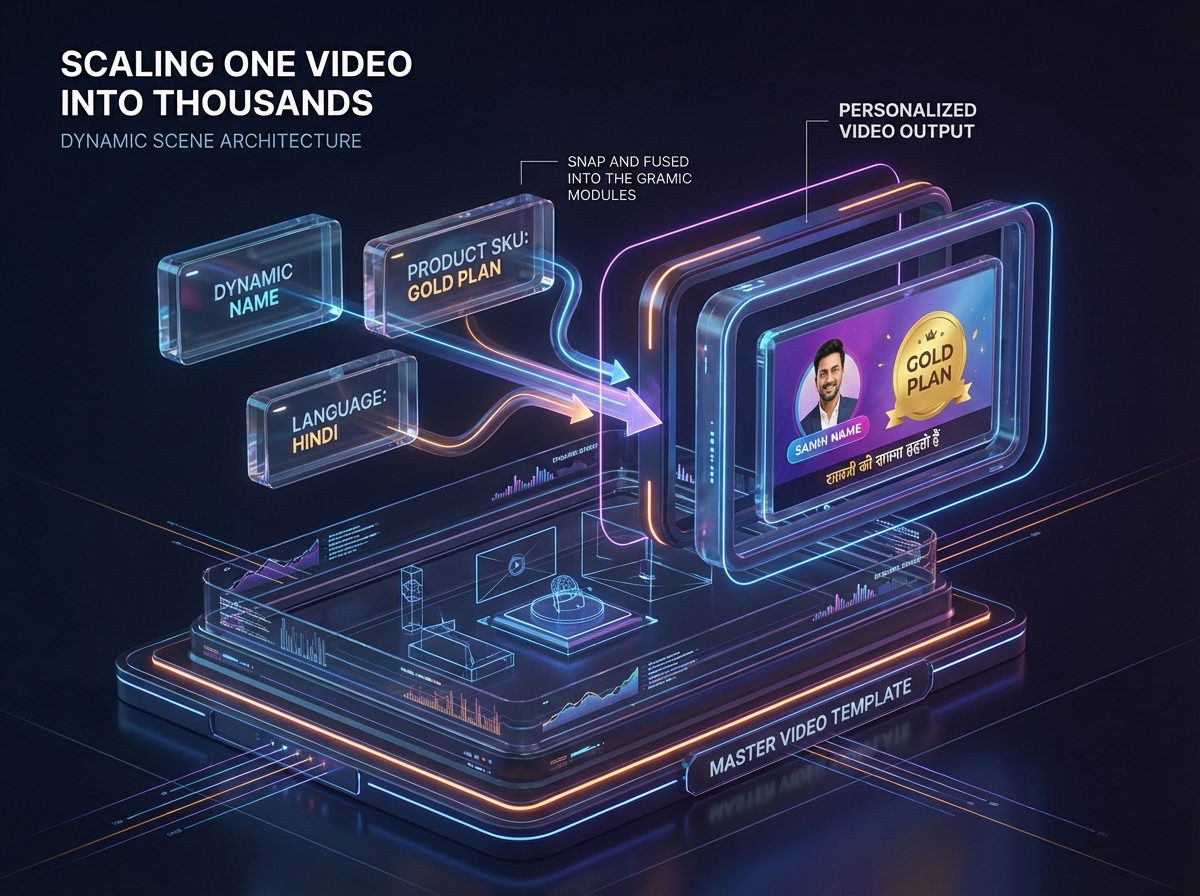
Building a scalable foundation for lifecycle marketing video personalization requires a robust data model and a modular creative system. The data model must go beyond basic merge fields like “First Name” to include complex variables such as “Next-Best-Action,” “Predicted Need Date,” and “Locale-Specific Dialects.” This depth allows the video to address the customer’s specific context, such as a replenishment reminder for a specific SKU based on their individual consumption rate.
The creative system relies on a “Master + Dynamic Scenes” architecture. A single master recording serves as the template, while dynamic scenes are swapped in or out based on the user's lifecycle stage. For instance, an onboarding video might include a dynamic module showing the specific features of a “Gold” vs. “Platinum” plan. This modularity allows for thousands of unique variants without the need for multiple film shoots.
TrueFan AI's 175+ language support and Personalised Celebrity Videos further enhance this foundation by allowing brands to localize content at a granular level. This includes not just translation, but voice retention and lip-syncing that feels natural to the viewer. Such capabilities are essential for Indian enterprises operating across diverse linguistic regions, ensuring that the brand voice remains consistent while the message remains hyper-local.
Sources:
Customer journey optimization videos across the post-purchase funnel
Predictive customer success videos (onboarding/activation)
The primary objective of predictive customer success videos is to compress the time-to-value (TTV) for new users. Triggers are set for account creation followed by 24 hours of inactivity or the failure to complete a critical setup step, such as KYC in BFSI. A 60-second personalized tour can guide the user through the “first win,” significantly boosting day-7 retention and overall product adoption.
Behavioral trigger video campaigns (feature adoption, expansion)
Behavioral trigger video campaigns target users who have mastered core features but have yet to explore advanced functionalities. By analyzing product analytics, the system identifies users with a high propensity to upgrade and sends a video explaining the ROI of an add-on. These videos often feature a 1-click enablement CTA, driving assisted conversions and increasing expansion ARPU.
Predictive churn prevention videos (saves/retention)
Predictive churn prevention videos are deployed when risk signals—such as an NPS score below 6 or a 40% decay in usage—are detected. These videos empathize with the user's potential friction points and offer a targeted fix or a retention incentive. By including a direct link to a CSM escalation or a self-serve resolution portal, brands can achieve significant ticket deflection and save-rate improvements. Agentic AI now allows these videos to be part of a two-way conversation, where the customer’s response to the video can trigger an immediate resolution flow (predictive churn prevention videos guide).
Replenishment reminder automation (reorders/consumables)
For eCommerce and D2C brands, replenishment reminder automation is vital for stabilizing reorder cadences. Using SKU-specific decay models, the system predicts when a customer’s supply is running low (e.g., T-5 days) and triggers a video reminder. These videos include real-time inventory checks and delivery ETAs specific to the customer’s city, reducing stockouts and increasing average order value.
Milestone celebration videos (loyalty/advocacy)
Milestone celebration videos strengthen the emotional connection between the brand and the customer. Triggers are based on tenure (e.g., a 1-year anniversary) or achieving a specific usage streak. These videos celebrate the customer’s journey and often include a referral CTA or a VIP reward, turning satisfied users into active brand advocates and driving high-quality reviews.
Sources:
Post-purchase engagement automation orchestration
Effective post-purchase engagement automation requires a sophisticated rules hierarchy to prevent “notification fatigue.” Enterprises must prioritize critical “save” interventions and payment risk alerts over expansion or loyalty messages. Frequency caps are essential; for example, a user should typically receive no more than two personalized videos per week, with 24-hour suppression windows to avoid cross-channel collisions.
In the Indian context, orchestration must also account for the Digital Personal Data Protection (DPDP) Act of 2023. This legislation mandates explicit, granular consent for data usage and provides users with the right to data deletion. Automation workflows must include consent gates that verify a user’s opt-in status for specific channels like WhatsApp before a video is even rendered. This ensures compliance while maintaining a high-trust relationship with the customer.
Quality assurance (QA) is the final layer of orchestration. Before a video is delivered, automated checks must validate that all dynamic data fields are present and that the content is free of PII (Personally Identifiable Information) spills. Content moderation filters and link-tracking appendages ensure that every video is not only personalized but also safe and measurable, providing a seamless experience for the end-user.
Sources:
Measuring customer lifetime value video campaigns
Measuring the impact of customer lifetime value video campaigns requires a move beyond surface-level metrics like click-through rates. While leading indicators such as playthrough percentage (25/50/75/100) and “quick action” replies on WhatsApp are useful for creative optimization, the true value lies in lagging indicators. These include renewal rates, expansion ARPU, and net incremental CLV compared to a 10-20% holdout group.
Experiment design should involve multi-cell tests that compare video-led journeys against static control groups. This allows teams to isolate the specific uplift generated by video personalization. For example, a BFSI brand might measure the difference in “time-to-KYC-completion” between a standard email nudge and a personalized video delivered via WhatsApp. The resulting data provides the necessary evidence to justify further investment in video automation.
Dashboards should provide a weekly executive snapshot of cohort-level CLV and the shift in the LTV:CAC ratio. Solutions like TrueFan AI demonstrate ROI through these deep-funnel metrics, showing how automated video interventions directly correlate with churn reduction and increased repeat purchase frequency. This data-driven approach ensures that the post-purchase strategy remains aligned with the broader business objectives of the enterprise.
Sources:
Implementation roadmap (pilot to scale)
A successful rollout of post-purchase customer lifecycle optimization follows a structured 90-day plan. The first 30 days focus on data readiness and trigger taxonomy. Teams must audit their event schemas and ensure that consent logs are DPDP-compliant. Selecting two high-impact journeys—typically onboarding activation and churn prevention—allows for a focused pilot that can demonstrate immediate value.
Days 31 to 60 involve the technical build and soft launch. This includes creating the master video templates, configuring dynamic scenes, and setting up the necessary APIs or webhooks for real-time rendering. During this phase, brands should run small-scale tests with holdout groups to refine the messaging and ensure that the WhatsApp templates are pre-approved by Meta.
The final 30 days are dedicated to scaling and optimization. This involves expanding the strategy to include replenishment reminders and milestone celebrations, as well as rolling out localization for different regions. “Virtual reshoots” can be used to iterate on offers without the need for new filming, allowing the team to continuously optimize the creative based on performance data.
Conclusion
The era of generic post-purchase communication is over. By mastering post-purchase customer lifecycle optimization, enterprise brands can transform their retention strategies into a source of sustainable competitive advantage. Through the strategic use of predictive video trigger automation and hyper-personalized content, companies can drive measurable growth in CLV while building deeper, more meaningful relationships with their customers. As we move through 2026, the brands that prioritize automated, video-first journeys will be the ones that lead their respective industries in loyalty and revenue growth.
Frequently Asked Questions
How does predictive video trigger automation differ from standard email automation?
Standard automation often relies on simple time-based triggers and static content. Predictive video trigger automation uses behavioral signals and machine learning to anticipate a user's needs and delivers a hyper-personalized video in real-time. This medium is significantly more engaging and effective at explaining complex post-purchase steps.
Is video personalization compliant with the DPDP Act in India?
Yes, provided the implementation includes explicit consent management and data minimization practices. TrueFan AI ensures compliance by using consent-first talent usage and providing robust data retention controls that align with the Digital Personal Data Protection Act requirements.
What is the typical ROI for customer lifetime value video campaigns?
While ROI varies by industry, enterprises typically see a 15–25% reduction in churn and a significant lift in feature adoption. By automating the post-purchase journey, brands also reduce the load on customer support teams, leading to lower operational costs.
Can these videos be delivered via WhatsApp Business API?
Absolutely. In fact, WhatsApp is the preferred channel for video delivery in India due to its high open rates. The orchestration layer ensures that videos are delivered as high-quality templates with interactive buttons for immediate customer action.
How long does it take to render a personalized video?
For enterprise-scale operations, speed is critical. Advanced platforms can render hyper-personalized videos in under 30 seconds, ensuring that the content is delivered to the user almost instantly after a trigger event occurs.



