B2B Contract Negotiation Automation 2026: The April–May AMC Renewal Playbook with AI Video Personalization
Estimated reading time: ~13 minutes
Key Takeaways
- April–May is India’s peak AMC renewal window; use AI-driven renewal prediction to prioritize risk and opportunity.
- Contract analytics personalization maps SLAs to realized value, strengthening negotiation narratives.
- Scale personalized video to deliver stakeholder-specific value stories and accelerate approvals.
- Negotiation automation with AI guardrails speeds redlines and increases multi-year conversions.
- Front-load compliance to accelerate procurement and unlock expansion via one-click upsells.
In the high-stakes landscape of Indian enterprise commerce, the period between April and May represents a critical revenue inflection point. As the Indian fiscal year resets on April 1st, procurement budgets are reauthorized, and a massive cluster of Annual Maintenance Contracts (AMCs) enters the renewal cycle. For sales and customer success leaders, navigating this window requires more than just persistence; it demands B2B contract negotiation automation 2026 strategies that integrate enterprise retention intelligence and contract analytics personalization to secure long-term loyalty and prevent churn.
According to the Government Accounting Rules, the Indian financial year runs from 1 April to 31 March, which creates a unique seasonal pressure for domestic enterprises to finalize maintenance agreements in the first quarter of the new cycle. Source: Government Accounting Rules of India (PDF)
By 2026, the standard for renewal excellence has shifted from reactive emails to proactive, data-driven orchestration. Organizations that leverage AI-driven insights to predict renewal outcomes and deploy hyper-personalized value-reinforcement videos are seeing a 25% increase in multi-year agreement conversions. This playbook outlines how to master the April–May window using advanced automation and personalized media.
Why April–May AMC cycles are high-stakes for enterprise revenue
The April–May window is the “danger zone” for vendor churn because it aligns with the peak of the Indian procurement cycle. During these sixty days, annual maintenance contract intelligence becomes the primary lever for revenue protection. We define this intelligence as a unified data framework that merges contract metadata—such as SLAs, service credits, and price escalators—with real-world usage logs and stakeholder engagement scores.
For many Indian enterprises, the budget reset means that every line item is under fresh scrutiny by finance and procurement teams. If a vendor cannot demonstrate tangible value delivered in the previous twelve months, they become prime targets for vendor switching prevention failures. This is also the period when competitors launch aggressive competitive displacement campaigns, specifically targeting accounts with expiring AMCs.
To survive this window, revenue teams must deploy a rolling 120-day AMC radar. Starting in February, systems should begin flagging high-risk renewals based on incident ticket volume, SLA breaches, and lack of executive engagement. By the time April arrives, the sales team should have pre-approved offers and personalized value narratives ready for every key stakeholder in the buying committee.
Source: Government Accounting Rules – financial year runs 1 April–31 March: Official reference (PDF)
Build AMC renewal prediction models that sales can use tomorrow
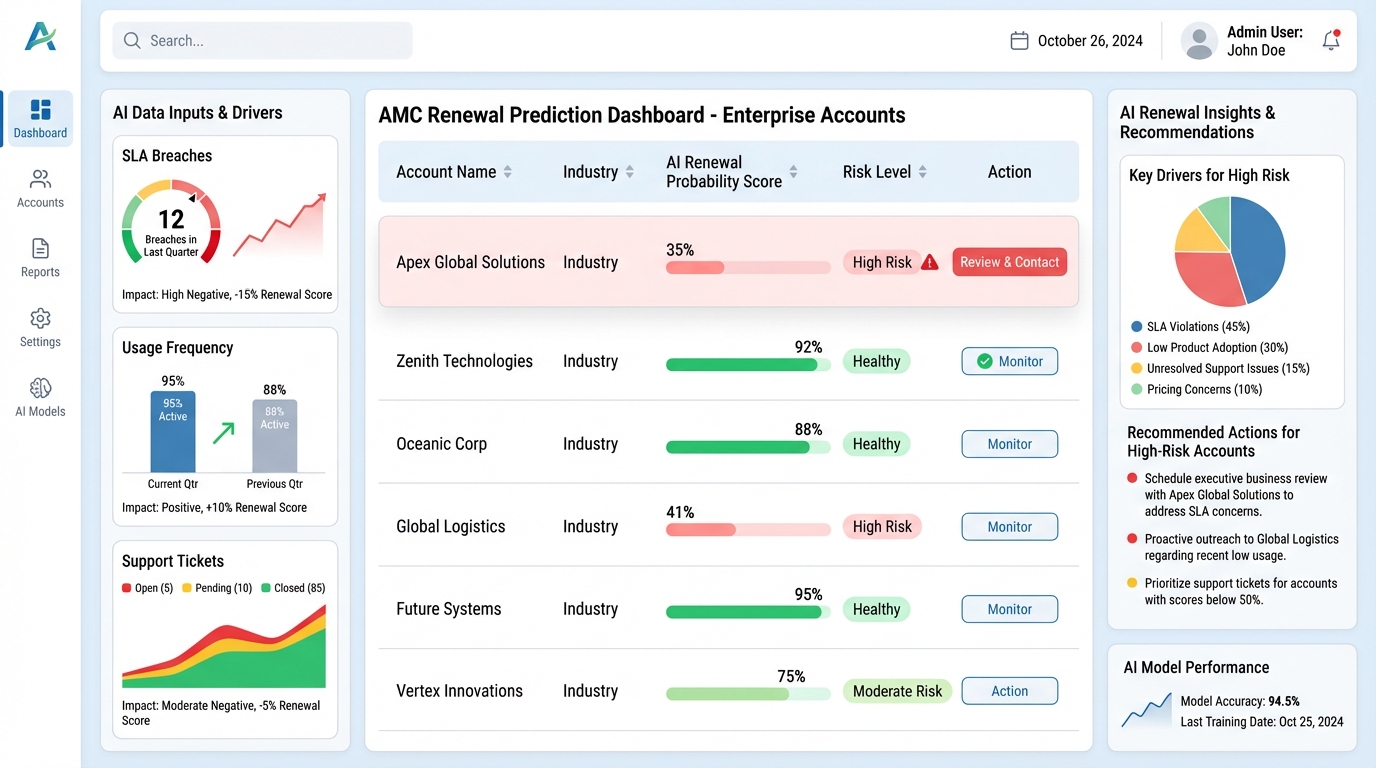
To move beyond guesswork, enterprises are now implementing sophisticated AMC renewal prediction models for 2026 renewals. These supervised machine learning models score the probability of a successful renewal on a scale of 0 to 100. By 2026, these models have evolved to include features such as feature adoption depth, seat utilization, and even macro-economic seasonality specific to the Indian market.
The implementation process involves building a feature store that pulls data from the CLM (Contract Lifecycle Management), CRM, and support ticketing systems. For example, a high volume of “Severity 1” tickets in the quarter leading up to renewal is a heavy weight against a positive outcome. Conversely, deep adoption of “sticky” features acts as a strong predictor of retention.
When these models identify a high-risk account, they trigger automated renewal rate improvement strategies. This might include a high-touch intervention from a Customer Success Manager or a specialized “save” offer delivered via an automated workflow. By surfacing these insights directly within the CRM, sales teams can prioritize their efforts on the accounts that are most likely to churn or those with the highest contract expansion opportunities.
Source: Sirion – Predicting Renewal Probability with Machine Learning (2026): Sirion resource
Contract analytics personalization for value reinforcement
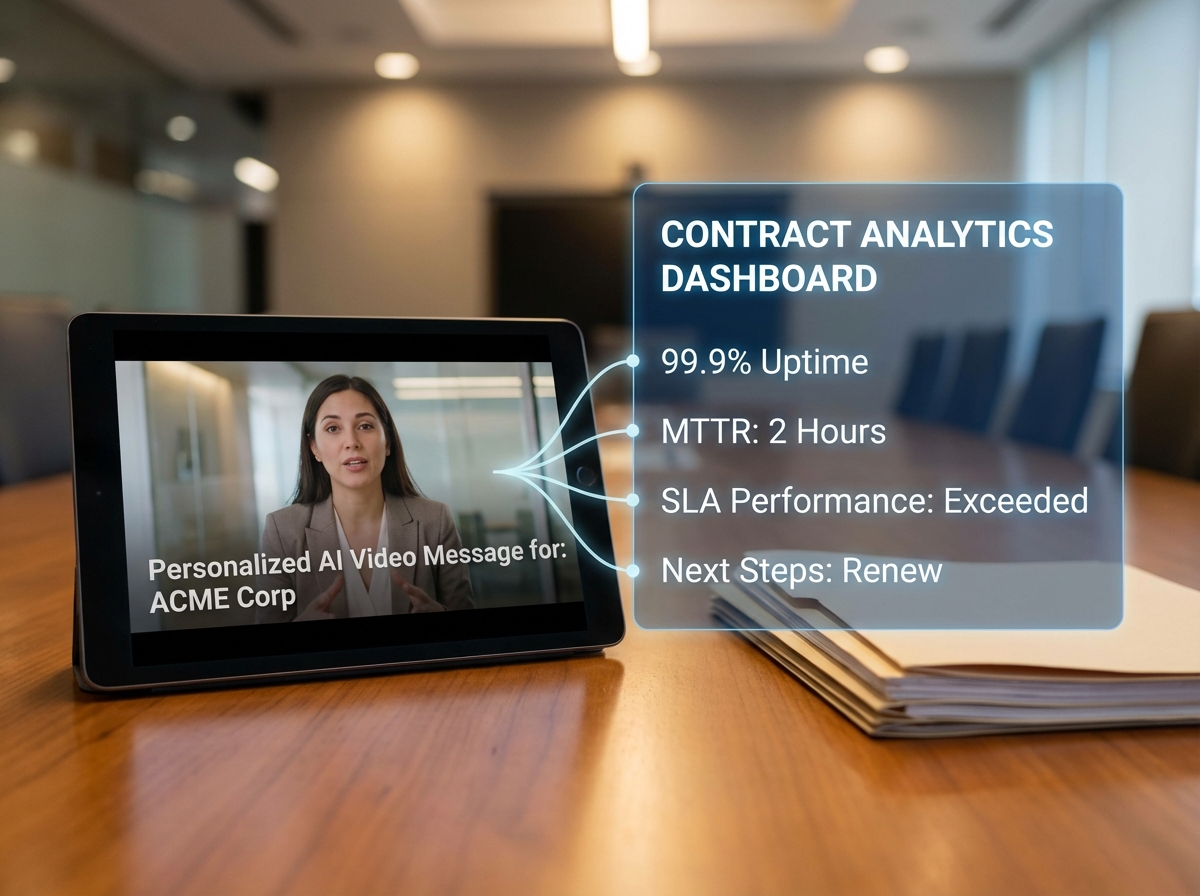
One of the most significant coverage gaps in traditional renewal strategies is the failure to link contract terms to realized value. Contract analytics personalization solves this by mapping specific clauses—like uptime commitments or MTTR (Mean Time To Repair) guarantees—to the actual performance data recorded during the year. This creates a powerful, evidence-based narrative for the renewal discussion.
Imagine a scenario where a procurement officer receives a report showing that the vendor maintained 99.98% uptime, effectively avoiding ₹15 Lakhs in potential downtime penalties. This level of detail transforms the renewal from a cost-center discussion into a value-reinforcement exercise. It strengthens the vendor relationship strengthening process by proving that the vendor is not just a service provider, but a reliable business partner.
These insights are then converted into dynamic scripts for contract value optimization videos. Instead of a generic PDF, the stakeholder receives a video that mentions their name, their specific contract ID, and the exact SLA wins achieved over the past year. This personalized approach ensures that the value message reaches the decision-maker in a format that is impossible to ignore.
Source: SpotDraft – Buyer’s Guide to Automated Contract Management in 2026: SpotDraft guide
Personalized video at scale: how TrueFan AI operationalizes renewals
The challenge of personalization has always been scalability, but generative AI has eliminated that barrier. Platforms like TrueFan AI enable enterprise teams to create thousands of hyper-personalized videos from a single master recording. This allows a CEO or a high-profile brand ambassador to address every customer by name, discussing their specific renewal terms and performance metrics.
TrueFan AI's 175+ language support and Personalised Celebrity Videos allow Indian enterprises to communicate with stakeholders in their preferred regional language, whether it is Hindi, Tamil, or Marathi. This localized approach is particularly effective in the Indian market, where regional relevance can significantly influence procurement decisions. The system can render these videos in under 30 seconds, allowing for real-time delivery via WhatsApp or email.
Furthermore, the integration of two-way AI avatars allows for interactive Q&A sessions within the video itself. A procurement officer can ask about DPDP (Digital Personal Data Protection) compliance or SOC 2 certification, and the AI avatar provides an immediate, accurate response. This level of B2B customer success automation not only delights the customer but also significantly accelerates the procurement cycle acceleration by resolving objections instantly.
Source: TrueFan – Two-Way Conversation AI Video: Two-Way Conversation AI Video
Source: WebEngage x Goibibo case study (India): Goibibo uplift in conversions
Vendor switching prevention and competitive displacement campaigns
In the 2026 B2B environment, defense is just as important as offense. Vendor switching prevention requires a proactive stance that neutralizes competitor narratives before they can take root. By using AI to monitor market signals—such as a competitor's recent funding or a new product launch—enterprises can deploy targeted counter-messages to at-risk accounts.
During the April–May window, you should also be running competitive displacement campaigns against your rivals. By identifying accounts where a competitor’s AMC is expiring, you can present a “switch-back” offer that highlights your superior SLA performance and lower Total Cost of Ownership (TCO). This is often the best time to poach high-value accounts, as they are already in a “review and renew” mindset.
The key to success here is precision timing. Using annual maintenance contract intelligence, you can time your outreach to hit exactly when the customer is feeling the most friction with their current vendor. A personalized video message that acknowledges their specific pain points and offers a seamless migration path can be the deciding factor in a successful displacement.
Source: The Smarketers – B2B Marketing Trends 2026 (India): B2B Marketing Trends 2026
Multi-year agreement incentives and negotiation automation
The ultimate goal of any renewal strategy is to move the customer from a precarious annual cycle to a stable multi-year agreement. Multi-year agreement incentives—such as price protection caps, complimentary modules, or premium support tiers—are essential for this transition. However, negotiating these terms across hundreds of accounts can overwhelm a legal team.
This is where B2B contract negotiation automation 2026 becomes a competitive advantage. AI-guided redline playbooks and agentic bots can handle the bulk of the negotiation within pre-approved guardrails. If a customer requests a specific discount or a change in liability clauses, the AI can propose a counter-term that aligns with the company's risk profile, only escalating to a human lawyer when necessary.
By pairing these automated negotiations with renewal rate improvement strategies, companies can significantly increase their “multi-year mix.” For example, a personalized video could feature a “limited-time” incentive tile that allows the customer to lock in 2025 pricing for the next three years with a single click. This reduces friction and makes the “yes” much easier for the procurement team.
Source: SpotDraft – 2026 Buyer’s Guide to Automated Contract Management: SpotDraft 2026 guide
Procurement cycle acceleration and contract expansion opportunities
The final hurdle in any renewal is the procurement approval process. Procurement cycle acceleration is achieved by front-loading all the necessary compliance and security documentation. By embedding ISO 27001 certificates, SOC 2 reports, and DPDP mapping documents directly into an interactive video microsite, you eliminate the back-and-forth that typically stalls deals in May.
This streamlined process also opens the door for contract expansion opportunities. While the customer is in the mindset of renewing their AMC, it is the perfect time to introduce AMC upsell automation. If the data shows they are approaching a usage threshold, the AI can automatically include an add-on offer in the renewal proposal. This “one-click upsell” approach has been shown to increase expansion ACV by up to 15% in enterprise accounts.
Solutions like TrueFan AI demonstrate ROI through these types of integrated journeys, where a single personalized video serves as a value recap, a negotiation portal, and an upsell engine. By the end of May, your organization should not only have retained its core revenue but also expanded its footprint within its most valuable accounts.
Source: TrueFan – Enterprise Video ROI Metrics Dashboard (2026): Enterprise Video ROI Metrics Dashboard
Implementation Checklist: The 4-Week Sprint
Week 1: Data Merge and Modeling
- Inventory all AMCs expiring in April–May.
- Normalize contract metadata and ingest it into your feature store.
- Train your AMC renewal prediction models to identify high-risk cohorts.
Week 2: Creative System and Incentives
- Develop script matrices for contract analytics personalization.
- Define multi-year agreement incentives based on account risk tiers.
- Prepare the compliance “vault” for procurement cycle acceleration.
Week 3: Automation and Channels
- Connect CRM triggers to the TrueFan AI API.
- Configure delivery channels across WhatsApp, email, and personalized microsites.
- Set up A/B tests for different incentive structures.
Week 4: Go-Live and Optimization
- Launch the T-60 and T-30 renewal sequences.
- Monitor the enterprise retention intelligence dashboard for engagement.
- Deploy competitive displacement campaigns for targeted rival accounts.
Summary of 2026 Statistics and Trends
- 85% of enterprise contracts are expected to be managed by AI-driven CLM platforms by the end of 2026.
- Personalized video content has been shown to increase B2B renewal rates by an average of 22% in the SaaS and IT services sectors.
- Procurement cycle times are projected to decrease by 40% for organizations using interactive AI compliance hubs.
- 60% of Indian B2B buyers now prefer receiving a video-based value recap over a traditional static QBR (Quarterly Business Review) deck.
- Multi-year conversion rates rise by 30% when incentives are presented through personalized, data-driven media rather than standard PDF proposals.
Frequently Asked Questions
How do AMC renewal prediction models handle the “April–May” cluster in India?
The models are trained specifically on Indian fiscal year seasonality. They weigh the “budget reset” factor heavily, knowing that procurement scrutiny is at its highest during these months. By analyzing historical data from previous Q1 cycles, the AI can predict which stakeholders are most likely to demand discounts or explore competitors.
Can B2B contract negotiation automation 2026 handle complex legal redlines?
Yes. Modern systems use agentic AI that understands the context of specific clauses. They work within a “playbook” of pre-approved fallback positions. If a negotiation exceeds these guardrails, the system automatically routes the contract to a human legal expert with a summary of the conflict.
What is the typical ROI of using personalized video for renewals?
Enterprises typically see a 70–90% reduction in creative production costs compared to traditional video editing. More importantly, they often experience a 15–40% lift in conversion rates for multi-year agreements. TrueFan AI provides a real-time ROI dashboard to track these metrics directly against signed ACV.
How does interactive video help with DPDP compliance in India?
Interactive videos can include “two-way” avatars that answer specific data privacy questions. They can also serve as a secure portal for stakeholders to view and sign DPA (Data Processing Agreements) and other compliance documents, ensuring that all interactions are logged and audit-ready.
How do I prevent “vendor switching” if a competitor offers a lower price?
Price is rarely the only factor. By using contract analytics personalization, you can demonstrate the hidden value you provided, such as avoided downtime or specialized support. Highlighting the high cost and risk of migration often neutralizes a lower-priced bid from a competitor.