Vernacular Voice Commerce India 2026: The Enterprise Blueprint to Reach 650M Regional-Language Shoppers
Estimated reading time: ~12 minutes
Key Takeaways
- By 2026, vernacular voice will be the primary gateway for 650M regional-language users engaging with Indian enterprises
- Winning requires a voice-first architecture spanning ASR/TTS, smart speakers, IVR fallbacks, and UPI-linked payments
- Regional playbooks (Hindi, Tamil, Bengali) must handle accents, colloquialisms, and cultural context, not just translation
- Drive growth with multilingual automation, voice-activated offer redemption, and intent-level personalization
- Governance hinges on WER, latency, agent containment, and compliant, multilingual consent and security
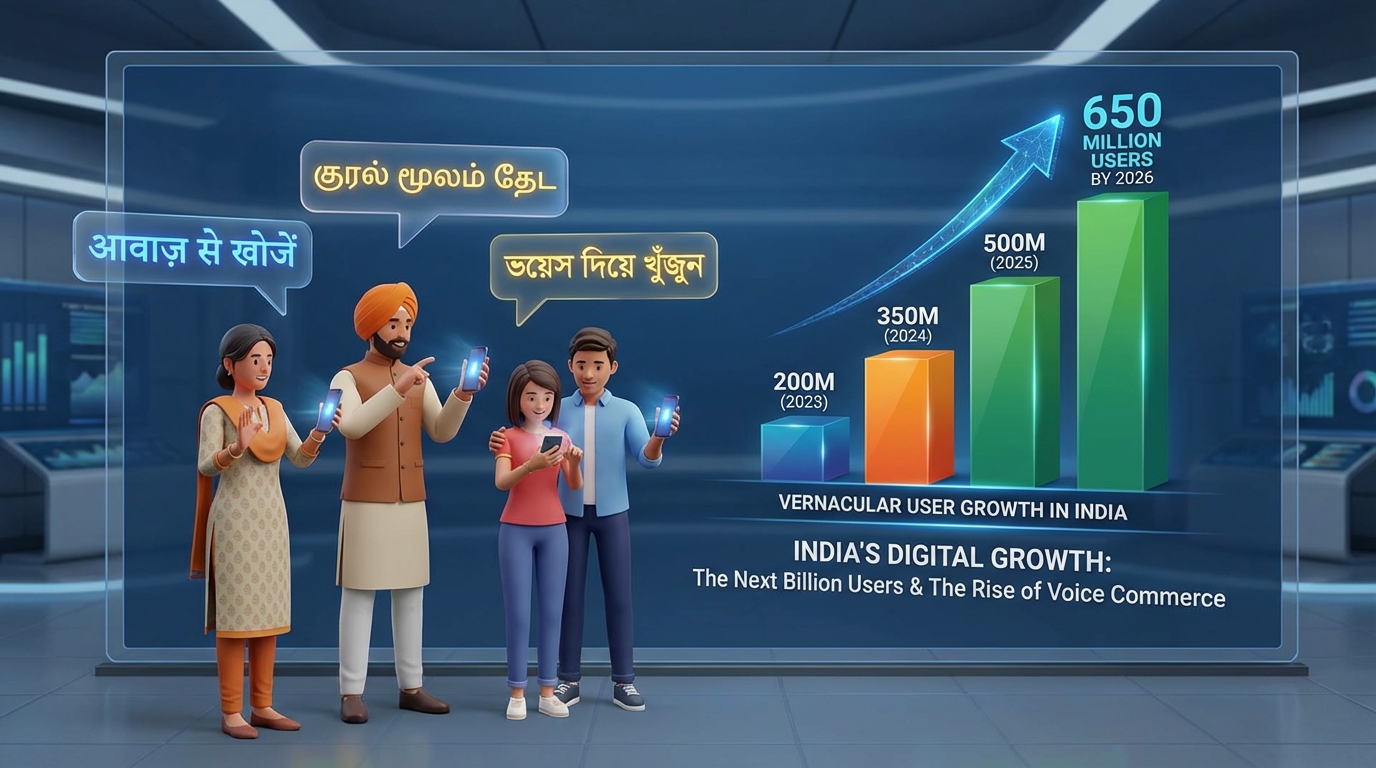
The landscape of digital consumption in India is undergoing a seismic shift, moving away from text-heavy interfaces toward intuitive, auditory experiences. By 2026, vernacular voice commerce India 2026 will represent the primary gateway for over 650 million regional-language users to interact with enterprise brands. This evolution is driven by a fundamental “speak not type” preference among the next billion users who find traditional typing cumbersome and exclusionary.
For enterprise leaders in retail, CPG, and BFSI, the mandate is clear: transition from static localized websites to dynamic, voice-first ecosystems. This blueprint provides the strategic framework to master regional language voice shopping, ensuring your brand captures the tier-2 voice commerce adoption wave. We will explore the technical architecture, language-specific playbooks, and ROI metrics required to dominate the Indian market in 2026.
Platforms like TrueFan AI enable enterprises to bridge the gap between voice intent and visual engagement, creating a seamless loop of personalized commerce. As we move into an era where 90% of new internet users are non-English speakers, voice assistant regional integration is no longer a luxury—it is the baseline for survival.
1. The 650M Vernacular Opportunity: Driving Tier-2 Voice Commerce Adoption
The urgency for vernacular voice commerce India 2026 is rooted in the sheer scale of India’s digital expansion. India is on track to exceed 900 million internet users by 2025, with the vast majority of new entrants hailing from Tier-2 and Tier-3 cities. These users prioritize Indic languages for discovery, research, and transactions, creating a massive demand for regional language voice shopping interfaces.
The “vernacular internet user” is defined by a preference for Hindi, Tamil, Bengali, and other regional tongues over English. For these cohorts, voice-first journeys eliminate the friction of complex keyboards and varying literacy levels, offering a cognitive ease that text cannot match. This shift is supported by the maturing of Automatic Speech Recognition (ASR) and Text-to-Speech (TTS) technologies specifically tuned for Indian dialects.
Market data indicates that Tier-2 voice commerce adoption is being accelerated by affordable 5G smartphones and the normalization of voice notes on platforms like WhatsApp. In noisy, low-bandwidth environments, a quick voice command is more reliable than navigating a multi-step checkout process. Furthermore, the rise of agentic commerce means that by 2026, AI agents will handle end-to-end shopping tasks—from price comparison to UPI-based checkout—all triggered by a single vernacular utterance.
Sources:
- IBEF: India’s internet users to exceed 900 million by 2025 (Indic language drivers)
- Techarc: Why India’s next billion users will speak, not type
- LS Digital (2026): The rise of AI-native advertising in India
2. Architecture Blueprint: Implementing Smart Speaker Commerce Integration
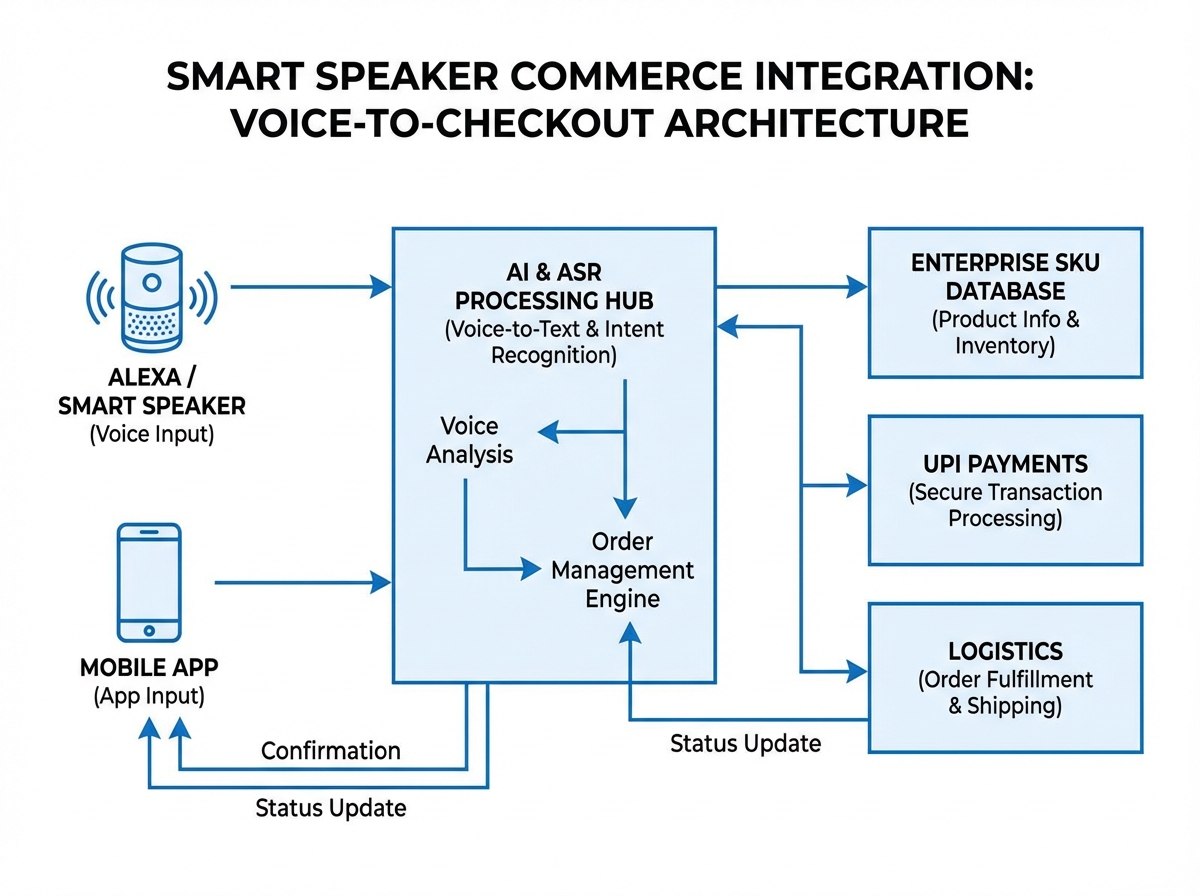
Building a robust regional language voice shopping stack requires a multi-layered technical architecture. At the core is the smart speaker commerce integration, which connects Alexa and Google Assistant ecosystems to your enterprise SKU database. This allows users to perform voice-to-cart actions, check order statuses, and receive personalized recommendations through their home devices.
The second layer involves voice assistant regional integration within your brand’s own mobile application. This includes “wake-word” mini-assistants that understand local intents and can handle complex queries like “Show me the cheapest red saree” in various dialects. To maintain high availability, enterprises must implement IVR (Interactive Voice Response) fallbacks for feature-phone users and low-bandwidth areas.
Multilingual voice marketing automation serves as the engine for proactive engagement. By using language auto-detection, the system can trigger lifecycle journeys—such as abandoned cart reminders or reorder nudges—in the user’s preferred tongue. Conversational shopping AI personalization then refines these interactions using first-party data to tailor bundles and offer COD (Cash on Delivery) reassurance, which remains a critical trust factor in regional markets.
Finally, the payments layer must support voice-activated offer redemption tied to UPI and loyalty programs. This ensures that the transition from “voice discovery” to “voice payment” is frictionless. By 2026, the integration of low-latency validation at the Point of Sale (POS) will allow users to redeem voice-triggered discounts instantly, whether shopping online or in-store.
Sources:
3. Regional Playbooks: Hindi Voice Commerce Optimization and Beyond
To succeed in vernacular voice commerce India 2026, enterprises must move beyond literal translation and embrace cultural transcreation. Hindi voice commerce optimization requires handling “Hinglish” utterances—a blend of Hindi and English that is standard in urban and semi-urban India. Your ASR models must recognize local intents like “sasta” (cheap), “jaldi bhejo” (send quickly), and specific product synonyms that vary by state.
Tamil voice search marketing presents unique challenges due to the stark difference between formal and colloquial Tamil. Systems must be tuned for regional accents from Chennai to Madurai and Coimbatore. During festive periods like Pongal or Aadi, localized scripts and dialect-specific shopping videos can significantly boost engagement. These videos should use subtitles and voiceovers that resonate with the local linguistic nuances of the region.
Bengali conversational commerce involves catering to both the formal Bangla of West Bengal and the colloquial influences of specific districts. Trust markers are paramount here; clearly articulated return policies and price clarity in the local tongue help overcome the skepticism often associated with digital transactions. Empathetic sentiment handling—using polite confirmation patterns like “thik ache”—can turn a standard transaction into a loyal customer relationship.
TrueFan AI’s 175+ language support and Personalised Celebrity Videos allow brands to create these dialect-specific shopping videos at scale. By featuring recognizable voices or localized celebrity endorsements that speak directly to the user in their dialect, brands can achieve a level of intimacy that traditional advertising cannot match. This hyper-localization is the key to penetrating the Marwari-speaking pockets of Kolkata or the Bundelkhandi regions of the Hindi belt.
Sources:
- India Digital Advertising: 2026 digital marketing trends
- RoyAlways: 2026 trends Indian brands must watch
4. Growth Levers: Multilingual Voice Marketing Automation and ROI
The transition to a voice-first strategy must be backed by clear growth levers and measurable outcomes. Multilingual voice marketing automation allows enterprises to scale their reach without a linear increase in manual effort. By auto-detecting a user’s language from their first interaction, the CRM can trigger personalized voice notes or IVR calls that offer relevant discounts, effectively moving them through the sales funnel.
Voice-activated offer redemption is a powerful tool for driving conversion in Tier-2 markets. Imagine a user receiving a voice notification about a flash sale; they can simply say “Claim offer” or “Redeem discount” to have the coupon applied to their UPI-linked account. This eliminates the need for copying and pasting codes, which is a major drop-off point in mobile commerce.
Solutions like TrueFan AI demonstrate ROI through increased view-through rates and conversion lifts by integrating these voice-triggered offers into personalized video content. When a user hears their name and a personalized offer in their mother tongue, the psychological barrier to purchase is significantly lowered. This approach not only drives immediate sales but also increases the Lifetime Value (LTV) of the customer by building deep-seated brand affinity.
To measure success, enterprises must look beyond traditional clicks. The voice commerce ROI measurement framework should include metrics like Word Error Rate (WER) by dialect, intent fulfillment rate, and the reduction in customer support costs through automated voice FAQs. By 2026, the ability to attribute revenue directly to voice-first journeys will be the hallmark of a mature digital enterprise.
Sources:
- The Tribune: Netcore’s e-commerce agentic trends (2026)
- LS Digital: AI-native personalization budgets (2026)
5. Governance and Measurement: The Voice Commerce ROI Measurement Framework
As enterprises scale their vernacular voice commerce India 2026 initiatives, governance and quality control become critical. A robust voice commerce ROI measurement framework must account for both technical performance and business impact. Technical KPIs include ASR accuracy across 20+ Indian dialects, NLU (Natural Language Understanding) intent precision, and system latency. If a voice assistant takes more than two seconds to respond, the user is likely to abandon the journey.
From a business perspective, ROI is calculated by comparing the AOV (Average Order Value) of voice-led transactions against traditional tap-based flows. Early data suggests that voice shoppers often have higher repeat rates because the convenience of reordering via a simple command—“Order my usual milk and bread”—is unparalleled. Furthermore, agent containment—the ability of the AI to resolve queries without human intervention—provides significant cost savings for large-scale enterprises.
Safety and compliance are equally important. Enterprises must ensure that regional-language consent prompts are transparent and legally compliant with India’s evolving data protection laws. PII (Personally Identifiable Information) minimization and secure audit logs for voice-triggered transactions are mandatory to prevent fraud, especially in voice-activated offer redemption scenarios.
By 2026, the integration of advanced fraud detection that analyzes voice biometrics and transaction velocity will be standard. This ensures that while the user experience is frictionless, the enterprise remains protected against sophisticated digital threats. Transparency in how voice data is used will be the primary driver of trust for the next 650 million shoppers.
Sources:
- The Tribune India: Agentic commerce is becoming the new OS for e-commerce
- LS Digital (2026): Vernacular AI and personalization discourse
6. The 2026 Implementation Roadmap: A Quarterized Enterprise Strategy
Scaling vernacular voice commerce India 2026 requires a phased approach to manage complexity and ensure model accuracy. The following 12-month roadmap is designed for enterprise-grade deployment, focusing on high-impact languages and essential commerce journeys.
Q1: Pilot Foundation (0–90 Days)
The focus is on Hindi voice commerce optimization and Tamil voice search marketing. Enterprises should define the top 50 shopping intents for their category—such as “Check delivery status” or “Find nearest store.” This phase involves building the voice FAQ database and integrating basic reorder journeys. Establishing a KPI baseline is crucial to measure the incremental lift of voice versus text.
Q2: Scale Footprint (90–180 Days)
In the second quarter, the program expands to include Bengali conversational commerce. This is the time to launch smart speaker commerce integration for home-based shopping. Enterprises should also roll out voice-activated offer redemption across their app and physical POS locations. The first wave of dialect-specific shopping videos should be deployed to target specific regional clusters with high growth potential.
Q3: Optimize and Govern (180–365 Days)
The final phase focuses on deep optimization and lifecycle multilingual voice marketing automation. This involves refining ASR models to reduce WER in difficult dialects and implementing advanced latency-shaving techniques. By this stage, the enterprise should have a full-funnel voice strategy—from acquisition via voice-led ads to retention via automated reorder nudges. Comprehensive safety audits and bias checks for regional languages must be institutionalized to ensure long-term sustainability.
7. Strategic Integration and FAQ: Future-Proofing with TrueFan AI
The success of vernacular voice commerce India 2026 hinges on the ability to combine auditory convenience with visual trust. While voice handles the “command,” video provides the “validation.” This is where the synergy between conversational AI and personalized video content becomes a competitive advantage. By delivering a cohesive experience where the voice assistant and the visual interface speak the same regional dialect, brands can eliminate the “digital divide” for Tier-2 and Tier-3 users.
Conclusion
The roadmap to 2026 is paved with regional languages and vocal commands. By adopting a structured approach to vernacular voice commerce India 2026, enterprise brands can unlock the massive potential of the next 650 million shoppers. The combination of smart speaker commerce integration, regional playbooks, and hyper-personalized video content will define the leaders of India’s digital future.
Final CTA:
Ready to lead the vernacular revolution? Book an enterprise demo to pilot your Hindi and Tamil voice shopping journey in 90 days, or download our Enterprise Checklist for Vernacular Voice Commerce India 2026.
Frequently Asked Questions
How accurate are Hindi/Tamil/Bengali models in noisy Tier-2 contexts?
Modern ASR models have reached high levels of accuracy by using noise-cancellation algorithms and dialect-specific training sets. Enterprises should use short, unambiguous prompts and implement confirmation loops (e.g., “Did you mean 5kg of rice?”) to ensure accuracy. Fallback to IVR or WhatsApp text is recommended for low-confidence utterances.
How do we prevent fraud in voice-activated offer redemption?
Fraud prevention is managed through multi-factor authentication. A voice command triggers a validation check against the user’s registered mobile number, UPI ID, or loyalty account. For high-value offers, a quick OTP sent via WhatsApp or a voice-guided OTP entry provides an additional layer of security.
What is the integration timeline for TrueFan AI with our existing CRM?
TrueFan AI is designed for rapid enterprise integration, typically taking 6 to 12 weeks. The platform connects via API to major CRM and e-commerce backends, enabling real-time rendering of personalized videos triggered by voice commerce events.
How do we handle consent and data privacy across multiple languages?
Obtain consent using clear, jargon-free language in the user’s native tongue, explaining what voice data is recorded and how it improves their experience. Provide easy opt-out options via a simple voice command—“Stop recording”—to maintain trust and comply with Indian data regulations.
Can voice commerce handle complex product specifications?
Yes, by using a voice-plus-visual approach. While the user asks about specifications via voice, the app can display a comparison chart or a dialect-specific shopping video that explains features. This hybrid model conveys depth without forcing users to listen to long descriptions.