Poila Boishakh marketing campaigns 2026: An enterprise playbook for Bengal growth, Kolkata wins, and diaspora momentum
Estimated reading time: 9 minutes
Key Takeaways
- Adopt a dual-wave timing (April 14 diaspora, April 15 West Bengal) to maximize reach and relevance
- Combine cultural authenticity (alpona, laal-par shada, Rabindra Sangeet) with data-driven personalization
- Leverage regional-language personalized videos for higher CTR, UPI adoption, and Kolkata market conversion
- Use a macro + micro influencer mix, with hyperlocal creators driving Tier-2 and diaspora engagement
- Implement ISO 27001/SOC 2 compliant platforms and rigorous cultural guardrails for brand safety
Poila Boishakh marketing campaigns 2026 will define how brands win in Bengal and among Bangla-speaking audiences across India this April. As the Bengali New Year approaches, enterprise leaders must navigate a complex landscape of cultural nuance, shifting digital behaviors, and the dual-wave timing of celebrations across West Bengal and the global diaspora.
The 2026 festive window presents a unique opportunity for regional marketing teams and Eastern India expansion leaders to secure high-intent customer acquisition. With West Bengal typically observing the festival on April 15 and Bangladesh (along with significant diaspora segments) celebrating Pohela Boishakh on April 14, a sophisticated, bifurcated strategy is no longer optional—it is a prerequisite for market leadership.
This playbook provides a comprehensive framework for executing Eastern India festival marketing that balances cultural authenticity with data-driven personalization. We will explore how to leverage regional language video marketing, optimize for Tier-2 Bengal expansion, and utilize enterprise-grade automation to drive measurable ROI during this critical commercial period.
The Cultural and Commercial Architecture of Bengali Cultural Celebration Campaigns
Bengali cultural celebration campaigns succeed when they move beyond superficial aesthetics and tap into the deep-seated emotional triggers of the “Nabo Barsho” spirit. In 2026, the visual language of Poila Boishakh remains anchored in tradition, yet the delivery mechanisms have become increasingly sophisticated.
Authentic creative must respect established cultural markers: the intricate geometry of alpona motifs, the classic laal-par shada (red-bordered white) saree palettes, and the evocative sounds of Rabindra Sangeet. These elements are not merely decorative; they signal brand respect for Bengali heritage, which is essential for building long-term trust in the Kolkata market and beyond.
The commercial significance of this period is most pronounced in the F&B and lifestyle sectors. Traditional sweet brand campaigns are the heartbeat of the festival, focusing on rosogolla, mishti doi, and sandesh hampers. Data from 2025 indicates that pre-order peaks now occur 3–5 days prior to the festival, necessitating early-funnel engagement strategies.
For apparel and lifestyle brands, the “new clothes” tradition (notun jama) drives a massive surge in demand. Successful campaigns in 2026 will focus on nostalgia-first storytelling and intergenerational pride. By showcasing “family twinning” looks and creator-led try-ons, brands can capture the millennial and Gen Z segments who are increasingly looking for modern interpretations of traditional attire.
Source: DrikPanchang: Pohela Boishakh 2026 Dates
West Bengal Market Penetration: Navigating the Digital Landscape of Kolkata and Beyond
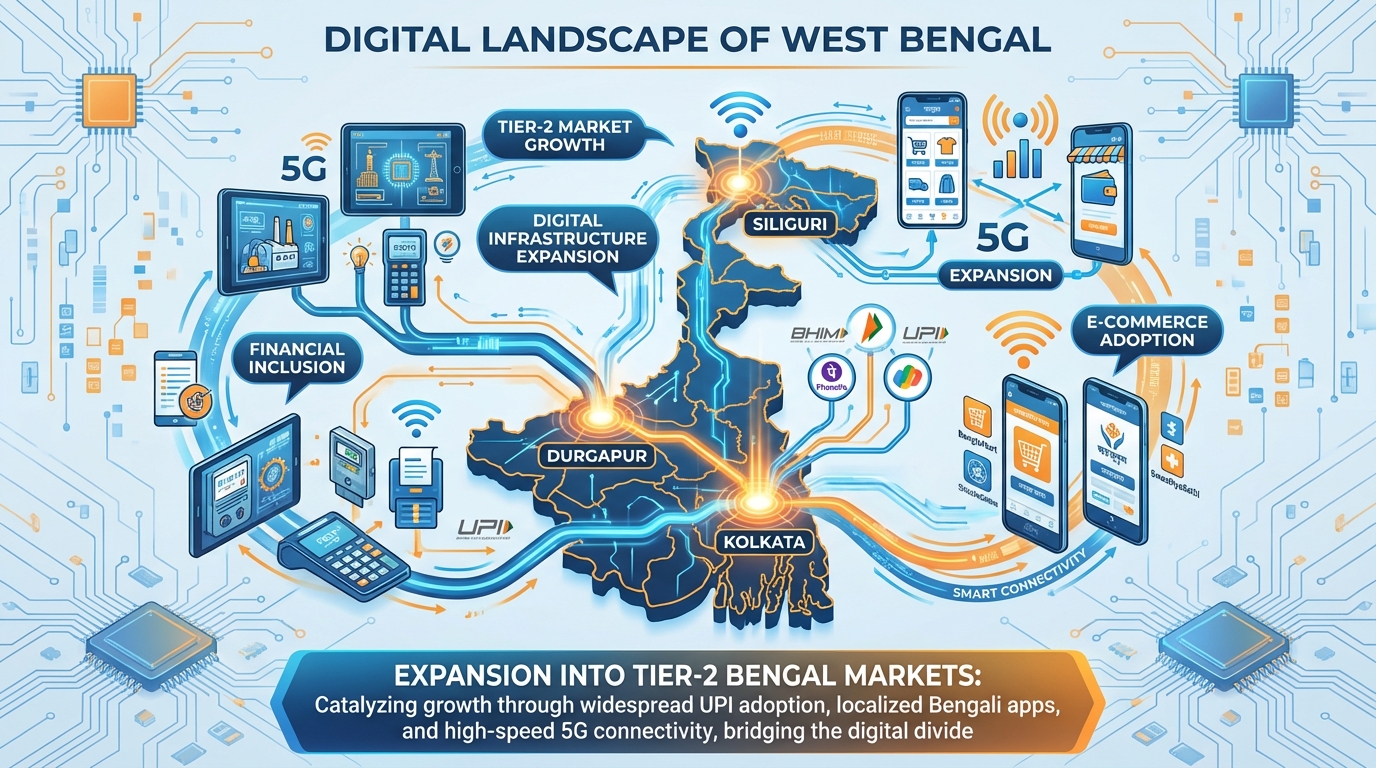
Achieving deep West Bengal market penetration in 2026 requires a granular understanding of the state's unique digital infrastructure. West Bengal operates as a distinct telecom circle, and enterprise planners must account for the heterogeneous nature of internet access across the region.
According to the latest TRAI projections for 2026, internet penetration in West Bengal has reached a record 68%, yet the quality of access varies significantly between the Kolkata metro and Tier-2 hubs. The state's proactive Data Centre Policy has bolstered enterprise cloud availability, allowing for the low-latency delivery of rich media content, which is vital for high-impact video campaigns.
Kolkata market customer acquisition strategies must prioritize organic discovery via Instagram and YouTube, where creator density is highest. In contrast, tier-2 Bengal expansion strategies for cities like Asansol, Siliguri, and Durgapur should lean into hyperlocal community pages and short-form video platforms like ShareChat and Moj. These platforms remain dominant for Bengali-first reach in suburban and rural belts.
Payment behavior is another critical factor. While UPI is ubiquitous, West Bengal’s per-capita usage in early 2026 still lags behind national leaders like Karnataka or Maharashtra. This gap presents an opportunity for brands to use education-driven creatives. Instead of simple discount messaging, successful campaigns will utilize regional payment adoption videos that demystify UPI flows and promote festive cashback in the local tongue.
Source: TRAI: Quarterly Performance Indicator Report
Source: West Bengal Data Centre Policy
Source: ICRIER: State of India’s Digital Economy Report 2024
Source: Economic Times: Statewise UPI Adoption Trends
Bengali New Year Personalization: Scaling Regional Language Video Marketing for Enterprise Growth
The most significant shift in Poila Boishakh marketing campaigns 2026 is the move from mass broadcasting to hyper-personalization. Bengali New Year personalization now involves delivering one-to-one video messages that greet users by name, reference their specific city, and offer localized incentives in fluent Bengali.
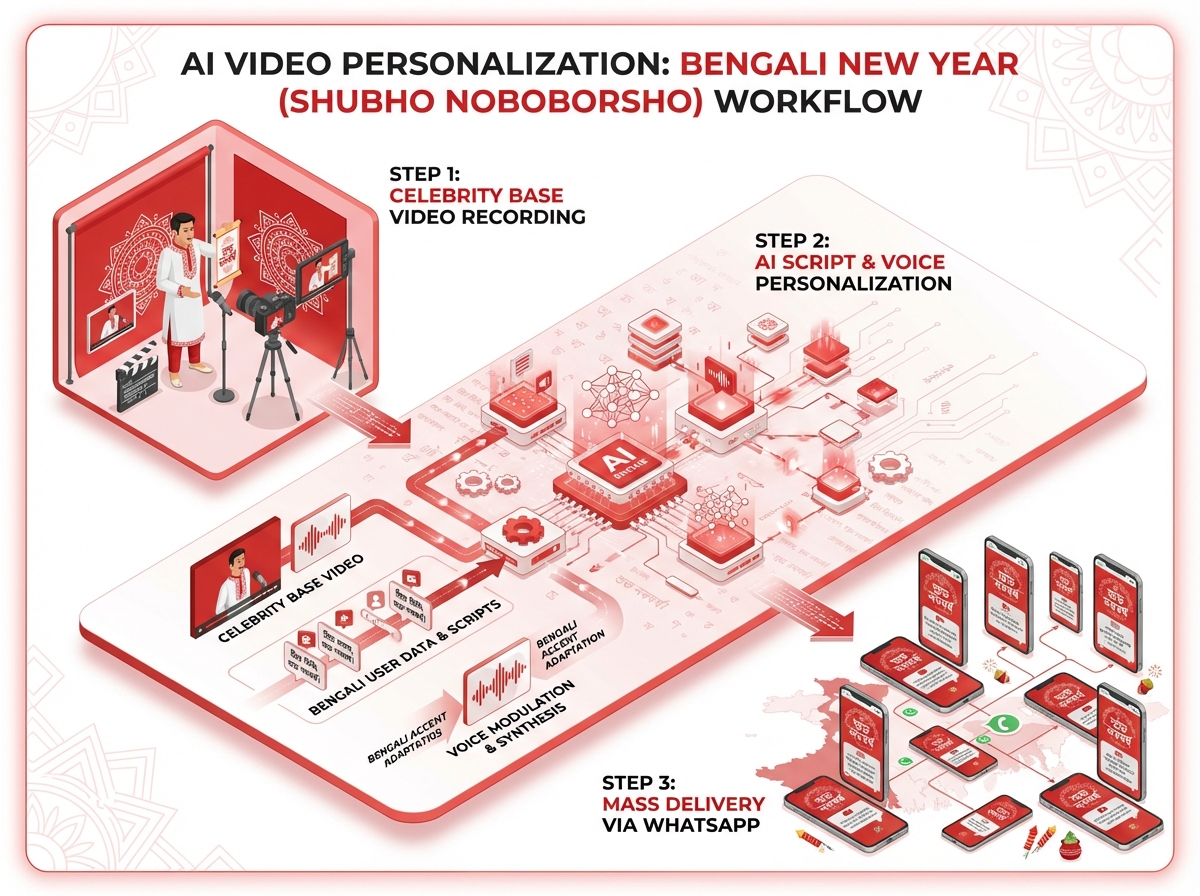
Platforms like TrueFan AI enable brands to bridge the gap between celebrity-led aspiration and individual customer recognition. By automating the creation of thousands of personalized videos, enterprises can achieve a level of intimacy that was previously impossible at scale. This is particularly effective for loyalty renewals, where a “Shubho Noboborsho” wish from a brand ambassador can trigger significant increases in customer lifetime value.
TrueFan AI's 175+ language support and Personalised Celebrity Videos allow for perfect lip-sync and voice retention, ensuring that the Bengali dialect used is authentic to the region—whether it’s the refined Shuddho Bhasha of Kolkata or the specific nuances of North Bengal. This level of regional language video marketing is essential for overcoming the “uncanny valley” of AI-generated content and establishing genuine emotional resonance.
To activate this at an enterprise level, brands should follow a structured seven-step recipe:
- Base Shoot: Record a 15-minute session with a celebrity or brand face, covering various script fragments.
- Script Variants: Prepare Bengali scripts that include dynamic tokens for name, city, and specific offers.
- CRM Integration: Connect the CDP via API to map fields such as
first_name,last_purchase, andpincode. - Cohort Generation: Segment the audience into new users, lapsed customers, and high-LTV segments.
- Auto-Generation: Produce videos with dynamic overlays showing the nearest store location and real-time pricing.
- Orchestrated Delivery: Deploy via WhatsApp on April 14 for the diaspora and April 15 for West Bengal.
- Optimization: Use virtual reshoots to A/B test different value propositions, such as “flat discount” versus “UPI cashback.”
Source: TrueFan AI: Video Personalization ROI Metrics
Source: TrueFan AI: NPS Video Automation 2026
Source: TrueFan AI: Enterprise Platform
Regional Influencer Partnerships Bengali: Engaging the Millennial and Diaspora Audience
Influencer marketing in Bengal has matured into a sophisticated ecosystem. For Poila Boishakh marketing campaigns 2026, the focus has shifted toward regional influencer partnerships Bengali that prioritize credibility over mere follower counts.
A successful creator mix for 2026 involves a bifurcated approach. Macro-influencers provide the necessary awareness bursts across the state, while hyperlocal micro-influencers in cities like Howrah, Malda, and Kharagpur drive actual footfall and conversion. These micro-influencers often have higher engagement rates within specific community clusters, making them ideal for vernacular commerce activation Bengal.
When targeting the Bangladesh diaspora targeting India, the creative strategy must pivot toward nostalgia. Millions of Bangla-speaking individuals living in Mumbai, Delhi-NCR, and Bengaluru seek a connection to their roots during Pohela Boishakh. Campaigns that celebrate “bringing home to where you live” through curated sweet bundles or traditional apparel perform exceptionally well in these metros.
Briefing creators requires strict adherence to cultural guardrails. Non-negotiables include the correct spelling of the festival (Poila vs. Pohela depending on the target geography), the avoidance of political symbolism, and a focus on community togetherness. Content formats should prioritize 30–45 second Reels that combine a personal “Shubho Noboborsho” memory with a clear call to action, such as scanning a QR code for a personalized celebrity greeting.
Source: Exchange4Media: Social Media Campaigns 2026
Source: Social Samosa: Cultural Essence in Advertising
Traditional Sweet Brand Campaigns and Tier-2 Bengal Expansion Strategies
The commercial heart of the Bengali New Year lies in the “Mishti” (sweet) industry and the burgeoning retail sectors of Tier-2 cities. Traditional sweet brand campaigns in 2026 are leveraging digital tools to solve the perennial problem of last-mile delivery and peak-day congestion.
Leading F&B brands are now using “pre-order windows” (T-5 to T-2) supported by personalized video reminders. By offering limited-edition boxes featuring alpona art and referral rewards, these brands are successfully shifting demand away from the frantic morning of April 15. In Tier-2 cities, where physical retail still dominates, the “QR commerce island” has become a staple. Customers scan a code in-store to receive a personalized video wish and an instant UPI cashback offer, bridging the gap between offline browsing and online payment.
Tier-2 Bengal expansion strategies must account for the unique logistics and payment preferences of cities like Siliguri and Bardhaman. In these markets, the “COD-to-UPI” nudge is a powerful tool for improving operational efficiency. By delivering regional payment adoption videos that explain the security and ease of digital transactions in Bengali, brands can significantly reduce their Cash-on-Delivery overheads.
Furthermore, hyperlocal playbooks should include sponsorships of community gatherings and local club tie-ups. In 2026, ward-level creator challenges—where residents compete to create the best alpona or festive meal—have proven to be highly effective for driving brand salience in suburban Bengal.
Kolkata Market Customer Acquisition: Measurement, Security, and ROI Frameworks
For any enterprise-scale Poila Boishakh marketing campaign, the ability to measure impact and ensure brand safety is paramount. Kolkata market customer acquisition is no longer just about reach; it is about the precision of conversion and the security of user data.
KPI frameworks for 2026 must be multi-layered. Beyond standard metrics like VTR (View-Through Rate) and CTR (Click-Through Rate), brands are now tracking “UPI initiation uplift” and “store visit attribution” via QR scans. Data from early 2026 suggests that personalized video content drives a 17% higher read rate on WhatsApp compared to static images, directly impacting the bottom line.
Solutions like TrueFan AI demonstrate ROI through their ability to provide detailed analytics on personalization elements. This allows marketing teams to iterate on their scripts in real-time. For instance, if data shows that “city-first” greetings are outperforming “name-first” greetings in North Bengal, the system can pivot the remaining video generation to the higher-performing variant via virtual reshoots.
Brand safety and cultural authenticity marketing guardrails are equally critical. All content must undergo rigorous tone checks by regional experts to avoid unintentional insensitivity. Furthermore, enterprise execution requires adherence to global security standards. Utilizing platforms that are ISO 27001 and SOC 2 compliant ensures that customer data used for personalization—such as names and purchase history—is handled with the highest level of integrity.
Summary Checklist for Poila Boishakh 2026
- Dual-Wave Timing: April 14 (Diaspora) and April 15 (West Bengal).
- Visual Language: Alpona, laal-par shada, and Rabindra Sangeet.
- Personalization: Name-based video greetings with localized store mentions.
- Influencer Mix: Macro for reach, Micro for Tier-2 trust.
- Payment Education: Regional language videos to drive UPI adoption.
- Security: Ensure all personalization platforms are ISO 27001/SOC 2 compliant.
Frequently Asked Questions
What is the best time to launch Poila Boishakh marketing campaigns 2026?
The campaign should follow a two-wave model. Wave 1 should launch on April 13–14 to target the Bangladesh diaspora and Bangla-speaking segments in Indian metros. Wave 2 should focus intensely on West Bengal on April 14–15. Teaser phases should begin at least 10 days prior (T-10) to build anticipation for personalized offers.
How can brands ensure cultural authenticity in their Bengali New Year campaigns?
Authenticity is achieved by using native Bengali speakers for scriptwriting and voiceovers, respecting traditional visual motifs like alpona, and understanding the specific rituals of the day. Avoid generic “Indian festive” templates; instead, focus on Bengal-specific elements like the Haal Khata (new ledger) tradition or the exchange of sweets.
Why is regional language video marketing more effective than static ads in Bengal?
Bengali consumers, particularly in Tier-2 and Tier-3 cities, show a strong preference for video content in their mother tongue. Video allows for better emotional storytelling and can simplify complex information, such as how to use a new UPI feature or claim a festive discount, leading to higher trust and conversion rates.
How does personalization at scale work for a festival with millions of participants?
Personalization at scale is managed through AI-driven video automation. TrueFan AI allows brands to take a single celebrity recording and dynamically generate thousands of unique videos where the celebrity mentions the customer's name and local city. This is delivered via automated WhatsApp or email triggers based on CRM data.
What are the key metrics to track for Kolkata market customer acquisition?
Key metrics include View-Through Rate (VTR) on personalized content, Click-Through Rate (CTR) to the product page, the rate of UPI transaction completion, and offline footfall measured through unique store-specific QR codes. Additionally, tracking the Net Promoter Score (NPS) uplift post-campaign provides insights into long-term brand loyalty.