AI video cart abandonment India 2026: Recover 25–40% via personalized WhatsApp, email, and SMS nudges
Estimated reading time: ~10 minutes
Key Takeaways
- India’s cart abandonment exceeds 70% on mobile; AI video nudges outperform static reminders.
- Personalized videos on WhatsApp, email, and SMS address confidence anxiety and reduce friction.
- Localization at scale with 175+ languages and AI avatars boosts trust and engagement.
- Shopify & WooCommerce integrations enable automated triggers, deep links, and guardrails.
- Proven ROI with 8.5% recovery vs. 5% text, delivering 45x+ returns under DPDP-compliant workflows.
India’s digital landscape has shifted, yet one challenge remains stubbornly high: AI video cart abandonment India 2026 strategies are now the only way to combat the 70% abandonment rate plaguing mobile-first brands. While traditional text-based reminders are being ignored, hyper-personalized video nudges delivered via WhatsApp, email, and SMS are rebuilding shopper confidence and recovering lost revenue at unprecedented scales.
1. The State of Cart Abandonment in India 2026
In 2026, the Indian e-commerce market is no longer just about price; it is about trust and friction. According to Statista’s global cart abandonment data, the global digital shopping cart abandonment rate reached 70.22% in early 2026, but in India, the numbers are even more stark due to a mobile-heavy user base. Data from ClickPost reveals that mobile abandonment in India hovers around 75.5%, while Mailmodo reports that for certain high-intent categories, it can spike as high as 85.65%.
The “3-click death trap” is real. Indian shoppers often abandon carts not because of price shocks, but due to “confidence anxiety”—a lack of trust in product efficacy, fit, or the return process. ET BrandEquity highlights that 70% of Indian shoppers abandon carts when they feel a disconnect with the brand's persona or face technical friction during OTP flows.
Key 2026 Benchmarks for India:
- Average Abandonment Rate: 71.72% (Source: Baymard)
- Mobile-Specific Abandonment: 75.5% to 85.65%
- Primary Driver: Confidence anxiety and mobile friction.
- Emerging Trend: Interactive, AI-driven creatives are replacing static banners to improve engagement by up to 3x (Source: SunTec India). Social commerce shoppable videos 2026 guide
Platforms like Studio by TrueFan AI enable brands to bridge this trust gap by replacing cold, automated text with warm, humanized video messages that address these specific anxieties in real-time.
2. The Psychology of the Indian Shopper: Why Static Reminders Fail
Static reminders—the “You forgot something!” emails—have reached a point of diminishing returns. In a market saturated with generic notifications, the Indian shopper in 2026 requires a more sophisticated nudge.
The Trust Deficit
Indian consumers are increasingly wary of “ghost brands.” When a shopper adds a ₹3,000 serum to their cart but doesn't check out, they aren't usually waiting for a 10% discount. They are wondering: Will this suit my skin? Is the return process actually hassle-free? A static image cannot answer these questions with the same authority as a human face.
The Mobile Friction Factor
With over 90% of Indian e-commerce traffic coming from mobile devices, small screens make form-filling and reading long policy texts a chore. Video content is the native language of the Indian mobile user. A 15-second video that summarizes the product benefits and offers a “one-tap” checkout via WhatsApp is significantly more effective than a multi-paragraph email.
Localization and Dialect
India is not a monolith. A shopper in Tamil Nadu responds differently to a Hindi-speaking avatar than they would to one speaking Tamil or “Tanglish.” Static tools struggle with this level of granular localization. Studio by TrueFan AI’s 175+ language support and AI avatars allow brands to automatically switch the spokesperson's language based on the user's IP or profile data, creating an instant emotional connection that static text simply cannot replicate.
3. The New Playbook: D2C Retention Video Marketing Automation
D2C retention video marketing automation is the orchestrated use of automatically generated, personalized video messages triggered by customer lifecycle events. In 2026, this isn't just a “nice-to-have”—it's the backbone of high-growth CRM strategies.
How Personalized Cart Recovery Videos AI Work
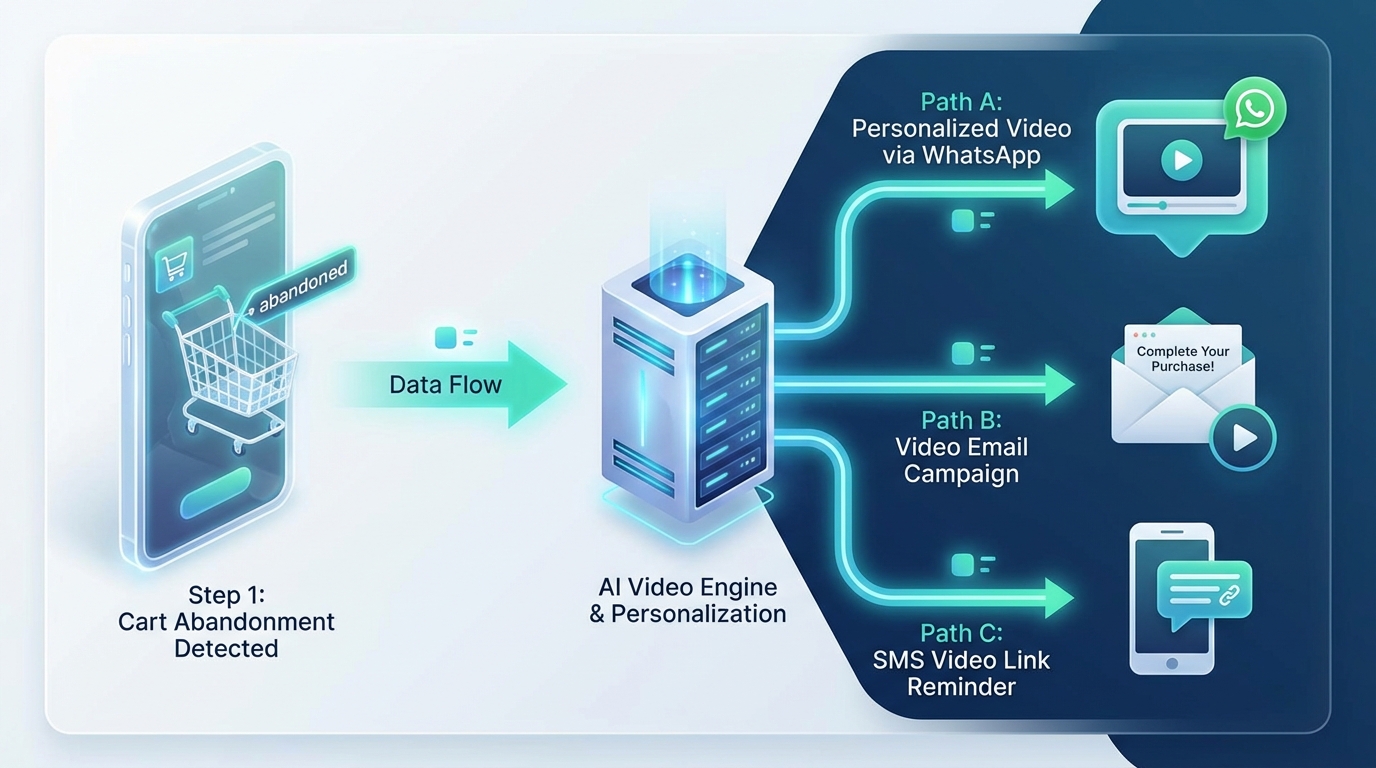
The process begins with a trigger from your e-commerce platform (Shopify, WooCommerce, or Magento). When a cart is abandoned, the system pulls dynamic data:
- [FirstName]: To grab attention immediately.
- [ProductImage]: To remind them of exactly what they liked.
- [Price/Discount]: To provide a clear incentive.
- [CheckoutURL]: For a frictionless path back to the cart.
The AI then renders a unique video for that specific user. Imagine a spokesperson like “Gunika” or “Aryan” (TrueFan AI's photorealistic avatars) appearing on the shopper's WhatsApp, saying: “Hey Rahul, I saw you looking at the Midnight Recovery Cream. It’s one of our bestsellers for oily skin! I’ve reserved it for you for the next 4 hours with a special 15% discount. Click the link below to grab it before it goes out of stock.”
The Multi-Channel Drip
- The 15-Minute Nudge (WhatsApp): High-urgency, low-friction. A video thumbnail with a “Play” button. WhatsApp business video strategy
- The 6-Hour Follow-up (Email): A more detailed video explaining the “Returns & Exchange” policy to solve confidence anxiety. Video email marketing ROI in India
- The 24-Hour Final Call (SMS/WhatsApp): A video featuring a countdown timer and a final discount code.
This multi-touch approach ensures that you are meeting the customer where they are, using the medium they prefer.
4. Platform Integrations: Scaling with Shopify & WooCommerce
To execute AI video cart abandonment India 2026 strategies at scale, seamless integration with your e-commerce stack is non-negotiable.
Shopify Playbook (AI Video Shopify Cart Recovery) — read the full guide
For Shopify brands, the integration works via webhooks. When the checkouts/update or checkouts/create webhook triggers and remains “unpaid” for a set duration (e.g., 30 minutes), the data is pushed to the AI video engine.
- Dynamic Deep-Linking: The video CTA doesn't just go to the homepage; it goes to a pre-filled checkout page where the discount code is already applied.
- Product Mapping: The AI automatically selects the primary product image from the Shopify liquid variables to overlay within the video.
WooCommerce Playbook (WooCommerce Cart Recovery Video AI)
WooCommerce users leverage the REST API to map order_status and cart fragments. Given the customizable nature of WooCommerce, brands can also include “COD Reassurance” videos for customers who have a history of choosing Cash on Delivery, a critical factor in the Indian market.
Data Hygiene and Fail-safes
Automation at this scale requires guardrails:
- Stock Checks: Never send a recovery video for an out-of-stock item.
- Frequency Caps: Ensure a user doesn't receive five videos if they abandon five different items in an hour.
- Language Fallback: If the user's preferred language is unknown, the system should default to “Hinglish”—the most widely understood commercial dialect in urban India.
5. ROI Modeling: The Math Behind 40% Recovery
Marketing leaders need to justify the shift from “free” text to “paid” AI video. Solutions like Studio by TrueFan AI demonstrate ROI through a combination of higher Click-Through Rates (CTR) and significantly improved conversion-to-recovery metrics.
The 2026 Cost-Benefit Analysis
Let's look at the numbers for a mid-sized Indian D2C brand:
- Monthly Carts Initiated: 100,000
- Abandonment Rate: 70% (70,000 abandoned carts)
- WhatsApp Opt-in Rate: 60% (42,000 reachable users)
- WABA Marketing Message Cost: ~₹0.86 per message (Source: ChatMitra)
- Total Monthly Investment (Messaging + Platform): ~₹65,000 - ₹80,000
The Recovery Lift
- Standard Text Recovery Rate: 5% (3,500 orders)
- AI Video Recovery Rate: 8.5% (5,950 orders)
- Incremental Orders: 2,450
- Average Order Value (AOV): ₹1,500
- Incremental Revenue: ₹36,75,000
- ROI: >45x
Even with the higher cost of WhatsApp Business API (WABA) marketing templates in 2026—which Flowcall and Authkey note have seen slight adjustments for INR billing—the sheer lift in conversion makes the “cost per recovery” significantly lower than traditional retargeting ads on Meta or Google.
As mTalkz points out, the cost of a WhatsApp conversation in India ranges from ₹0.30 to ₹2.50 depending on the category, but the high engagement of video ensures that every paisa spent works harder than a static SMS.
6. Implementation & Compliance: DPDP Act 2023 & WABA 2026
Deploying AI video in India requires strict adherence to the Digital Personal Data Protection (DPDP) Act 2023. As we move through 2026, the Ministry of Electronics and Information Technology (MeitY) has intensified enforcement.
DPDP Compliance Checklist for E-commerce
- Lawful Basis: You must have a clear “Notice and Consent” flow at the point of cart entry.
- Purpose Limitation: Data collected for checkout cannot be used for unrelated marketing without explicit permission.
- Right to Erasure: Your WhatsApp and Email videos must include an easy “Opt-out” or “Unsubscribe” mechanism.
- Data Residency: Ensure your AI partner stores and processes personal data within Indian borders where required.
For a deep dive into the legalities, refer to the Official MeitY DPDP Act PDF or the JISA Softech Compliance Guide.
WhatsApp Business API (WABA) Best Practices
In 2026, Meta's pricing and policy for the Indian market have evolved. Brands must use “Marketing” templates for cart recovery, which require pre-approval.
- The 24-Hour Window: If a customer replies to your video, you enter a “Service Window” where messaging costs are lower.
- Interactive Buttons: Use “Quick Reply” buttons like “Buy Now” or “Talk to Expert” to keep the conversation within WhatsApp.
- INR Direct Billing: Ensure your provider supports direct INR billing to avoid currency fluctuation hits (Source: Fyno 2026 Guide).
7. FAQ: Solving the Enterprise Cart Recovery Puzzle
Q: How does AI video handle high-volume sales events like Diwali?
A: Enterprise-grade platforms use cloud-agnostic GPU backends to render thousands of personalized videos in minutes. During peak traffic, the system prioritizes “Utility” reminders to ensure no shopper is left waiting.
Q: Can we use our own brand ambassadors as AI avatars?
A: Yes. Advanced solutions allow for “Custom Avatar Training” where your brand's face—whether it's a founder or a celebrity—is digitized into a “Digital Twin” that can deliver personalized messages at scale.
Q: Is the video quality high enough for premium luxury brands?
A: In 2026, AI video has moved beyond “uncanny valley.” Studio by TrueFan AI offers 4K resolution and production-grade lip-sync, ensuring that the video looks like a high-end ad, not a deepfake.
Q: How do we measure the “Lift” specifically from video vs. text?
A: We recommend a 90/10 split test. Send 90% of your abandoned carts the AI video flow and 10% the standard text flow. Measure the “Recovered Revenue per Send” to see the true delta.
Q: What happens if a user abandons multiple items?
A: The system uses “Cart Logic” to identify the highest-value item or the item with the most stock and features that in the video, while mentioning “and other items in your bag” to keep the message concise.
Q: Are these videos compliant with global privacy standards?
A: Yes, top-tier platforms are ISO 27001 and SOC 2 certified, ensuring that customer data is encrypted and handled with enterprise-grade security.
Conclusion: The 2026 Competitive Edge
The era of generic “Come back” messages is over. In the hyper-competitive Indian D2C space, the winner is the brand that can humanize its automation. By integrating AI video cart abandonment India 2026 strategies, brands are doing more than just recovering revenue—they are building a relationship with the shopper at the most critical moment of the journey.
Ready to see how personalized video can transform your retention? The 10-day implementation window is open for brands looking to lead the 2026 e-commerce revolution.
Recommended Internal Links
Frequently Asked Questions
How do AI videos recover abandoned carts?
They trigger on cart events, pull dynamic fields (name, product, discount, checkout URL), and deliver a personalized video via WhatsApp, email, or SMS that reduces friction and addresses trust gaps, driving shoppers back to a pre-filled checkout.
What recovery lift can Indian D2C brands expect?
Brands typically see recovery move from ~5% with text to ~8.5% with AI video, translating to 25–40% more recovered orders and 45x+ ROI depending on AOV, opt-in rate, and template costs.
Can we localize by language and region?
Yes. With 175+ languages and AI avatars, messaging can adapt to Hindi, Tamil, Bengali, or Hinglish based on user data, dramatically improving engagement in India’s diverse markets.
Is this compliant with DPDP Act 2023?
When implemented with notice-and-consent, purpose limitation, easy opt-outs, and data residency controls, AI video cart recovery remains compliant. Choose ISO/SOC2-certified vendors.
Which platforms are supported?
Native workflows exist for Shopify (webhooks, deep links) and WooCommerce (REST API, cart fragments), with guardrails like stock checks, frequency caps, and language fallbacks.