ONDC seller onboarding marketing: The Enterprise Playbook for Hyperlocal Growth in India
Estimated reading time: ~12 minutes
Key Takeaways
- ONDC unlocks a decentralized, interoperable network that democratizes discovery and transactions across buyer and seller apps.
- WhatsApp Business ONDC integration enables frictionless conversational KYC, catalog coaching, and SLA education at scale.
- Hyperlocal personalization at pin-code and ward level boosts conversion via language, festival alignment, and real-time delivery promises.
- Enablement videos in vernacular languages accelerate seller activation and reduce support costs for enterprises.
- ROI measurement requires end-to-end metrics from Cost-to-Onboard and Time-to-First-Order to SLA compliance and retention.
The landscape of Indian e-commerce is undergoing a seismic shift, moving away from centralized “walled gardens” toward a decentralized, interoperable network. At the heart of this evolution is ONDC seller onboarding marketing, a strategic imperative for enterprises looking to capture the next 500 million shoppers in Tier-2 and Tier-3 cities.
Open Network for Digital Commerce (ONDC) is not a traditional marketplace or a standalone app; it is a government-backed digital public infrastructure (DPI) built on open protocols. This infrastructure enables any buyer on any participating app to discover and purchase from any seller on any participating seller app. By 2026, this “unbundling” of the e-commerce value chain is projected to democratize digital commerce, allowing millions of small merchants and kiranas to compete on a level playing field with global giants.
For the enterprise leader, the challenge is no longer just about listing products; it is about scaling merchant acquisition, ensuring high-fidelity KYC, and driving buyer demand at a hyperlocal level. This playbook provides a comprehensive framework for ONDC seller onboarding marketing, integrating WhatsApp Business ONDC integration, hyperlocal commerce personalization India, and data-driven ROI models to ensure sustainable growth in the 2026 digital economy.
1. The 2026 Landscape: Retail Digital Transformation India
The year 2026 marks a tipping point for retail digital transformation India. As ONDC matures, the network is expected to facilitate over 30 million monthly transactions, with a significant portion originating from non-metropolitan clusters. This growth is fueled by the “Five Es” framework—Enable, Empower, Encourage, Ease, and Expand—which guides the integration of MSMEs into the formal digital economy.
The Shift to Democratic Marketplace Marketing
Traditional e-commerce relied on high take-rates and controlled discovery. In contrast, democratic marketplace marketing focuses on portability and transparency. Sellers are no longer “owned” by a platform; their reputation and catalog are portable across the entire network. This shift requires a new marketing narrative that emphasizes seller autonomy and local choice.
Government Marketplace Adoption and Scale
The Indian government’s commitment to government marketplace adoption is evident in the rapid expansion of support tools. The ONDC Sahayak WhatsApp bot, which launched in five languages, has now expanded to support 22 regional dialects by 2026. This allows even the most digitally nascent kirana owner to navigate the network using familiar conversational interfaces.
Key 2026 Statistics & Trends:
- Market Penetration: ONDC is projected to capture 25% of India's total digital commerce GMV by the end of 2026.
- User Base: WhatsApp Business users in India have surpassed 600 million, making it the primary channel for seller-buyer interactions.
- Regional Growth: Tier-2 and Tier-3 cities now contribute 65% of all new e-commerce shoppers in India, necessitating a vernacular-first approach.
- Hyperlocal Density: The number of active hyperlocal delivery partners integrated into ONDC has grown by 300% since 2024, reducing average delivery times to under 45 minutes in urban clusters.
- Language Diversity: Over 80% of new sellers on the network prefer onboarding and support in their native tongue rather than English.
Sources:
2. Designing ONDC Seller Onboarding Marketing at Enterprise Scale
Scaling ONDC seller onboarding marketing requires a departure from “one-size-fits-all” digital marketing. Enterprises must segment sellers by category (e.g., Grocery, F&B, Pharma) and digital maturity. A merchant in a Tier-2 city like Coimbatore has different friction points than a boutique owner in Jaipur.
The Assisted Onboarding Journey
The onboarding process must be assisted and vernacular-first. The journey begins with attracting the seller through localized offline-to-online (O2O) camps, followed by a streamlined KYC and cataloging process. Enterprises should leverage Technology Service Providers (TSPs) that offer robust seller-side apps with integrated inventory management.
WhatsApp Business ONDC Integration: The Frictionless Funnel
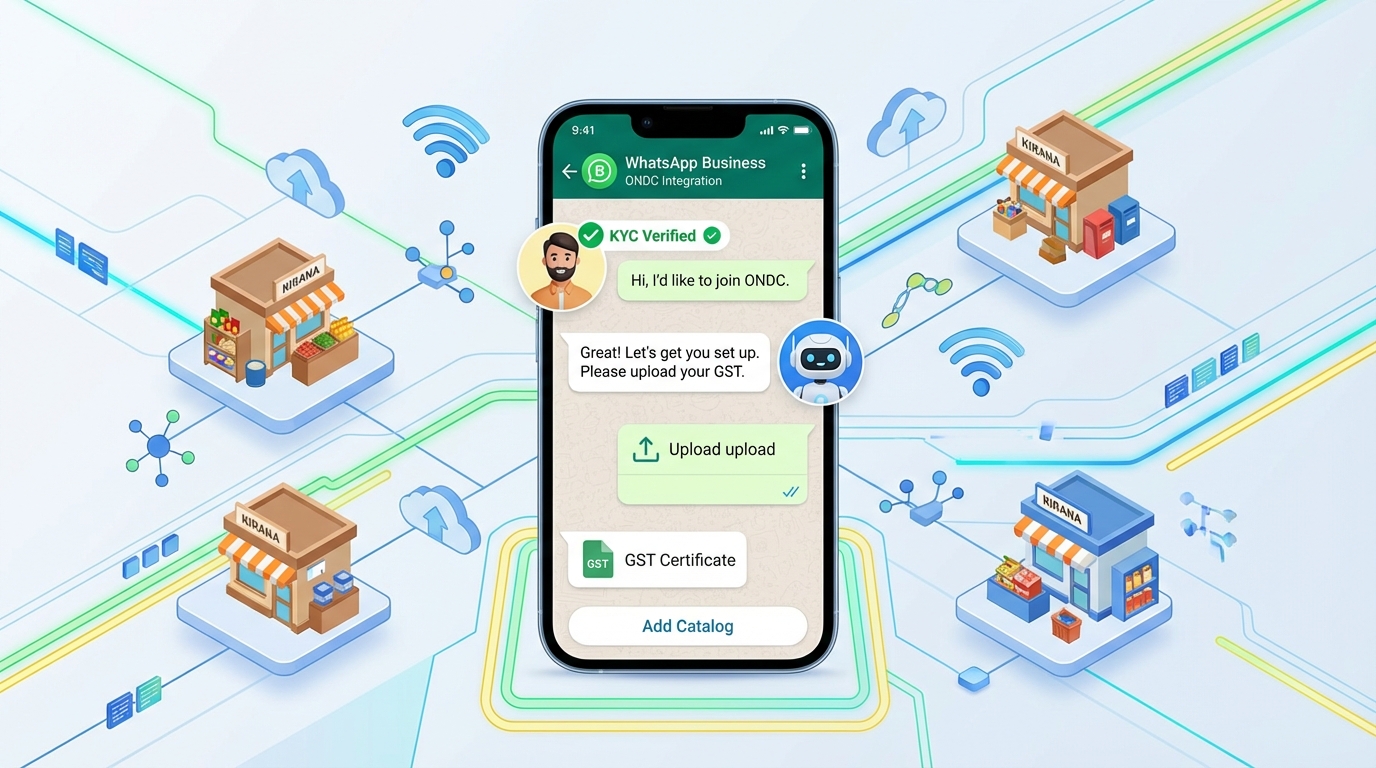
The most effective tool for scaling onboarding is WhatsApp Business ONDC integration. By utilizing WhatsApp as the primary interface, enterprises can guide sellers through:
- Conversational KYC: Sellers can upload GST certificates and ID proofs directly via chat, with AI-driven validation providing real-time status updates.
- Catalog Coaching: Instead of complex spreadsheets, sellers receive prompts to “Add your top 10 SKUs” by simply sending photos and prices over WhatsApp.
- SLA Education: Micro-learning modules delivered via WhatsApp ensure sellers understand order fulfillment timelines and return policies before they go live.
Addressing Coverage Gaps: The “Last-Mile” of Onboarding
A common coverage gap in competitor strategies is the failure to address post-onboarding SLA compliance. Most playbooks stop at “Go-Live.” An enterprise-grade strategy includes a 14-day activation sprint that monitors the seller's first five orders, providing real-time nudges and support to prevent early-stage churn.
Sources:
3. Hyperlocal Commerce Personalization India and Delivery Strategies
In the ONDC ecosystem, discovery is driven by proximity. Hyperlocal commerce personalization India involves tailoring the buyer's experience based on their specific pin-code, ensuring that the most relevant local sellers are surfaced first.
Pin-Code Targeting and Regional Nuance
Enterprises must move beyond city-level targeting. In 2026, successful campaigns are executed at the ward or pin-code level. This includes:
- Dynamic Language Variants: A buyer in a Bengali-dominated neighborhood of Kolkata receives different creative assets than a buyer in a Marwari-dominated area of the same city.
- Festival Alignment: Automatically updating seller storefronts and buyer ads to reflect local celebrations like Bihu, Gudi Padwa, or Onam. Tier-2 festival commerce automation
Hyperlocal Delivery Personalization
The “delivery promise” is a critical conversion factor. Hyperlocal delivery personalization allows the network to show real-time delivery windows based on the buyer's distance from the seller and the current availability of logistics providers like Dunzo, Shiprocket, or Shadowfax. Personalizing these promises—such as “Delivery in 18 minutes to HSR Layout”—dramatically increases AOV and repeat rates.
Inventory Surfacing and Substitutes
Advanced personalization engines now predict neighborhood-specific demand patterns. If a specific brand of milk is out of stock at a local kirana, the system should automatically suggest a substitute from a neighboring seller within the same pin-code, maintaining the “hyperlocal” trust factor while ensuring the sale remains within the ONDC network.
Sources:
4. ONDC Buyer Activation Campaigns and Democratic Marketing
While seller onboarding builds supply, ONDC buyer activation campaigns are essential to stimulate demand. These campaigns must highlight the unique value proposition of the open network: choice, transparency, and the ability to support local businesses.
The Lifecycle of Buyer Activation
- The Welcome Narrative: Use video-led “Welcome” messages that explain how ONDC works, emphasizing that the buyer is now part of a digital commerce democratization movement. WhatsApp catalog video marketing guide
- Cart Recovery via WhatsApp: If a buyer abandons a cart on a buyer app (like Pincode or Magicpin), a WhatsApp nudge featuring a short video of the local seller can humanize the transaction and drive recovery.
- Category Adjacency Cross-Sell: If a buyer purchases groceries, trigger a campaign for local F&B or home supplies, leveraging the interoperability of the network to offer a seamless multi-category experience.
Positioning the “Open Network” Advantage
Enterprises should adopt a democratic marketplace marketing narrative. This involves contrasting the “closed loop” of traditional apps with the “open freedom” of ONDC. Messaging should focus on:
- Lower Discovery Costs: Explaining how lower seller fees can lead to better prices for the consumer.
- Data Portability: Assuring buyers that their preferences and loyalty are respected across the entire ecosystem, not just within one app.
- Empowering MSMEs: Tapping into the growing consumer sentiment of “vocal for local” by showcasing real stories of small merchants thriving on the network.
Tier-2 ONDC Expansion Strategies
For tier-2 ONDC expansion strategies, enterprises should partner with local influencers and community leaders. These “digital sahayaks” can host offline activation events where buyers are taught how to use their existing apps (like Paytm or PhonePe) to discover ONDC sellers, bridging the digital literacy gap. Tier-2 festival commerce automation
Sources:
5. Small Merchant Enablement Videos: The Key to Conversion
The most significant barrier to ONDC adoption is not technology, but education. Small merchant enablement videos serve as the bridge between a traditional shopkeeper and a successful digital entrepreneur. These videos must be short, vernacular, and actionable.
The Content Blueprint for Seller Success
Platforms like TrueFan AI enable enterprises to generate thousands of personalized enablement videos at scale. These videos should cover:
- Module 1: The “Why” of ONDC: A 60-second explainer on how one registration opens doors to millions of buyers across multiple apps.
- Module 2: The KYC Masterclass: A step-by-step visual guide on photographing documents to ensure 100% first-time approval rates.
- Module 3: Cataloging for Growth: Demonstrating how to use a smartphone to take high-quality product photos that drive clicks.
- Module 4: Managing the Order Flow: A simulation of receiving an order, confirming it, and handing it over to the logistics partner.
Personalization at Scale
Generic training videos are often ignored. By using AI-driven personalization, an enterprise can send a video to a merchant in Madurai that features their own store name, mentions their specific product category, and is delivered in perfect Tamil. This level of relevance significantly reduces the “time-to-first-order” and increases long-term seller retention.
Video-Led Support and Troubleshooting
Beyond onboarding, videos should be used for ongoing support. When a seller's SLA drops or a return is initiated, an automated video can explain the “next steps” in a non-threatening, educational manner. This reduces the load on human support centers and empowers the merchant to self-correct.
Sources:
6. The ONDC ROI Measurement Framework
For any enterprise initiative, CFO-grade accountability is mandatory. The ONDC ROI measurement framework must track metrics across the entire seller and buyer lifecycle to prove the efficacy of the digital transformation. Predictive inventory marketing 2026
Input and Enablement Metrics
- Cost-to-Onboard (CTO): The total marketing and operational spend divided by the number of KYC-passed sellers.
- Content Completion Rate: The percentage of sellers who watch the full suite of small merchant enablement videos.
- Time-to-Live: The average number of days from initial contact to the first active product listing.
Activation and Performance Metrics
- Time-to-First-Order: A critical health indicator; successful programs aim for under 72 hours post-activation.
- SLA Adherence Rate: The percentage of orders fulfilled within the promised delivery window.
- Catalog Depth: The average number of SKUs per seller and the rate of inventory updates.
Unit Economics and Growth
- CAC vs. LTV: Comparing the cost of acquiring a buyer on the network versus their projected lifetime value across multiple categories.
- GMV Contribution: The total value of goods sold through the enterprise's seller or buyer app integration.
- WhatsApp Engagement Lift: Measuring the increase in conversion rates when using WhatsApp Business ONDC integration versus traditional SMS or email.
Solutions like TrueFan AI demonstrate ROI through significant reductions in support tickets and a marked increase in seller activation rates by delivering hyper-personalized, vernacular content that resonates with the merchant's local context.
| Metric Category | Key Performance Indicator (KPI) | 2026 Benchmark Target |
|---|---|---|
| Onboarding | KYC Pass Rate (First Attempt) | > 85% |
| Activation | Time to First 10 Orders | < 14 Days |
| Efficiency | Cost per Active Seller | -20% YoY |
| Quality | SLA Compliance | > 98% |
| Retention | Seller 90-Day Retention | > 70% |
7. Enterprise Toolkit: Executing with TrueFan AI
To execute this playbook at the scale required for the Indian market, enterprises need tools that combine AI-driven personalization with robust API delivery. TrueFan AI's 175+ language support and Personalised Celebrity Videos provide a unique edge in capturing the attention of both sellers and buyers in a crowded digital landscape.
Hyper-Personalization at Ward Level
TrueFan AI allows enterprises to auto-generate vernacular onboarding and activation videos with dynamic fields such as the seller's name, their specific city, and even pin-code-specific offers. This ensures that the ONDC seller onboarding marketing feels like a 1-on-1 consultation rather than a mass broadcast.
Real-Time Delivery and Analytics
The platform’s API-driven architecture enables sub-30-second render-to-send latency. This means a video can be triggered the moment a buyer abandons a cart or a seller hits a milestone, ensuring the message is delivered at the peak of relevance. Furthermore, integrated dashboards provide deep insights into video impact, directly feeding into the ONDC ROI measurement framework.
Final Strategic Note: The democratization of digital commerce in India is not just a policy goal; it is a massive commercial opportunity. By mastering ONDC seller onboarding marketing and leveraging advanced tools for hyperlocal commerce personalization India, enterprises can build a resilient, scalable, and truly inclusive digital retail footprint. The winners of 2026 will be those who move beyond the “walled garden” mindset and embrace the transparency and interoperability of the open network.
Sources:
Frequently Asked Questions
How does ONDC seller onboarding marketing differ from traditional marketplace marketing?
Unlike traditional marketplaces where you market a single platform, ONDC marketing focuses on the openness of the network. It emphasizes that once a seller is onboarded via your app, they are visible to buyers across the entire network, increasing their discovery potential exponentially.
Why is WhatsApp Business ONDC integration considered the best channel for Tier-2 cities?
WhatsApp is the most widely used app in India with high digital comfort levels. It allows for conversational KYC, rich-media training, and real-time order notifications, making it the ideal operating system for small merchants who may struggle with complex app interfaces.
Can small merchant enablement videos really improve ROI?
Yes. Data shows that sellers who engage with vernacular, video-based training have a 40% higher activation rate and 25% better SLA compliance. Platforms like TrueFan AI enable the creation of these videos at a fraction of the cost of traditional production.
What are the biggest risks in ONDC expansion for enterprises?
The primary risks include fragmented buyer demand and digital literacy gaps. These are mitigated by implementing multi-app buyer activation campaigns and using vernacular-first communication strategies to build trust and competence among sellers.
How do I measure the success of my ONDC initiatives?
Success should be measured using a comprehensive ONDC ROI measurement framework that tracks cost-to-onboard, time-to-first-order, SLA adherence, and long-term seller retention.



