
Micro-influencer automation India 2026: Enterprise playbook to scale authentic regional creator programs in tier-2/3 cities
Estimated reading time: ~15 minutes
Key Takeaways
- Scale regional creator programs by combining AI automation with human cultural QA for authenticity.
- Adopt a hybrid platform approach: integrate discovery tools with in-house content automation and RBAC.
- Operationalize ASCI/CCPA compliance via automated disclosures, audit trails, and rights management.
- Measure impact with a CFO-ready ROI model using city lift tests, assisted conversions, and MMM.
- Treat micro-influencers as long-term micro-retailers to build creator-led distribution networks in tier-2/3 cities.
Micro-influencer automation India 2026 represents the definitive enterprise blueprint required to operationalize regional content creator partnerships across the diverse landscape of Bharat. This strategic framework blends AI-powered content automation with human-led authenticity and strict regulatory compliance to ensure brands can scale without losing the local trust that defines the next billion users. By 2026, the shift from vanity metrics to hyper-local performance will necessitate a sophisticated operating model that treats micro-influencers not as one-off assets, but as long-term micro-retailers within a brand's ecosystem.
The 2026 Market Context: Why Regional Micro-Influencer Scaling is Non-Negotiable
The Indian influencer marketing sector is projected to reach a staggering INR 3,375 crore by 2026, growing at a compound annual growth rate (CAGR) of approximately 18%. This growth is not merely a function of increased digital spending but a fundamental shift in where the Indian consumer resides and how they consume information. With India expected to exceed 900 million internet users by 2025, the majority of new entrants are coming from rural areas and tier-2/3 cities, making vernacular influencer content the primary vehicle for brand discovery and trust. Voice commerce and vernacular in India (2026)
In this landscape, the “Bharat” user prioritizes authenticity over high-production value. Data from 2026 trend signals indicates that micro-influencers (those with 5,000 to 50,000 followers) are functioning as “micro-retailers,” driving double-digit conversion rates through live commerce and localized social proof. Nano and micro-influencer marketing in Bharat (2026) Platforms like TrueFan AI enable enterprises to bridge the gap between high-volume content needs and the necessity for personalized, culturally resonant messaging that traditional creative agencies struggle to produce at scale.
The rise of regional and vernacular content is no longer a peripheral strategy; it is the core growth engine for FMCG, BFSI, and e-commerce sectors. Short-form video remains the dominant format, but the differentiator in 2026 is the integration of offline experiences and community-first activations. Enterprises that fail to automate the repetitive aspects of these partnerships—such as brief localization, versioning, and compliance—will find themselves buried under operational debt while competitors capture the regional market share.
Sources:
- EY India: State of Influencer Marketing (2026 Outlook)
- IAMAI–Kantar: Internet in India 2024 Report
- Royalways: 2026 Digital Marketing Trends for Indian Brands
- Brandly Global: Influencer Marketing Trends in India 2026
Architecting the Regional Influencer Marketing Platform
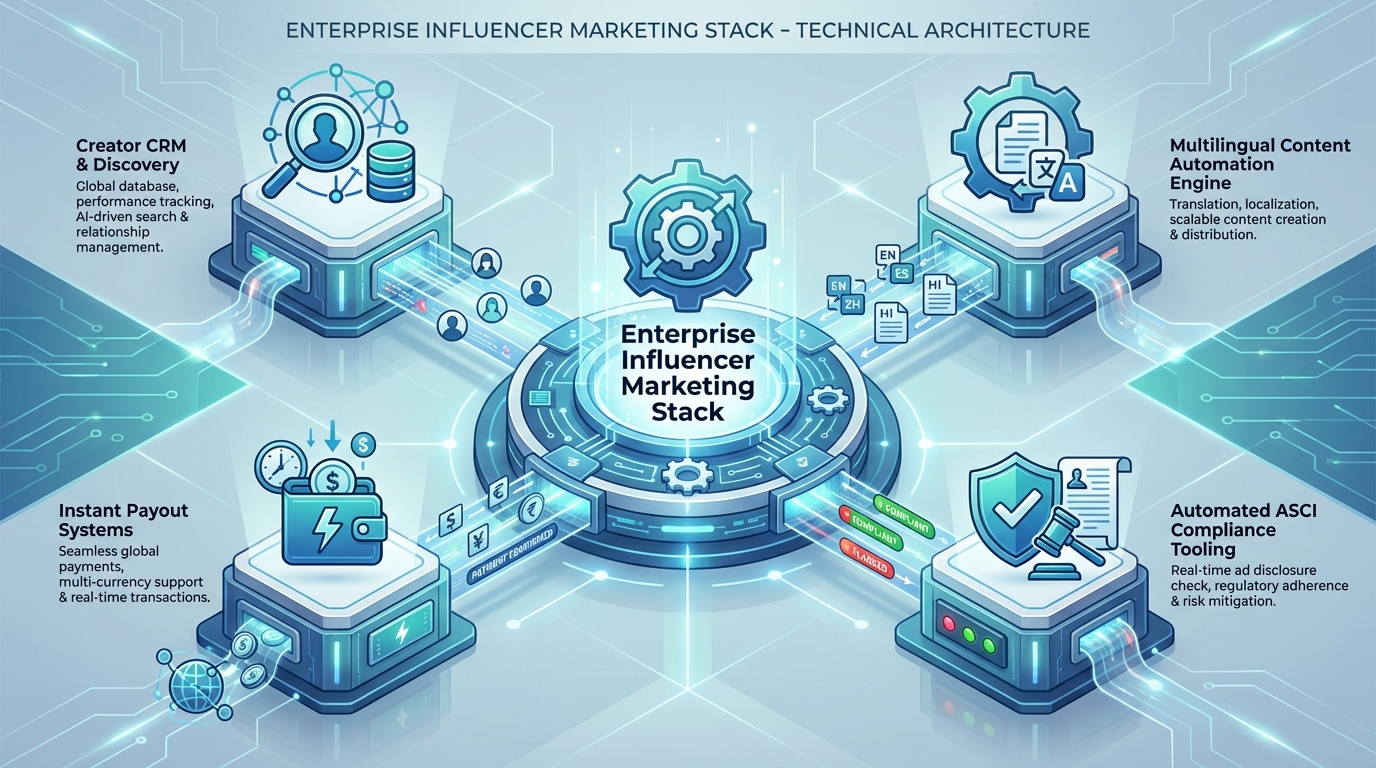
A regional influencer marketing platform is defined as an integrated enterprise stack that orchestrates the entire creator lifecycle: from discovery and CRM to content personalization, asset management, and automated payments. For an enterprise operating in 2026, the “build vs. buy” debate has shifted toward a “hybrid integration” model. Brands are increasingly buying specialized discovery tools while building or integrating bespoke content automation engines that can handle batch multilingual video production.
The technical requirements for such a platform are rigorous, demanding ISO 27001 or SOC 2 compliance to protect sensitive creator data and brand IP. The stack must include role-based access controls (RBAC) to allow regional managers to oversee local campaigns while central marketing teams maintain brand governance. Furthermore, the platform must feature ASCI-compliant disclosure tooling that automatically embeds the necessary “Paid Partnership” or “Ad” labels in the appropriate local language and script.
Effective local influencer campaign automation requires seamless API connectivity between the influencer CRM and the Digital Asset Management (DAM) system. This ensures that when a creator in a city like Indore is onboarded, they automatically receive a localized toolkit—complete with hooks, scripts, and CTAs tailored to the Malwi dialect. By automating the distribution and scheduling of these assets across city-specific cohorts, enterprises can reduce the time-to-market from weeks to hours, ensuring they can react to local trends in real-time.
Sources:
- Tantrash: AI-Powered Marketing Automation Trends 2026
- MintLink: Performance ROI and the Rise of Micro-Influencers
Playbook for Tier-2 City Influencer Partnerships and Community Engagement
Tier-2 city influencer partnerships are defined as strategic collaborations with creators who possess deep neighborhood credibility, localized dialect proficiency, and a strong presence within offline community ecosystems. In 2026, the most successful brands are moving beyond digital-only campaigns to create offline-to-online (O2O) loops. This might involve sampling products at local “haats” or festivals Tier-2 festival commerce automation, which then triggers creator-led Reels that encourage WhatsApp group shares and subsequent UPI-led micro-purchases at local kirana stores. Quick-commerce video personalization in India
Community-driven influencer marketing leverages creators as community anchors rather than just content broadcasters. In a city like Coimbatore, a brand might partner with influencers who are active in local college groups or Self-Help Groups (SHGs) to drive financial literacy programs. These creators don't just post content; they host micro-events and live sessions that address specific local pain points, such as gold loan transparency or micro-savings benefits, using culturally apt references that a national celebrity could never replicate.
To scale these community-driven efforts, enterprises must adopt local market influencer automation that handles the logistical heavy lifting. This includes automated KYC for hundreds of micro-creators and structured rate cards that reflect the specific market dynamics of tier-2 and tier-3 cities. By treating micro-influencers as long-term partners rather than one-off vendors, brands can build a “creator-led distribution network” that functions with the efficiency of a traditional supply chain but the heart of a local community.
Sources:
- Wordsmith Creations: Micro vs. Nano Influencers in 2026
- Web Marketing Academy India: Authenticity in the 2026 Influencer Landscape
Orchestrating Vernacular Influencer Content and the Automation Blueprint
Vernacular influencer content is defined as creator-led media produced in native languages and dialects, incorporating local idioms, cultural nuances, and region-specific calls to action. Vernacular voice SEO strategies In 2026, simply translating a Hindi script into Tamil is insufficient; the content must be “re-authored” to resonate with the specific linguistic sensibilities of the target audience. This requires a sophisticated briefing process where AI assists in dialect localization and taboo checking, while human experts provide the final cultural QA.
The automation blueprint for regional micro-influencer scaling involves a clear division between what can be automated and what requires a human touch. Gen Z creator automation (2026 guide) Intake, creator mapping, and the generation of creative variants (such as batch video personalization) are prime candidates for automation. However, the initial creator fit-check and the final creative “cut” must remain human-led to ensure the brand's voice isn't lost in the machine. This hybrid approach allows a single brand manager to oversee thousands of creators across multiple states without compromising quality.
A typical pipeline starts with a pilot in three diverse tier-2/3 cities to establish baselines for engagement and conversion. Following a 12-week expansion phase, the program moves to a national rollout supported by automated dashboards that track city-level reach and brand safety flags. TrueFan AI's 175+ language support and Personalised Celebrity Videos provide the technological backbone for this level of scale, allowing brands to deliver hyper-personalized content that feels bespoke to every individual user in their native tongue.
Sources:
- IAMAI–Kantar: Rural Internet Usage and Vernacular Growth
- Brandly Global: The Surge of Short-Form Vernacular Content
Governance, Compliance, and Authentic Influencer Collaboration Tools
Authentic influencer collaboration tools are the systems and processes that safeguard the trust between a brand, a creator, and the audience. These tools facilitate creator consent, co-creation workspaces, and transparent feedback loops that ensure the creator's unique voice is not stifled by corporate over-regulation. In 2026, “spammy” automation—such as mass-DMing creators or using generic AI avatars—is easily detected and rejected by the savvy Bharat consumer, making authentic collaboration the only viable path forward.
Micro-influencer relationship management at the enterprise level requires a robust governance framework. This includes structured onboarding, clear SLAs, and automated rights management to handle the complexities of usage windows across different platforms. Compliance is further complicated by the ASCI Guidelines for Influencer Advertising, which mandate clear disclosure labels in the local language. Enterprises must maintain an immutable audit trail of all creator communications and asset approvals to satisfy both internal legal teams and external regulators.
The collaboration between the Central Consumer Protection Authority (CCPA) and ASCI has led to stricter enforcement of consumer protection laws in the digital space. Brands must now ensure that their local influencer campaign automation includes mandatory disclosure prompts and automated checks for misleading claims. By integrating these compliance gates directly into the creator workflow, enterprises can mitigate the risk of heavy fines and reputational damage while maintaining the speed of their regional marketing operations.
Sources:
- ASCI: Guidelines for Influencer Advertising in Digital Media
- CCPA–ASCI: Joint Press Release on Consumer Protection (2024)
Measuring Local Influencer Campaign ROI: A CFO-Ready Model
Local influencer campaign ROI is defined as the measurement of incremental business impact at the city or cluster level, integrating both digital engagement signals and offline sales data. In 2026, CMOs must move beyond “likes” and “shares” to present a CFO-ready model that demonstrates how regional creator partnerships drive actual revenue. This involves pre-and-post city lift tests, tracking assisted conversions, and measuring the lifetime value (LTV) propensity of customers acquired through vernacular cohorts.
The ROI model should account for the efficiency gains provided by local market influencer automation. For instance, reducing the creative turnaround time (TAT) from 10 days to 48 hours directly impacts the agility of the marketing budget. Benchmarks for 2026 suggest that micro and nano-influencers often deliver 3x to 5x higher engagement rates than mega-celebrities in regional contexts, primarily due to the perceived “neighborly” trust they command.
Solutions like TrueFan AI demonstrate ROI through their ability to generate thousands of personalized video assets that drive significantly higher read rates and participation levels. For example, a campaign that uses personalized creator videos delivered via WhatsApp can see a 17% higher read rate compared to generic brand messaging. WhatsApp catalog video marketing By aligning these digital signals with Marketing Mix Modeling (MMM) for low-signal regional markets, enterprises can justify continued investment in micro-influencer programs as a core pillar of their growth strategy.
Sources:
- EY India: Industry Sizing for Influencer Marketing Budgets
- MintLink: The Shift to Performance Metrics in Influencer Marketing
Enterprise Implementation: How TrueFan AI Powers Micro-influencer Automation India 2026
TrueFan AI serves as the enterprise content automation nucleus, designed to plug into existing influencer discovery platforms, CRMs, and DAMs to scale regional programs securely. Unlike a simple marketplace, TrueFan AI provides the infrastructure for hyper-personalized, API-driven video production at a scale previously unimaginable. The platform can generate thousands of unique videos per day, featuring perfect lip-sync and voice retention across 175+ languages, ensuring that every regional micro-influencer can deliver a message that feels truly local.
The implementation process begins with integrating TrueFan APIs with the brand's existing marketing stack. Marketing teams can then create city and language-specific templates that creators use to generate their content. This automation allows for rapid variant testing—where different hooks or CTAs are tested in real-time across different cities like Lucknow or Coimbatore. The platform's sub-30 second render time means that personalized content can be triggered by real-time events, such as a user abandoning a cart or a local festival starting.
The impact of this technology is reflected in the success of major Indian enterprises. For instance, Zomato utilized this infrastructure to generate 354,000 unique videos in a single day, while Hero MotoCorp delivered 2.4 million personalized festive greetings. These are not just vanity numbers; they represent a fundamental shift in how brands communicate with the “Bharat” audience. By saving thousands of hours of creative time and driving 3.2x higher participation rates, TrueFan AI enables the level of micro-influencer automation India 2026 demands.
Key Capabilities for 2026:
- Hyper-Personalization: API-driven video creation at the individual user level.
- Multilingual Mastery: 175+ languages with native-level lip-sync and voice consistency.
- Enterprise Security: ISO 27001 and SOC 2 certified with role-based access.
- Real-time Delivery: Instant distribution via WhatsApp Business API, email, or SMS.
- Proven Scale: Capability to handle millions of unique renders for national campaigns.
Sources:
6-Week Implementation POC Plan:
- Week 0–1: Audit current marketing stack; select 3 pilot cities and 30–60 micro-creators; integrate TrueFan API with CRM/DAM.
- Week 2–3: Develop vernacular templates and creator toolkits; automate ASCI disclosure prompts; launch pilot campaigns with defined stage gates.
- Week 4–5: Analyze real-time data via city-level dashboards; optimize content variants based on engagement; expand to 10 cities if KPIs are met.
- Week 6: Conduct a CFO-ready ROI review; finalize the national rollout strategy; secure procurement sign-off on security and compliance protocols.
Frequently Asked Questions
How does micro-influencer automation India 2026 differ from traditional influencer marketing?
Traditional influencer marketing relies on manual outreach, individual negotiations, and bespoke content creation for a limited number of creators. Micro-influencer automation India 2026 uses an integrated stack to manage hundreds or thousands of creators simultaneously. It automates the repetitive tasks of briefing, versioning, and compliance, allowing brands to scale their regional presence in tier-2/3 cities without a proportional increase in headcount.
Can automation coexist with authenticity in regional campaigns?
Yes, provided the automation is used to support the creator rather than replace them. Authentic influencer collaboration tools focus on automating the “boring” parts—like KYC, payments, and disclosure labels—while giving the creator the creative freedom to adapt the brand's core message into their local dialect and cultural context. The goal is to remove operational friction, not creative soul.
What are the mandatory compliance requirements for influencer marketing in India by 2026?
Enterprises must adhere to the ASCI Guidelines for Influencer Advertising, which require clear and prominent disclosure labels (e.g., #Ad, #PaidPartnership) in the language of the content. Additionally, the CCPA mandates that brands ensure their influencers do not make misleading claims. Automated systems like TrueFan AI help maintain an audit trail and ensure these disclosures are consistently applied across thousands of assets.
How do I measure the ROI of a campaign in a tier-3 city with low digital signals?
In markets with low digital signals, enterprises use “city lift tests” where they compare sales or brand awareness in a test city (with influencer activity) against a control city (without). Additionally, tracking offline-to-online signals—such as coupon redemptions at local stores or WhatsApp inquiries—provides a more accurate picture of the campaign's impact than digital engagement metrics alone.
How does TrueFan AI integrate with my existing influencer CRM?
TrueFan AI is designed as an API-first platform. It can be easily integrated with your existing influencer CRM to trigger personalized video creation based on creator milestones or campaign schedules. This allows your team to continue using their preferred discovery and management tools while leveraging TrueFan AI's powerful content engine for regional micro-influencer scaling and vernacular personalization.



