Zero-party data collection videos 2026: DPDP-compliant interactive strategies for consent-based personalization in India
Estimated reading time: ~13 minutes
Key Takeaways
- Shift from third-party tracking to zero-party data to stay compliant with India’s DPDP Act and build trust.
- Use interactive videos—surveys, quizzes, and preference centers—to capture declared data with 3x engagement.
- Integrate Consent Managers and granular purpose tags to maintain immutable audit trails and lawful processing.
- Adopt progressive profiling and a modular reference architecture to activate data across channels like WhatsApp and SMS.
- Follow a 90-day roadmap from foundations to governance to launch DPDP-compliant, ROI-positive programs.
Zero-party data collection videos 2026 represent the definitive shift for Indian enterprises moving away from intrusive tracking toward a transparent, value-driven relationship with their customers. As the Digital Personal Data Protection (DPDP) Act enters full enforcement, the reliance on third-party cookies and inferred behavioral data has become a liability rather than an asset. Modern marketing leaders are now prioritizing zero-party data—information that a customer intentionally and proactively shares—to fuel their personalization engines while maintaining absolute regulatory compliance.
The landscape of 2026 is defined by a “privacy-first” mandate where consent is not just a legal checkbox but a competitive differentiator. Interactive video data capture has emerged as the most effective medium for this transition, offering a 3x higher engagement rate compared to traditional static forms. By integrating surveys, quizzes, and preference centers directly into the video experience, brands can facilitate a seamless “give-to-get” exchange that respects user autonomy.
This comprehensive guide explores how Indian enterprises in BFSI, Retail, and Travel can deploy DPDP-compliant interactive strategies. We will detail the technical architecture, the psychology of value exchange, and the 90-day roadmap required to master consent-based personalization India. Through these strategies, organizations can build robust, declared-attribute profiles that drive long-term loyalty and measurable ROI.
Sources:
- CleverTap: What is zero-party data—definition, benefits, and strategies
- Salesforce India: Zero-party data for personalization
- Royalways: 13 digital marketing trends for Indian brands in 2026
- Scribblers India: Content marketing strategy 2026 trends
India’s regulatory lens: DPDP essentials for DPDP compliant data gathering
The implementation of the Digital Personal Data Protection Act (DPDPA) has fundamentally altered the mechanics of data acquisition in the Indian market. Under this regime, DPDP compliant data gathering requires consent that is free, specific, informed, unconditional, and unambiguous. Every interactive video campaign must now be preceded by a clear notice that outlines the specific purpose of data collection in plain, accessible language.
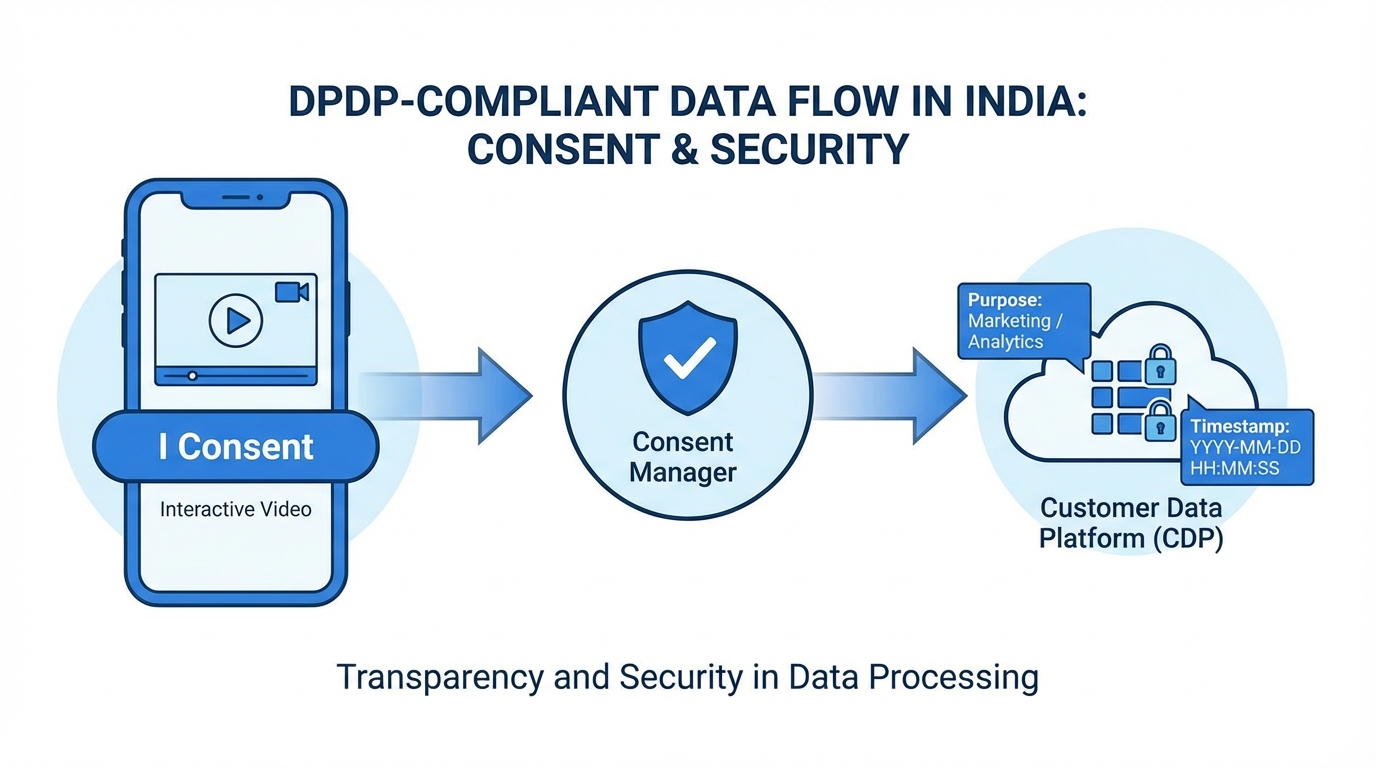
A critical component of the 2026 regulatory framework is the emergence of Consent Managers (CMs). These are RBI-regulated or MeitY-authorized entities that act as intermediaries, allowing users to give, manage, and withdraw consent through a single interface. Enterprises must ensure their interactive video SDKs are fully integrated with these CM APIs to maintain an immutable audit trail of every data point collected.
Ethical UX design is no longer optional; it is a legal necessity to avoid “dark patterns” that could lead to heavy penalties. This means that voluntary data sharing incentives must be presented without coercion, allowing users to opt-out or withdraw consent as easily as they provided it. Privacy-first data collection ensures that if a user decides to revoke access, the enterprise can programmatically purge that specific attribute across its entire tech stack.
Furthermore, the DPDP Act emphasizes purpose limitation, meaning data collected for a “skincare quiz” cannot be used for “unrelated insurance cross-selling” without fresh consent. Organizations must implement granular opt-ins within their video flows, tagging each response with a unique purpose ID and consent version. This level of transparency builds deep trust, which is the foundational currency of the 2026 digital economy.
Sources:
- PRS India: Digital Personal Data Protection Bill 2023
- DLA Piper Data Protection: India overview
- IAPP: Decoding India’s draft DPDPA rules
- Ikigai Law: From principles to practice—deep dive into India’s draft DPDP rules
- Ikigai Law: A closer look at the DPDP rules 2025
Value exchange data strategies that actually work in the Indian market
To successfully solicit zero-party data, brands must master the art of the “value exchange,” where the benefit to the consumer is immediate and obvious. Value exchange data strategies in 2026 focus on transparency, ensuring the user understands exactly how their data will be used to improve their specific experience. In India, this often translates to personalized recommendations, exclusive festive offers, or early access to high-demand products.
Ethical incentive design ensures that rewards—whether loyalty points or micro-rewards—are not perceived as “buying” the data but as a fair trade for a better service. For instance, a D2C brand might offer a “Style Persona” video quiz where the reward is a curated lookbook rather than just a generic discount code. This approach encourages voluntary data sharing incentives that result in higher quality, more accurate data points.
Channel orchestration is vital for the Indian consumer, who spends a significant portion of their digital life on WhatsApp (WhatsApp catalog video marketing). Deploying interactive video flows through WhatsApp allows for a frictionless experience where the user can respond to video prompts within a familiar interface. This localized approach, combined with regional language support, ensures that the value proposition resonates across diverse demographic segments.
Enterprises should also consider the “festive calendar” (Diwali, Akshaya Tritiya, EOSS) as a prime window for these exchanges. During these periods, consumers are more willing to share preferences in exchange for highly relevant, time-sensitive deals. By aligning video data collection with these cultural milestones, brands can achieve significantly higher opt-in rates while maintaining a privacy-first posture.
Sources:
- CleverTap: What is zero-party data—definition, benefits, and strategies
- Scribblers India: Content marketing strategy 2026 trends
- Royalways: 13 digital marketing trends for Indian brands in 2026
Interaction mechanics: How to capture preferences through interactive video data capture
The technical execution of interactive video data capture involves several sophisticated formats designed to minimize friction and maximize engagement. Interactive survey videos allow brands to embed tappable questions directly into the video timeline, capturing attributes like budget bands or product interests in real-time. These videos use branching logic, where the next scene changes based on the user’s previous response, creating a truly personalized narrative.
Video quiz marketing automation takes this a step further by gamifying the data collection process. Quizzes like “Find Your Perfect Investment Portfolio” or “Discover Your Travel Soulmate” use time-bound challenges and scoring mechanics to keep users invested. Platforms like TrueFan AI enable enterprises to generate these interactive experiences at scale, ensuring that every video is uniquely tailored to the individual viewer’s context.
Gamified preference collection utilizes psychological triggers such as loss aversion and achievement streaks to encourage deeper data sharing. For example, a user might earn “Profile Completion Badges” that unlock higher tiers of a loyalty program as they share more about their preferences. This method transforms a mundane data entry task into an entertaining experience that reinforces the brand’s value proposition.
Finally, preference center personalization videos serve as a recurring touchpoint for maintaining data hygiene. Instead of a static “Manage Preferences” page, a personalized video can recap what the brand knows about the user and invite them to update their details. This not only ensures data accuracy but also serves as a transparency exercise, reminding the user that they remain in full control of their information.
Sources:
Progressive profiling video campaigns and technical reference architecture
Progressive profiling video campaigns are the strategic antidote to “form fatigue,” breaking down data collection into bite-sized interactions over the customer lifecycle. Rather than asking twenty questions at once, a brand might ask about “preferred travel style” during the awareness phase and “budget flexibility” during consideration. This staged approach ensures a low-friction entry point while gradually building a rich, multi-dimensional profile of the customer.
The reference architecture for a DPDP-first enterprise requires a seamless integration between the capture layer and the identity layer. The capture layer—the interactive video itself—must generate standardized event schemas that include question IDs, responses, and, crucially, consent versioning. This data is then passed to a Customer Data Platform (CDP) or CRM, where it is stitched to a verified identity, such as a phone number or email.
A robust governance layer is essential to manage the lifecycle of this declared data, including automated retention policies and data minimization rules. Every attribute must be tagged with its specific “purpose of collection,” ensuring that the activation layer only uses the data for consented activities. This architecture allows for real-time personalization across WhatsApp, SMS, and email, triggered by the specific outcomes of the video interactions.
Furthermore, the system must support regional data residency and encryption both at rest and in transit to meet Indian sovereign data requirements. By building a modular stack that separates consent management from data storage, enterprises can remain agile as regulations evolve. This technical foundation is what allows for the scalable deployment of video quiz marketing automation across millions of unique users.
Sources:
- PRS India: Digital Personal Data Protection Bill 2023
- Ikigai Law: From principles to practice—deep dive into India’s draft DPDP rules
- WebEngage: Introducing universal control group uplift
Industry playbooks and ROI for consent-based personalization India
In the BFSI sector, consent-based personalization India is revolutionizing how complex products like insurance and credit cards are sold. Interactive survey videos can assess a user’s risk appetite or life stage through a series of engaging prompts, leading to a “product-fit” score. This declared data allows banks to send highly relevant cross-sell nudges via WhatsApp, backed by an immutable consent receipt that satisfies stringent regulatory audits.
For the Travel and Hospitality industry, video quiz marketing automation serves as a powerful “destination finder” tool. By capturing preferences for climate, activity level, and budget sliders, travel brands can move away from generic newsletters to hyper-personalized itineraries. This strategy has been shown to significantly increase Average Daily Rates (ADR) and upsell conversion by presenting offers that align perfectly with the traveler’s stated desires. See travel booking recovery campaigns.
Retail and D2C brands are leveraging gamified preference collection to solve the perennial problem of size and fit. A “Style Persona” quiz can capture not just physical measurements but also aesthetic preferences, reducing return rates and increasing Average Order Value (AOV). TrueFan AI’s 175+ language support and Personalised Celebrity Videos allow these brands to reach customers in their native tongue, further enhancing the trust and engagement required for data sharing.
Measuring the ROI of these programs requires a shift from traditional vanity metrics to “trust-based” KPIs. Key indicators include the opt-in rate, the depth of declared attribute coverage, and the “Time-to-Preference” (TTP)—how quickly a brand can move a new user from anonymous to a fully-profiled customer. Solutions like TrueFan AI demonstrate ROI through increased conversion lifts and a significant reduction in the cost of customer acquisition by utilizing high-intent, zero-party data.
Sources:
- TrueFan AI: Powering the full BFSI journey with GenAI
- Experian: Digital marketing trends and audience insights
- WebEngage: Universal control group uplift
90-day implementation roadmap for privacy-first data collection
Launching a successful privacy-first data collection program requires a disciplined, phased approach that balances technical readiness with creative execution. The first three weeks should be dedicated to “Foundations,” focusing on a comprehensive legal review of DPDP requirements and the design of consent UX patterns. During this phase, the data model must be defined, ensuring that every attribute to be collected has a corresponding purpose tag and storage policy.
Weeks 4 through 6 focus on the “MVP” (Minimum Viable Product) launch, where the first two interactive flows are deployed. These typically include an interactive survey video for core preferences and a video quiz for initial segmentation. This stage is critical for testing the “value exchange” mechanics and ensuring that the data flows correctly from the video widget into the central CRM or CDP.
In the “Scale” phase (Weeks 7–9), enterprises introduce progressive profiling video campaigns to deepen the data pool. This is also the time to roll out regional language versions and implement universal control groups to measure the incremental lift of personalized vs. non-personalized journeys. Expanding the reach to WhatsApp and SMS ensures that the program captures data across the most relevant touchpoints for the Indian consumer.
The final three weeks are focused on “Governance and Optimization,” where dashboards are finalized to track ROI and consent health. Automated data minimization and deletion policies are activated to ensure the brand never holds data longer than necessary. By the end of this 90-day sprint, the organization will have a fully functional, DPDP-compliant engine for zero-party data collection that is ready for enterprise-wide rollout.
Sources:
- 2026 digital transformation budget planning
- YouTube: Related insights on data-driven marketing
- Nudge theory video implementation
Ready to transform your data strategy?
Book an enterprise workshop to design your consent-based personalization India program with zero-party data collection videos 2026. Our experts will help you navigate DPDP compliant data gathering, deploy interactive survey videos, and master video quiz marketing automation to drive your progressive profiling video campaigns into the future.
Frequently Asked Questions
What is zero-party data and how is it different from first-party data?
Zero-party data is information that a customer intentionally and proactively shares with a brand, such as their preferences, purchase intentions, and personal context. In contrast, first-party data is behavioral information collected by the brand through observation, such as website clicks, purchase history, and app usage patterns. While first-party data is inferred, zero-party data is declared, making it significantly more accurate for personalization.
Is it legal to use incentives for data collection under DPDP?
Yes, it is legal to use voluntary data sharing incentives under the DPDP Act, provided that the consent remains “free.” This means the incentive should not be coercive, and the user must be able to access the core service even if they choose not to share additional non-essential data. Brands must ensure that the “give-to-get” exchange is transparent and that the withdrawal of consent is as easy as providing it.
How do Consent Managers work with video-based journeys?
Consent Managers (CMs) act as a centralized platform where users can manage their consent across multiple data fiduciaries. In a video-based journey, the interactive video SDK communicates with the CM via APIs to present the required notice and capture the user’s choice. The CM then issues a digital consent receipt, which the enterprise must store as an immutable record of the transaction.
Which channels are best in India for zero-party collection?
In the Indian market, WhatsApp is the leading channel for zero-party data collection due to its high penetration and interactive capabilities. See the WhatsApp catalog video marketing guide. Other effective channels include SMS with links to interactive microsites, in-app overlays, and personalized email campaigns. Utilizing TrueFan AI within these channels allows for the delivery of high-quality, interactive video content that drives superior engagement across all demographics.
What are the risks of “consent fatigue” in 2026?
Consent fatigue occurs when users are overwhelmed by frequent requests for data and permission. To mitigate this, brands should use progressive profiling to spread out requests and ensure that every ask is accompanied by a clear value proposition. Using engaging formats like interactive survey videos can also make the process feel less like a chore and more like a personalized brand experience.