Silent Video Optimization AI India 2026: Winning the Sound-Off Feed on Instagram, Facebook, and LinkedIn
Estimated reading time: 11 minutes
Key Takeaways
- Silent-first consumption dominates India in 2026; your first 0–3 seconds must deliver a visual hook that works with audio off.
- Platform-specific design matters: respect UI safe zones and formats across Instagram, Facebook, LinkedIn, and programmatic.
- Automate at scale with Studio by TrueFan AI to generate multilingual overlays, avatars, and rapid variants.
- Measure what matters: track Thumbstop Rate, first-3s retention, and unmute rate to iterate creative quickly.
- Regionalize and govern with code-mixed captions, local cues, and compliant, licensed AI avatars for brand safety.
In the fast-paced digital landscape of 2026, the battle for consumer attention in India has moved beyond the “skip” button to the “mute” icon. As we navigate the era of silent video optimization AI India 2026, social media marketers and performance ad teams are facing a stark reality: over 85% of video views on platforms like Instagram, Facebook, and LinkedIn now occur without sound. In a market where internet users are projected to hit 1 billion by the end of 2026, the ability to communicate a value proposition through purely visual storytelling is no longer a “nice-to-have”—it is the baseline for conversion.
The shift toward silent-first consumption is driven by a combination of public transit commuting, open-office environments, and the sheer speed of the “thumb-stop” economy. Users in Mumbai, Delhi, and Bangalore are scrolling through Reels and professional feeds in environments where audio is either socially intrusive or physically impossible to hear. Consequently, the “silent hook” has become the most critical asset in a marketer’s toolkit. This guide provides a comprehensive roadmap for mastering silent video optimization, leveraging the latest AI-driven workflows to ensure your creative converts even when the volume is at zero.
1. The Silent-First Reality: Why Audio-Off is the Default in 2026 India
The Indian digital ecosystem in 2026 is defined by “zero-click” consumption and “silent-scrolling” behaviors. According to recent forecasts, India’s digital advertising spend is set to surpass $21 billion by 2026, with short-form video accounting for nearly 45% of that investment. However, the ROI on this spend is increasingly tied to how well a video performs in a muted state.
The Data Behind the Mute Button
Recent market data highlights the urgency of this shift:
- 88% of mobile video views in India are initiated with audio off, particularly on programmatic outstream and social feeds.
- 70% of Indian internet users now reside in non-metro areas, where multilingual, visual-first content travels 3x faster than English-only audio-dependent ads.
- AI-generated video volume has increased by 400% since 2024, leading to a “content glut” where only the most visually arresting hooks survive.
- Retention rates for videos with burned-in captions are 52% higher than those relying on platform-generated closed captions.
- Multilingual engagement: Content using code-mixed overlays (Hinglish, Benglish) sees a 35% higher CTR in regional markets compared to pure English text.
Platforms like Studio by TrueFan AI enable marketers to navigate this complexity by automating the creation of visually-rich, captioned variants that speak to India's diverse linguistic landscape without needing a single decibel of sound.
The “Earned Audio” Model
In 2026, we no longer design for sound; we design to earn the unmute. The first three seconds of your video must act as a visual silent hook that proves relevance, establishes the brand, and promises value. Only after these visual boxes are checked will a user consider tapping for audio. If your message is buried in a voiceover that starts at second five, you have already lost the impression.
Source: EY India Agentic AI Outlook 2026
2. The Silent-First Creative Framework: Visual Storytelling That Converts
To win in a sound-off environment, marketers must adopt a “Visual-First” grammar. This involves a radical restructuring of the narrative beats, moving away from traditional TV-style storytelling toward a high-speed, text-heavy, and motion-driven approach.
The Anatomy of a Silent Hook
A silent hook is a visual pattern-break occurring in the first 0–2 seconds. In 2026, the most effective hooks include:
- The Progress Meter: An animating bar or percentage (0% to 100%) that signals a transformation or a “time-to-result.”
- The Split-Screen Comparison: A “Before vs. After” or “Old Way vs. New Way” visual that requires no explanation.
- The Kinetic Number: Large, bold typography flashing a single, high-impact statistic (e.g., “70% Savings” or “3x Faster”).
- The Creator Reaction: A 9:16 shot of a photorealistic AI avatar (like Gunika or Aryan) expressing an immediate emotion—surprise, relief, or excitement—paired with a large text bubble.
Text Overlay Hierarchy
In a silent feed, your text is your script. You must establish a clear visual hierarchy to guide the viewer’s eye:
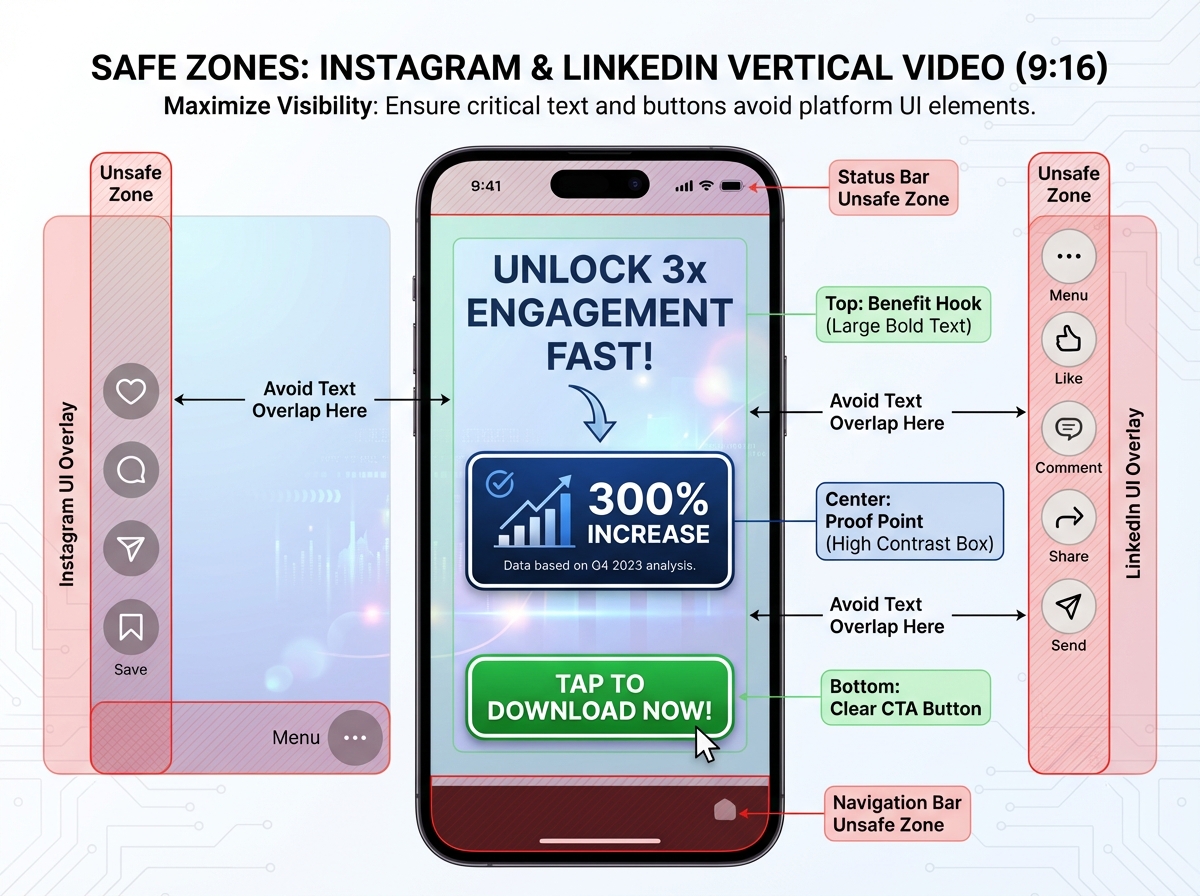
- Level 1: The Benefit Hook (Top/Center): Use the largest font size. This should be a curiosity-gap or a direct benefit. (e.g., “Stop Wasting 2 Hours Daily”).
- Level 2: The Proof Point (Mid-Screen): Use high-contrast boxes. This is where you flash social proof or data. (e.g., “Trusted by 10k+ Indian Founders”).
- Level 3: The CTA (Bottom Third): A persistent or timed “Shop Now” or “Book Demo” button that remains visible for the final 5 seconds of the loop.
Multilingual and Code-Mixed Captions
India's 2026 internet is vernacular-first. However, simply translating text isn't enough. Successful brands are using “Hinglish” (Hindi + English) or “Tamilish” overlays to match how people actually communicate on WhatsApp and Telegram. For instance, instead of “Buy Now,” an overlay might say “Abhi Order Karein” or “Best Deal for You.”
Studio by TrueFan AI's 175+ language support and AI avatars allow teams to generate these localized variants in minutes, ensuring that a campaign launched in Mumbai feels equally native in Chennai or Kolkata by swapping text overlays and avatar personas without re-shooting.
Source: Almost Zero on Subtitle Effectiveness
3. Platform-Specific Optimization: IG, FB, LinkedIn, and Programmatic
Each platform has unique “safe zones” and autoplay behaviors that dictate how silent video optimization AI India 2026 should be executed. Failing to account for UI overlays (like the “Like” heart on Reels or the “Follow” button on LinkedIn) can render your most important text unreadable.
Instagram & Facebook Reels
- Safe Zone Strategy: Keep all crucial text within the 1080x1420 center area. Avoid the bottom 20% where the caption and music title sit, and the right 15% where the interaction icons live.
- Pacing: Scenes should change every 1.5 to 2 seconds. In a muted feed, static shots are perceived as “frozen” or “broken.”
- Branding: Place your logo in the top-left or top-right within the first 1 second. In 2026, “brand-late” is “brand-never.”
LinkedIn Professional Feed
- The 1:1 vs. 9:16 Debate: While 9:16 is dominant on mobile, 1:1 still performs better on LinkedIn desktop. For B2B silent video, use 1:1 with “Letterbox” captions (text above and below the video) to ensure readability on all devices.
- Data Visualization: LinkedIn users stop for charts. Use animating line graphs or bar charts as your silent hook to establish authority instantly.
Programmatic Outstream & In-Feed
Programmatic video is almost exclusively muted and often appears in the middle of editorial articles.
- Contrast is King: Because you don't know the background color of the publisher's site, use Burned-in captions with a solid background box (e.g., white text on a black semi-transparent box).
- The “No Sound” Indicator: Occasionally, adding a small “Sound Off” icon with a “Tap to Hear” callout can actually increase engagement by acknowledging the user's context.
Source: Amazon Ads Video Specs
4. AI-Driven Production Workflow: Scaling Silent-First Content
The biggest challenge in 2026 is not making one silent video; it’s making 50 variants for A/B testing across different regions and segments. This is where agentic AI workflows transform production from a manual bottleneck into an automated pipeline.
The Scriptless Storyboard
Instead of writing a dialogue script, marketers now use “Visual Prompts.” An AI agent takes a product benefit (e.g., “Long-lasting battery”) and generates a shot-list focused on visual evidence:
- Shot 1: Phone at 1% battery (0.5s).
- Shot 2: Charger plugged in, lightning bolt animation (0.5s).
- Shot 3: Clock spinning fast (1.0s).
- Shot 4: Phone at 100%, user smiling (1.0s).
- Overlay: “Full Charge in 15 Mins.”
Automation with Studio by TrueFan AI
Solutions like Studio by TrueFan AI demonstrate ROI through their ability to handle the “packaging” of these visual assets. By using the in-browser editor, teams can:
- Auto-Generate Subtitles: Convert any voiceover into perfectly timed, high-contrast captions.
- Aspect Ratio Transformation: One-click conversion from a 16:9 brand film into 9:16 Reels and 1:1 LinkedIn ads, with AI-driven “Smart Cropping” that keeps the subject centered.
- Avatar Integration: Use pre-licensed AI influencers like Annie or Gunika to act as on-screen presenters who “point” to text overlays, creating a pseudo-interactive experience even without sound. See more on AI avatars.
The Variant Factory
In 2026, the “Winner” is found through volume. A typical workflow involves creating 5 different hooks, 3 different caption styles, and 2 different CTA placements. This results in 30 unique video files. Manually editing these would take days; using an AI-driven studio reduces this to under an hour.
Source: Daffodil Software Gen AI Trends 2026
5. Measurement & KPIs for Sound-Off Performance
Traditional metrics like “View Count” are vanity metrics in a muted-autoplay world. To truly measure the success of silent video optimization AI India 2026, performance teams must look at “Thumbstop” and “Retention” data.
The Thumbstop Rate (TSR)
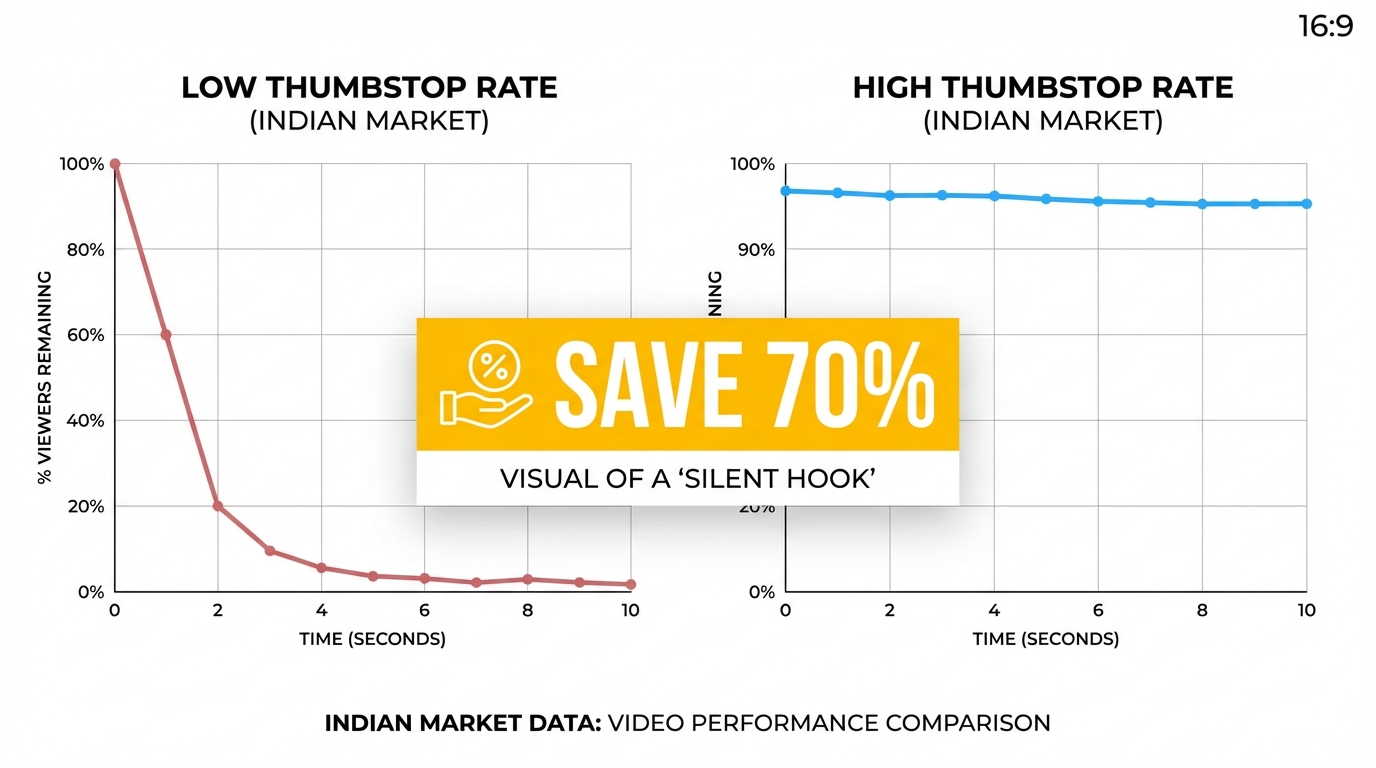
The TSR is the percentage of people who saw the first frame and stayed for at least 2 seconds.
- 2026 Benchmark: In the Indian market, a TSR of 25-30% is considered good. If your TSR is below 15%, your silent hook is failing.
- Optimization: If TSR is low, change the first 0.5 seconds of the video. Try a brighter color, a faster motion, or a larger font size for the H1 hook.
First-3s Retention
This measures how many users who “stopped” actually stayed to understand the message.
- The “Drop-off” Analysis: If you see a massive drop at 4 seconds, it usually means your text is too hard to read or your scene transition was too slow.
- The Unmute Rate: While we design for silence, the “Unmute Rate” is a high-intent signal. A user who unmutes is 4x more likely to convert. Track which visual hooks lead to the highest unmute rates to identify your most “intriguing” content.
Closed-Loop Learning
By 2026, leading agencies are using AI agents to analyze these metrics in real-time. If a specific “Hinglish” caption variant is outperforming the English version by 20% in Delhi, the AI automatically shifts the ad budget and generates five more variants using that specific linguistic style.
Source: Videonetics AI Video Intelligence
6. India 2026 Roadmap: Regionalization and Lo-Fi Trends
As we look toward the end of 2026, the “polished” high-production ad is being replaced by “Lo-Fi” episodic content. Consumers in India are showing a preference for videos that look like they were made by a creator rather than a corporation.
The Rise of “Episodic” Silent Content
Instead of one-off ads, brands are moving toward serialized “Tip-a-Day” or “Myth vs. Fact” formats. These videos use consistent overlay templates and a recurring AI avatar. Because they are silent-first, they function like a “digital comic strip” that users can consume quickly while scrolling.
Regionalization at Scale
The next frontier is “Hyper-Localization.” This goes beyond language to include regional iconography and cultural nuances.
- West Bengal: Using overlays with Bengali script and cultural cues like “Pujo Specials.”
- Tamil Nadu: Leveraging specific local idioms that don't translate directly but resonate deeply.
- The “Agentic” Solution: AI agents now allow brands to maintain “Brand Governance” (ensuring the logo and colors are correct) while allowing for “Local Flexibility” in the text and avatar choice.
Governance and Compliance
With the surge in AI-generated content, ISO 27001 and SOC 2 compliance have become mandatory for enterprise marketing stacks. Ensuring that your silent video optimization tools are secure and that your AI avatars are fully licensed (not unauthorized deepfakes) is critical for brand safety in 2026. Learn more about AI avatars.
Source: Tangence AI SEO Trends 2026
7. Actionable Toolkit
Actionable Silent-First Checklist
- Hook: Is there a visual pattern-break in the first 1.5 seconds?
- Branding: Is the logo visible by second 2?
- Legibility: Is the text large enough to read on a 5-inch screen at 50% brightness?
- Contrast: Does the text have a background box or drop shadow to separate it from the footage?
- Pacing: Are there at least 3 scene changes in the first 6 seconds?
- CTA: Is the final action clear without needing to hear the “Click the link below” instruction?
Conclusion
The era of “Sound-On” as a requirement is over. To thrive in the Indian market of 2026, brands must master the art of the silent scroll. By combining a visual-first creative framework with the scaling power of AI, you can ensure your message is heard—even when it isn't spoken. Start by auditing your current video assets: if you mute them, do they still make sense? If the answer is no, it's time to embrace silent video optimization AI India 2026 and build a workflow that wins the thumb-stop.
Source: TrueFan AI Zero-Click Video SEO Guide
Frequently Asked Questions
Does optimizing for silence hurt my video's SEO or ranking?
Actually, it helps. In 2026, search engines and social algorithms prioritize “Completion Rate” and “Engagement.” By making your video accessible and engaging without sound, you increase the likelihood that a user will watch to the end, which signals high quality to the algorithm. Furthermore, burned-in captions provide additional metadata that AI-driven search crawlers use to index your content—see the Zero-Click Video SEO India 2026 guide.
How do I handle Hinglish or code-mixed text in my overlays?
Use English script (Roman characters) for Hindi words unless you target a very specific traditional demographic. For example, write “Best Quality Sabse Sasta” instead of Devanagari. This Romanized Hindi is the default for Gen Z and Millennials in India’s urban centers.
Can I use AI avatars for silent-first videos, or do they need to speak?
AI avatars are highly effective in silent videos. They can act as visual guides, point to text overlays, nod with proof points, or demonstrate products. Studio by TrueFan AI lets you generate “silent-acting” shots where avatar expressions match on-screen text, giving a human face to your brand without audio.
What is the ideal word count for on-screen captions?
Keep it under 32 characters per line. The brain processes about 140–160 words per minute in video. If captions are too long or fast, users feel overwhelmed and scroll. Use “Chunking”—break long sentences into 3–4 word bursts in sync with visual beats.
Is it better to use platform-native captions or burned-in captions?
For performance ads, burned-in (hardcoded) captions are superior. Platform-native captions can be turned off or fail to load. Burned-in captions ensure delivery regardless of user settings or connection speed.
How often should I refresh my silent hooks?
Creative fatigue sets in fast in 2026. Refresh hooks every 2–4 weeks. Keep the body of the video consistent but swap the first 2 seconds (hook) and the final CTA to extend campaign life while maintaining high TSRs.



