Live Commerce Personalization India 2026: The Enterprise Playbook for Real-Time Video Shopping Growth
Estimated reading time: 16 minutes
Key Takeaways
- India’s live commerce will be a multi-billion dollar opportunity by 2026, driven by real-time, personalized video shopping and social proof.
- Enterprises need a real-time personalization stack spanning identity, inventory sync, and decisioning to reduce friction and lift conversion.
- A hybrid creator and channel strategy—social for reach, owned platforms for data and conversion—maximizes ROI at enterprise scale.
- Track live shopping engagement metrics and post-live flash videos to drive incrementality, not vanity metrics.
- Studio by TrueFan AI and enterprise workflows enable faster time-to-value with governance, speed, and multilingual reach.
The landscape of live commerce personalization India 2026 is defined by a shift from generic broadcasts to hyper-relevant, real-time video shopping experiences. As enterprise retailers integrate real-time product recommendations and live streaming personalized offers, the friction between discovery and conversion vanishes. By leveraging instant purchase video triggers and live shopping cart optimization, brands can dominate social commerce live streaming while maintaining rigorous data governance and operational scale. This playbook provides a revenue-focused path to execution, ensuring enterprise governance remains at the core of every interactive stream.
The India 2026 live commerce personalization opportunity
The trajectory of the Indian digital economy has reached a critical inflection point where video is no longer a secondary channel but the primary driver of high-intent commerce. By 2026, the Indian live commerce market is projected to be a conservative $4.5 billion opportunity, fueled by a staggering 46.2% CAGR that significantly outpaces traditional e-commerce growth. This momentum is driven by a consumer base that increasingly demands immediacy, transparency, and a personalized touch that static product pages simply cannot provide.
Marketplace leaders like Flipkart have already signaled this shift, with their 2025 sale communications highlighting “Deals on Live Commerce & Video Demos” as a core pillar of their peak event strategy. This mainstream adoption by tier-1 players indicates that the infrastructure for social commerce live streaming has matured, moving from experimental pilots to mission-critical revenue streams. For enterprises, the 2026 baseline requires a move beyond simple “broadcast” models toward sophisticated live commerce personalization India 2026 strategies that treat every viewer as a segment of one.
Indian shoppers convert on live platforms for specific behavioral reasons: the desire for real-time Q&A, the psychological comfort of social proof, and the reduction of purchase anxiety through live demonstrations. Statista data confirms that the primary motivator for Indian consumers engaging in live commerce is the ability to have questions answered in real-time. When this interaction is layered with personalized incentives, the conversion lift is exponential.
Source: Grand View Research India Live Commerce Outlook
Source: IBEF India E-commerce Scale Tailwinds
Source: Flipkart GOAT Sale Press Release
The real-time personalization stack for an interactive video commerce platform
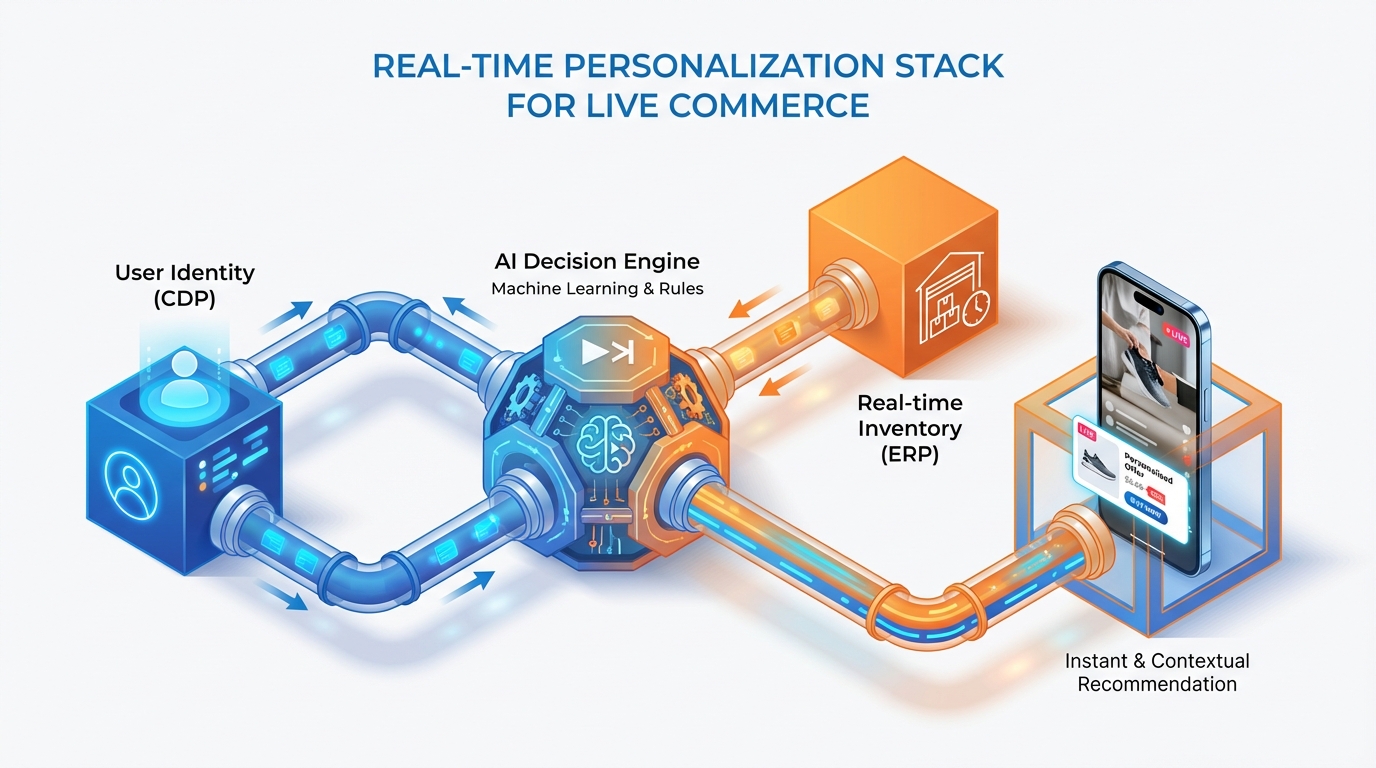
To achieve true live commerce personalization India 2026, enterprises must build a robust data foundation that synchronizes identity, events, and inventory in sub-second intervals. This starts with a sophisticated identity and consent model that utilizes hashed IDs and CRM/CDP integration to recognize loyalty members the moment they join a stream. Platforms like TrueFan AI enable enterprises to bridge the gap between high-level celebrity engagement and granular, data-driven personalization.
A critical component of this stack is real-time inventory sync, which ensures that the products showcased during a live event are actually available for purchase. Utilizing Change-Data-Capture (CDC) from OMS/ERP systems via Kafka or Kinesis allows for <1s propagation of stock levels. This prevents the “out-of-stock” friction that often plagues high-velocity live events, maintaining consumer trust and maximizing the effectiveness of real-time product recommendations.
The decisioning engine must deliver live streaming personalized offers based on a combination of viewer segments, engagement depth, and real-time scarcity. For example, a VIP customer might see a “Loyalty Exclusive” 15% discount overlay, while a first-time viewer receives a “New Joiner” bundle offer. These instant purchase video triggers must be context-aware and time-coded, deep-linking directly to a pre-filled cart to minimize the steps to purchase on mobile devices.
Furthermore, live shopping cart optimization techniques are essential for lifting Average Order Value (AOV). This involves real-time shipping ETA calculations, free-shipping threshold nudges, and AOV-boosting bundles that update dynamically as the user adds items. In the 2026 landscape, latency is the enemy of conversion; CTA renders must occur in under 150ms, and cart deep-links must open in less than 500ms even on 4G networks to meet the expectations of the modern Indian shopper.
Source: iThink Logistics on India 2026 AI Ecommerce Trends
Source: McKinsey Global Live Commerce Conversion Mechanics
Creator and channel strategy using influencer live commerce automation
Scaling live commerce requires moving away from manual coordination toward influencer live commerce automation. For an enterprise, this means utilizing templated scripts that are automatically mapped to SKUs and real-time pricing. Automation ensures brand safety by locking in approved assets and multi-language overlays, allowing creators to focus on engagement while the interactive video commerce platform handles the technical heavy lifting of offer injection and inventory checks.
The choice between social commerce live streaming and an on-site interactive video commerce platform is a strategic one. Social platforms like YouTube Shopping offer massive reach and native affiliate tools, but they often limit data ownership and attribution granularity. Conversely, an on-site platform provides full data visibility, tighter inventory integration, and enterprise-grade governance. The most successful 2026 strategies involve a hybrid approach: using social channels for discovery and simulcasting to an owned platform for high-conversion, personalized experiences.
Enterprises must also consider the “long-tail” of live commerce through interactive shopping video campaigns. These are not just one-off events but a series of automated, creator-led demos and live polls that drive continuous engagement. By rotating creators based on regional language expertise and category affinity, brands can reach India’s diverse demographic segments with surgical precision. Post-live, these streams should be automatically edited into short, shoppable clips for retargeting, extending the ROI of the initial production.
A significant coverage gap in many current strategies is the live auction personalization platform. In 2026, real-time bidding overlays with bidder-segmented prompts will become a key driver for high-value categories like electronics and luxury fashion. These platforms use scarcity counters and dynamic price floors to create a high-energy environment where personalized “outbid” pings and instant payment links drive rapid-fire conversions.
Source: YouTube Shopping Affiliate Program in India
Source: Adscrey India Performance Marketing Trends 2026
Source: SellersCommerce on AI Video Production Scalability
Measurement, attribution, and optimization of live commerce conversion tracking
To justify enterprise investment, live commerce conversion tracking must move beyond vanity metrics. A sophisticated tracking schema includes unique impression IDs, creator IDs, and recommendation algorithm IDs, all tied to final purchase data via server-side events. This level of detail allows for true incrementality testing, comparing the performance of personalized live streams against standard e-commerce flows or non-personalized broadcasts.
Key live shopping engagement metrics that demand tracking include view depth, chat participation rate, and the “add-to-cart-live” rate. These behavioral signals are leading indicators of revenue per viewer (RPV). By analyzing which real-time product recommendations drive the highest engagement, brands can optimize their stream flow in real-time, switching featured products or adjusting offer intensity based on live audience sentiment and conversion velocity.
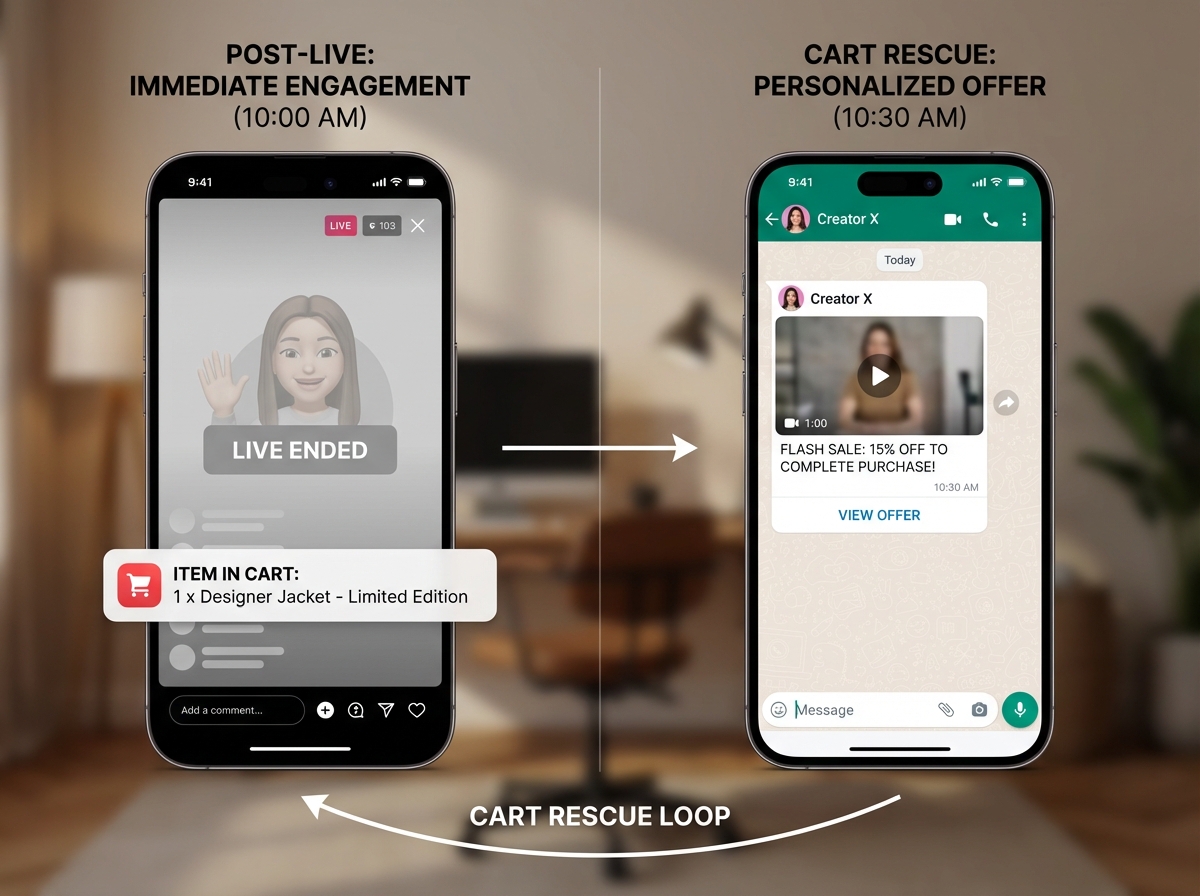
Post-live monetization is another area where enterprises often leave money on the table. Within 60 minutes of a stream ending, automated systems should trigger personalized flash sale videos to high-intent cohorts, such as those who added items to their cart but didn’t check out. These videos, featuring the same creator from the live stream, provide a personalized “cart rescue” experience that feels like a continuation of the live event rather than a generic marketing email.
Solutions like TrueFan AI demonstrate ROI through these high-touch, automated video follow-ups, which have shown significantly higher read and conversion rates compared to traditional text-based notifications. By integrating these post-live triggers into the broader CRM strategy, enterprises can ensure that the energy of a live event translates into sustained sales growth over the following 72 hours.
How TrueFan AI Enterprise accelerates time-to-value
For large-scale organizations, the challenge of live commerce personalization India 2026 is often one of speed and scale. Studio by TrueFan AI provides the infrastructure necessary to deploy interactive video commerce at an enterprise level, supporting over 175 languages and offering under-30-second low-latency rendering. This capability is vital for the Indian market, where regional language support is not just a feature but a requirement for national reach.
TrueFan AI’s 175+ language support and Personalised Celebrity Videos allow brands to create a sense of intimacy and trust at a scale previously impossible. Whether it is Zomato delivering 354,000 personalized videos in a single day or Hero MotoCorp reaching 2.4 million customers with festive greetings, the infrastructure is built to handle the massive concurrency of the Indian market. This is supported by ISO 27001 and SOC 2 security certifications, ensuring that enterprise data governance and privacy standards are never compromised.
The implementation of an interactive video commerce platform through TrueFan AI follows a structured 30/60/90-day timeline. The first 30 days focus on data readiness and pilot streams featuring instant purchase video triggers. By day 60, the focus shifts to hardening real-time inventory sync and expanding to a multi-creator calendar. By day 90, the full suite of tools—including the live auction personalization platform and comprehensive live commerce conversion tracking—is fully operational, providing a CFO-ready breakdown of ROI and LTV lift.
Source: TrueFan AI Official Website
Step-by-step implementation checklist (India 2026)
To successfully navigate the live commerce personalization India 2026 landscape, enterprise leaders should follow this strategic checklist:
1. Pilot Design and KPI Setting
- Select a high-margin category with strong replenishment potential (e.g., Beauty, Health, or Fashion).
- Define success via live shopping engagement metrics (RPV, add-to-cart-live rate) rather than just total views.
- Recruit 2–3 creators with proven regional language influence and category expertise.
2. Data and Offer Logic Integration
- Connect your CDP/CRM to the interactive video commerce platform for real-time identity resolution.
- Configure real-time inventory sync to ensure 100% accuracy of on-stream product availability.
- Design live streaming personalized offers with automated guardrails for minimum margins and stock thresholds.
3. Commerce UX and Trigger Deployment
- Implement instant purchase video triggers that support UPI and one-tap mobile payments.
- Enable live shopping cart optimization features like dynamic bundling and free-shipping progress bars.
- Test deep-link performance across various network conditions (4G/5G) and mobile devices.
4. Creator Operations and Automation
- Establish influencer live commerce automation workflows for briefing, script approval, and asset management.
- Set up automated “highlight” clipping to transform live streams into evergreen shoppable content.
- Link creator payouts to live commerce conversion tracking for a performance-based incentive model.
5. Post-Live Monetization and Retargeting
- Deploy personalized flash sale videos via WhatsApp or SMS to cart abandoners within 60 minutes of the stream.
- Measure the incremental revenue lift from post-live follow-ups versus a control group.
- Analyze live shopping engagement metrics to refine the product mix for future events.
Benchmarks and FAQs for Enterprise Leaders
As you scale your live commerce personalization India 2026 initiatives, use these directional benchmarks to measure success. Optimized product overlays typically see a 2–3x higher CTR compared to static ads. An “add-to-cart-live” rate of 5–8% is considered healthy for promoted SKUs, while live shopping cart optimization should drive a 5–15% increase in final checkout conversion.
Source: McKinsey on Live Commerce Value Mechanics
Source: iThink Logistics 2026 AI Trends
Source: TrueFan AI ROI Metrics
Frequently Asked Questions
What are the primary budget considerations for enterprise live commerce?
Budgets should be allocated across four pillars: Creator fees, platform licensing for an interactive video commerce platform, production automation, and media spend for stream discovery. ROI should be modeled based on RPV (Revenue Per Viewer) and long-term LTV lift.
How does real-time inventory sync handle high-concurrency flash sales?
Enterprises should use Change-Data-Capture (CDC) mechanisms to push inventory updates to the video overlay layer in under one second. This prevents overselling and maintains the integrity of instant purchase video triggers.
Can we use social commerce live streaming and still own our data?
While social platforms own the top-of-funnel interaction, a hybrid strategy that drives high-intent viewers to an owned interactive video commerce platform ensures you capture first-party data and granular live commerce conversion tracking.
How do we ensure brand safety with influencer live commerce automation?
By using templated overlays and pre-approved SKU libraries, the platform controls the “hard” data (price, specs, offers) while the creator provides the “soft” engagement. Automated moderation filters for chat and UGC further protect the brand environment.
What is the role of AI in live commerce personalization India 2026?
AI drives the real-time product recommendations engine, automates the creation of personalized flash sale videos, and enables real-time translation and dubbing for multi-lingual Indian audiences. TrueFan AI uses AI to render personalized celebrity interactions at massive scale, providing engagement that manual production cannot match.