live commerce Holi marketing 2026: AI playbook for real-time video shopping experiences in India
Estimated reading time: ~9 minutes
Key Takeaways
- Holi 2026 presents a multi-billion rupee opportunity driven by live, shoppable video across India.
- Win on YouTube, Instagram, and marketplaces with instant purchase triggers and native shopping features.
- AI personalization and real-time inventory sync are essential to prevent stockouts and maximize GMV.
- Optimize with engagement metrics like Product Click Rate, Instant Purchase CTR, and Inventory Velocity.
- Follow a 30-day execution timeline for creator onboarding, tech dry runs, and festival day flash sales.
How enterprise e-commerce teams can launch Holi live streaming personalized offers and festival flash sale videos across YouTube, Instagram, and marketplaces
The digital commerce landscape in India is undergoing a seismic shift as we approach the festive window of 2026. For enterprise e-commerce leaders, live commerce Holi marketing 2026 represents the pinnacle of high-intent consumer engagement, merging the cultural vibrancy of the festival with the technical precision of real-time video shopping experiences. With Holi 2026 falling on March 3 (Holika Dahan) and March 4 (Rangwali Holi), brands have a condensed, high-velocity window to capture a projected trade value exceeding Rs 75,000 crore, building upon the Rs 60,000 crore milestone achieved in 2025.
Platforms like TrueFan AI enable enterprise teams to navigate this complexity by automating the intersection of celebrity influence and hyper-personalized consumer outreach. As social commerce live streaming matures, the focus has shifted from mere broadcasting to the execution of sophisticated, data-driven interactions that drive immediate GMV. This guide provides the strategic blueprint for VPs of E-commerce and Growth to master the 2026 festive season through AI-powered automation and real-time synchronization.
1. The 2026 live commerce landscape: India’s multi-billion festive opportunity
The economic impact of Holi has scaled dramatically, with 2025 seeing a massive surge in local trade and digital transactions. For 2026, the trajectory suggests a further 20-25% growth in digital-first festive spending, particularly as quick-commerce platforms have normalized same-day delivery for festival essentials. For a deeper strategy, see the Quick Commerce Holi Marketing 2026 playbook. This shift in consumer behavior—characterized by "instant gratification" and "impulse discovery"—makes social commerce live streaming the primary vehicle for conversion.
Enterprise retailers must align their merchandizing with high-velocity categories. Data from previous cycles indicates that herbal gulal, stain-repellent apparel, premium skincare, and gourmet food hampers (specifically thandai and fusion sweets) dominate the search intent. By integrating these products into interactive shopping video campaigns, brands can capitalize on the urgency of the March 3-4 window.
The 2026 market is defined by platform-native shopping features that reduce the friction between "seeing" and "buying." Whether it is YouTube’s integrated product shelves or Instagram’s deep-linked WhatsApp catalogs, the goal is to minimize the path to purchase. Success in this environment requires more than just a camera; it requires a synchronized stack of inventory data, creative automation, and real-time triggers.
Sources:
2. Platform-by-platform execution: YouTube, Instagram, and Marketplaces
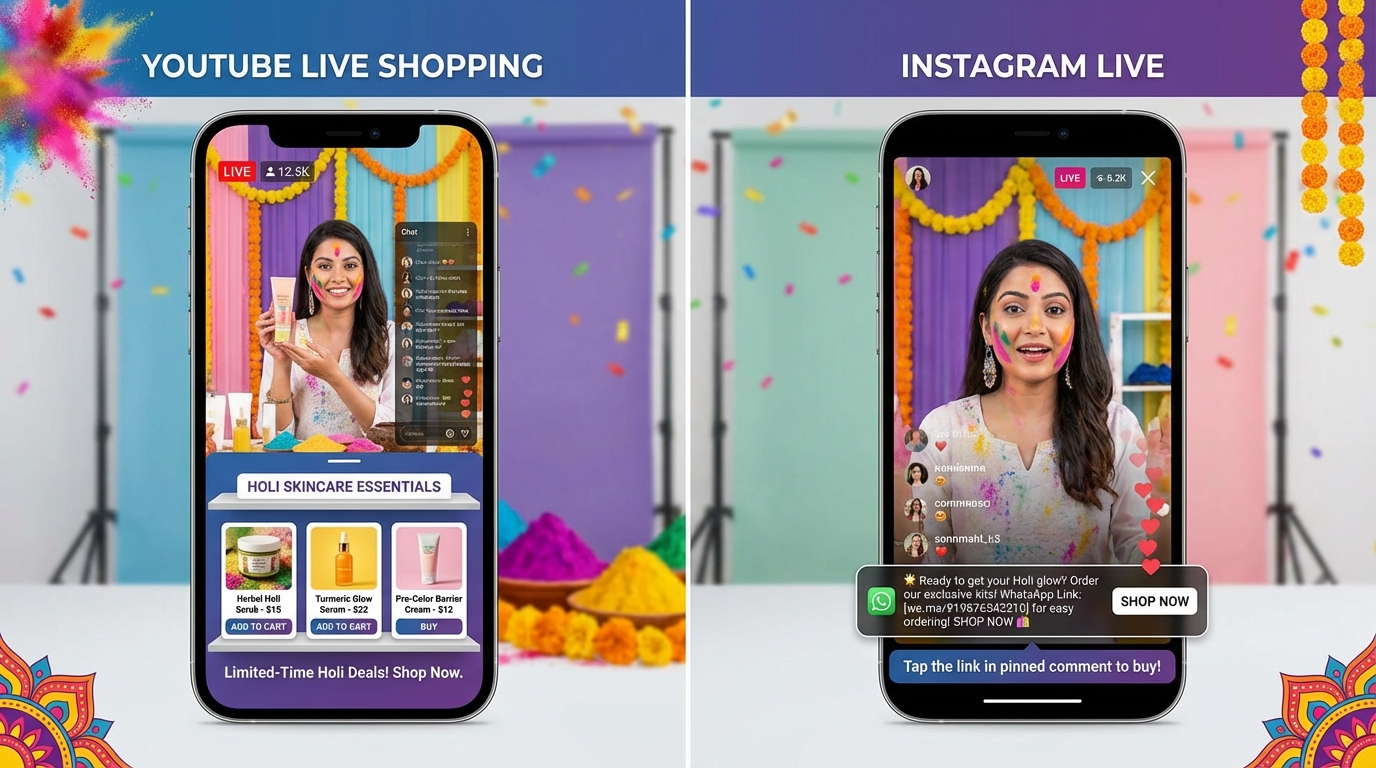
To dominate YouTube live commerce India, enterprise teams must treat livestreams as high-production broadcast events. The architecture involves pre-seeding the event with 30-second trailers featuring top-tier creators or celebrities to build a "remind me" audience. During the live event, the use of instant purchase video triggers—such as pinned chat links and lower-third overlays—allows viewers to transition to a pre-filled cart without leaving the video environment.
Instagram live shopping Holi strategies for 2026 focus on "burst" content. Rather than one long stream, brands should execute 15-minute high-energy sessions every three hours during the peak of Holika Dahan. Since full Instagram Checkout availability can vary, the most robust enterprise workflow involves pinning WhatsApp Business CTAs that trigger automated product catalogs. This ensures that the high engagement of a live creator co-host is immediately funneled into a high-conversion chat environment.
On marketplaces like Amazon Live India and Flipkart, the strategy revolves around festival flash sale videos supported by real-time best practices. For tactical guidance, explore the Quick Commerce Holi Marketing 2026 playbook. These platforms allow for sophisticated real-time inventory sync, where "Deal Badges" and "Stock Countdowns" are dynamically updated on the video overlay. For Holi 2026, brands should implement tiered price windows—for example, a "Golden Hour" from 10:00 AM to 11:00 AM on March 4—to drive peak concurrency and inventory velocity.
Sources:
- YouTube Shopping Implementation Guide
- Instagram Shopping Policies and Setup
- Amazon Live India Dashboard
3. AI Personalization: Real-time offers and inventory synchronization
The core of a sophisticated 2026 strategy is the deployment of Holi live streaming personalized offers. This involves an AI-driven personalization layer that segments the audience in real-time based on their CDP profile, previous purchase history, and in-stream behavior. For instance, a repeat high-LTV customer might see a "VIP Holi Bundle" overlay, while a first-time visitor is presented with a "New Joiner Cashback" trigger.
TrueFan AI's 175+ language support and Personalised Celebrity Videos provide the necessary scale for this level of localization. In a diverse market like India, delivering a live commerce experience in the viewer's native tongue—be it Hindi, Marathi, Bengali, or Tamil—drastically improves watch-time and trust. This creative automation allows brands to generate thousands of personalized video hooks that can be served as pre-rolls or mid-stream highlights.
Technical excellence in real-time inventory sync is non-negotiable for 2026. For implementation patterns, reference the Quick Commerce Holi Marketing 2026 playbook. The system must connect the brand’s Order Management System (OMS) to the live video overlay engine with a latency of less than two seconds. If a specific SKU of "Organic Pink Gulal" falls below a certain threshold, the AI should automatically swap the featured product on the screen to a high-stock alternative, preventing customer frustration and maximizing the yield of every live second.
4. Interactive experience design: Flash sales and purchase triggers
To maximize interactive shopping video campaigns, brands must move beyond passive viewing. The 2026 playbook includes "Live Auction" simulations—a live auction personalization platform approach where prices drop dynamically as more people join the stream or as specific engagement milestones are met. While maintaining regulatory compliance, these gamified elements create a "theatre of retail" that is perfectly suited for the high-energy atmosphere of Holi.
Instant purchase video triggers should be mapped to specific psychological cues within the stream. For example, when a creator demonstrates a "Stain-Proof White Kurta," a QR code or a "Buy Now" button should pulse on the screen. These triggers are most effective when they lead to a "Deep Link" that not only opens the app but also applies the specific festive coupon code automatically, reducing the checkout time to under 10 seconds. For trigger orchestration examples, see the Quick Commerce Holi Marketing 2026 playbook.
Festival flash sale videos should be day-parted to match the rhythm of the festival. Pre-Holi streams (Feb 28 - Mar 2) should focus on "Preparation Kits" and "Gifting." Holika Dahan night (Mar 3) should pivot to "Last Minute Digital Vouchers" and "Post-Holi Skincare." By the morning of Rangwali Holi (Mar 4), the focus shifts to "Replenishment" and "Cleaning Essentials," utilizing quick-commerce integrations guided by the Quick Commerce Holi Marketing 2026 playbook to deliver products while the celebration is still ongoing.
Sources:
5. Measurement and Optimization: Live shopping engagement metrics
Success in live commerce Holi marketing 2026 is determined by granular data analysis. Enterprise teams must move beyond "Total Views" and focus on live shopping engagement metrics that correlate directly with revenue. For metric definitions and dashboards, consult the Quick Commerce Holi Marketing 2026 playbook. Key Performance Indicators (KPIs) for 2026 include:
- Product Click Rate (PCR): The percentage of viewers who interact with a product pin or overlay.
- Instant Purchase CTR: The specific effectiveness of AI-triggered prompts during the stream.
- Inventory Velocity: The rate at which units are moved per minute of live airtime.
- Chat Participation Rate: A proxy for community sentiment and brand affinity.
Solutions like TrueFan AI demonstrate ROI through their ability to track these metrics at a cohort level, allowing brands to see which personalized hooks drove the highest conversion lift. By analyzing the "Drop-off Points" in a 60-minute stream, growth teams can optimize the script for the next session, ensuring that the most compelling offers are aligned with peak viewership periods.
Attribution for live commerce must be "Incremental." This means measuring the lift in sales compared to a control group that was not exposed to the live event. In the 2026 festive window, where organic demand is already high, proving that the real-time video shopping experiences actually drove additional sales is critical for securing future budget allocations.
6. Enterprise Delivery: The 30-day execution timeline
Executing influencer live commerce automation at scale requires a disciplined countdown. For Holi 2026, the preparation begins in early February.
- D-30 to D-21: Finalize the product catalog and lock in inventory buffers. Identify the top 50 creators and automate their onboarding using standardized scripts and coupon code generation.
- D-20 to D-14: Conduct technical dry runs of the real-time inventory sync and the AI overlay engine. Ensure that all deep links are functional across iOS and Android.
- D-7: Launch "Teaser" campaigns. Use short-video platforms like Moj and Josh to seed the "Instant Buy" clips that will funnel traffic to the main event.
- D-1: Final "War Room" check. Verify the failover protocols for the stream and ensure that customer service teams are staffed for the expected surge in WhatsApp inquiries.
- D0 & D+1 (Holi): Execute the live cadence. Anchor the main event on YouTube while running parallel "Flash Bursts" on Instagram and Amazon Live.
This timeline ensures that by the time the first color is thrown on March 4, the brand's digital infrastructure is already operating at peak efficiency, capturing every possible rupee of festive intent.
7. FAQ and Strategic Conclusion
What is live commerce Holi marketing 2026 and why does it matter for Indian e-commerce?
It is the integration of real-time video, AI-driven personalization, and instant checkout features specifically designed for the Holi festival window. It matters because it captures high-intent festive shoppers in a high-engagement environment, driving significantly higher conversion rates than static display ads.
How do instant purchase video triggers work during a livestream?
These are interactive elements—like buttons, QR codes, or chat keywords—that, when clicked, immediately take the user to a checkout page with the product and relevant festive discounts already applied.
How to set up real-time inventory sync for live shopping in India?
It requires an API-led connection between your Order Management System and your video overlay platform. This ensures that when a product sells out, the "Buy" button on the video is automatically disabled or swapped for a different SKU within seconds.
Can I implement TikTok shopping integration for India audiences in 2026?
As of current regulations, TikTok remains unavailable in India. Enterprise brands should instead focus on mirroring that functionality through YouTube Shorts, Instagram Reels, and local platforms like Moj or Josh, which offer similar social commerce live streaming capabilities.
How to run influencer live commerce automation at scale with compliance?
By using platforms like TrueFan AI, brands can automate the creation of personalized creator content while ensuring all #ad disclosures and platform-native rules are strictly followed across thousands of unique video variants.
In conclusion, the success of your live commerce Holi marketing 2026 strategy depends on the seamless integration of cultural relevance and technical sophistication. By prioritizing real-time video shopping experiences and robust real-time inventory sync, enterprise brands can transform the "Festival of Colors" into a festival of record-breaking growth.
Sources:
Recommended Internal Links
Frequently Asked Questions
What is live commerce Holi marketing 2026?
It’s an AI-powered approach that combines real-time video, instant checkout, and personalized offers to capture high-intent festive demand during the Holi period.
How do instant purchase video triggers work?
Triggers like pinned links, overlays, QR codes, or chat keywords deep link shoppers to pre-filled carts with auto-applied coupons, cutting checkout to under 10 seconds.
How do I implement real-time inventory sync for live shopping?
Connect your OMS to the video overlay engine via APIs with sub-2s latency so out-of-stock SKUs are swapped or disabled instantly to avoid broken experiences.
Which platforms should brands prioritize for Holi 2026?
Anchor on YouTube for scale, run burst sessions on Instagram with WhatsApp CTAs, and leverage Amazon/Flipkart for deal overlays and stock countdowns.
What metrics matter most for live commerce ROI?
Track Product Click Rate, Instant Purchase CTR, Inventory Velocity, and Chat Participation; use cohort analysis and incremental lift to prove impact.



