AI Video Slack Integration India 2026: Replace Long Messages and Meetings with Async Video in Indian Enterprises
Estimated reading time: 11 minutes
Key Takeaways
- Indian enterprises are shifting from long text threads to asynchronous AI video updates in Slack and Microsoft Teams by 2026.
- Internal communications video automation turns event triggers (e.g., HRIS, Jira) into short, multilingual video briefings.
- Adopting meeting replacement videos reduces calendar load, boosts engagement, and improves retention across distributed teams.
- DPDP-compliant governance, localization, and integrations (Slack, Teams, WhatsApp, IdPs) are critical selection criteria.
- Solutions like Studio by TrueFan AI deliver measurable ROI via time saved, higher watch rates, and rapid multilingual scale.
In the rapidly evolving landscape of the Indian corporate sector, the year 2026 marks a definitive shift in how teams communicate. The era of “meeting fatigue” and “notification overload” is being replaced by a more streamlined, human-centric approach. Implementing an AI video Slack integration India 2026 strategy is no longer a luxury for forward-thinking firms; it is a necessity for maintaining productivity across India’s 15M+ knowledge workers. As distributed teams become the norm, the reliance on lengthy, text-heavy messages in Slack and Microsoft Teams is giving way to high-impact, asynchronous AI video updates.
The problem is clear: the sheer volume of digital noise is diluting leadership visibility and slowing down execution. However, the readiness for change is unprecedented. According to the Microsoft and LinkedIn 2024 Work Trend Index, a staggering 92% of Indian knowledge workers already use AI at work, a signal that the workforce is primed for AI-native communication workflows. By 2026, this adoption has matured into sophisticated internal communications video automation, where AI-generated avatars deliver personalized, multilingual updates directly within the chat interfaces teams use every day.
1. The Slack-First Blueprint: Internal Communications Video Automation
For Indian enterprises, Slack has evolved from a simple messaging tool into an AI-native command center. The core of this transformation is internal communications video automation. This involves the automated generation and distribution of short-form video updates triggered by specific business events—such as a new hire joining via the HRIS or a critical project milestone reached in Jira.
Rather than expecting employees to read through a 500-word “State of the Project” post, a Slack video bot AI integration can automatically synthesize channel data into a 60-second video summary. These videos leverage photorealistic AI avatars to present information with a human touch, complete with automated subtitles and regional language tracks.
How Slack Video Bot AI Integration Works
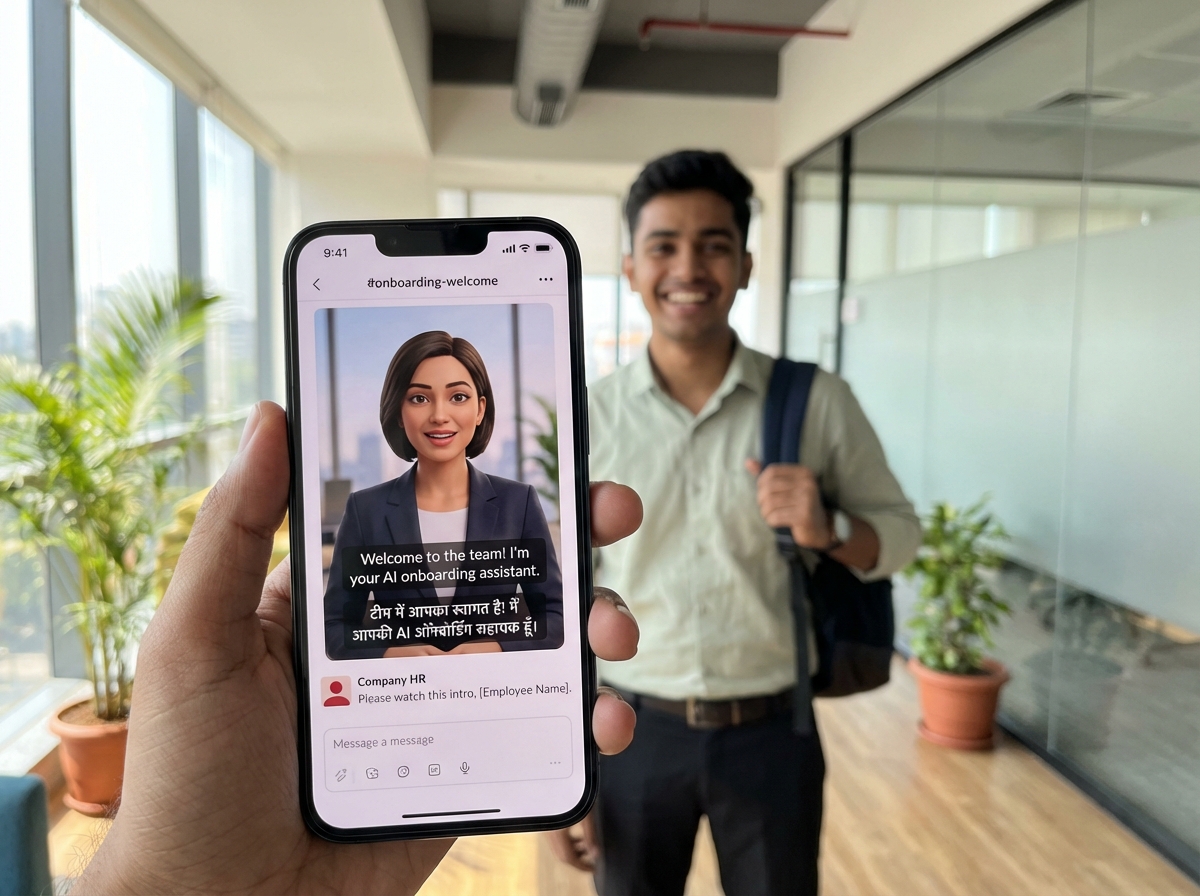
The workflow for a modern Slack-integrated video system typically follows a four-stage “Capture-Generate-Distribute-Govern” pattern:
- Capture: Slack AI summarizes a day’s worth of channel activity or pulls data from integrated tools like Jira or Salesforce.
- Generate: This summary is sent via webhook to an AI video engine. Platforms like Studio by TrueFan AI enable enterprises to transform these text summaries into high-definition videos featuring professional avatars and cloned voices in minutes.
- Distribute: The bot automatically posts the video to relevant channels (e.g.,
#eng-updatesor#sales-wins) with a searchable transcript. - Govern: Every video is watermarked and logged, ensuring that internal communications remain compliant with corporate standards and the Digital Personal Data Protection (DPDP) Act (see brand guideline enforcement AI).
By swapping long threads for asynchronous video, companies are seeing a significant uptick in information retention. Research into workplace behavior suggests that employees are 75% more likely to watch a video than read documents, especially when the content is delivered in their preferred language.
Source: Slack Blog on Asynchronous Video
2. Microsoft Teams Track: Meeting Replacement and HR Automation
While Slack dominates the startup and tech ecosystem, Microsoft Teams remains the backbone of large-scale Indian conglomerates. In 2026, the focus for Teams users has shifted toward Microsoft Teams video messages AI to solve the “calendar clutter” crisis.
Replacing Low-Stakes Meetings
Not every update requires a 30-minute synchronous call. Indian enterprises are now categorizing meetings into “Decision-Based” (Live) and “Information-Based” (Async). For information-based updates—such as weekly roadmap changes or policy rollouts—Teams meeting replacement videos are the new standard.
An AI-generated video recap of a sprint can be distributed to hundreds of stakeholders simultaneously, allowing them to consume the update at 1.5x speed during their commute or between deep-work sessions. This “async by default” culture is projected to reduce meeting load by up to 42% in high-performing Indian IT firms by the end of 2026.
HR Video Automation Slack Teams
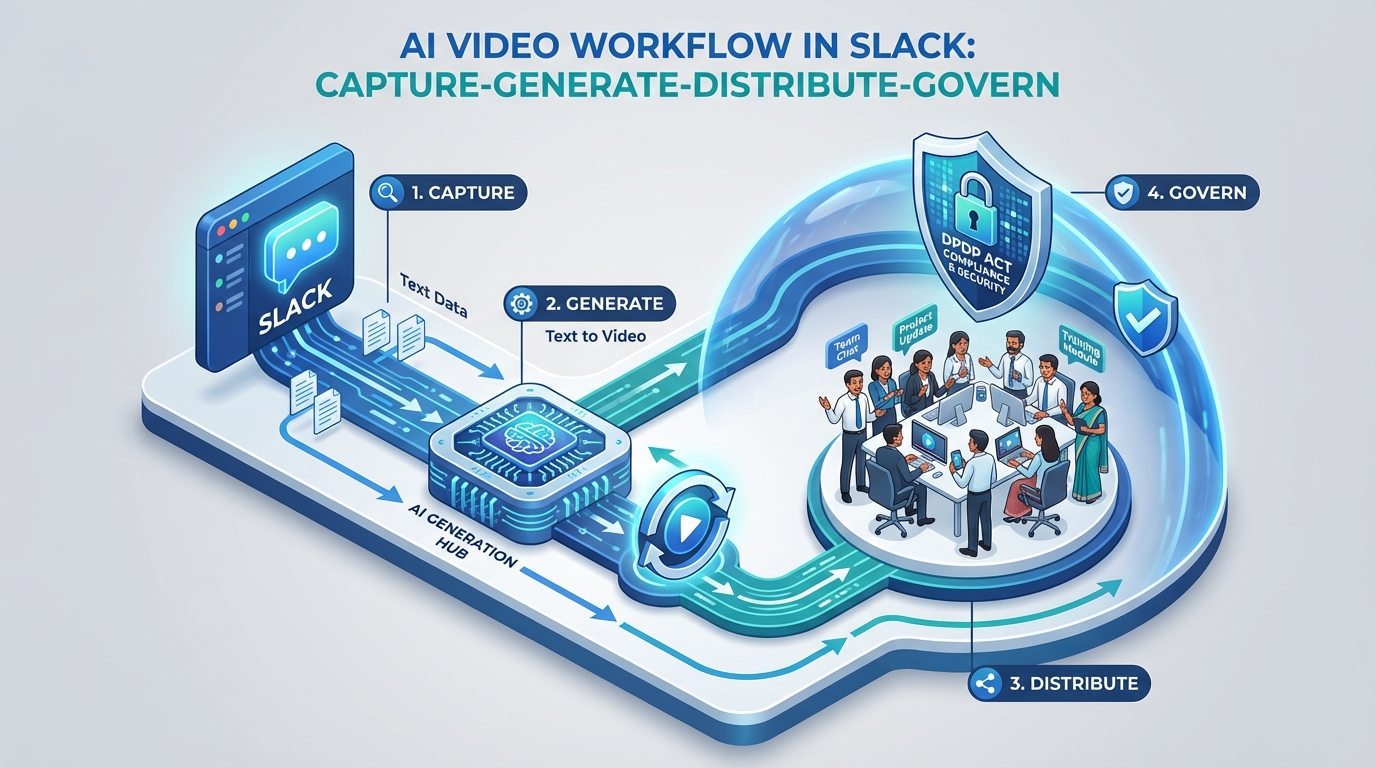
The synergy between HR tech and AI video is particularly potent during onboarding. HR video automation Slack Teams workflows now allow for “Day 0” engagement. When a candidate signs an offer letter, the system triggers a personalized welcome video from the CEO's AI avatar, delivered via Slack or Teams.
These videos can include:
- Multilingual Benefits Walkthroughs: Explaining insurance and PF details in Hindi, Kannada, or Marathi to ensure clarity for a diverse workforce.
- IT Setup Guides: Step-by-step visual instructions that reduce the volume of “How do I set up my VPN?” tickets by an estimated 30%.
- Culture Primers: Short, engaging clips that introduce the company's core values through storytelling rather than static handbooks.
Source: Microsoft India Work Trend Index 2024
3. Priority Use Cases: Scripts, Triggers, and Measurement
To successfully implement an AI video Slack integration India 2026 strategy, enterprises must move beyond generic use cases and focus on high-impact “video-first” moments.
Employee Onboarding Video Slack
The first 90 days are critical for retention. Automated onboarding videos ensure every hire receives a consistent, high-quality introduction.
- The Script: A 90-second “Welcome to the Team” video featuring a department head avatar.
- The Trigger: Integration with HRIS (like Darwinbox or Workday) when a new profile is activated.
- The Metric: Watch rate and “Time to First Contribution.”
Async Video Standup AI Tools
Daily standups often devolve into status reporting rather than blocker resolution. Async video standup AI tools allow team members to record or generate a quick update at their convenience.
- The Workflow: A bot pings the team at 9:00 AM; by 10:00 AM, it compiles an AI-summarized montage of all updates, highlighting dependencies and blockers.
- The Benefit: Teams across different time zones (e.g., Bengaluru and San Francisco) stay aligned without midnight calls.
Leadership Video Announcements AI
In large organizations, leadership can feel distant. Leadership video announcements AI allows executives to maintain a “visible” presence without spending hours in a recording studio. Studio by TrueFan AI’s 175+ language support and AI avatars ensure that a message from a Mumbai-based CEO is just as impactful for a factory manager in Tamil Nadu, delivered in fluent Tamil with perfect lip-sync.
Corporate Video Messages Automation
For governance and compliance, corporate video messages automation is used to disseminate InfoSec advisories and policy changes. Instead of a “Required Reading” email that gets ignored, a 45-second video with bullet-point overlays ensures the message is heard and understood.
| Use Case | Primary Trigger | Key Metric |
|---|---|---|
| Onboarding | HRIS New Hire Event | 20% Faster Day 1 Readiness |
| Standups | Scheduled Bot Ping | 80% Reduction in Meeting Time |
| Leadership | Quarterly Calendar | Reach & Sentiment Analysis |
| Compliance | Policy Update in SharePoint | 100% Audit Trail Completion |
4. Platform and Procurement: Internal Comms Video Platform India
Choosing an internal comms video platform India requires a rigorous evaluation of security, localization, and integration capabilities. In 2026, the “procurement checklist” for Indian enterprises has become significantly more complex due to new data regulations.
Security and DPDP Act Compliance
The Digital Personal Data Protection (DPDP) Act of India mandates strict controls over how employee data is processed. Any AI video tool must offer:
- Data Minimization: Only processing the scripts necessary for video generation.
- Audit Logging: A complete record of who generated which video and where it was distributed.
- Content Moderation: Real-time filters to prevent the generation of unauthorized or inappropriate content (see brand guideline enforcement AI).
Localization and Accessibility
India’s workforce is linguistically diverse. A platform must support not just English and Hindi, but a wide array of regional languages. Furthermore, accessibility features like mandatory closed captioning and downloadable transcripts are essential for inclusive communication.
Integration Ecosystem
The platform shouldn't exist in a silo. It must offer robust APIs and webhooks to connect with:
- Slack and Microsoft Teams: For seamless distribution.
- WhatsApp API: Crucial for reaching field staff and non-desk workers in India who may not use Slack or Teams daily.
- Identity Providers (IdP): Supporting SSO and Role-Based Access Control (RBAC) to ensure only authorized personnel can generate leadership-level videos.
Source: Summary of India's DPDP Act
5. Implementation Blueprints: Rolling Out AI Video
Transitioning to async communication AI video India requires a phased approach to ensure cultural buy-in and technical stability. See MLOps video production infrastructure for deeper guidance.
The Slack Rollout Blueprint
- Phase 1: Governance (Week 1-2): Define which channels are “video-enabled.” Set up moderation gates and watermarking defaults.
- Phase 2: Template Creation (Week 3): Develop standardized scripts for onboarding, IT alerts, and weekly wins.
- Phase 3: Integration (Week 4): Connect your Slack App to the AI video API. Map triggers (e.g., a “New Deal” in Salesforce triggers a celebratory video in
#sales-wins)—see video production infrastructure. - Phase 4: Pilot (Month 2): Launch with a specific department (e.g., Engineering) to measure engagement and refine the bot's interaction model.
- Phase 5: Scale (Month 3+): Roll out company-wide with a centralized content calendar and analytics dashboard.
The Teams Rollout Blueprint
For Microsoft Teams, the focus is often on enterprise internal video AI India integration within the Viva or SharePoint ecosystem.
- Channel Strategy: Create dedicated “Video Hub” channels for different functions.
- Meeting Replacement Policy: Codify the rule that status updates under 5 minutes must be sent as AI video messages rather than scheduled meetings.
- Archive and Search: Ensure all video transcripts are indexed by Microsoft 365 Search, making the knowledge within videos as discoverable as a Word document.
Source: Slack AI Enterprise Search and Tools
6. ROI Model and the Future of Internal Video
The shift toward workplace video messaging tools is driven by a clear return on investment. Solutions like Studio by TrueFan AI demonstrate ROI through an enterprise video analytics platform across several key pillars:
1. Time Reclaimed
If an average manager spends 15 hours a week in status meetings, and 30% of those are replaced by 2-minute AI videos, the organization reclaims 4.5 hours per manager, per week. For an enterprise with 1,000 managers, this equates to 4,500 hours of high-value work time unlocked weekly.
2. Engagement and Retention
Standard internal emails have an average open rate of 20-30%. In contrast, internal AI videos delivered via Slack see watch rates exceeding 65%. Higher engagement leads to better alignment with company goals and, ultimately, higher employee retention.
3. Localization Savings
Traditional video production with professional voiceovers in 10 Indian languages would cost lakhs of rupees and take weeks. AI video reduces this cost by over 90% and the turnaround time to minutes.
The 2026 Outlook: Agents and LLMs
As we look toward the end of 2026, the integration of Large Language Models (LLMs) and AI agents will further automate these workflows. We are moving toward a “Self-Generating Intranet,” where AI agents proactively identify information gaps in Slack channels and generate video explainers to fill them. The convergence of UCaaS (Unified Communications as a Service) means that video, voice, and text will be seamlessly orchestrated by AI to ensure the right message reaches the right employee at the right time.
Source: Salesforce 2026 AI Agent Predictions
Conclusion
The integration of AI video into Slack and Microsoft Teams represents a fundamental shift in the Indian workplace. By 2026, the enterprises that thrive will be those that have successfully moved away from the “wall of text” and toward a more human, efficient, and governed form of communication. Whether it's through employee onboarding video Slack workflows or leadership video announcements AI, the goal remains the same: to build a more connected and productive workforce.
Ready to transform your internal communications? Explore how enterprise internal video AI India can be operationalized for your team by visiting Studio by TrueFan AI at studio.truefan.ai. From API-driven automation to ISO 27001-certified security, the future of async work is here.
7. Frequently Asked Questions (FAQs)
How does AI video integration handle low bandwidth in remote Indian locations?
Modern platforms use adaptive bitrate streaming, similar to Netflix or YouTube. This ensures that an employee in a Tier 3 city with a 3G/4G connection can still view the video in a lower resolution without buffering, while those on high-speed office Wi-Fi receive HD/4K quality.
Is it possible to use a real company leader’s voice and likeness for these videos?
Yes. Through “Custom Avatar Training,” enterprises can create a digital twin of their CEO or department heads. This requires explicit consent and a secure recording session, after which the AI can generate new videos from text scripts using that specific likeness and voice.
How do we ensure that AI-generated videos aren't used for deepfake misinformation internally?
Governance is key. Studio by TrueFan AI provides watermarked outputs and real-time moderation to ensure all content is traceable and adheres to corporate safety standards. Additionally, internal communication policies should mandate a “Disclosure Tag” (e.g., “AI-Generated Update”) on all such content.
Can these videos be distributed to employees who don't use Slack or Teams?
Absolutely. For field staff, delivery drivers, or factory workers in India, the most effective channel is often WhatsApp. Leading platforms offer WhatsApp API integration, allowing you to push the same AI-generated internal updates to a mobile-first workforce.
What is the typical “Time to Value” for an AI video integration project?
Most enterprises can go from procurement to their first automated video pilot in under 30 days. The Time to Value is almost immediate, as the first few replaced meetings or automated onboarding sequences provide instant data on time saved and engagement levels.
How does the DPDP Act affect the storage of these internal videos?
The DPDP Act requires that personal data (including an employee's image or voice if used in a video) be stored securely and deleted once the “purpose” is served. Enterprises must ensure their AI video partner has clear data retention and deletion policies that align with these Indian regulations.



