
Zero-party data collection videos 2026: A DPDP-compliant playbook for consent-based personalization in India
Estimated reading time: 12 minutes
Key Takeaways
- Zero-party data with explicit consent is the foundation for DPDP-compliant personalization in India.
- Interactive videos enable transparent value exchange, boosting completion rates over static forms.
- Adopt progressive profiling and preference centers to reduce friction and sustain trust.
- Use a consent manager + CDP architecture to orchestrate permissions and automate journeys.
- Avoid dark patterns; keep decline paths visible and maintain audit-ready consent logs.
In 2026, zero-party data collection videos 2026 are the fastest path for Indian enterprises to build privacy-first data collection programs that respect the Digital Personal Data Protection (DPDP) Act. As third-party cookies vanish and ad-blocker usage in India climbs to 37%, brands must pivot from “observing” users to “asking” them. Zero-party data—information voluntarily and proactively shared by consumers—is the gold standard for trust.
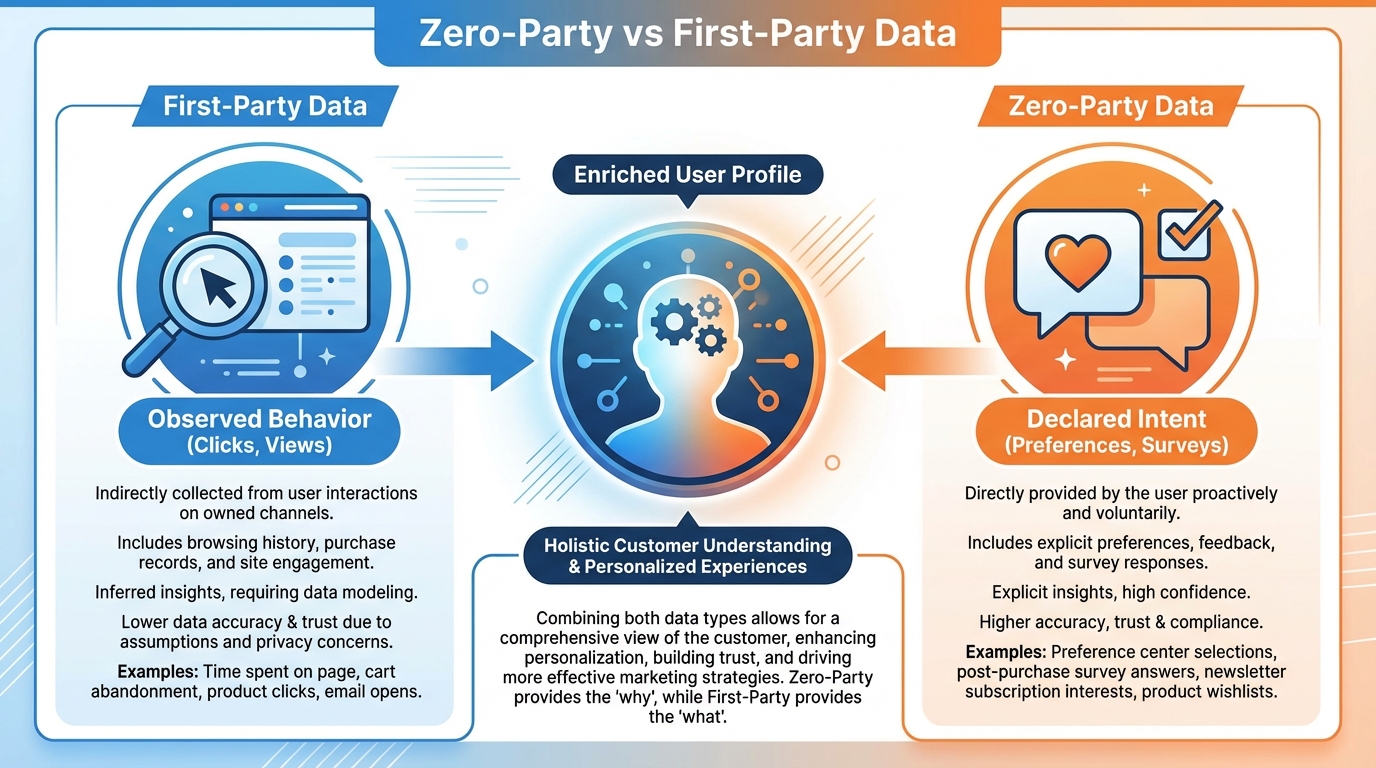
By 2026, over 60% of Indian marketers will prioritize zero-party data to fuel their personalization engines. Unlike first-party data, which tracks clicks and views, zero-party data captures intent, preferences, and personal context directly from the source. This distinction is critical for consent-based personalization India, where the legal landscape now demands explicit, granular permission for every data point processed.
Interactive videos serve as the ideal medium for this exchange. They offer a high-engagement surface where transparent data usage videos can explain the “why” behind data requests, leading to higher completion rates than static forms. For enterprises, this means moving beyond generic marketing to a model where every interaction is a value-driven conversation.
The privacy shift in India: DPDP and the end of third‑party cookies
The implementation of the DPDP Act has fundamentally rewritten the rules for DPDP compliant data gathering. Enterprises can no longer rely on “implied consent” or pre-ticked boxes. The law mandates that consent must be free, specific, informed, unconditional, and unambiguous, with a clear affirmative action from the Data Principal.
In this new era, privacy-first data collection is not just a legal requirement but a competitive advantage. Marketers must now provide notices in local languages, ensuring that a user in Tamil Nadu or West Bengal understands exactly what they are signing up for. This granularity prevents the “bundling” of consent, where a user is forced to accept marketing emails just to use a basic service.
Furthermore, the Central Consumer Protection Authority (CCPA) has cracked down on “dark patterns”—deceptive UI/UX designs that trick users into sharing more data than intended. This includes “basket sneaking,” “forced action,” and “interface interference.” In 2026, any enterprise found using these tactics faces not only heavy fines under the DPDP Act but also severe brand reputation damage in a hyper-aware consumer market.
The cookieless reality of 2026 means that the 55% of digital ad spend now directed toward mobile must be supported by consented signals. Without third-party cookies, the only way to maintain targeting accuracy is through robust first-party data enrichment campaigns that are anchored by zero-party declarations.
Source: CCPA Guidelines for Prevention of Dark Patterns
Source: Cookieless Strategy Guidance 2026
Zero-party vs first-party data—and why videos win in 2026
To master zero-party data collection videos 2026, one must first distinguish between “declared” and “observed” data. First-party data is what you see: a user clicked on a red shoe, spent 40 seconds on a pricing page, or downloaded a whitepaper. It is behavioral and often requires sophisticated AI to “guess” the user’s intent.
Zero-party data is what the user tells you: “I am looking for running shoes for a marathon in three months,” or “My monthly budget for skincare is ₹2,000.” This data is 100% accurate because it comes directly from the consumer. When combined, these two data sets create a powerful profile that drives first-party data enrichment campaigns with surgical precision.
Video is the superior vehicle for this collection because it solves the “trust gap.” A static form asking for a phone number feels like a chore; an interactive video featuring a trusted brand ambassador explaining how that number will be used to send exclusive, localized offers feels like a service. In 2026, video consumption in India dominates mobile usage, making it the natural environment for data capture. Platforms like TrueFan AI enable enterprises to deliver hyper-personalized, interactive videos that capture data in real-time.
Interactive video allows for “progressive profiling,” where data is collected in bite-sized chunks over multiple sessions. Instead of a 10-field form that causes 80% drop-off, a video might ask one question about a user’s favorite color in the first minute and another about their preferred communication channel at the end. This reduces friction while building a comprehensive data asset over time. Progressive profiling
Source: Future of Digital Marketing Trends 2026
Source: India-focused Transparency Trends 2026
Mechanics that work—interactive video data capture patterns
Successful interactive video data capture relies on seamless UX patterns that blend entertainment with utility. In 2026, enterprises are moving away from “interruptive” ads toward “participatory” content. This involves embedding interactive overlays directly into the video player, allowing users to respond without leaving the experience.
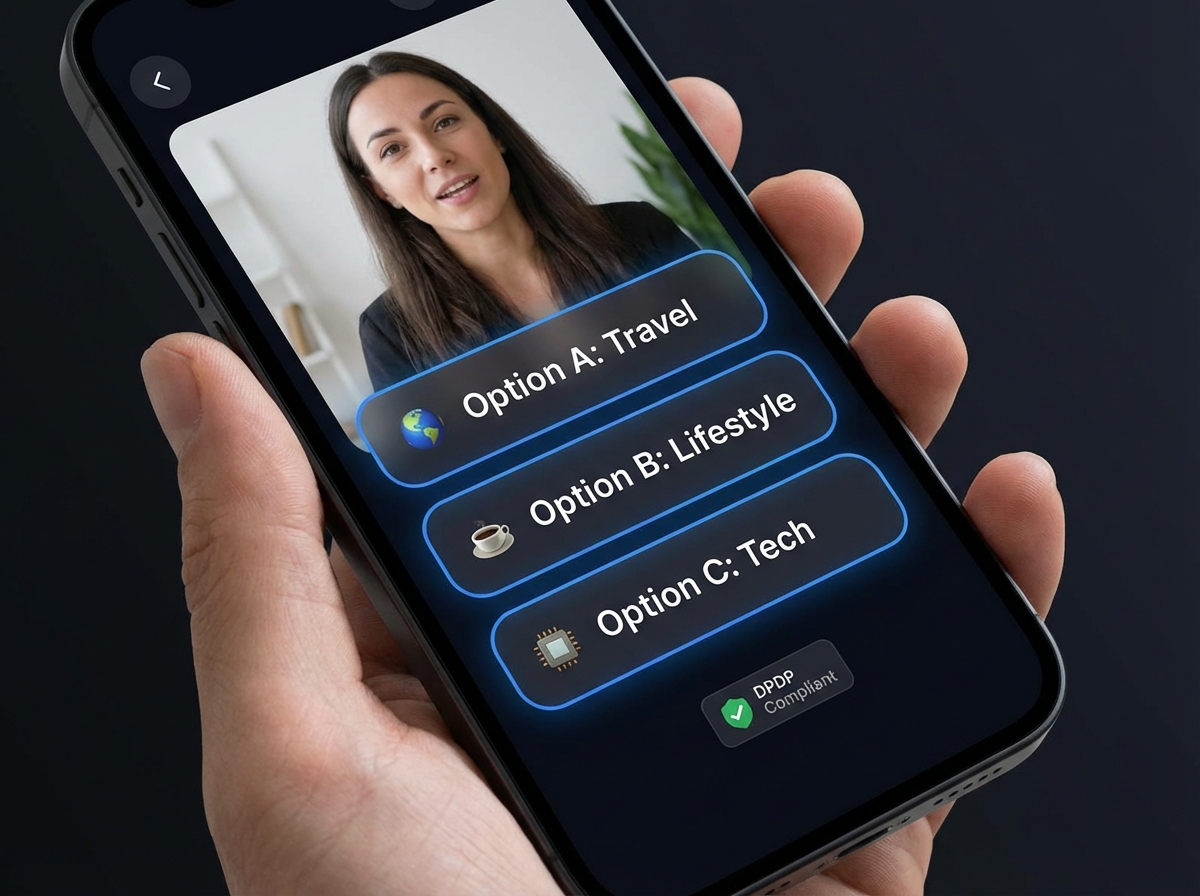
Interactive survey videos are particularly effective for initial onboarding. By presenting 2-3 high-value questions—such as “Which product category interests you most?”—brands can immediately segment their audience. These videos should always include a “time-to-complete” indicator and a clear link to the privacy policy to maintain DPDP compliance.
Another high-performing pattern is video quiz marketing automation. For example, a financial services brand might use a “Find Your Perfect Credit Card” quiz. As the user selects their spending habits (travel, groceries, fuel), the system captures these preferences as zero-party data. This data is then pushed to the CRM to trigger a personalized follow-up with the exact product the user “built” during the quiz. Video quiz marketing automation
For long-term engagement, progressive profiling video campaigns are essential. These campaigns use logic to ensure users are never asked the same question twice. If a user has already declared their city, the next video interaction might focus on their language preference or product sub-category. This creates a sense of “being known” by the brand, which significantly boosts loyalty and reduces “consent fatigue.”
Source: Performance Marketing Trends India 2026
Source: Interactive Video Statistics 2026
Gamified preference collection and value exchange (without dark patterns)
In 2026, gamified preference collection has become the standard for high-volume data gathering. By adding elements like points, badges, or “unlockable” content, brands can turn data sharing into a rewarding experience. However, this must be balanced with strict adherence to value exchange data strategies that are transparent and fair.
The “value exchange” must be clearly articulated: “Tell us your skin type, and we’ll unlock a 15% discount on the specific products you need.” This creates a voluntary data sharing incentives model where the user feels they are getting a fair deal. Crucially, the “decline” path must be as prominent as the “accept” path to avoid being flagged as a dark pattern under Indian law.
Enterprises should avoid “forced gamification,” where a user cannot access basic content without playing a data-capture game. Instead, use “opt-in” rewards. For instance, a video might offer a “Style Persona” badge that users can earn by answering three questions about their fashion preferences. This badge could then grant early access to new collections, providing a tangible benefit for the data shared.
Throttling and frequency capping are also vital. Even the most engaging gamified video can become annoying if it appears too often. In 2026, smart orchestration layers ensure that a user is only prompted for data when they have reached a specific engagement milestone, such as watching 75% of three consecutive videos. This ensures that the data collection feels organic rather than intrusive.
Source: CCPA Dark Patterns Prevention Guidelines
Source: Digital Video Advertising Market Report 2026
Preference centers powered by video for consent-based personalization India
A modern preference center is no longer a boring list of checkboxes; it is a dynamic hub for consent-based personalization India. By using preference center personalization videos, brands can explain the benefits of each communication channel. A 15-second clip might show how “WhatsApp Alerts” provide real-time delivery updates, while “Email Newsletters” offer deep-dive industry insights.
Transparent data usage videos are critical for building long-term trust. These videos should explicitly state how long data is kept, who it is shared with (if anyone), and how a user can exercise their “Right to be Forgotten” under the DPDP Act. In a multilingual market like India, providing these explainers in regional languages is not just good practice—it is often a legal necessity to ensure “informed” consent.
The design of the preference center must allow for “granular toggles.” A user should be able to opt-in to “New Product Launches” but opt-out of “Partner Offers” without losing all communications. This level of control reduces total unsubscribes, as users can “down-subscribe” to only the content they find valuable.
Finally, the preference center must be easily accessible. It should be linked in every video description, email footer, and app menu. When a user makes a change, an automated confirmation (via email or WhatsApp) should be sent, providing an audit trail for both the user and the enterprise. This transparency is the bedrock of DPDP compliant data gathering.
Source: Consent Managers under DPDP Act 2025
Source: 2026 Marketing Statistics - HubSpot
Reference architecture for DPDP compliant data gathering and customer preference automation
To implement customer preference automation at scale, enterprises need a robust technical architecture. This begins with a “Consent Manager,” a registered entity under the DPDP Act that orchestrates consent across all digital touchpoints. The Consent Manager acts as the single source of truth for what a user has—and has not—agreed to.
The “Video Experience Layer” is where the actual interaction happens. Platforms like TrueFan AI enable enterprises to deliver hyper-personalized, interactive videos that capture data in real-time. When a user interacts with a video, the event (e.g., field_captured: {budget_range: "50k-100k"}) is sent via secure webhook to the Consent Manager and the Customer Data Platform (CDP).
The CDP then handles “Identity Resolution,” linking the new zero-party data to the existing user profile. This triggers customer preference automation workflows. For example, if a user selects “Hindi” as their preferred language in a video quiz, the CDP immediately updates their profile, and all subsequent communications—from WhatsApp messages to app notifications—switch to Hindi.
Governance is the final piece of the puzzle. The architecture must include a “Schema Registry” that defines every data field and its associated “Purpose ID.” This ensures that data collected for “Product Recommendations” is never accidentally used for “Third-party Marketing” without additional consent. Regular audit log exports and automated retention schedules ensure the enterprise remains audit-ready at all times.
Source: MeitY DPDP Act Official PDF
Source: TrueFan AI Enterprise Product Offering
90‑day enterprise rollout plan (pilot → scale)
Deploying a zero-party data collection videos 2026 strategy requires a structured approach. Enterprises should start with a 30-day pilot focused on a single high-impact use case, such as “New User Onboarding.” During this phase, the focus is on “compliance-by-design”—mapping data purposes, drafting layered notices, and ensuring the technical integration between the video player and the Consent Manager is seamless.
In the second 30-day phase, the focus shifts to progressive profiling video campaigns and video quiz marketing automation. This is where the “value exchange” is tested. Brands should run A/B tests on different incentives—such as “Exclusive Content” vs. “Early Access”—to see which drives the highest quality zero-party data. During this time, the CDP should begin automating journeys based on the initial data captured.
The final 30 days are dedicated to scaling and institutionalizing the program. This involves launching preference center personalization videos and transparent data usage videos across all major customer touchpoints. Enterprises should also roll out first-party data enrichment campaigns that leverage the newly acquired zero-party insights to re-engage dormant users or upsell existing ones.
By Day 90, the enterprise should have a “Consent Dashboard” that tracks key metrics: interaction rates, consent opt-in rates, and the “Value of a Preference” (the revenue lift associated with a personalized interaction). Regular governance routines, including consent log audits and Data Protection Impact Assessments (DPIAs), should be established as part of the standard operating procedure.
Source: 2026 Digital Marketing Trends - VNet Academy
Source: GrowthStack360 Marketing Automation Summit
How TrueFan AI supports enterprise execution
For enterprises looking to master interactive video data capture, TrueFan AI provides the necessary infrastructure for hyper-personalization and real-time engagement. TrueFan AI’s 175+ language support and Personalised Celebrity Videos allow brands to speak to every customer in their native tongue, significantly increasing the trust required for zero-party data sharing.
Solutions like TrueFan AI demonstrate ROI through massive scale; for instance, Zomato used the platform to deliver 354,000 personalized videos in a single day for their “Maa ke liye” campaign. This level of throughput is essential for customer preference automation, where millions of unique video interactions must be rendered and delivered in under 30 seconds to maintain user attention.
The platform’s API-driven architecture allows for seamless integration into existing martech stacks. Whether it is pushing consented fields to a Salesforce CRM or triggering a personalized travel nudge on WhatsApp (as seen with Goibibo), TrueFan AI acts as the “engagement engine” for first-party data enrichment campaigns.
Furthermore, TrueFan AI’s commitment to security—evidenced by its ISO 27001 and SOC 2 certifications—ensures that enterprise data is handled with the highest level of care. By providing built-in moderation and a consent-first operational model, the platform helps brands navigate the complexities of the DPDP Act while delivering cutting-edge preference center personalization videos.
Source: TrueFan AI Case Studies
Source: AWS Gen AI/ML Market Disruptor Award 2025
Compliance checklist (copy-ready callout)
- Explicit Consent: Use clear, affirmative actions for every data point; avoid pre-ticked boxes.
- Purpose Limitation: Ensure data is only used for the specific reason it was collected.
- Data Minimization: Only ask for what you absolutely need for the stated value exchange.
- Withdrawal Path: Provide a “one-click” way for users to revoke consent via the preference center.
- Local Language Notices: Use transparent data usage videos in regional languages to ensure comprehension.
- Minor Protection: Implement verifiable parental consent flows for users under 18.
- Audit Trails: Maintain time-stamped logs of every consent event and preference change.
- No Dark Patterns: Ensure “Accept” and “Decline” buttons have equal visual weight.
Conclusion
The transition to zero-party data collection videos 2026 is not merely a response to regulation; it is a fundamental shift toward a more respectful and effective marketing ecosystem. By leveraging the power of interactive video, Indian enterprises can turn the “burden” of DPDP compliance into a “bridge” for deeper customer relationships.
In a world without third-party cookies, trust is the only currency that matters. Brands that prioritize privacy-first data collection and offer a transparent, value-driven exchange will not only survive the regulatory shift but will thrive by building the most accurate and actionable data assets in their industry. The future of personalization in India is consented, video-driven, and powered by the voices of the customers themselves.
Frequently Asked Questions
Is interactive video data capture DPDP-compliant in India?
Yes, provided the enterprise captures explicit consent, follows purpose-binding rules, and maintains verifiable logs as per the MeitY DPDP Act guidelines.
What voluntary data sharing incentives are acceptable under DPDP?
Incentives must be optional and proportionate; they cannot be used to “coerce” consent or penalize users who choose not to share data, as per CCPA dark pattern regulations.
How do progressive profiling video campaigns reduce friction while staying compliant?
By asking for 1–2 fields per interaction and tagging each with a specific purpose and consent version, brands build trust without overwhelming the user.
How do preference center personalization videos improve consent-based personalization in India?
They increase user comprehension of why data is needed, leading to higher opt-in rates and lower withdrawal rates compared to text-only centers.
What’s the difference between zero-party and first-party data?
Zero-party data is “declared” (e.g., “I like blue”), while first-party data is “observed” (e.g., the user clicked a blue item). Platforms like TrueFan AI help bridge these to create a 360-degree customer view.
How does TrueFan AI handle data security for large enterprises?
TrueFan AI is ISO 27001 and SOC 2 certified, ensuring all user data and celebrity likenesses are processed within a secure, consent-first framework.



