Hyperlocal Community Commerce Videos 2026: An Enterprise Playbook for Residential Society Marketing in India
Estimated reading time: 12 minutes
Key Takeaways
- Short-form, hyperlocal video is the primary engine for acquisition in 2026, driven by AI personalization and community distribution.
- Successful execution hinges on RWA partnerships, multi-channel access (apps, WhatsApp, lobby screens), and trust-compliant workflows.
- Micro-market orchestration aligns society-level data signals with dynamic video offers and UPI-first checkout paths.
- Collaborations with resident nano-influencers and event automation drive higher conversion vs. traditional ads.
- A phased roadmap with feed-based varianting enables scale to 10,000+ societies while maintaining measurement rigor.
The evolution of digital engagement has reached a critical inflection point where generic broadcasting is being replaced by hyper-granular, localized storytelling. Hyperlocal community commerce videos 2026 represent the pinnacle of this shift, utilizing AI-personalized, neighborhood-specific video campaigns tailored to micro-markets—drilling down from the city level to specific localities, societies, and even individual towers. These campaigns are strategically distributed via society-specific applications, WhatsApp community lists, lobby digital signage, and on-ground activations, all optimized for immediate commerce actions such as UPI-linked checkouts and QR-based redemptions.
As we navigate 2026, the Indian market has witnessed a paradigm shift where short-form video is no longer just a discovery tool but the primary engine for customer acquisition. The creator economy has achieved unprecedented scale, and AI-native personalization has become the baseline expectation for premium residential audiences. Current data indicates that over 82% of Indian D2C brands now prioritize short-form video as their lead channel, while UPI integration within social and community commerce has surged by 45% year-over-year. Furthermore, influencer-led video commerce is demonstrating conversion rates 20–30% higher than traditional static catalogs, supported by a robust ecosystem of approximately 2.5 million monetized creators across the country. For enterprise leaders, mastering community-driven commerce India and micro-market personalization strategies is no longer optional; it is the prerequisite for capturing the high-intent, high-LTV (Life Time Value) audience residing in India's gated communities.
1. The Landscape of Residential Society Marketing India: RWA Dynamics and Multi-Channel Access
The foundation of any successful hyperlocal campaign lies in understanding the governance and social fabric of Indian gated communities. Residential society marketing India is governed by Resident Welfare Associations (RWAs), which are resident-elected bodies responsible for managing amenities, security, and brand permissions. These associations act as the ultimate gatekeepers for any commercial activity within the premises, making RWA partnership marketing campaigns a critical component of the enterprise strategy.
To penetrate these high-value micro-markets, brands must leverage established market access platforms that have already secured trust and digital real estate within these complexes. Platforms like MyGate provide an advertising ecosystem reaching over 4 million premium households through a combination of digital in-app banners and physical on-ground activations. Similarly, NoBrokerHood offers sophisticated “Advertise With Us” programs that allow for upscale targeting, ensuring that brand messages reach residents through app push notifications, digital notice boards, and lobby screens.
Effective residential complex engagement requires a multi-touchpoint approach. Beyond digital apps, brands must integrate into the daily flow of the resident: WhatsApp community lists managed by society admins, clubhouse kiosks, and even the security guard stations where deliveries are coordinated. Navigating the RWA process involves a structured approach: presenting a comprehensive proposal deck that emphasizes resident safety and compliance, providing a clear disclosure plan for sponsored content, and delivering a detailed post-activity measurement report to ensure long-term partnership viability.
Source: MyGate Ad Platform
Source: NoBrokerHood Advertise With Us
2. Neighborhood Video Personalization: AI-Driven Creative Systems and Workflows
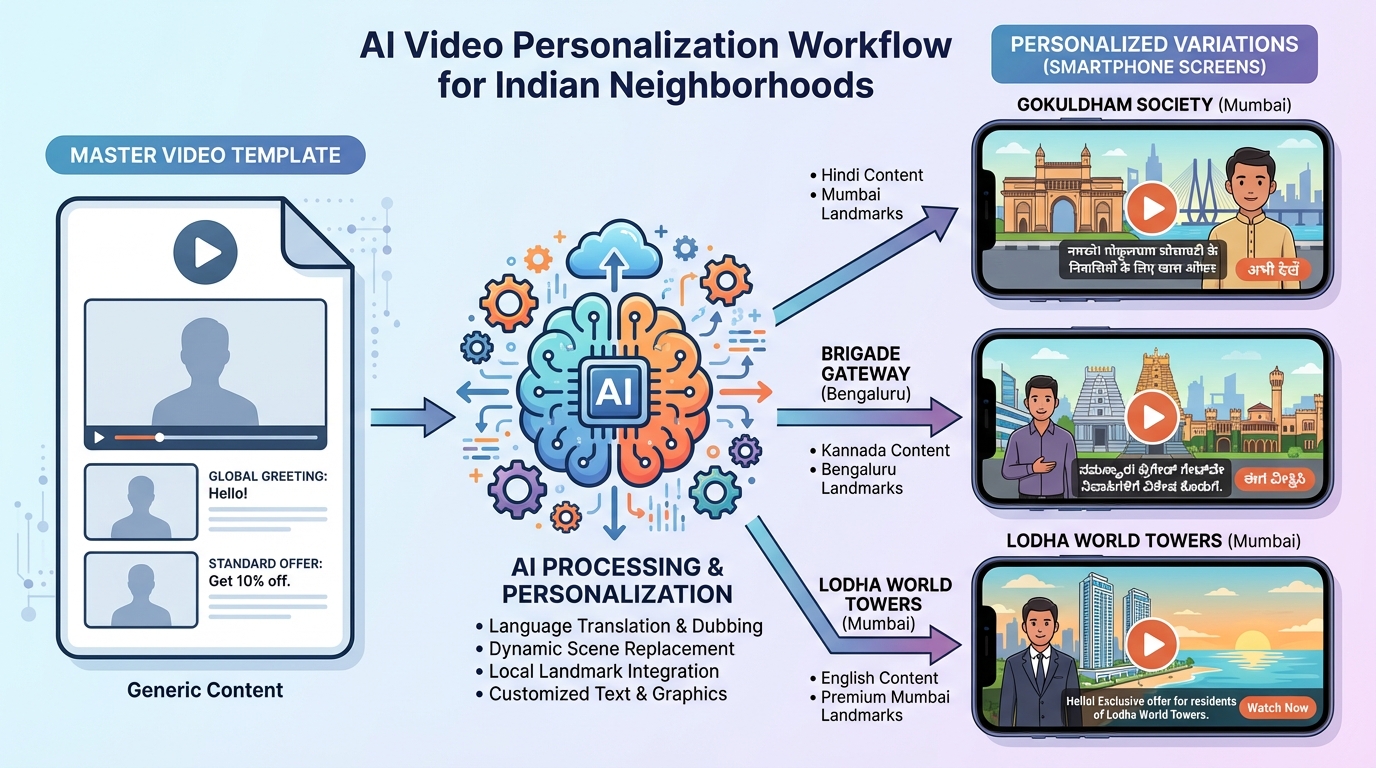
The technical core of 2026 marketing lies in neighborhood video personalization, a process that dynamically localizes every element of a video—from the script and voiceover to the visual landmarks and specific calls to action (CTAs). This level of granularity ensures that a resident in a specific tower of a Bangalore society sees a different video than a resident in a Delhi colony, even if the core product remains the same. The creative anatomy of these videos follows a strict “Hook Rule,” where the first 3 seconds must front-load value and local relevance to prevent the viewer from scrolling past.
Platforms like TrueFan AI enable enterprises to achieve this hyper-personalization at scale through advanced API integrations. These systems can dynamically insert the resident's name, their specific locality, and even the name of their society or the nearest partner merchant into the video in near-real-time, with rendering targets often falling under 30 seconds. This ensures that the content feels bespoke rather than mass-produced, significantly increasing trust and engagement.
Furthermore, the integration of multilingual localization is paramount in the Indian context. Modern AI workflows now support over 175 languages, maintaining the original voice retention and lip-sync accuracy of a celebrity or brand spokesperson. This allows for virtual reshoots and AI-driven edits where lines or offers can be swapped instantly without the need for expensive physical production. These personalized assets are then deployed across CRM-integrated channels, including WhatsApp Business API, email, and synchronized lobby screens, creating a seamless and immersive brand experience.
3. Society-Level Offer Personalization: Data Signals and Micro-Market Orchestration
To drive actual commerce, brands must move beyond generic discounts toward society-level offer personalization. This involves tailoring benefits and CTAs based on micro-cluster signals such as pincode-level affluence, tower-specific demographics, amenity usage patterns, and even local festival calendars. By analyzing these data points, enterprises can deploy dynamic creative rules—for instance, offering weekend activity deals to towers with a high density of families with children, or pharmacy and health-check benefits to blocks primarily occupied by senior citizens.
The data-to-creative pipeline requires a robust schema that includes society IDs, language preferences, average basket sizes, and the nearest partner merchant’s UPI credentials. This orchestration is often managed through advanced martech stacks like WebEngage, which allows for micro-segmentation and live triggers. When a resident interacts with a society app or enters a specific geofence, the system can trigger a personalized video offer that is contextually relevant to that exact moment and location.
Privacy and governance are the cornerstones of this data-driven approach. Enterprises must adhere to strict data minimization principles, ensuring that only necessary signals are used to drive personalization. Consent logging and transparent opt-out workflows must be integrated into every digital placement. By maintaining high standards of data ethics, brands can build long-term trust, transforming a simple advertisement into a valued community service.
Source: WebEngage Micro-segmentation
4. Hyperlocal Influencer Collaborations and Community Event Marketing Automation
In 2026, the most effective voices are those that reside within the community itself. Hyperlocal influencer collaborations have shifted from macro-celebrities to “Resident Champions”—the sports captain, the cultural committee lead, or the popular nano-creator living in the next block. These individuals possess a level of localized trust that traditional advertising cannot replicate. Influencer-led video commerce in these settings converts at a significantly higher rate because the recommendation comes from a peer who understands the specific needs and nuances of the society.
TrueFan AI's 175+ language support and Personalised Celebrity Videos can be integrated here to augment these local voices, allowing a resident creator to “collaborate” with a national icon in a way that feels authentic to the neighborhood. This hybrid approach combines the reach of a celebrity with the trust of a neighbor. To manage these collaborations at scale, brands provide briefing packs that include brand safety rules, disclosure tags, and approved visual landmarks to ensure consistency across thousands of different societies.
The automation of community event marketing further amplifies this reach. The workflow begins with pre-event RSVP microsites and WhatsApp reminders, moves to during-event QR standees tied to instant UPI offers, and concludes with personalized post-event recap videos. These recaps, sent to each resident's phone, feature highlights from their specific society's event, reinforcing the sense of community and driving loyalty through personalized redemption reminders.
Source: Royalways 2026 Trends India
Source: Sharptech Social Media 2026
5. Local Merchant Partnership Videos: Co-Branded Storytelling and UPI Integration
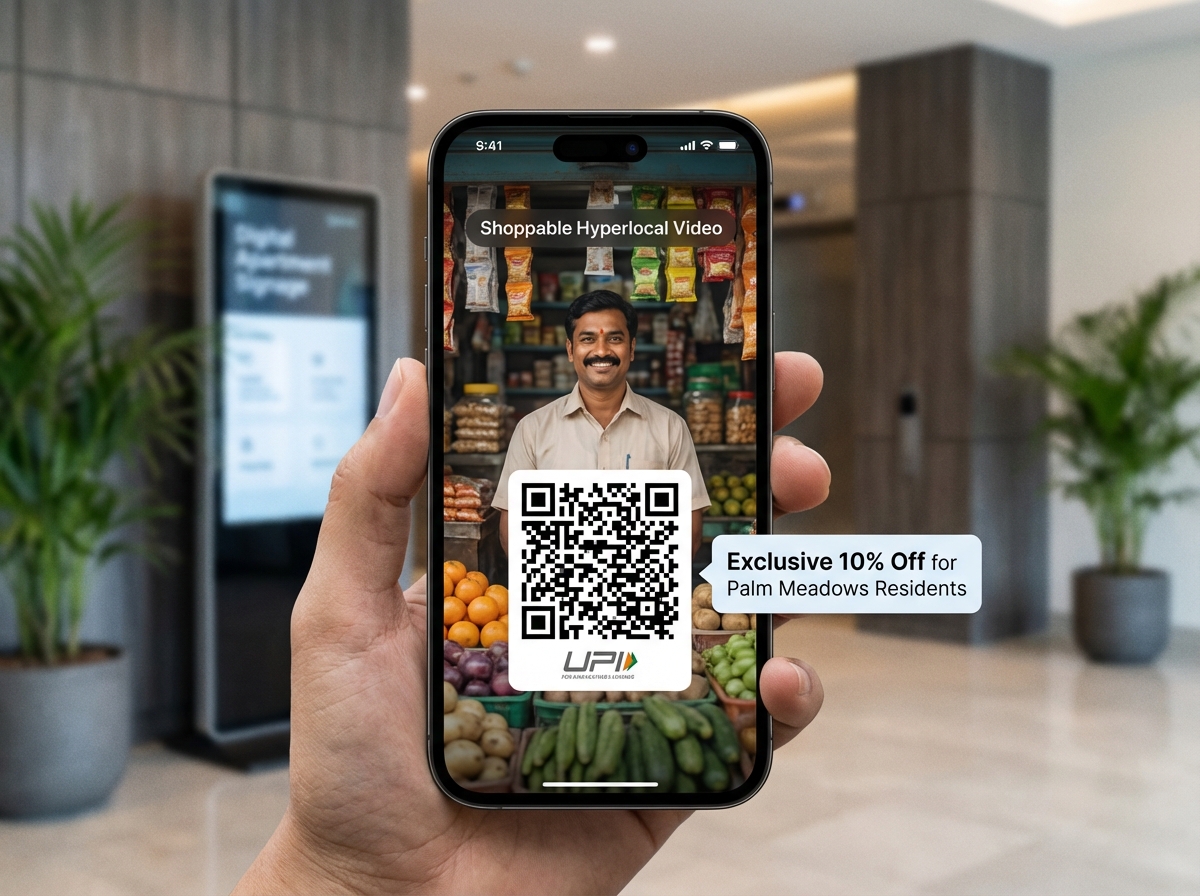
The final mile of community-driven commerce India is the integration of local merchants—the neighborhood kirana, the nearby pharmacy, or the local salon. Local merchant partnership videos use co-branded storytelling to bridge the gap between digital discovery and physical fulfillment. These videos often follow a “Shop Local, Save Local” narrative, featuring recognizable landmarks of the colony, a greeting from the merchant, and a society-exclusive UPI offer.
The behavior of the 2026 consumer is “UPI-first.” Shoppable video ads now feature embedded QR codes or direct UPI-linked CTAs that allow for a frictionless checkout experience. Whether the resident is watching a Reel-style video on their phone or a loop on the elevator screen, the path to purchase is immediate. This synergy between the brand, the local merchant, and the resident creates a sustainable ecosystem where everyone benefits from the localized commerce loop.
To scale these colony-specific marketing campaigns, enterprises use automated feed-based varianting. This allows a central marketing team to produce one master campaign that automatically generates thousands of versions, each featuring the correct local merchant's details and specific inventory based on the society's preferences. This level of automation ensures that even the smallest local partner can benefit from enterprise-grade video marketing.
Source: TrueFan AI Shoppable Video Ads
Source: Inc42 Ecommerce Trends 2026
7. Micro-Market Personalization Strategies: Measurement, Governance, and the 2026 Roadmap
Scaling hyperlocal community commerce videos 2026 to over 50,000 societies requires a sophisticated operational blueprint. Micro-market personalization strategies must be built on a hierarchy that moves from city zones to specific colonies, then to societies, and finally to tower-level household propensities. This allows for affluence-led variants and lifestyle clusters—such as fitness enthusiasts or pet owners—to receive content that is uniquely relevant to their daily lives.
Solutions like TrueFan AI demonstrate ROI through comprehensive measurement dashboards that track KPIs such as 3-second watch rates, UPI redemption numbers, and footfall lift at partner merchants. By using geo-split tests across similar societies, brands can accurately measure the incremental lift generated by personalized video versus generic creative. This data-driven approach allows for continuous optimization, ensuring that marketing spend is allocated to the highest-performing micro-markets.
The roadmap for 2026 execution follows a pilot-to-scale trajectory. Phase 0 involves discovery and data mapping across a small selection of societies to define the feed schema. Phase 1 focuses on producing master templates and launching initial variants. By Phase 2, the program expands to hundreds of societies with integrated merchant partnerships. Finally, Phase 3 sees the full automation of feed-based varianting, rolling out to over 10,000 societies and establishing a permanent neighborhood loyalty ecosystem.
Source: TrueFan AI Case Studies
Source: India Digital Advertising Trends
Frequently Asked Questions
How do RWA partnership marketing campaigns work and what permissions are needed?
RWA partnership marketing campaigns require formal approval from the Resident Welfare Association's elected board. Brands must submit a proposal detailing the campaign's duration, the channels used (lobby screens, app notifications, on-ground kiosks), and a safety/compliance plan. Often, a community benefit component, such as a contribution to society funds or exclusive resident discounts, is required to secure permission.
What are effective micro-market personalization strategies for Indian metros?
Effective strategies involve segmenting audiences by lifestyle clusters within a society. For example, target towers with larger configurations (3BHK/4BHK) with premium luxury offers, while using amenity-based triggers—such as sending a health-drink ad to residents who frequently use the society gym. Language localization into the regional tongue (e.g., Kannada in Bangalore, Marathi in Mumbai) is also a core strategy.
How to measure community-driven commerce outcomes from videos?
Measurement is achieved through unique UPI transaction IDs and society-specific QR codes. By tracking the redemption of these codes at local partner merchants or through the brand's D2C site, marketers can calculate the exact conversion rate and ROI for each specific society. Advanced dashboards also track view-through rates on lobby screens and engagement metrics on society apps.
Can TrueFan AI help in scaling these localized video campaigns?
Yes, TrueFan AI is designed for this level of scale. Using an API-driven personalization engine, a brand can take a single video shoot and automatically generate thousands of versions, each customized with different society names, local merchant details, and personalized celebrity greetings in over 175 languages.
What is the typical timeline for a hyperlocal society rollout?
A pilot program typically takes 4–6 weeks to set up, including RWA permissions and template creation. Scaling to a city-wide level (500+ societies) usually occurs over a 3-month period, while a national rollout to 10,000+ societies is a 12-month initiative involving automated data feeds and localized influencer pods.