
Shoppable Video Ads Instagram Reels India 2026: A Complete Guide for D2C and E‑commerce Teams
Estimated reading time: 10 minutes
Key Takeaways
- Reels and Shorts-led shoppable video experiences now drive primary acquisition for Indian D2C brands.
- Optimize for UPI-first checkout, timed overlays, and deep links to reduce friction and boost conversions.
- Regional language localization and Hinglish hooks significantly lift engagement and CVR in 2026.
- AI-driven creative automation via Studio by TrueFan AI enables rapid scaling across SKUs and languages.
- Measure beyond last click with Tag-Tap, PCV, VTC, and creative-level RTO to model true ROI.
Shoppable video ads Instagram Reels India 2026 have officially become the cornerstone of digital retail, transforming how the “Bharat” shopper discovers and purchases products. As we navigate 2026, the convergence of high-speed 5G penetration, the ubiquity of UPI, and a cultural shift toward video-first discovery has made interactive video commerce no longer optional for D2C brands. In this landscape, turning a 15-second Reel into an instant storefront is the ultimate competitive advantage for performance marketers and e-commerce heads.
The Indian social commerce market is currently on an explosive trajectory, projected to reach $60–70 billion by 2030 (approximately ₹5–7 trillion). This growth is fundamentally driven by short-form video discovery and seller-led commerce that resonates with both urban and Tier-2+ audiences. According to recent 2026 data, over 82% of Indian D2C brands now prioritize short-form video as their primary acquisition channel, with UPI transactions within social commerce platforms growing by 45% year-over-year.
Why do Reels dominate the 2026 landscape? Data from MediaPost and Sensor Tower indicates that the vast majority of Instagram ad spend is now concentrated on Reels, which generate significantly higher engagement rates compared to static image ads. For the Indian market, where “see it, like it, buy it” is the prevailing consumer behavior, shoppable video ads provide the frictionless path to purchase that modern shoppers demand.
1. Instagram Shopping Video Ads Guide: Setup and 2026 Reality in India
Implementing shoppable video ads requires a strategic understanding of the Instagram Shopping ecosystem. In 2026, while native in-app checkout remains selectively available in India, the standard high-conversion flow involves product tags that lead to an in-app Product Detail Page (PDP), followed by a deep link to a mobile-optimized checkout with UPI-first options.
The Step-by-Step Setup
To launch successful Instagram Shopping video ads, D2C teams must follow a rigorous technical and creative workflow:
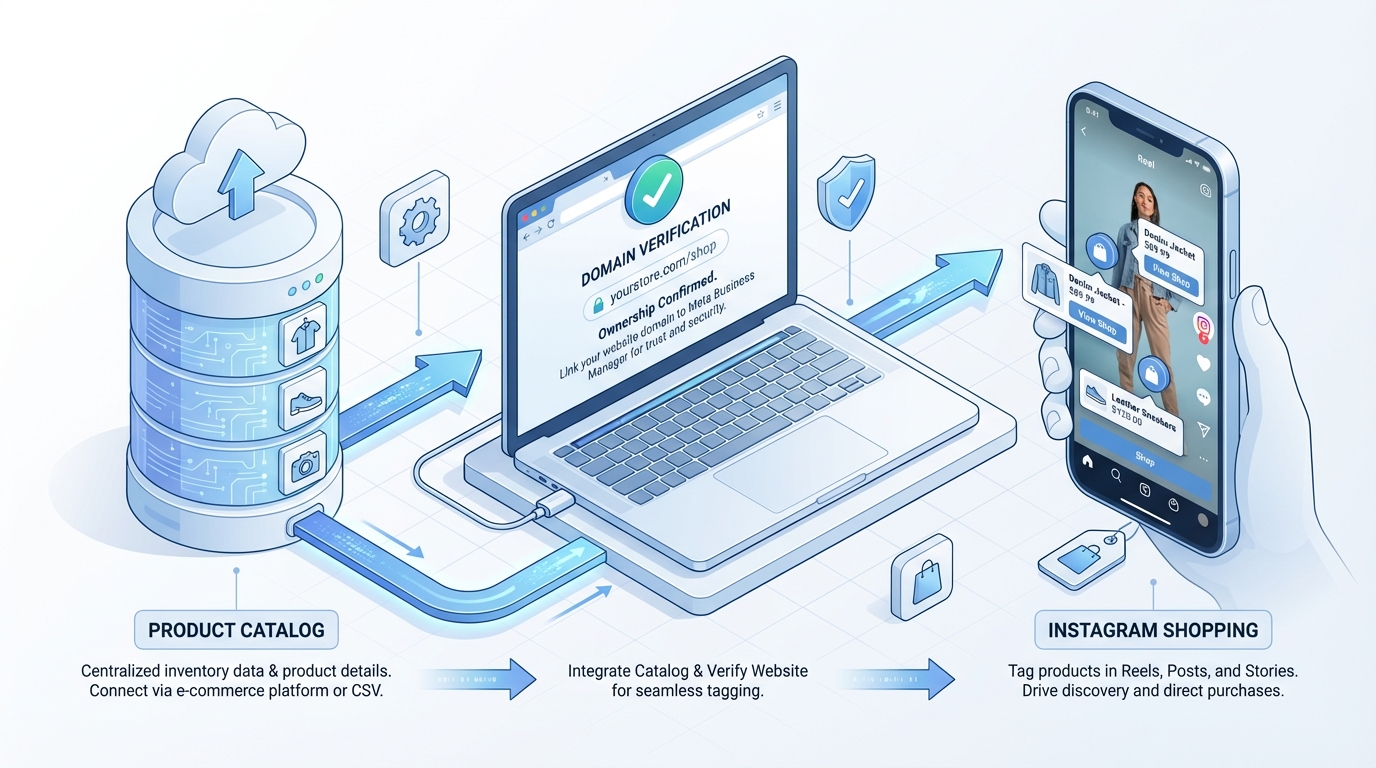
- Catalog Synchronization: Ensure your product catalog in Meta Commerce Manager is fully synced with real-time inventory. In 2026, accuracy is paramount; 64% of Indian shoppers abandon brands if a tagged product is out of stock upon clicking.
- Domain Verification & Approval: Your website domain must be verified within Business Manager to enable product tagging. Once approved, connect your catalog to your professional Instagram account.
- Tagging in Reels: When uploading a 9:16 creative, use the “Tag Products” feature. While you can tag up to 30 SKUs, the 2026 best practice is to limit visible tags to 1–3 per Reel to avoid cluttering the mobile UI.
- Strategic Placement: Place tags away from “safe zones”—avoiding the bottom area where captions sit and the right side where engagement icons (Like, Share) reside. Use timed tag reveals that appear exactly when the product is demonstrated in the video.
Creative Requirements for the Indian Market
The 2026 Indian consumer has a low tolerance for generic content. Success requires a 2-second hook that addresses a specific pain point or aspiration. Incorporating “Hinglish” or regional language subtitles is no longer a niche tactic; it is a necessity for trust. Platforms like Studio by TrueFan AI enable brands to generate these localized video variants at scale, ensuring that a single campaign can resonate across different linguistic demographics in India.
Source: YourStory on India’s social commerce potential.
Source: MediaPost on Reels ad dominance.
2. YouTube Shorts Shopping: Product Tagging and Merchant Integrations
While Instagram dominates the lifestyle and fashion segments, YouTube Shorts has emerged in 2026 as a powerhouse for “search-led” social commerce and tech-heavy D2C categories. YouTube Shopping allows brands to link their merchant feeds (via Shopify or Google Merchant Center) to tag products directly within Shorts.
The YouTube Product Tagging Workflow
For D2C teams, the process of enabling YouTube Shorts shoppable product tags involves:
- Merchant Program Connection: Linking your e-commerce store to the YouTube Studio Shopping tab.
- Tagging and Pinning: During the upload process of a Short (15–60 seconds), marketers can select specific products from their catalog. A “pinned” product remains visible as a persistent overlay, while other tagged items appear in the “View Products” drawer.
- Timestamps for Multi-Product Videos: For “Top 5” or “Haul” style Shorts, using timestamps allows the product tag to update dynamically as the creator moves from one item to the next.
Repurposing Strategy
In 2026, the most efficient D2C teams do not create separate content for each platform. Instead, they use a unified short-form strategy. However, platform-native elements are crucial. A Reel repurposed for Shorts should have its text overlays and music adjusted to fit YouTube’s unique UI and copyright libraries. Studio by TrueFan AI’s 175+ language support and AI avatars allow brands to take a core product demo and instantly create 9:16 variants optimized for both Instagram’s aesthetic and YouTube’s information-dense environment.
Source: YouTube Blog on Shopping features.
Source: SellersCommerce on video marketing usage.
3. In-Video Checkout CTA Tools and Video Commerce Conversion Optimization India
The “leaky bucket” in social commerce is often the transition from the video to the checkout. In India, where network speeds can fluctuate and trust is a major factor, optimizing the in-video checkout CTA tools India is critical for maintaining momentum.
Clickable Video Ad Layers and Deep Linking
Beyond native tags, 2026’s top-performing brands use layered interactive elements:
- Timed Overlays: Motion graphics that appear at the 3s, 7s, and 12s marks, pointing directly to the “Shop Now” button.
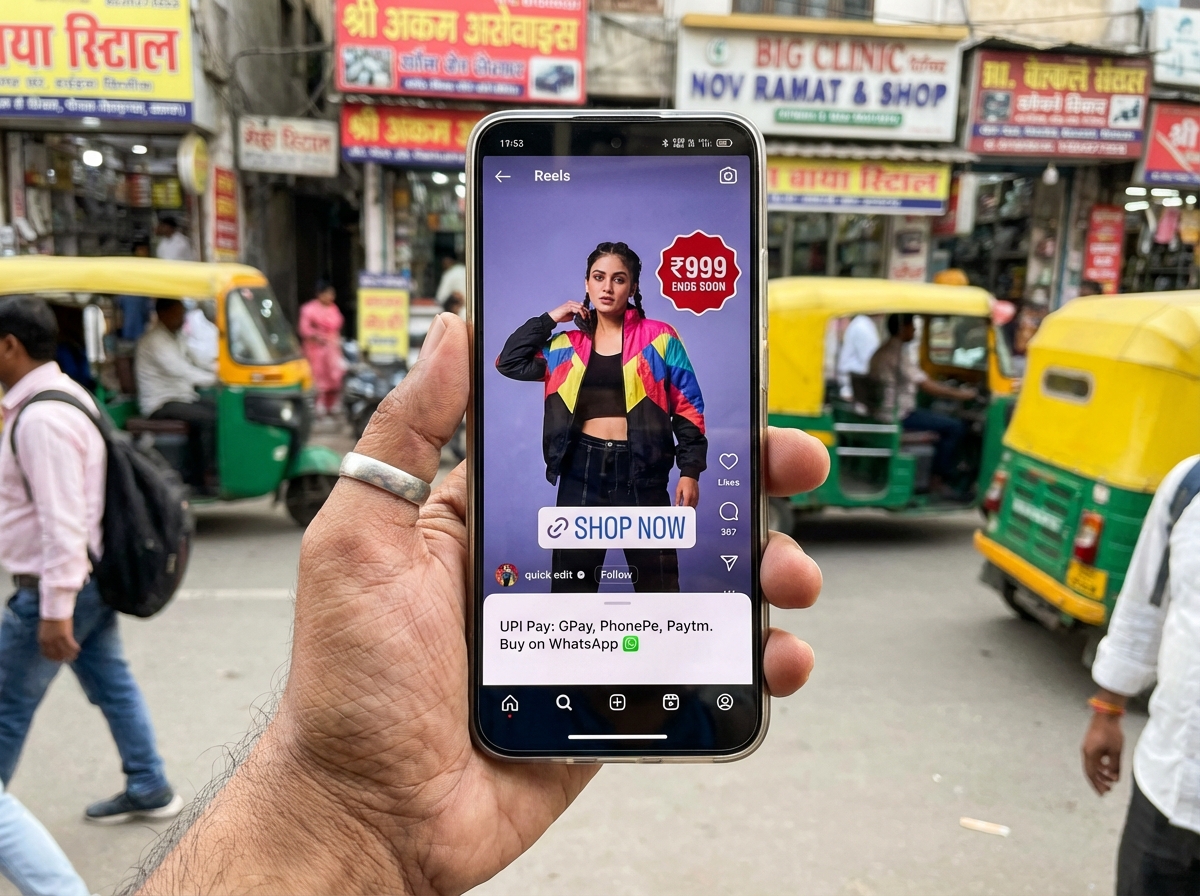
- UPI-Intent Deep Links: Instead of a standard web URL, use links that trigger the user's preferred UPI app (GPay, PhonePe, Paytm) directly. This reduces the checkout steps from five to two.
- WhatsApp for COD: For the 60% of Indian shoppers who still prefer Cash on Delivery (COD), providing a “Buy via WhatsApp” CTA allows for automated bot-led order confirmation, which significantly reduces RTO (Return to Origin) rates.
The CRO Playbook for 2026
- Speed to Checkout: Ensure your PDP loads in under 2 seconds on a 4G connection. Use prefetching techniques so that when a user taps a product tag, the page is already partially loaded in the background.
- Social Proof Overlays: Include small, non-intrusive badges showing “4.8/5 Rating” or “10k+ Sold this month” within the video creative itself.
- Regional Language Hooks: 2026 data shows that Reels ads in regional languages like Tamil or Telugu see a 2.4x higher conversion rate than English-only ads in those specific clusters.
- Price Transparency: Always display the price (and any active discount) clearly in the video. Indian shoppers are value-conscious; hiding the price until the PDP click often leads to high bounce rates.
Source: TrueFan AI 2026 Guide on Interactive Commerce.
Source: IBEF on India E-commerce Growth.
4. Measurement and Modeling Shoppable Video ROI India Ecommerce
In 2026, the traditional “Last Click” attribution model is obsolete for social commerce. Shoppable video ads Instagram Reels India 2026 require a holistic measurement framework that accounts for both direct conversions and view-through influence.
The KPI Funnel for Shoppable Video
Marketers must track the following metrics to understand the true health of their campaigns:
- Tag-Tap Rate: The percentage of viewers who interact with a product tag. A benchmark of 2–4% is considered healthy in 2026.
- Product Card View (PCV): The bridge between the video and the website.
- View-Through Conversions (VTC): Shoppers who watched the Reel, didn't click immediately, but purchased within 7 days.
- RTO % per Creative: Tracking which video styles lead to higher returns (often due to misleading product representation).
ROI Modeling and Attribution
Solutions like Studio by TrueFan AI demonstrate ROI through their ability to rapidly iterate on creative variants. By testing different “hooks” and “CTAs” across hundreds of AI-generated video versions, brands can identify the exact combination that lowers Customer Acquisition Cost (CAC). For example, a beauty D2C brand might find that a “Hinglish” tutorial hook performs 30% better in North India than a standard English product demo.
An effective ROI model for 2026 should include:
ROI = [(Total Revenue from Clicks + VTC Revenue) - (Ad Spend + Production Cost)] / (Ad Spend + Production Cost)
By using AI automation to reduce production costs, the denominator decreases, significantly boosting the overall ROAS (Return on Ad Spend).
Source: ElectroIQ on Instagram Ad Benchmarks.
Source: AffiverseMedia on Instagram Ad Revenue.
5. 2026 Social Playbook: Scaling with AI and Regional Localization
Scaling shoppable video ads across a diverse market like India requires more than just a large budget; it requires an “always-on” content engine. In 2026, the editorial calendar is no longer monthly—it is daily.
The Multi-Format Mix
A winning 2026 social commerce strategy utilizes a specific ratio of content:
- 60% Shoppable Reels: High-energy, trend-driven videos with direct product tags.
- 20% Tagged Shorts: Educational or “unboxing” style content focusing on utility.
- 20% Interactive Stories: Using product stickers, “This or That” polls, and countdown timers for limited-time drops.
The Role of AI in Enterprise Scaling
For enterprise-level D2C brands, manually filming 50 different Reels for 50 different SKUs in 10 different languages is logistically impossible. This is where AI-driven creative automation becomes the differentiator. By importing a product feed into a browser-based studio, brands can auto-generate video variants where real influencers' digital twins deliver personalized messages. This allows for hyper-localization—where a shopper in Chennai sees a Tamil-speaking avatar while a shopper in Lucknow sees a Hindi-speaking one—all generated from the same base script.
Compliance and Operational Guardrails
Operating in the Indian e-commerce space in 2026 also means adhering to strict consumer protection guidelines. Brands must ensure:
- GST-Inclusive Pricing: Prices shown in videos must match the final checkout price.
- Clear Return Policies: Especially for COD orders, the return window must be clearly stated in the caption or a pinned comment.
- Influencer Disclosures: Any AI-generated or creator-led content must carry the “Paid Partnership” or “AD” label to remain compliant with ASCI (Advertising Standards Council of India) guidelines.
Source: Inc42 on Social Commerce Growth.
Source: AffiliateBooster on Reels Engagement.
6. Case Snapshots: Success Patterns in the 2026 Indian Market
To understand the practical application of these strategies, let's look at how different sectors are winning with shoppable video ads Instagram Reels India 2026.
Beauty and Personal Care: The “Tutorial-to-Cart” Flow
A leading Indian skincare brand shifted from high-production celebrity ads to a “volume-first” strategy using AI avatars. By generating 200+ micro-tutorials showing the product being used on different skin tones and addressing regional concerns (e.g., “humidity-proof” for Mumbai vs “intense hydration” for Delhi winters), they saw a 40% increase in tag-tap rates. The key was the 6-second CTA—moving the “Shop Now” prompt from the end of the video to the middle.
Fashion: The “Mix & Match” Reels
Fashion brands are utilizing the “Collections” feature in Instagram Shopping. Instead of tagging a single dress, they tag the entire “look”—shoes, accessories, and apparel. In 2026, interactive product videos social media that allow users to “swipe through” a carousel of tagged items within a single Reel have shown a 15% higher Average Order Value (AOV).
Electronics: The “Feature-First” Shorts
For high-consideration purchases like electronics, YouTube Shorts has proven superior. Brands use pinned products and timestamps to highlight specific technical specs. A smartphone brand recently achieved a 9% higher CTR by using Hinglish subtitles and a “Buy with UPI” overlay that appeared during the battery-life demonstration.
Home Decor: Repurposing Live Sessions
Since the discontinuation of native Live Shopping, clever brands now run “Live Product Reveals” and immediately clip the best 30-second segments into shoppable Reels. These “highlights” carry the energy of a live event but the permanence and shoppability of a Reel, resulting in a 25% longer shelf-life for their live content.
Conclusion
As we look toward the remainder of 2026, the brands that win will be those that treat shoppable video not as a sub-tactic, but as their primary storefront. By combining the reach of Instagram Reels and YouTube Shorts with the efficiency of AI-driven localization and the friction-free nature of UPI, D2C teams can build a social commerce engine that is truly future-proof. The era of “passive” video is over; the era of the “clickable, shoppable, and personalized” video has arrived.
Frequently Asked Questions
How do clickable video ads help D2C brands achieve scale on Reels without a massive production team?
Scale is achieved through creative automation. By using tools like Studio by TrueFan AI, brands can generate hundreds of video variants from a single script, localizing them into regional languages and testing different product tags. This “AI-first” approach allows for high-volume testing which is essential for finding winning creatives in the 2026 algorithm.
What are the best in-video checkout CTA tools for Instagram in India?
The most effective setup is a combination of native Instagram product tags and custom timed overlays. For the Indian market, ensure your overlays include “UPI Available” or “COD Available” messaging. Using deep-link generators that open GPay or PhonePe directly from the in-app browser is the current gold standard for reducing friction.
How can I run YouTube product tagging videos for Shorts effectively?
First, connect your Google Merchant Center to your YouTube channel. When uploading a Short, use the “Products” section in YouTube Studio to tag up to 30 items. Crucially, pin the hero product so it stays visible throughout the video, and use timestamps when showcasing multiple items to ensure tags update in real-time. Learn more about YouTube Shorts automation.
Any tips to optimize interactive product videos on social media for conversion?
Focus on the first 2 seconds—the hook must be visual and immediate. Use price badges as soon as the product appears, and ensure your regional language captions (Hinglish, Tamil, etc.) are large enough to read on small screens. Finally, always include a reassurance element like a “7-Day Easy Return” badge near the CTA.
Is live shopping via Instagram still relevant in India in 2026?
While the native “Live Shopping” tab was discontinued, the strategy has evolved. Brands now host “Live Q&A” sessions, use pinned comments with discount codes, and then immediately repurpose those sessions into shoppable Reels with product tags. This hybrid approach actually yields better ROI as it combines the urgency of Live with the reach of the Reels algorithm. Explore real-time interactive AI avatars to enhance these experiences.
How should I handle Cash on Delivery (COD) in shoppable videos?
COD is a reality of the Indian market. In your video overlays or captions, explicitly mention “COD Available.” To prevent high RTO rates, many brands now use a “Click to WhatsApp” CTA for COD orders, where a bot confirms the address and intent before the order is processed.



