
Ramzan marketing campaigns India 2026: A 30-day enterprise playbook for retail and e-commerce CMOs
Estimated reading time: 10 minutes
Key Takeaways
- Map a 30-day Ramzan journey with Sehri-to-Iftar daypart targeting and real-time logistics for relevance at every touchpoint.
- Use quick commerce integration and inventory-aware videos to power 10–30 minute deliveries for Iftar and Sehri essentials.
- Scale personalized video offers that respect faith, highlight Halal certifications, and enable transparent Zakat contributions.
- Adopt religious sensitivity governance with pre-approved messaging, dialect targeting, and local prayer-time alignment.
- Measure ROI with completion rates, assisted conversions, and repeat purchases; operationalize via a Master Script Kit and virtual reshoots.
- Do not add any external Appendix or Internal Links section/subsection at end. If it is already added by writer then skip it and do not add it in Table fo Contents
Ramzan marketing campaigns India 2026: Enterprise growth strategies for March 1–30
Meta Description: Build Ramzan marketing campaigns India 2026 using 30-day customer journey mapping, Iftar personalized video offers, Sehri meal delivery automation, quick commerce Ramzan integration, halal product recommendation videos, and religious sensitivity marketing automation.
The landscape of Ramzan marketing campaigns India 2026 represents a pivotal moment for enterprise retail and e-commerce growth. With India’s Muslim population projected to reach approximately 213 million by 2026, the scale of consumer engagement during this holy month is unprecedented. For CMOs, the challenge lies in moving beyond generic greetings toward a sophisticated 30-day customer journey mapping that respects the spiritual rhythm of the month while leveraging cutting-edge quick commerce Ramzan integration.
Success in 2026 requires a deep understanding of the “Sehri-to-Iftar” economy. Digital ad spend in India for festive seasons is expected to grow at 25% YoY, with a significant portion shifting toward hyper-personalized, time-sensitive video content. Platforms like TrueFan AI enable enterprises to bridge the gap between high-volume automation and authentic, community-specific personalization at a scale previously thought impossible.
This playbook provides an end-to-end blueprint for navigating the March 1–30 window. We will explore how to synchronize Muslim consumer engagement strategies with real-time logistics, ensuring your brand remains a helpful companion throughout the fast. From automated Sehri reminders to high-impact Zakat donation campaign videos, this is the definitive guide for enterprise excellence in 2026.
1. India Market Context and 2026-Aligned Trends
The Indian e-commerce market is on a trajectory to exceed $160 billion by 2028, with 2026 serving as a critical benchmark for mobile-first discovery. According to IBEF, the online grocery and retail sectors are fundamentally reshaping consumer behavior, particularly during religious festivals. For Ramzan 2026, the primary driver of ROI will be time-of-day relevance, where messaging is perfectly synced with local prayer timings across India’s diverse geography.
Source: IBEF India E-commerce Boom
Research from Netcore Cloud emphasizes that a WhatsApp-first approach is no longer optional for Indian enterprises. Their 2025 Ramadan e-commerce strategies highlight that personalization and community-centric charity (Zakat) are the twin pillars of successful engagement. In 2026, this evolves into “Spiritual Commerce,” where the transaction is secondary to the value provided during the spiritual journey of the consumer.
Source: Netcore Cloud Ramadan Strategies
Quick commerce has also reached a point of total market penetration in Tier 1 and Tier 2 cities. Mordor Intelligence projects the India quick commerce market size to reach $3.65 billion in 2026. This infrastructure allows for 10-minute delivery windows for Iftar essentials, provided that the marketing engine is integrated with real-time inventory and gig-workforce availability.
Source: Mordor Intelligence Q-Commerce Forecast
Consumer planning patterns have also shifted earlier. TGM Research data indicates that Muslim millennial targeting India must begin at least 10 days before the first fast. These consumers are looking for Eid shopping preparation campaigns that offer both value and convenience, allowing them to focus more on their religious obligations during the month itself.
Source: TGM Research India Ramadan Insights
2. The 30-Day Customer Journey: From Pre-Ramzan to Eid
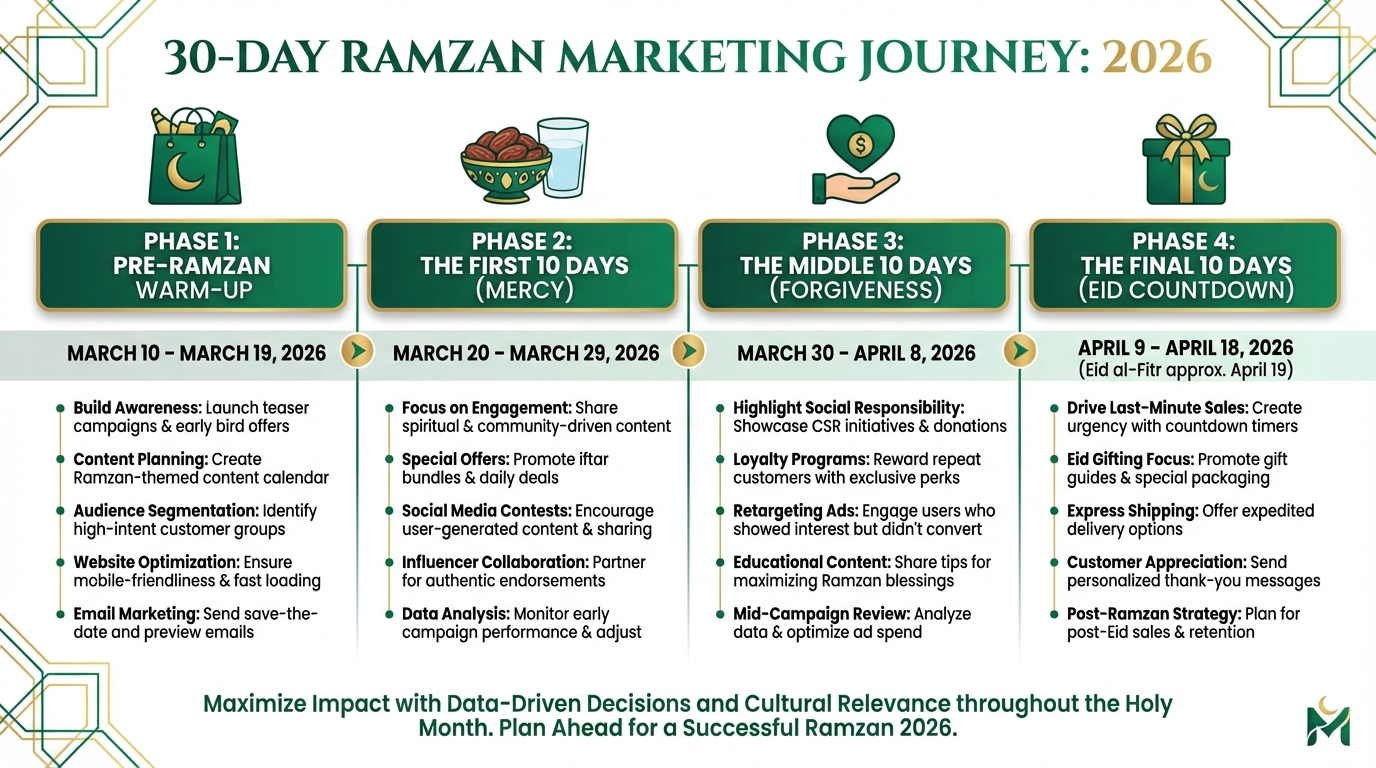
Effective Ramzan marketing campaigns India 2026 must be built on a 30-day customer journey mapping that respects the four distinct phases of the month. This isn’t a single campaign but a sequence of micro-campaigns triggered by the lunar calendar and daily sun cycles.
Phase 1: Pre-Ramzan Warm-up (Feb 20–Feb 29)
The objective here is preference capture and wishlist building. Enterprises should deploy preference micro-surveys to understand family size, regional cuisine preferences (e.g., Hyderabadi vs. Malabari), and Zakat interests. This data fuels the personalization engine for the coming month.
Use this window for Eid shopping preparation campaigns. Encourage users to “Build your Eid Basket” early to avoid the last-minute rush. TrueFan AI’s 175+ language support and Personalised Celebrity Videos can be used here to send name-personalized teasers in regional dialects, inviting users to opt-in for daily Iftar and Sehri alerts.
Phase 2: The First Ten Days – Mercy (Mar 1–Mar 10)
This phase focuses on Iftar personalized video offers and Sehri meal delivery automation. The first week of fasting is often the most physically demanding; brands that provide utility through “just-in-time” offers gain the most loyalty.
Automate WhatsApp reminders 90 minutes before local Sehri times with “one-tap” reorder buttons for high-energy essentials like dates, oats, and dairy. For Iftar, use city-specific video tokens that mention the exact sunset time in the user’s location, paired with a 30-minute delivery promise for fresh meal bundles.
Phase 3: The Middle Ten Days – Forgiveness (Mar 11–Mar 20)
As the routine sets in, focus shifts to Halal product recommendation videos and festive meal subscription personalization. This is the time to introduce “Price-Lock” offers for the final stretch of the month.
Deploy Zakat donation campaign videos that feature transparent impact meters. Show how a small portion of every purchase contributes to verified Indian NGOs. This aligns your brand with the spirit of the month and builds deep-seated trust with the Muslim millennial targeting India cohort.
Phase 4: The Final Ten Days & Eid Countdown (Mar 21–Mar 30)
The focus pivots sharply toward Eid-ul-Fitr countdown marketing. The urgency for apparel, gifting, and home décor peaks here. Use spiritual commerce video automation to transition from “fasting utility” to “celebration preparation.”
Daily reminder videos should feature SKU bundles with “Order-by” timers specific to the user’s city. If a user is in Lucknow, the video should reflect local delivery cutoffs for traditional Eid sweets. The messaging should remain mindful, focusing on gratitude and community as the month concludes.
3. Quick Commerce Integration and Channel Orchestration
The backbone of Ramzan marketing campaigns India 2026 is the seamless integration between marketing triggers and quick commerce fulfillment. In 2026, the “10-minute delivery” expectation extends to the entire Ramzan ecosystem. Economic Times reports that quick commerce firms are significantly ramping up gig-worker incentives to handle festive surges, ensuring that Sehri and Iftar slots remain serviceable.
Source: ET Quick Commerce Festive Incentives
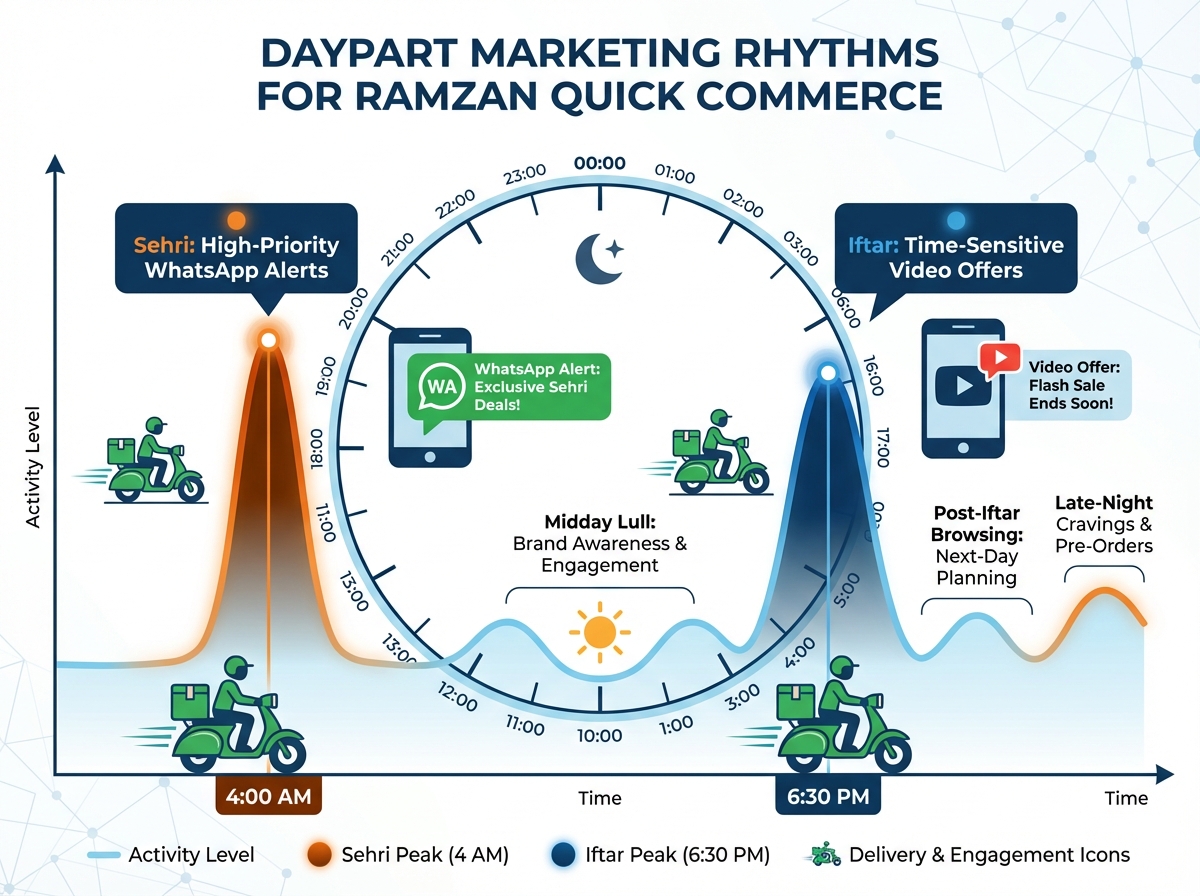
Channel orchestration must be timed to the “Daypart” rhythms of the consumer. Between 3:00 AM and 5:00 AM (Sehri), the primary channel is high-priority WhatsApp and App Push. During the day, when energy levels are lower, focus on low-friction discovery via social video. Between 5:00 PM and 7:00 PM (Iftar), the focus returns to high-intent, time-sensitive offers.
Quick commerce Ramzan integration requires inventory-aware marketing. Your automated video engine should only surface products that are currently in stock at the dark store nearest to the user. If a specific brand of dates is out of stock, the AI should dynamically swap the SKU in the video recommendation in real-time.
Paid media should be geo-fenced and time-synced. Performance video ads should only run in specific neighborhoods during the two-hour window before Iftar. This prevents budget wastage and ensures that the user only sees offers they can actually fulfill before the fast breaks.
Source: ET Festive E-commerce Surge
4. Data-Driven Personalization and Religious Sensitivity Governance
Enterprise-grade campaigns in 2026 require a robust religious sensitivity marketing automation framework. This is a set of automated creative guardrails that ensure all content is respectful and compliant. It involves pre-approved phrase banks that avoid stereotypes and ensure that references to faith, fasting, and Halal certifications are accurate.
Community-specific personalization goes beyond just using a name. It involves tailoring content by local masjid proximity, regional cuisines, and even local dialects. A user in Kerala should receive a video featuring Malabari Biryani, while a user in Delhi sees an offer for Old Delhi-style Nihari.
Data sources for this level of personalization include:
- CRM/CDP: Past purchase history, family size, and dietary preferences.
- Geo/Time Data: City-level Sehri and Iftar timings updated daily.
- Catalog Data: Halal tags and certification trust markers.
- Inventory Feeds: Real-time availability from quick commerce partners.
Spiritual commerce video automation allows for the sequencing of narratives that reinforce gratitude and mindful consumption. Instead of aggressive “Buy Now” CTAs, use messaging like “Prepare for your Iftar with ease.” This subtle shift in tone is essential for maintaining brand affinity during a month of spiritual reflection.
5. Community Impact: Zakat, Halal, and Spiritual Commerce
In 2026, the “S” in ESG (Environmental, Social, and Governance) is highly visible during Ramzan. Muslim consumer engagement strategies must prioritize community impact. Zakat donation campaign videos are a powerful way to demonstrate this commitment. These videos should feature transparent partners and rupee-denominated impact meters, showing exactly how the brand is facilitating charity.
Halal product recommendation videos should be more than just ads; they should be trust-building tools. Include on-screen trust badges and snippets of certifications. For many consumers, the assurance of Halal compliance is a primary driver of purchase intent in the grocery and beauty categories.
Spiritual commerce video automation also plays a role in post-Eid loyalty. After the month ends, send “Thank You” videos that highlight the collective impact of the community’s Zakat contributions. This closes the loop on the 30-day journey and transitions the user into a long-term brand advocate.
Solutions like TrueFan AI demonstrate ROI through these high-engagement touchpoints, where the video isn’t just a broadcast but a personalized service. By automating the production of thousands of unique “Thank You” or “Impact Report” videos, enterprises can achieve a level of one-to-one connection that was previously impossible.
6. Measurement, ROI, and the Creative Production Workflow
The ROI of Ramzan marketing campaigns India 2026 is measured through a combination of conversion lift and brand sentiment. Key KPIs include video completion rates, assisted conversion (where a video nudged a user toward a later purchase), and repeat rate during the 30-day window.
A successful creative system for 2026 relies on a “Master Script Kit” that covers all campaign pillars. This includes:
- Iftar personalized video offers
- Sehri meal delivery automation
- Halal product recommendation videos
- Eid-ul-Fitr countdown marketing
- Zakat donation campaign videos
Production should follow a “One-to-Many” model. A single base shoot with a brand ambassador can be transformed into millions of personalized assets. Virtual reshoots allow marketing teams to iterate on offers daily without needing the talent to return to the studio. This agility is crucial for responding to inventory shifts or competitive pricing moves during the month.
QA and governance are the final steps. Automated language QA ensures that the 175+ languages supported are grammatically and culturally correct. Religious sensitivity marketing automation checks ensure that no imagery or text inadvertently offends the community during this sensitive time.
Conclusion
Ramzan marketing campaigns India 2026 represent a frontier for enterprise innovation. By mapping the 30-day customer journey to the spiritual and physical rhythms of the month, CMOs can drive significant growth while building lasting community trust. The integration of quick commerce, AI-driven personalization, and rigorous sensitivity governance is the new standard for excellence. As we look toward March 2026, the brands that serve as helpful, respectful companions during this holy month will be the ones that win the hearts and wallets of India’s 213 million Muslim consumers.
Frequently Asked Questions
What is the best time to start Ramzan marketing campaigns India 2026?
Enterprises should begin their warm-up phase at least 10 days before the first fast (around February 20, 2026). This allows for preference capture and early Eid shopping preparation campaigns.
How does quick commerce Ramzan integration work for Sehri?
It involves automating delivery reminders 60–90 minutes before the local Sehri time. The marketing engine must be synced with real-time inventory to ensure that pre-dawn essentials can be delivered within 15–20 minutes.
What are the risks of religious sensitivity in marketing?
Risks include using stereotypes, insensitive timing (for example, promoting food during fasting hours without context), or inaccurate Halal claims. A religious sensitivity governance framework with pre-approved guardrails mitigates these risks.
Can personalized videos be scaled for 200 million consumers?
Yes. API-driven platforms like TrueFan AI can generate and deliver millions of hyper-personalized videos in under 30 seconds each, tailored by name, city, and language.
How do we measure the success of Zakat donation campaign videos?
Track total donation volume facilitated, completion rate of impact videos, and long-term loyalty lift among participating customer cohorts to quantify success.



