Climate adaptive marketing 2026: India’s enterprise playbook for temperature-triggered personalization, health-first growth, and climate resilience
Estimated reading time: ~11 minutes
Key Takeaways
- Climate-adaptive marketing turns real-time heat, AQI, UV, and rainfall data into context-aware campaigns that drive revenue and protect wellbeing.
- Weather-triggered automation and regional targeting enable hyperlocal personalization at PIN-code granularity across India.
- A health-first governance layer aligns messaging with NDMA/NCDC guidance, prioritizing safety over promotions during severe events.
- Resilience products (UPF apparel, inverter ACs, water-saving fixtures) and energy efficiency storytelling shift consumers toward long-term value.
- Measure success with conversion lift per +1°C, AQI-day ROAS, attach rates for resilience SKUs, and opt-ins for hydration reminders.
In the high-stakes landscape of Indian retail, climate adaptive marketing 2026 enterprise playbook has emerged as the definitive enterprise discipline for turning hyperlocal environmental signals into revenue-driving campaigns. This strategic approach moves beyond simple seasonal planning, instead utilizing real-time heat index, air quality, and UV data to power weather prediction commerce. By integrating regional weather targeting with automated decisioning, brands can now deliver heat wave product personalization that respects consumer health while maximizing conversion.
The core promise of this playbook is to leverage weather-triggered offer automation to navigate the complexities of India’s 2026 climate reality. With more frequent heat waves, escalating water stress, and volatile air quality spikes, Indian retailers must transition to a data-driven engagement model. This framework ensures that every interaction—from a push notification in a sweltering Pune afternoon to a localized video in a humid Chennai evening—is contextually relevant and ethically grounded.
Why now: The 2026 signals every Indian CMO must act on
The urgency for climate adaptive marketing 2026 is driven by a convergence of technological maturity and environmental necessity. India-focused adaptation technologies, including advanced IoT sensors and AI-driven analytics, have reached a point of enterprise-grade reliability. This allows marketers to tap into the same precision data used for infrastructure planning to drive consumer engagement. According to PwC India, adaptation technologies are now essential for business resilience, providing the granular data needed for precision targeting.
Furthermore, the 2026 economic landscape is heavily influenced by climate policy. India’s 2026 budget debates have emphasized the need to accelerate the climate transition, particularly regarding water stress and energy reliability. This shift in policy mirrors a shift in consumer sentiment, where sustainable cooling solutions and climate resilience products are no longer niche interests but mainstream requirements. Brands that fail to align their marketing with these realities risk losing relevance in a market increasingly sensitive to environmental impact.
Sustainability trends for 2026 indicate that adaptation and AI-enabled energy management have moved from CSR departments to the core of business operations. The IMD highlights that businesses must watch these trends closely to maintain trust. Additionally, the concept of “Nature as an HR stakeholder” has gained traction, suggesting that employee and customer wellbeing are now board-level agendas. Retailers are now expected to lead hydration initiatives and heat stress prevention efforts as part of their brand promise.
The power sector also presents a unique challenge and opportunity. While there are early indicators of reduced power emissions, ongoing grid reliability concerns mean that energy efficiency campaigns must be timed with grid realities. Similarly, with water risk peaking in 2026, water conservation offers have become a critical tool for rewarding sustainable consumer behavior. The capital and policy tilt toward a climate-resilient economy means that the business case for these initiatives is stronger than ever.
Sources:
- PwC India: Six technologies shaping climate adaptation in India
- Economic Times: Budget 2026 and India's climate transition
- IMD: Sustainability trends for 2026
- HR Economic Times: Nature as HR's most powerful stakeholder
- S&P Global: 2026 Sustainability Trends and Water Risk
- Ostara Advisors: Building the climate-resilient economy
Definitions and the 2026 operating framework
To implement climate adaptive marketing 2026 effectively, enterprise teams must align on a standardized vocabulary. This framework is built on the ingestion of live environmental signals—temperature, heat index, AQI, humidity, UV Index, and rainfall—to personalize creative assets and offers across regions. It prioritizes customer safety and sustainability while maintaining a rigorous focus on sales performance.
Temperature-based commerce India refers to the programmatic orchestration of merchandising, pricing, and logistics based on absolute temperature and “feels-like” thresholds. For example, a sustained temperature of 38°C in a specific PIN code might automatically trigger the promotion of cooling assortments and activate same-day delivery flags. This level of granularity ensures that the right products are visible exactly when the consumer's need is most acute.
Weather prediction commerce utilizes short-range “nowcasting” (0–72 hours) and medium-range forecasts to time promotions. This allows retailers to place inventory strategically and launch campaigns before a weather event occurs. Coupled with regional weather targeting, which accounts for vernacular nuances and local climate variations (such as the difference between dry heat in Delhi and coastal humidity in Mumbai), brands can achieve a level of relevance previously impossible at scale.
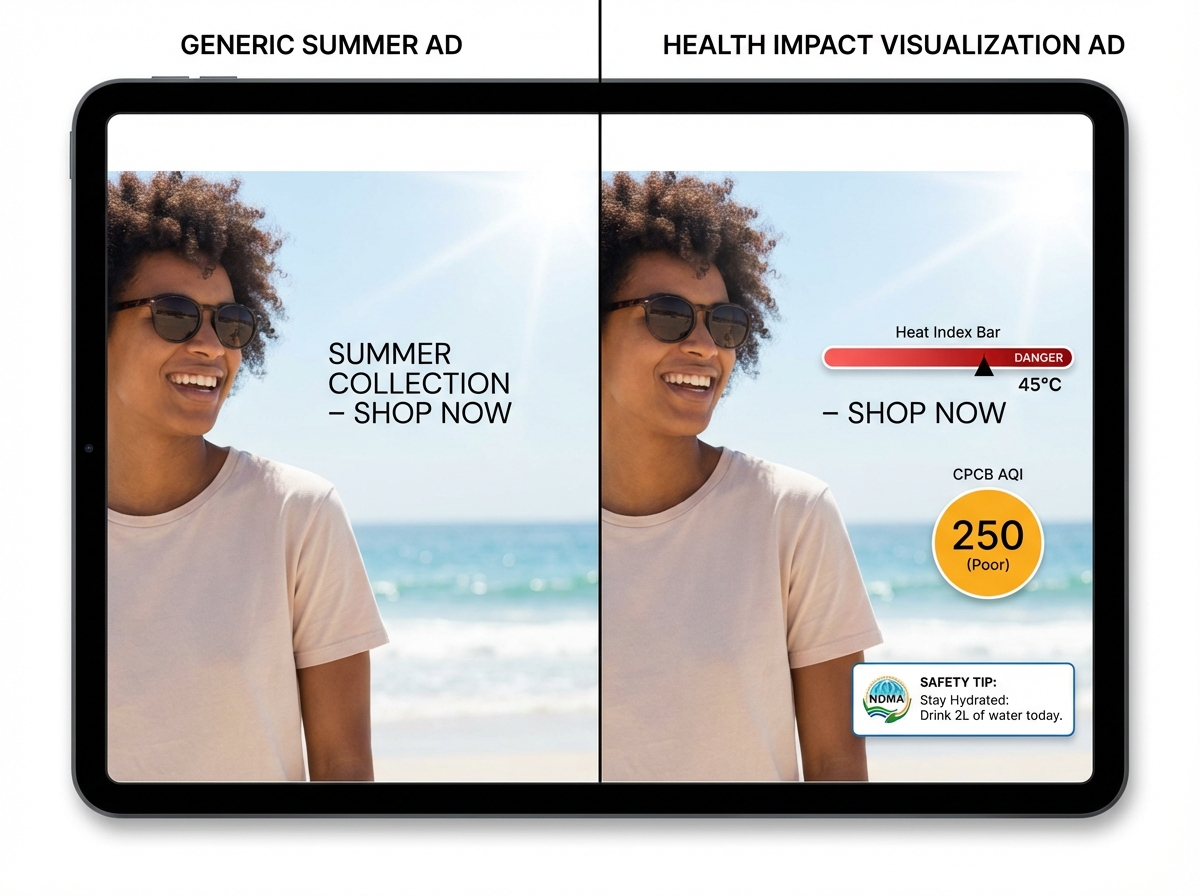
Air quality index marketing involves adapting creative logic based on CPCB AQI bands. On days when air quality is “Poor” or “Severe,” marketing shifts to prioritize protective products like N95 masks and air purifiers. This is often accompanied by health impact visualization, which embeds simple, visual overlays—like an AQI icon or a heat index color bar—into marketing materials. These visual cues provide micro-explainers for safe exposure, reinforcing the brand's role as a trusted advisor.
Finally, climate resilience products represent a growing retail category. These are products that reduce vulnerability to climate hazards, ranging from UPF-rated apparel and cooling fabrics to inverter ACs and water-saving fixtures. Marketing these products requires a shift from traditional lifestyle messaging to a focus on resilience and long-term value.
Tactical playbooks for climate-adaptive growth
Implementing these strategies requires a series of tactical blueprints that connect environmental triggers to specific marketing actions. Platforms like TrueFan AI enable brands to execute these blueprints with unprecedented speed and personalization, ensuring that every message is tailored to the recipient's local environment.
1. Heat wave product personalization
When the temperature hits ≥40°C or the heat index exceeds 41°C for a 24–72 hour forecast, the system triggers heat wave product personalization. The digital storefront automatically surfaces cooling apparel, hydration SKUs, and inverter ACs, often accompanied by “cooling score” badges. Offer logic is tiered by the temperature delta; for instance, a 5°C spike above the weekly average might unlock free expedited delivery. TrueFan AI's 175+ language support and Personalised Celebrity Videos can be used here to deliver dynamic greetings, such as a celebrity mentioning the specific local temperature and recommending a cooling combo, rendered in under 30 seconds via API.
2. Weather-triggered offer automation
This tactic relies on forecasted spikes. If a heat wave is predicted in 48 hours or the AQI is expected to cross 201, weather-triggered offer automation swaps out standard creatives for pre-approved, weather-contingent versions. A “health-first override” is built into the governance, ensuring that aggressive sales promotions are replaced with safety pointers on “Severe” AQI days. This maintains brand equity by showing the brand cares about consumer wellbeing during crises.
3. Temperature-based commerce India (Operations + Merchandising)
Operational agility is key to temperature-based commerce India. Triggers are set at the city level to account for regional differences—38°C in Delhi feels different than 34°C in humid Chennai. Operations teams use these triggers to surge same-day delivery for cooling SKUs and implement slot blackout rules during red alerts to protect delivery partners. Merchandising plans are adjusted state-wise, ensuring cold chains are robust for beverages and ice cream during peak heat.
4. Health impact visualization in marketing
By inserting heat index bars, CPCB AQI icons, and UV index chips into banners and videos, brands provide immediate value. This health impact visualization follows NDMA and NCDC guidance, offering one-line safe exposure tips. For example, a banner might show a “Very High” UV index of 9 and suggest seeking shade. These overlays can be automated in personalized videos, ensuring the data is always live and accurate for the viewer's specific location.
5. Air quality index marketing
When the AQI reaches “Moderate” (101–200), messaging focuses on sensitive groups like children and the elderly. Once it crosses into “Poor” (201+), the strategy shifts to universal protective messaging. Air quality index marketing prioritizes N95 masks, air purifiers, and anti-pollution skincare. Brands may offer delivery-fee waivers on high-pollution days to encourage consumers to stay indoors, further positioning themselves as health-conscious partners.
6. Sustainable cooling solutions storytelling
This playbook focuses on the long-term benefits of sustainable cooling solutions. Marketing highlights BEE star-rated inverter ACs, cool roof coatings, and passive cooling innovations like the CoolAnt Beehive. By referencing case studies from “This Is Cool” and providing energy-savings calculators, brands can move consumers toward higher-value, more efficient products. Financing options like EMIs tied to energy savings help lower the barrier to entry for these essential items.
7. Energy efficiency campaigns
Timed with grid pressure, energy efficiency campaigns educate consumers on off-peak usage and optimal thermostat settings. These campaigns are often co-branded with BEE guidance and feature “energy smart” kiosks in-store. Measurement focuses on engagement with energy-saving tips and the sales of smart-home bundles that help manage consumption.
8. Water conservation offers
In response to 2026 drought sensitivities, water conservation offers are triggered by reservoir alerts or district-level drought advisories. Retailers promote low-flow fixtures, rainwater harvesting kits, and greywater-friendly detergents. Some brands even partner with utilities to offer bill credits for consumers who participate in community water-saving challenges, demonstrating a deep commitment to regional resilience.
9. UV protection marketing and hydration reminders
When the UV Index hits ≥8, the system activates UV protection marketing for categories like SPF 50+ sunscreen and UPF apparel. This is paired with hydration reminder videos delivered via WhatsApp or SMS. These videos, personalized through TrueFan AI, can feature a celebrity reminding the user to stay hydrated based on their local heat index, providing a high-touch, helpful interaction that drives both trust and sales.
In the Indo-Gangetic Plain (>42°C): Focus on replenishment. Automated “nudge” campaigns for ORS, electrolytes, and bulk-buy beverage discounts are synchronized with instant-commerce delivery slots to ensure consumers don't have to step out in the heat.
Sources:
- NDMA: Heat Wave National Workshop Guidance
- CPCB: National Air Quality Index Bands
- BEE: Energy Efficiency G20 Brief
- SEforALL: This Is Cool - India Passive Cooling Stories
Safety, wellbeing, and data governance
A critical layer of climate adaptive marketing 2026 is the “duty of care.” Marketing must never compromise public safety for the sake of a sale. This means aligning all health-related messaging with official guidance from the NDMA and NCDC. Heat stress prevention protocols should be integrated into both customer-facing messaging and internal operations. For instance, retail stores should establish “cool zones” and hydration stations, and marketing should direct vulnerable populations to these locations during extreme events.
Data governance is equally paramount. In supply chain resilience marketing, personalization must be transparent and consent-based. When using environmental data to trigger offers, brands must ensure that regional weather targeting does not inadvertently exclude vulnerable groups from receiving protective information. All health-first messaging should include clear disclaimers to avoid being perceived as medical advice.
From a technical perspective, enterprise-grade security is non-negotiable. Systems must adhere to ISO 27001 and SOC 2 standards to protect consumer data. Furthermore, content moderation filters must be in place to ensure that automated or AI-generated content remains brand-safe and culturally sensitive, especially when dealing with localized vernaculars and celebrity endorsements.
Sources:
Measurement, ROI, and the 90-day roadmap
Proving the impact of climate adaptive marketing 2026 requires a sophisticated KPI tree. Beyond standard conversion rates, brands should measure the “conversion lift per +1°C delta” and the ROAS on AQI-triggered days. The attach rate for climate resilience products and the opt-in rate for hydration reminder videos serve as proxies for brand trust and customer wellbeing. Solutions like TrueFan AI demonstrate ROI through increased engagement rates and the ability to scale hyper-personalized content without the overhead of traditional production.
To achieve these results, CMOs should follow a structured 90-day roadmap:
- Weeks 1–3: Foundation. Map environmental triggers (temperature, AQI, UV) and define thresholds based on NDMA and CPCB guidance. Wire data feeds into the CDP and build a library of creative variants, including safety-first overrides.
- Weeks 4–6: Pilot. Launch a 3-city pilot (e.g., Delhi, Ahmedabad, Chennai). Implement DOOH-weather creative in one market and launch personalized video journeys for hydration and UV protection.
- Weeks 7–12: Scale. Expand to 12 major markets. Roll out heat wave product personalization across the web and app. Integrate seasonal modules for sustainable cooling solutions and water conservation offers. Finalize the Marketing Mix Model (MMM) reads to quantify the uplift from weather-activated campaigns.
These micro-journeys are often paired with instant-commerce tie-ins, showing the nearest store availability or providing a discount code that expires as the heat wave subsides.
Conclusion
The transition to climate adaptive marketing 2026 is no longer optional for Indian enterprises; it is a strategic imperative. By aligning marketing efforts with the environmental realities of the region, brands can drive significant ROI while performing a vital service to their customers. Through the use of weather-triggered offer automation, regional weather targeting, and a focus on climate resilience products, retailers can build a brand that is not only profitable but also indispensable in a changing world. The roadmap is clear: start with data, prioritize safety, and use advanced personalization to meet the consumer exactly where they are—regardless of the temperature.
Successfully executing climate adaptive marketing India 2026 requires a robust, integrated tech stack that can handle real-time data ingestion and automated content assembly across channels and markets.
Frequently Asked Questions
What thresholds should trigger air quality index marketing in India?
Marketing should be segmented by CPCB NAQI bands. “Moderate” (101–200) triggers messaging for sensitive groups. “Poor” (201–300) and above should trigger universal protective messaging and prioritize products like N95 masks and air purifiers. Always link to CPCB’s real-time AQI for accuracy.
How do we start weather prediction commerce in India within 30 days?
Begin by hooking up a reliable weather API to your CDP. Define simple trigger rules (e.g., “If forecast >38°C, swap homepage banner”). Create 3–4 creative variants and use a holdout group to measure the initial conversion lift.
What is regional weather targeting and how granular should we go?
It is the practice of tailoring marketing to hyperlocal conditions. In India, this should ideally go down to the PIN code or district level to account for micro-climates. It also requires vernacular pivots (Hindi, Tamil, Marathi, etc.) to ensure the message resonates locally.
How to design heat stress prevention messaging without medical claims?
Use language directly from NDMA or NCDC guidelines. Focus on actionable safety tips—like “stay hydrated” or “wear light clothing”—rather than medical diagnoses. Always include a disclaimer and direct users to official health resources.
Which climate resilience products perform best during Indian heat waves?
Top performers include BEE star-rated inverter ACs, cooling fabrics (linens, moisture-wicking tech), UPF-rated apparel, and hydration-related SKUs. Bundling these with energy-saving tips or “cool roof” kits can further drive interest. TrueFan AI can help personalize the promotion of these products by featuring celebrities who explain the resilience benefits in the user's local language.