Chaitra Navratri 2026 Marketing Campaigns: 9-Day Enterprise Playbook for Revenue Growth
Estimated reading time: ~16 minutes
Key Takeaways
- Build a nine-day automation aligned to daily deities and colors to drive intent-led merchandising and conversions.
- Use regional and vernacular personalization to localize content, offers, and rituals across India’s diverse markets.
- Anchor campaigns around Ram Navami and extend momentum with a March 29–April 6 clearance and loyalty push.
- Measure rigorously with KPIs like Revenue per Day, Vernacular Lift, AOV, and Video VTR.
- Ensure governance and consent while leveraging AI-driven creative to keep offers culturally respectful and fresh.
Chaitra Navratri 2026 marketing campaigns represent a critical pivot for Indian retail, moving beyond generic festive discounts toward a sophisticated model of spiritual commerce orchestration. Scheduled from March 19 to March 27, 2026, with the grand crescendo of Ram Navami on March 26, this nine-day window offers an unparalleled opportunity for brands to deploy nine-day customer journey automation that aligns with the deep-seated cultural and spiritual sentiments of over a billion consumers.
For Enterprise CMOs and e-commerce leaders, the objective for 2026 is clear: achieving measurable revenue growth through high-velocity personalization. By integrating March 29 April 6 festival marketing extensions to capture post-peak weekend traffic, brands can sustain momentum well into the spring season. This playbook outlines the technical and creative infrastructure required to master devotional commerce personalization at scale.
The Strategic Framework of Spiritual Commerce Orchestration
Spiritual commerce orchestration is the end-to-end management of festive content, vernacular assets, and cross-channel offers synchronized across the digital and physical ecosystem. In 2026, the Indian digital landscape is projected to see a 40% increase in spiritual commerce transactions via conversational AI platforms, making orchestration the primary differentiator between market leaders and laggards.
To succeed, brands must move away from “one-size-fits-all” greetings. Instead, they must implement a system that recognizes the user’s specific deity affinities, regional ritual variations, and linguistic preferences. This involves a complex data design where CRM inputs—such as fasting habits, puja samagri requirements, and color-of-the-day fashion choices—trigger real-time, localized content across WhatsApp, SMS, and app pushes.
Platforms like TrueFan AI enable enterprises to bridge the gap between high-level brand messaging and hyper-personalized consumer interactions, ensuring that every touchpoint feels culturally authentic and personally relevant. By 2026, 80% of Indian consumers are expected to favor brands that demonstrate this level of cultural intelligence and operational precision.
Sources:
- 360 Marketing Hub: 2026 social media event calendar
- Rudraksha Ratna: Navratri overview and significance
Nine-Day Customer Journey Automation: The Daily Blueprint
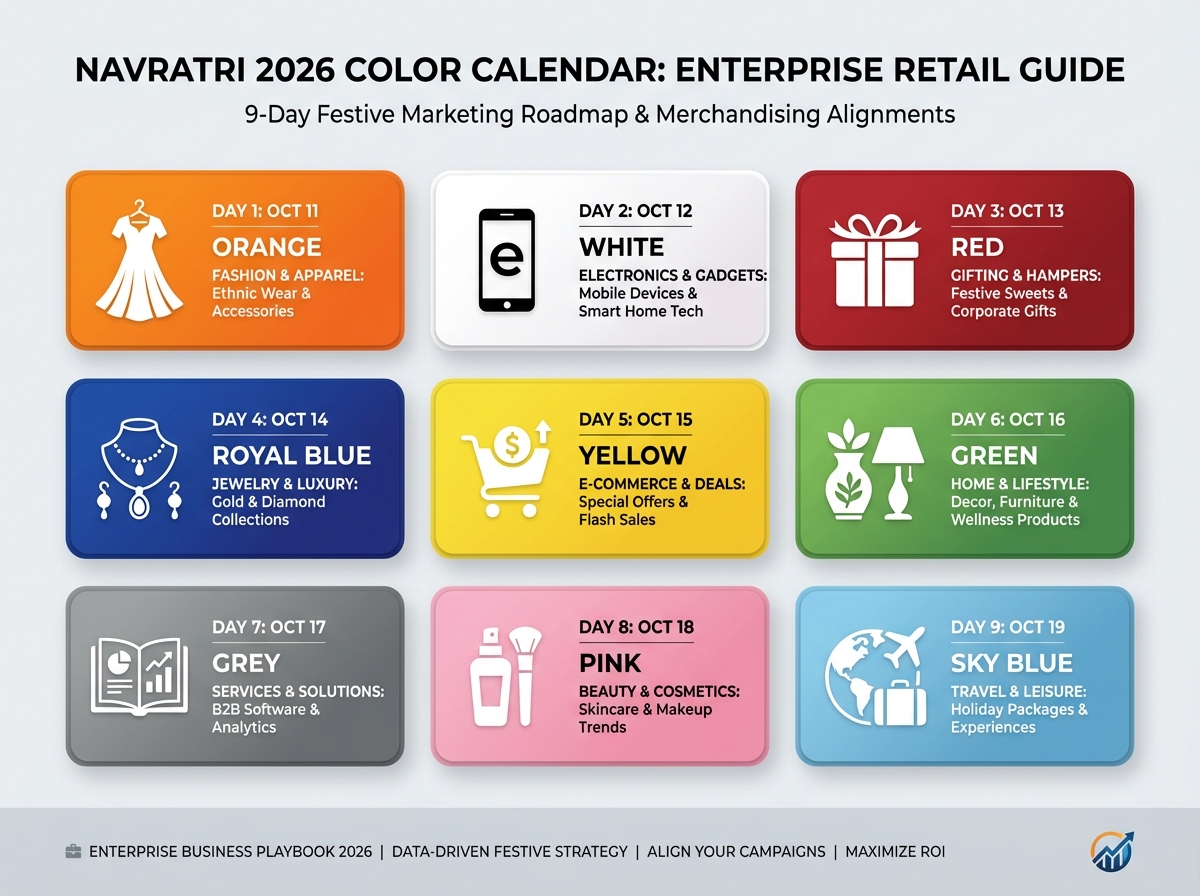
The core of Chaitra Navratri 2026 marketing campaigns lies in the execution of a nine-day customer journey automation. Each day is dedicated to a specific form of Goddess Durga, associated with a unique color and spiritual theme. For 2026, the color calendar provided by Drik Panchang serves as the foundational merchandising guide.
Day 1 to Day 3: The Foundation of Devotion
Day 1 (March 19) – Shailaputri (Orange): The journey begins with a focus on strength and new beginnings. Brands should launch goddess-themed daily campaigns featuring orange-themed apparel and home decor. The automation trigger should target all active users with a personalized welcome video, offering double loyalty points on “Orange Category” SKUs to drive early adoption.
Day 2 (March 20) – Brahmacharini (White): This day emphasizes purity and devotion. Merchandising should pivot to white ethnic wear, puja essentials, and dairy-based fasting foods. Use vernacular greeting automation to send morning ritual tips, followed by evening BOGO offers on white linens or skincare.
Day 3 (March 21) – Chandraghanta (Red): Representing courage, the color Red drives high-energy categories like bold fashion, cosmetics, and electronics. Tiered discounts (e.g., “Spend ₹5000, Save ₹1000”) are highly effective here. KPI focus should be on cart-to-order conversion rates as the festival gains momentum.
Day 4 to Day 6: Vitality and Growth
Day 4 (March 22) – Kushmanda (Royal Blue): Focus on wellness and vitality. This is the ideal window for health-tech and organic food brands to offer bundle savings on “fasting-friendly” nutrition kits. Royal Blue creative assets should dominate app interfaces to signal premium wellness offerings.
Day 5 (March 23) – Skandamata (Yellow): This day celebrates the nurturing aspect of the Goddess, making it the peak for family gifting and children’s apparel. Campaigns should emphasize “Family Packs” and offer free festive gift-wrapping. Multi-item orders are the primary KPI for this segment.
Day 6 (March 24) – Katyayani (Green): With a focus on determination and nature, brands can highlight eco-friendly products and “Green Beauty” detox kits. Store pickup incentives are particularly effective here, driving footfall for the upcoming peak days.
Day 7 to Day 9: The Spiritual Peak
Day 7 (March 25) – Kalaratri (Grey/Violet): This day is associated with protection. Merchandising should focus on incense, lamps, and evening ritual kits. Flash sales between 6 PM and 9 PM can capture the contemplative mood of the evening prayers.
Day 8 (March 26) – Mahagauri (Pink): Renewal and beauty are the themes. This is the final push for wardrobe refreshes and high-end jewelry. Last-mile shipping incentives (Same-Day Delivery) are crucial here to ensure products arrive before the Ram Navami conclusion.
Day 9 (March 27) – Siddhidatri & Ram Navami (Sky Blue): The ultimate peak. Ram Navami integrated marketing must focus on prasad bundles, family thalis, and gratitude-themed content. This is the day for maximum reach and high-volume transactions.
Sources:
Ram Navami Integrated Marketing and the Weekend Extension
Ram Navami, occurring on March 26, 2026 (with celebrations continuing through the 27th), serves as the commercial and spiritual anchor of the entire period. Ram Navami integrated marketing requires a shift from individual devotion to community celebration. Data from 2026 indicates that group-buying and referral-based commerce spike by 55% during this specific window.
Enterprises should deploy “Share the Blessing” referral programs where users can send personalized video greetings to friends, unlocking mutual discounts. This not only drives revenue but also lowers Customer Acquisition Cost (CAC) through organic social sharing.
The strategy must not end on March 27. The March 29 April 6 festival marketing window is essential for clearing seasonal inventory and capturing late-celebrant traffic. By leveraging the social media content calendars for 2026, brands can ride the wave of post-festival “gratitude” content, offering “Missed the Peak?” clearance deals and encouraging store visits for returns or exchanges, which can be converted into new sales.
Sources:
Regional Festival Customization India: A Multi-City Strategy
India’s diversity necessitates regional festival customization India to ensure resonance across different states. While the core nine days are universal, the cultural expression varies significantly. In 2026, hyper-localization is the standard; a campaign that works in Ahmedabad will likely fail in Kolkata without significant modification.
In the West (Gujarat and Maharashtra), garba dandiya event sponsorship is the primary driver of brand visibility. Brands should partner with local organizers to offer QR-linked discounts on event tickets and ethnic wear. In the North, the focus remains on the “Kanya Pujan” rituals, requiring specific bundles for gifting to young girls.
In the South, particularly in Tamil Nadu and Karnataka, the emphasis on silk and temple jewelry requires a different aesthetic and linguistic approach. TrueFan AI's 175+ language support and Personalised Celebrity Videos allow brands to speak to a consumer in Chennai in Tamil, referencing local temple traditions, while simultaneously engaging a consumer in Delhi in Hindi with a focus on Ram Leela narratives. This level of vernacular greeting automation ensures that the brand is perceived as a local participant rather than a distant corporate entity.
Sources:
- Digital Scholar: Navratri social media post ideas
- Brands.live: Chaitra Navratri marketing ideas to boost sales
Technical Execution and Measurement of Spiritual Commerce
The success of Chaitra Navratri 2026 marketing campaigns depends on a robust technical stack capable of handling millions of personalized requests in real-time. Spiritual commerce orchestration requires a seamless integration between the CRM, the creative automation engine, and the delivery channels like WhatsApp and App Push.
Key performance indicators (KPIs) must be tracked daily to allow for mid-campaign optimization. These include:
- Revenue per Day: Tracking the lift associated with each color-themed offer.
- Vernacular Lift: Measuring the conversion difference between English and regional language assets.
- AOV (Average Order Value): Monitoring the success of “Family Pack” and “Ritual Kit” bundling.
- Video View-Through Rate: Assessing the engagement levels of personalized video greetings.
Solutions like TrueFan AI demonstrate ROI through significant uplifts in click-through rates (CTR) and conversion, often exceeding 3x the performance of static creative. By utilizing AI-driven virtual reshoots, brands can swap product callouts or offer codes across the nine days without the need for multiple expensive production cycles, ensuring the creative remains fresh and relevant to the daily goddess theme.
Furthermore, governance and compliance are paramount. In 2026, data privacy regulations in India require strict adherence to consent-based messaging. Every personalized interaction must be backed by verifiable consent logs, and the content itself must undergo a cultural review to ensure respectful representation of deities and rituals.
Conclusion: Orchestrating Success in 2026
The landscape of Chaitra Navratri 2026 marketing campaigns is defined by the intersection of tradition and technology. To win, enterprises must move beyond simple transactions and embrace the role of a facilitator in the consumer's spiritual journey. Through nine-day customer journey automation, meticulous color-themed merchandising, and a deep commitment to regional customization, brands can unlock unprecedented growth.
By implementing the strategies of spiritual commerce orchestration and leveraging advanced tools for devotional commerce personalization, CMOs can ensure their brands remain relevant in an increasingly competitive and culturally conscious market. The path to 2026 revenue growth lies in the ability to speak to the heart of the consumer, one personalized greeting at a time.
Frequently Asked Questions
What are the key dates for Chaitra Navratri 2026 marketing campaigns?
Chaitra Navratri 2026 begins on March 19 and concludes with Ram Navami on March 26-27. Brands should plan their primary campaigns for this window, with an extension for March 29 April 6 festival marketing to capture late-season shoppers.
How do Navratri color-themed offers impact sales?
Color-themed offers align with the daily spiritual practice of consumers. By merchandising products that match the “Color of the Day” (e.g., Orange for Day 1, Royal Blue for Day 4), brands can tap into the high purchase intent for ritual-specific items and festive fashion, leading to higher AOV.
Why is regional festival customization India important for large enterprises?
India is a multi-lingual and multi-cultural market. A brand that uses vernacular greeting automation and adapts its creative to local customs (like Garba in Gujarat vs. Golu in the South) builds deeper trust and sees significantly higher conversion rates compared to generic national campaigns.
How can TrueFan AI help in scaling festive personalization?
TrueFan AI allows brands to create millions of personalized video messages featuring celebrities or brand ambassadors. By using TrueFan AI to address customers by name and in their preferred language, brands can create a “human” connection at an enterprise scale that static ads cannot replicate.
What is the significance of the March 29 April 6 festival marketing window?
This window captures the “weekend after” the festival peak. It is an ideal time for clearance sales, loyalty program nudges, and “thank you” campaigns that transition the festive shopper into a long-term loyal customer.