BNPL debt recovery automation India: Empathetic, post-festival strategies that boost retention
Estimated reading time: ~10 minutes
Key Takeaways
- Empathy and compliance with RBI and FACE guidelines are essential for respectful, effective BNPL recovery.
- Behavioral nudges and personalized videos improve engagement, cure rates, and self-serve repayments.
- Automation and orchestration scale portfolio coverage with right-time, right-channel communications.
- Flexible EMI strategies reduce default spirals and protect long-term customer relationships.
- Holistic KPIs like cost-to-collect, CLV, and video engagement drive measurable ROI.
The February-March window in the Indian financial calendar represents a unique period of systemic liquidity strain. Following the aggressive spending cycles of the festive season and year-end travel, a significant portion of the consumer base faces a temporary cash flow mismatch. For Buy Now, Pay Later (BNPL) providers, this seasonal volatility often manifests as a spike in early-stage delinquencies (DPD 1–30). Implementing BNPL debt recovery automation India is no longer just a matter of operational efficiency; it is a strategic necessity to balance risk mitigation with long-term customer loyalty.
By leveraging sophisticated behavioral psychology payment reminders, post-festival payment collection videos, and highly personalized payment flexibility campaigns, lenders can navigate this high-stress period effectively. The goal is to recover dues without eroding the trust that defines the modern fintech relationship. In 2026, the differentiator for leading NBFCs is the ability to transform a potentially adversarial collection touchpoint into a supportive, brand-reinforcing experience.
Empathetic debt recovery strategies: Building a compliance-first foundation in India
In the 2026 regulatory landscape, empathy is not merely a tonal choice; it is a compliance mandate. The Reserve Bank of India (RBI) and the Fintech Association for Consumer Empowerment (FACE) have established rigorous guardrails that define how digital lenders must interact with borrowers. Empathetic debt recovery strategies begin with a deep understanding of these guidelines, ensuring that every automated touchpoint respects the dignity and privacy of the consumer.
The shift toward "Fair Practices" means that BNPL debt recovery automation India must prioritize transparency. This includes clear disclosures regarding penal charges, interest accruals, and the long-term impact of delinquency on credit health. By aligning recovery workflows with the RBI’s Fair Practices Code, lenders minimize regulatory risk while building a reputation for ethical conduct. This foundation is critical during the post-festival stress months when consumers are most sensitive to aggressive outreach.
Furthermore, the 2025-2026 FACE guidelines emphasize the importance of "right-time, right-channel" communication. This means avoiding intrusive contact hours and ensuring that opt-out mechanisms are easily accessible. When a lender demonstrates respect for these boundaries, the borrower is more likely to engage with the recovery process rather than retreating into silence. Empathy, in this context, is the bridge between a missed payment and a successful cure.
Sources:
- RBI: Recovery Agents Guidance
- RBI: Fair Practices Code
- FACE: Code of Conduct
- FACE: Guidelines on Debt Recovery (2025)
Scaling BNPL debt recovery automation India for sustainable retention
As BNPL integrates deeper into the Indian digital commerce ecosystem, the volume of transactions necessitates a sophisticated orchestration of recovery efforts. BNPL debt recovery automation India involves the seamless integration of data inputs, decisioning logic, and multi-channel delivery. In 2026, the most effective systems use real-time affordability signals—such as changes in spending patterns or linked account balances—to trigger proactive interventions before a payment is even missed.
Platforms like TrueFan AI enable lenders to scale these personalized interventions by automating the creation of high-impact communication assets. The automation framework typically segments the portfolio into risk tiers based on DPD buckets, ticket sizes, and historical "Promise-to-Pay" (PTP) reliability. For a low-risk customer facing a temporary post-festival crunch, the system might trigger a gentle, video-based nudge. For a higher-risk segment, it might escalate to a structured restructuring offer, all without manual agent intervention.
The orchestration layer is where the strategy comes to life. It determines the "next-best-action" for each borrower, selecting the optimal channel—be it WhatsApp, SMS, or IVR—and the most resonant tone. By automating these decisions, BNPL providers can maintain a high frequency of contact without the high cost of a massive call center. This efficiency is vital for maintaining margins in a competitive lending environment where collection efficiency optimization is a primary KPI.
Sources:
Behavioral psychology payment reminders: Driving action through nudge marketing
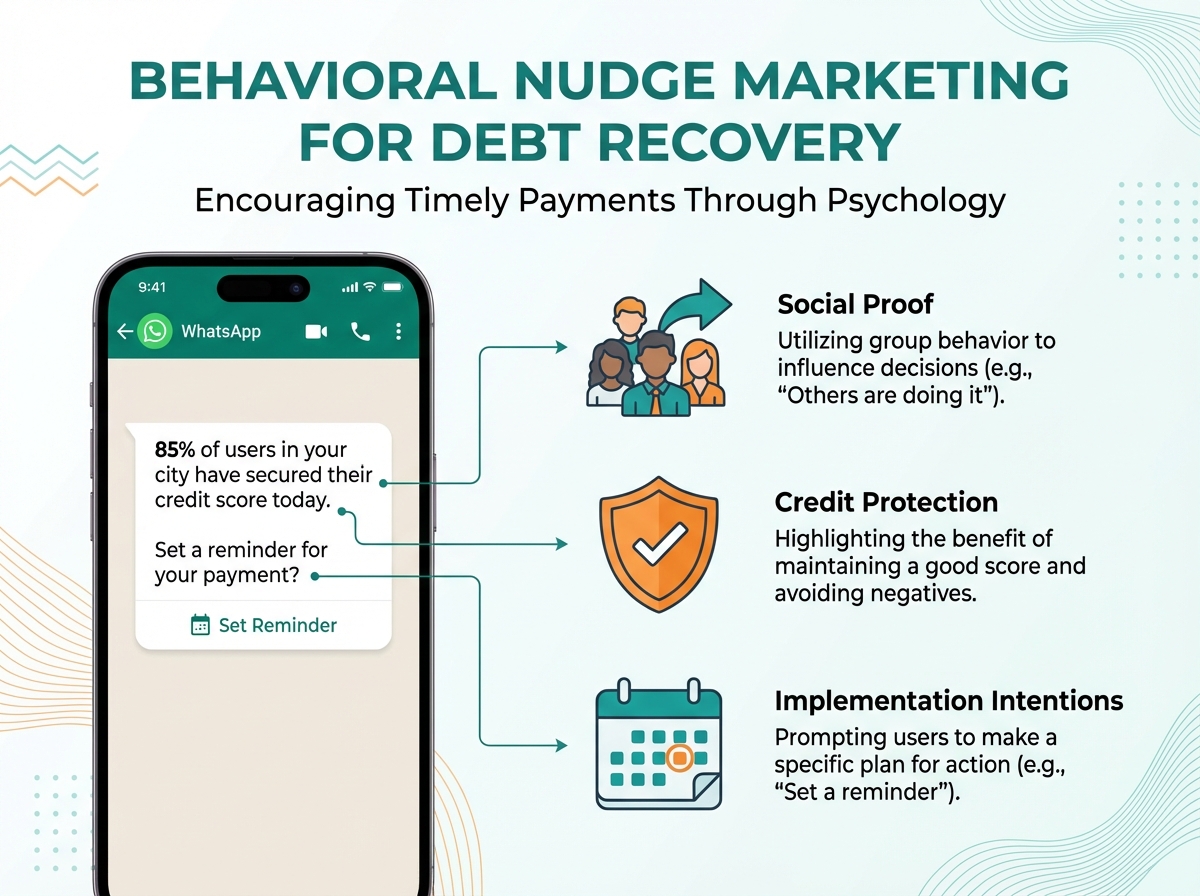
The effectiveness of a collection reminder is often determined less by the "what" and more by the "how." Behavioral psychology payment reminders leverage cognitive heuristics to encourage voluntary repayment. In the post-festival period, when consumers are overwhelmed by financial obligations, "salience" is key. Reminders must clearly highlight the exact amount due and the immediate benefits of payment, such as the preservation of a credit limit or the avoidance of late fees.
One of the most powerful tools in behavioral nudge marketing is social proof. By framing the message as, "Most customers in your city have already secured their credit health by completing their February EMI," lenders can tap into the human desire for conformity. Similarly, "loss aversion" can be used ethically by illustrating what the customer stands to lose—such as access to future "No-Cost EMI" offers—rather than just focusing on the penalty.
Implementation intentions also play a crucial role. Instead of a generic "Please pay now," a behavioral nudge might ask, "When do you plan to make your payment? Click to set a reminder for your payday." This small act of commitment significantly increases the likelihood of follow-through. A/B testing these psychological hooks allows lenders to refine their scripts, ensuring that the tone remains supportive while the call to action remains firm.
Sources:
Post-festival payment collection videos: Humanizing the recovery journey
In a sea of generic text messages and automated robocalls, video stands out as a medium of high engagement and trust. Post-festival payment collection videos are designed to break through the digital noise by providing a face and a voice to the lender. These videos are not generic advertisements; they are dynamic, personalized assets that address the borrower by name, state their specific due amount, and offer a clear, empathetic path forward.
TrueFan AI's 175+ language support and Personalised Celebrity Videos allow BNPL providers to deliver these messages in the borrower’s preferred regional dialect, significantly reducing the friction caused by language barriers. A video that acknowledges the "post-festival expense peak" in a warm, professional tone can de-escalate the stress a borrower might feel. This humanized approach is particularly effective for the "Gig Earner" or "Student" segments, who may be new to formal credit and require more guidance.
The technical integration of these videos is where the ROI becomes apparent. By embedding one-tap UPI deep links directly within the video interface, lenders can reduce the steps to repayment from five to one. In 2026, data shows that personalized video reminders can improve watch-through rates by up to 3x compared to standard video content, leading to a direct uplift in cure rates for DPD 1–15 cohorts. This is a cornerstone of modern BNPL retention strategies India.
Sources:
Payment flexibility campaigns and EMI modification personalization for long-term health
When a borrower is unable to pay in full due to seasonal liquidity issues, rigidity is the enemy of recovery. Payment flexibility campaigns offer a structured way to keep the borrower within the ecosystem while acknowledging their current constraints. This might involve offering a "Due-Date Shift" for a small fee or allowing a "Partial Payment" to prevent the account from slipping into a higher DPD bucket.
EMI modification personalization takes this a step further by using machine learning to suggest the most viable repayment plan for a specific individual. If a borrower has a history of on-time payments but is struggling in February, the system might automatically offer to split the current EMI into three smaller installments. This proactive restructuring, when clearly disclosed and consented to, prevents the "default spiral" and maintains the customer’s financial health.
These campaigns must be supported by payment restructuring offer videos that explain the new terms in simple, non-technical language. Transparency is vital here; the video should clearly state the total cost of the restructuring and how it will be reported to credit bureaus. By providing these options, BNPL lenders transition from being "collectors" to being "financial partners," a shift that is essential for high-LTV retention in the Indian market.
Sources:
Collection efficiency optimization: Measuring success in the 2026 ecosystem
To truly master collection efficiency optimization, BNPL providers must move beyond simple recovery rates and look at the holistic "Cost-to-Collect" and "Customer Lifetime Value" (CLV). In 2026, success is measured by the ability to recover funds while minimizing agent intervention and maximizing customer satisfaction. This requires a robust measurement plan that tracks every stage of the automated recovery funnel.
Key Performance Indicators (KPIs) should include:
- Roll Rates: The percentage of customers moving from DPD 0 to DPD 30 and beyond.
- Cure Rates: The speed and frequency with which delinquent accounts return to "Current" status.
- Self-Serve Completion Rate: The percentage of borrowers who resolve their dues via automated links or videos without speaking to an agent.
- Video Engagement Metrics: Watch-through rates and CTA click-through rates for personalized video assets.
Solutions like TrueFan AI demonstrate ROI through these metrics by significantly lowering the reliance on expensive, high-turnover manual collection teams. Furthermore, by integrating customer financial health monitoring, lenders can identify "at-risk" customers before they default, allowing for the deployment of financial wellness support campaigns. This proactive stance not only reduces credit risk but also fosters a sense of loyalty, as customers feel supported during their times of financial stress.
Sources:
2026 Market Context and Strategic Playbooks
As we look toward the remainder of 2026, the Indian BNPL market is evolving into a more mature, "embedded credit" model. This means that BNPL is no longer a standalone product but a feature within larger ecosystems like e-commerce, travel, and healthcare. In this environment, the cost of losing a customer due to a poor collection experience is astronomical. Retention is the new growth.
Strategic Playbook: The Salaried Professional (Post-Festival)
- Scenario: Payday is the 5th, but the EMI is due on the 2nd. Post-festival expenses have depleted the buffer.
- Action: Trigger a behavioral psychology payment reminder on the 1st, offering a 5-day due-date shift.
- Asset: A 20-second video explaining how this shift protects their credit score.
Strategic Playbook: The Gig Economy Worker
- Scenario: Variable income leads to a missed payment in late February.
- Action: Deploy EMI modification personalization via WhatsApp, offering to break the due amount into four weekly micro-payments.
- Asset: A multilingual video in the local dialect (e.g., Marathi or Kannada) explaining the "Weekly Pay" option.
Strategic Playbook: The Student/First-Time Borrower
- Scenario: Confusion over how a missed 500 INR payment affects their future.
- Action: Credit score education automation triggered at DPD 3.
- Asset: A "Financial Wellness" video showing how a clean record today leads to a car loan or home loan tomorrow.
By implementing these targeted, automated playbooks, BNPL providers can turn the "stress months" of February and March into an opportunity for deepening customer relationships. The future of debt recovery in India is automated, it is video-led, and above all, it is empathetic.
Frequently Asked Questions
How does BNPL debt recovery automation India improve recovery rates compared to traditional calling?
Automation allows for 100% portfolio coverage at a fraction of the cost. By using behavioral nudge marketing and personalized videos, lenders can reach customers on their preferred channels (like WhatsApp) at the optimal time, leading to higher engagement and faster "Promise-to-Pay" fulfillment without the friction of a phone call.
Are post-festival payment collection videos compliant with RBI guidelines?
Yes, provided they adhere to the Fair Practices Code. This includes using respectful language, ensuring the videos are sent during approved contact hours, and providing clear information about the debt. Platforms like TrueFan AI ensure that all automated video content can be audited and version-controlled to meet regulatory standards.
What is the role of EMI modification personalization in customer retention?
It prevents "default fatigue." When a customer feels overwhelmed, they may stop communicating. By offering a personalized, smaller repayment path that fits their current cash flow, you keep them engaged in the ecosystem and preserve their credit health, which is a core part of BNPL retention strategies India.
How does credit score education automation help first-time borrowers?
Many young borrowers in India do not fully understand the long-term impact of a 30-day delinquency. Automated education—delivered via short, engaging videos—explains how the bureau reporting process works, incentivizing them to prioritize their BNPL dues to protect their future borrowing power.
Can TrueFan AI integrate with my existing Loan Management System (LMS)?
Yes. TrueFan AI is designed to plug into modern fintech stacks via APIs. It can ingest triggers from your LMS (like a missed payment or a risk-tier change) and automatically generate and distribute personalized video assets through WhatsApp, SMS, or email, providing a seamless layer of BNPL debt recovery automation India.