AI video split testing framework India 2026: scientific creative testing video ads for ROAS
Key Takeaways
- In India’s 2026 market, AI video split testing is essential to combat creative fatigue and achieve sustainable ROAS.
- Multivariate testing with fractional factorial designs and sequential testing beats one-off A/Bs for discovery and speed without statistical bias.
- Optimize the first 3 seconds and localize for Hinglish vs. regional languages to lift attention and conversions across diverse audiences.
- Compliance-by-design with India’s 2026 AI governance is non-negotiable—integrate moderation, disclosures, and airtight data ops.
- Scale variant generation and tagging with Studio by TrueFan AI to accelerate testing from weeks to hours.
The digital landscape in India has undergone a seismic shift. As we navigate 2026, the reliance on “gut-feel” creative decisions has become a relic of the past. For performance marketing scientists and creative strategists, the AI video split testing framework India 2026 is no longer an optional luxury—it is the foundational architecture required to achieve sustainable ROAS in an environment defined by hyper-competition, media inflation, and sophisticated AI-driven platform algorithms.
In a market where short-form video dominates 75% of mobile data consumption and the “first 3 seconds” determine the fate of a multi-crore campaign, scientific creative testing video ads is the only way to isolate what truly drives conversion. First 3 Seconds video strategy. This guide provides a rigorous, data-driven blueprint for operationalizing multivariate video testing methodology and sequential testing video campaigns, specifically engineered for India’s unique 2026 regulatory and platform ecosystem.
1. Why India Needs an AI Video Split Testing Framework in 2026
India’s 2026 digital video environment is mobile-first, short-form heavy, and increasingly governed by a new “techno-legal” framework. The sheer volume of content being produced means that creative fatigue sets in 40% faster than it did in 2024. To counter this, marketers are shifting toward data-driven video optimization India strategies that prioritize rapid iteration over high-budget single-asset production.
The 2026 Platform and Regulatory Shift
The landscape is shaped by three critical forces:
- Platform Evolution: YouTube India has fully integrated its 2026 AI-enabled creator suite, reaching over 850 million users with tools that prioritize creative safety and automated testing workflows.
- Governance Compliance: The Indian government has operationalized the AI Governance Group (AIGG) and the Technology & Policy Expert Committee (TPEC). These bodies, supported by the AI Safety Institute (AISI), now mandate “compliance-by-design” for AI-generated ad creatives, requiring strict adherence to bias checks and incident reporting.
- Market Dynamics: With India’s digital ad market projected to hit $12 billion in 2026, with video accounting for nearly 40% of that spend, the cost of “guessing” has become prohibitive.
The “First 3 Seconds” Imperative
Research indicates that in 2026, the average Indian user’s “thumb-stop” window has shrunk to under 1.8 seconds. This necessitates a framework that can test dozens of “hooks” simultaneously. Platforms like Studio by TrueFan AI enable performance marketers to generate hundreds of controlled creative variants in minutes, ensuring that the “First 3 Seconds” are optimized for maximum thumb-stop rates across diverse demographics.
Source: YouTube India 2026 AI Tools - Times of India
Source: India's Techno-Legal AI Governance - Economic Times
Source: First 3 Seconds Video Strategy - TrueFan AI
2. The AI Creative Optimization Framework: Architecture and Logic
An AI creative optimization framework is a closed-loop, model-driven system designed to eliminate variables and isolate causality. Unlike traditional creative testing, which often compares two vastly different videos, this framework breaks a video down into its atomic “factors.”
Core Components of the Framework
To build a robust system, you must integrate five key pillars:
- Variant Generation at Scale: Moving beyond manual editing to automated production of hooks, VOs, CTAs, and localizations. AI UGC video creator
- Factor Tagging: Every element (e.g., “Hook: Social Proof,” “VO: Hindi-Female,” “CTA: Shop Now”) must be tagged in the metadata for automated analysis.
- Experiment Engine: A system that manages randomization, traffic allocation, and power analysis.
- Measurement & Significance: Utilizing factor-level lift and confidence intervals to determine winners.
- Governance & Safety: Ensuring all AI-generated content meets the 2026 AIGG standards for transparency and ethical representation.
Operationalizing with TrueFan Enterprise
The bottleneck in scientific creative testing has traditionally been production speed. By leveraging Studio by TrueFan AI’s 175+ language support and AI avatars (real-time interactive AI avatars in India), brands can execute hyper-localized experiments across India’s diverse linguistic landscape without the overhead of traditional production. This allows for the testing of “Hinglish” vs. pure Hindi, or Tamil vs. Telugu variants, with the same statistical rigor applied to a global English campaign.
Source: AI in Digital Marketing India 2026 - Spinta Digital
Source: Product Document: Studio by TrueFan AI
3. Creative Experiment Design: Hypothesis Testing and Factor Models
The heart of the AI video split testing framework India 2026 is creative experiment design AI video. This involves moving away from “Which video is better?” to “Which element of this video is driving the lift?”
Video Creative Hypothesis Testing
A hypothesis must be a falsifiable statement. For example: “A social-proof hook (User Testimonial) will increase the 3-second hold rate by 15% compared to a FOMO hook (Limited Time Offer) among female audiences in Tier-2 cities.”
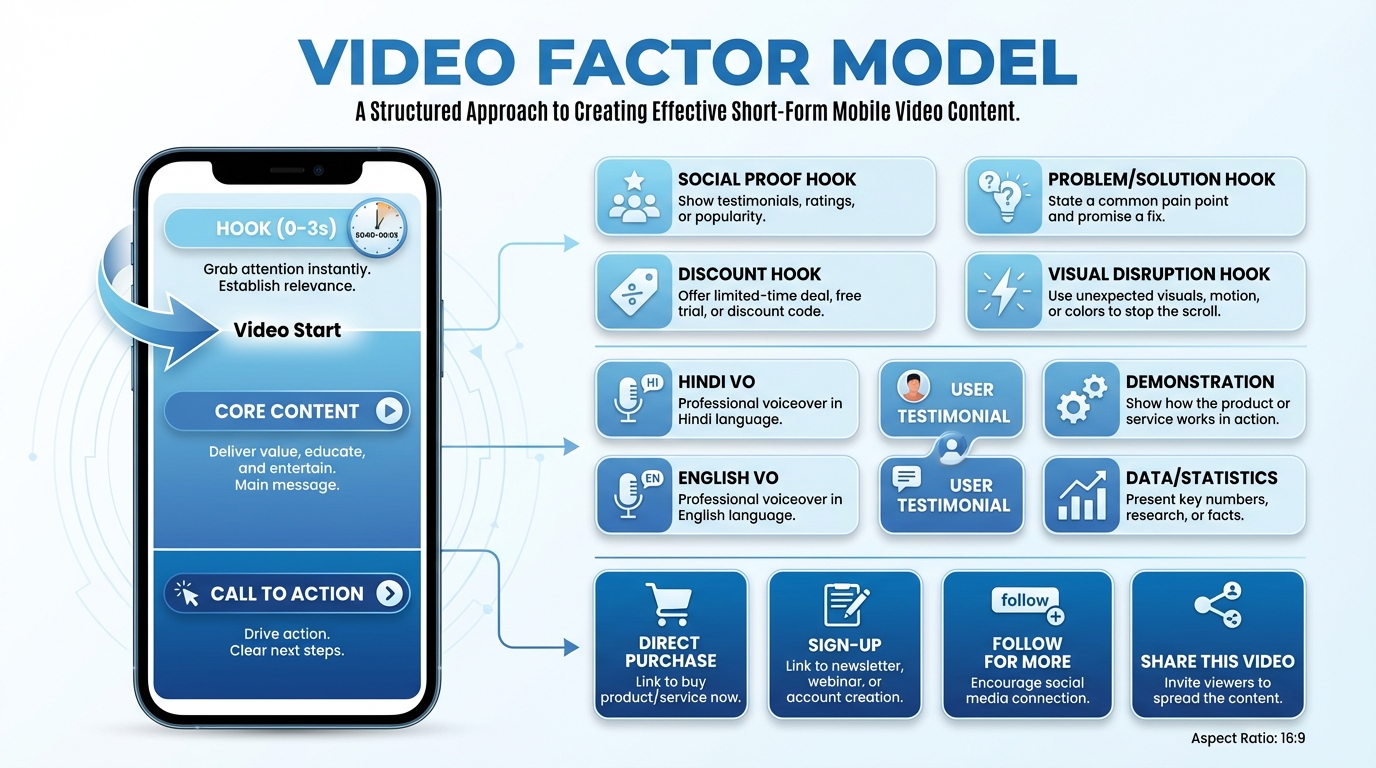
The Factor Model
In 2026, we categorize creative factors into three tiers:
- Visual Factors: Hook type, framing (close-up vs. wide), aspect ratio (9:16 vs. 1:1), and on-screen captions.
- Auditory Factors: Voiceover gender, language/dialect (e.g., Bengali vs. Sylheti), background music tempo, and sound-off readability.
- Offer Factors: CTA wording, price display (flat discount vs. percentage), and urgency cues.
Localization and Code-Switching
In the Indian context, “Hinglish” (the blending of Hindi and English) often outperforms pure Hindi in urban centers but fails in deep rural pockets. Testing these linguistic nuances is critical. The ability to rapidly clone voices and swap languages in a “walled garden” environment ensures that your experiments are both culturally resonant and legally compliant with the latest AI safety standards.
Source: AI Video Tools for Scaling Marketing 2026 - Shunya Anant
Source: Batch Video Creation Automation - TrueFan AI
4. Multivariate Video Testing Methodology vs. Traditional A/B
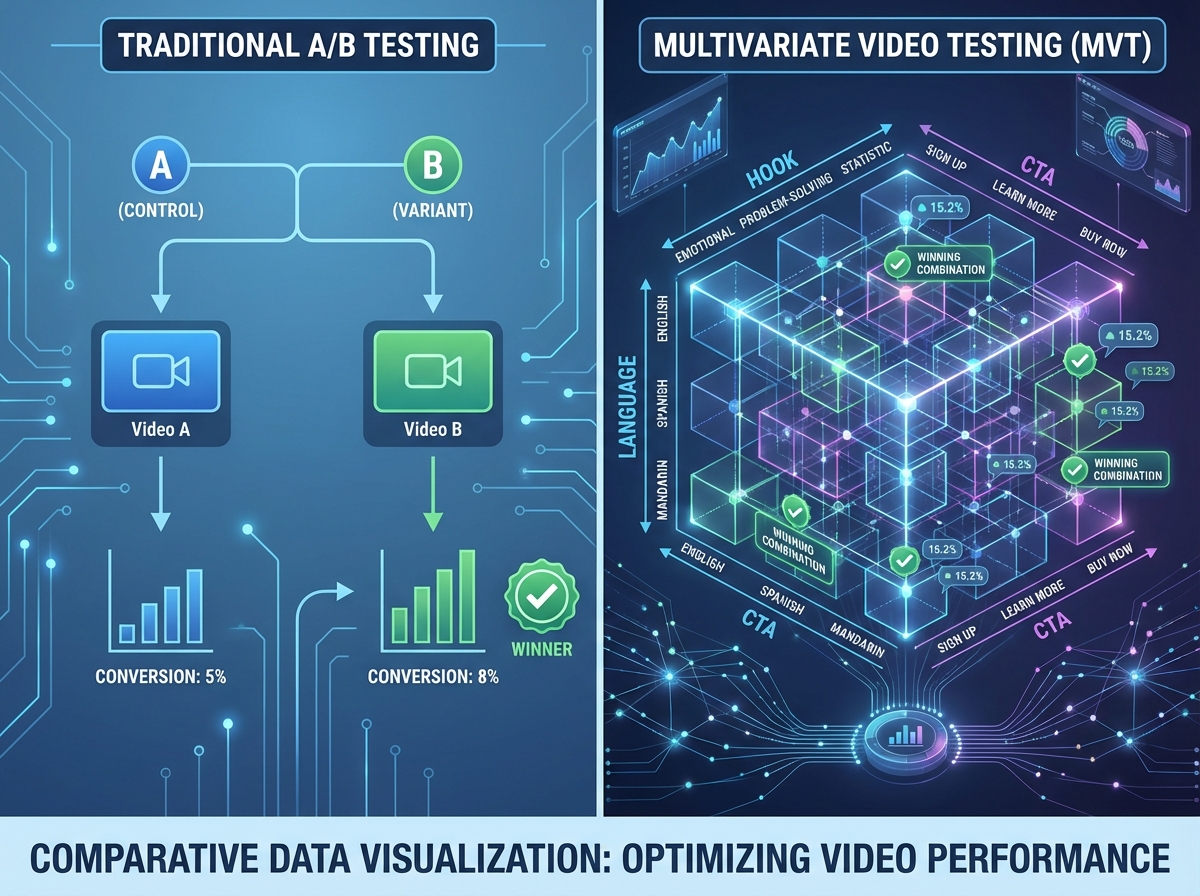
While A/B testing is useful for final validation, it is inefficient for the discovery phase of creative optimization. This is where multivariate video testing methodology becomes the superior choice for performance marketing video testing.
Why MVT Wins in 2026
Traditional A/B testing requires you to isolate one variable at a time. If you want to test 3 hooks, 2 voiceovers, and 2 CTAs, you would need 12 separate A/B tests. Multivariate testing allows you to test these simultaneously, identifying not just the best individual elements, but the interactions between them. For instance, you might find that a “Social Proof Hook” works best with a “Female Voiceover,” but a “Discount Hook” performs better with a “Male Voiceover.”
Fractional Factorial Design
To manage the “curse of dimensionality” (where too many variants require impossible amounts of traffic), we use Fractional Factorial Design. This statistical method allows us to test a subset of all possible combinations while still accurately estimating the main effects of each factor.
Example Test Plan for an Indian D2C Brand:
- Objective: Increase CVR by 15% for Tier-2 city buyers.
- Factors:
- Hook (Social Proof vs. Price-Drop)
- Language (Hindi vs. Hinglish)
- Aspect Ratio (9:16 vs. 1:1)
- Design: A 2x2x2 full factorial would be 8 cells. Using a fractional design, we might run 4 cells that are mathematically balanced to provide 90% of the insight at 50% of the cost.
Statistical Significance and Sample Size
Running statistical significance video campaigns requires a pre-calculated sample size. Using a video ad testing sample size calculator, we determine the required impressions based on:
- Baseline Metric: (e.g., 1.2% CTR)
- Minimum Detectable Effect (MDE): (e.g., 15% relative lift)
- Alpha (Confidence): (0.05 for 95% confidence)
- Power: (0.80 to ensure we don’t miss a real effect)
Source: VWO A/B Test Sample Size Calculator
Source: Sequential Testing Correction - VWO
5. Sequential Testing Video Campaigns and Platform Playbooks
One of the biggest mistakes in creative testing is “peeking”—checking results early and stopping a test because it “looks” like a winner. In 2026, we use sequential testing video campaigns to allow for safe interim analysis without inflating false positives.
The SPRT Approach
The Sequential Probability Ratio Test (SPRT) allows us to monitor data as it accumulates. We set “boundaries” (Pocock or O’Brien–Fleming) that define when a result is statistically significant enough to stop the test early for efficacy or futility. This can reduce testing time by up to 30%, allowing budget to be reallocated to winning creatives faster.
Meta Video Ad Scientific Testing
On Meta, the focus is on clean randomization. We utilize “Split Testing” features that ensure mutual exclusion—meaning a single user never sees two different versions of the same test.
- CAPI Integration: Server-side event tracking is mandatory in 2026 to bypass browser-level privacy restrictions.
- Factor Naming: Use standardized naming conventions like [Test_ID]_[Hook_A]_[VO_Hindi]_[CTA_Shop] to allow BI tools to aggregate data automatically.
YouTube and Programmatic
YouTube’s 2026 landscape requires a focus on “Shorts” optimization. YouTube Shorts automation with AI. With the platform’s new AI-driven parental controls and brand safety filters, creatives must be pre-vetted for compliance. Solutions like Studio by TrueFan AI demonstrate ROI through their built-in moderation layers, ensuring that every variant generated for a YouTube experiment is already compliant with the latest platform policies.
Source: VWO on Peeking and Significance
Source: YouTube Shorts Automation AI - TrueFan AI
Source: Video Personalization ROI Metrics - TrueFan AI
6. Compliance-by-Design and ROAS Optimization
In 2026, ROAS optimization video testing is inextricably linked to compliance. IPL brand video personalization
India’s AI Governance Framework (2026)
Marketers must now adhere to the “Techno-Legal” guidelines:
- AIGG (AI Governance Group): Oversees the ethical use of AI in advertising.
- TPEC (Technology & Policy Expert Committee): Provides the technical standards for AI watermarking and disclosure.
- AISI (AI Safety Institute): Conducts audits on AI models to ensure they don’t perpetuate demographic biases—a critical factor in a diverse nation like India.
Creative Testing Best Practices 2026
To maximize ROAS while remaining compliant:
- Pre-register Tests: Document your hypotheses and stopping rules before launching.
- Use Licensed Assets: Only use AI avatars that are fully licensed and consent-first to avoid intellectual property disputes.
- Automate Moderation: Use real-time profanity and policy filters during the generation phase.
- Tiered Testing: Start with high-level factor testing (MVT) and move to granular A/B testing for the final 5% optimization.
The Role of Data Ops
India’s AI data ecosystem has matured, with specialized providers now offering clean, labeled datasets for performance analysis. Ensuring your data pipeline is integrated with your creative production tool is the final step in achieving AI video experiment automation.
Source: India AI Governance Guidelines - IndiaAI.gov
Source: AI Data Service Providers India 2026 - Monisa Enterprise
Source: AI Video Moderation Tools Guide - TrueFan AI
Conclusion: The Path to Scientific ROAS
The AI video split testing framework India 2026 represents the pinnacle of performance marketing maturity. By combining the speed of AI video experiment automation with the rigor of statistical significance video campaigns, Indian brands can finally stop guessing and start scaling.
As media costs continue to rise, the ability to scientifically isolate and replicate winning creative factors is the only sustainable competitive advantage. Whether you are optimizing for Meta’s latest algorithm or navigating the complexities of India’s AI governance, a disciplined, data-driven approach to creative testing is your roadmap to ROAS in 2026.
Final Word: To begin operationalizing this framework, start by auditing your current creative production pipeline. If you aren’t testing at least 5 variants per campaign wave, you are leaving ROAS on the table.
Frequently Asked Questions
How many variants should I test in a single multivariate video campaign?
In 2026, for a standard India-wide campaign with a daily spend of ₹50,000, we recommend a fractional factorial design with 4–8 variants. This provides enough power to detect a 15% lift within 10–14 days without spreading the budget too thin.
Does the new 2026 AI Governance framework apply to all video ads?
Yes, any ad utilizing synthetic media (AI avatars, cloned voices, or AI-generated backgrounds) must comply with AIGG disclosure requirements. This includes clear watermarking and metadata tagging that identifies the content as AI-augmented.
What is the most important metric for video creative testing in India?
While ROAS is the ultimate goal, the “3-second hold rate” is the most critical diagnostic metric. In the Indian market, if you don’t capture attention in the first 3 seconds, your downstream conversion metrics (CVR, CAC) will inevitably suffer.
How does automation help in creative testing?
AI video experiment automation through tools like Studio by TrueFan AI allows for the rapid generation of factor-level variants (hooks, CTAs, VOs) which are then tagged for automated performance analysis. This reduces the time from “hypothesis” to “insight” from weeks to hours.
Can I use sequential testing on Meta and YouTube simultaneously?
While you can run tests on both, you should not aggregate the data. Meta and YouTube have different auction dynamics and user behaviors. A “winner” on Meta Reels might be a “loser” on YouTube Shorts. Always analyze platform-specific results before attempting a cross-channel synthesis.
What is the “Multiple Comparisons Problem” in video testing?
When you test 20 different variants, there is a high statistical probability that one will “look” like a winner purely by chance. In 2026, we use the Benjamini–Hochberg procedure to control the False Discovery Rate (FDR), ensuring that our “winning” creatives are statistically valid.
Is Hinglish always better than pure Hindi for Indian video ads?
Not necessarily. Our 2026 benchmarks show that while Hinglish dominates in metros like Delhi and Mumbai, pure Hindi (and regional languages like Marathi or Kannada) sees a 22% higher trust score in Tier-3 cities. This is why localized factor testing is essential.



