AI Video Agents India 2026: Building a Multi-Agent, Self-Directing Video Pipeline for Enterprise Growth
Estimated reading time: ~10 minutes
Key Takeaways
- Shift from single tools to multi-agent, self-directing systems that plan, generate, QA, and publish videos at scale.
- Enterprise orchestration with n8n/Make connects CRM, DAM, and vector memory for personalized, compliant video output.
- Governance and safety require real-time moderation, auditability, and consent-first avatar usage aligned to IndiaAI Mission.
- Measurable ROI: faster throughput, lower costs, and higher engagement—evolving from “cost per video” to “cost per conversion.”
The landscape of digital communication in India has reached a definitive inflection point. As we navigate the complexities of the AI video agents India 2026 market, Indian enterprises are no longer merely experimenting with generative tools; they are orchestrating multi-agent, self-directing video pipelines to 10x their content throughput. According to the latest “AIdea of India: Outlook 2026” report by EY, approximately 76% of Indian enterprises are now ready to deploy agentic AI workflows, shifting from isolated pilots to high-performance production environments.
This shift is driven by the need for autonomous content creation agents that can plan, generate, edit, and publish video at a scale previously reserved for global media houses. By leveraging an agentic video production workflow, businesses can move beyond “one-off” video generation to a multi-agent video creation system that operates 24/7, governed by enterprise-grade controls and local compliance standards.
1. The Multi-Agent Lexicon: Defining the 2026 Video Production Stack
To master the AI video agents India 2026 landscape, one must first understand the shift from “tools” to “systems.” In 2026, the industry has moved past simple prompt-to-video interfaces toward sophisticated, self-directing video AI systems.
- Agentic Video Production Workflow: A coordinated system where specialized AI agents handle distinct stages of production—from research and scripting to visual sourcing and quality control—under a central orchestrator.
- Autonomous Video Creation AI: Models and systems capable of completing video production stages without manual intervention, often triggered by external data like CRM updates or market trends.
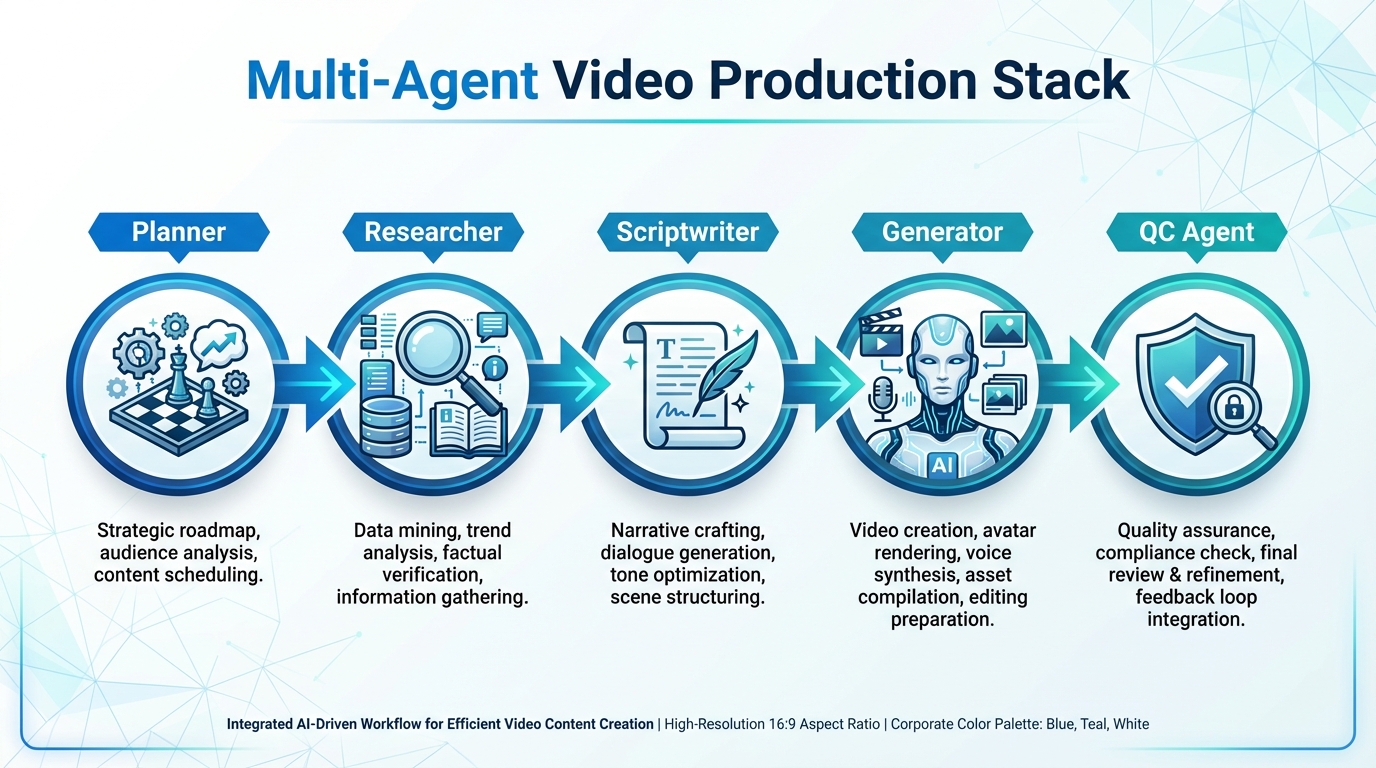
- Multi-Agent Video Creation System: A pipeline of cooperating agents (Planner, Researcher, Scriptwriter, Editor) that exchange structured data to ensure brand consistency and factual accuracy.
- Self-Directing Video AI Systems: Advanced architectures that decompose high-level business goals into subtasks, route work between specialized agents, and self-correct based on feedback loops.
The advantage of a multi-agent approach over single-agent systems is reliability. By specializing agents, enterprises can implement verifiable checkpoints, ensuring that a script is approved by a “Legal Agent” before the “Generator Agent” begins rendering.
Sources:
2. India 2026 Market Context: The Rise of Agentic Orchestration
The momentum for AI video agents India 2026 is anchored in a robust ecosystem of policy, compute, and enterprise readiness. The IndiaAI Mission, spearheaded by MeitY, has accelerated the empanelment of agencies to provide AI compute, ensuring that the infrastructure for “Safe and Trusted” AI is accessible to domestic players.
Key market signals for 2026 include:
- Enterprise Adoption: 47% of Indian enterprises have already moved multiple GenAI use cases into production, with a significant focus on marketing automation and customer experience (EY-CII Report).
- GCC Momentum: 58% of Global Capability Centers (GCCs) in India are actively investing in agentic AI to globalize local innovations.
- Economic Impact: Projections suggest that healthcare alone could save $150 billion annually through AI agents by 2026, with similar ROI patterns emerging in Indian retail and BFSI sectors.
- Startup Maturity: Indian conversational AI leaders like Gupshup have launched extensive libraries of pre-built AI agents, signaling a transition from “hype” to “last-mile adoption.”
Enterprises are now prioritizing contextual, domain-specific agents that plug directly into their proprietary data, moving away from generic, monolithic models. Platforms like Studio by TrueFan AI Real-time interactive AI avatars in India enable these enterprises to bridge the gap between autonomous planning and high-quality, localized video output.
Sources:
- Grand View Research: India AI Agents Market Outlook 2026–2033
- ET CIO: The Shifts Defining AI in 2026
- INDIAai Mission Updates
3. Reference Architecture: The Autonomous Video Pipeline India
Building an autonomous video pipeline India requires a layered architecture that balances creative flexibility with enterprise governance. The core of this system is the orchestration layer, typically managed by AI video orchestration platforms like n8n or Make.com.
The Orchestration Layer
This layer acts as the “brain,” coordinating the following agent roles:
- The Planner: Receives business goals (e.g., “Increase awareness for our new home loan product in Tamil Nadu”) and generates a content brief.
- The Researcher: Scours internal product docs and external market data to provide factual grounding.
- The Scriptwriter: Drafts the narrative, ensuring the tone matches the brand's voice and the language is culturally resonant.
- The Asset Sourcer: Identifies relevant B-roll, logos, and brand assets from the company's Digital Asset Management (DAM) system.
- The Generator: This is where the visual synthesis happens. Studio by TrueFan AI's 175+ language support AI voice cloning for Indian accents and AI avatars provide the photorealistic human element necessary for high-trust sectors like banking and education.
- The QC & Brand Guardrail Agent: Scans the final output for compliance, profanity, and brand alignment before any video is published.
Data & Infrastructure
The pipeline is fueled by a “Memory Layer” (Vector DB) and integrated with CRM/CDP systems. This allows for hyper-personalization—generating unique videos for individual leads based on their lifecycle stage.
Sources:
4. Implementation Playbook: n8n and Make.com Workflows
To operationalize AI video agents India 2026, enterprises are turning to low-code/no-code orchestration. Here is how to build a production-ready AI agent video automation system.
The n8n Video Automation Workflow
n8n is preferred for complex, self-hosted pipelines that require deep integration and custom logic.
- Trigger: A webhook from your CRM (e.g., Salesforce or HubSpot) when a new lead is qualified.
- Logic: The n8n workflow calls an LLM node to draft a personalized script in the lead's preferred regional language (Hindi, Marathi, etc.).
- Generation: The workflow sends a request to the Studio by TrueFan AI API to render a video using a licensed avatar.
- Post-Processing: An FFmpeg node overlays the lead's name and company logo.
- Distribution: The final MP4 is sent via the WhatsApp Business API directly to the lead.
Make.com Video Templates
For teams requiring speed and ease of use, make.com video templates offer a “plug-and-play” approach.
- Template 1: Script-to-Social: A Google Sheet row trigger that generates a video and automatically schedules it for YouTube Shorts and Instagram Reels.
- Template 2: Multi-Format Campaign: A single campaign brief in Airtable that branches out to create 16:9 explainers and 9:16 vertical ads simultaneously.
For organizations just starting, an AI video workflow automation free stack can be built using self-hosted n8n (Docker), Google Sheets as a database, and open-source LLMs. However, as scale increases, migrating to enterprise-grade generation and orchestration becomes critical for maintaining quality and security. Best AI voice cloning software
Sources:
5. Enterprise Governance, ROI, and Strategic Integration
As video production AI agents India become mainstream, the focus shifts from “can we build it?” to “how do we govern it?” Enterprise-grade solutions must align with the “Safe and Trusted” pillars of the IndiaAI Mission.
Governance and Safety
Autonomous content creation agents must operate within strict guardrails. This includes:
- Real-time Moderation: Filtering for prohibited topics, hate speech, and political endorsements.
- Traceability: Using watermarked outputs and maintaining comprehensive audit logs of every video generated.
- Consent-First Models: Ensuring all AI avatars are either licensed virtual humans or digital twins created with explicit consent. Voice cloning emotion control in India
Measuring ROI
Solutions like Studio by TrueFan AI demonstrate ROI through three primary metrics:
- Throughput Efficiency: Reducing the time-to-market for localized campaigns from weeks to minutes.
- Cost Reduction: Lowering the per-video production cost by up to 90% compared to traditional studio shoots.
- Engagement Lift: Personalized, avatar-led videos typically see higher click-through rates (CTR) and retention compared to static images or generic stock footage. Real-time interactive AI avatars in India
By 2026, the “cost per video” metric will be replaced by “cost per conversion,” as agentic systems optimize content in real-time based on performance data.
Sources:
6. The 180-Day Adoption Roadmap for Indian Enterprises
Transitioning to a multi-agent video system requires a phased approach to manage risk and ensure cultural alignment.
- Phase 1 (Days 1–30): The Pilot. Set up a basic n8n video automation workflow for a single use case, such as internal training or weekly product updates. Use manual approval gates for every video.
- Phase 2 (Days 31–90): Scaling with APIs. Integrate Studio by TrueFan AI via APIs to automate the generation of multilingual variants. Connect the pipeline to your CRM for automated lead nurturing. AI voice cloning for Indian accents
- Phase 3 (Days 91–180): Full Autonomy. Implement self-directing features where agents can choose the best-performing templates based on real-time analytics. Harden governance with ISO 27001 and SOC 2 compliant workflows.
By the end of this period, the enterprise will have a fully functional autonomous video pipeline India that serves as a competitive moat in the digital-first market.
Sources:
This strategic guide is designed to help Indian enterprises navigate the complex but rewarding transition to autonomous video operations in 2026.
Frequently Asked Questions
How do I ensure my autonomous video agents don't hallucinate brand facts?
Use a Retrieval-Augmented Generation (RAG) architecture. Your Researcher Agent should only pull data from a verified internal knowledge base or DAM, passing grounded context to the Scriptwriter Agent for factual accuracy and brand consistency.
What is the difference between a single-agent and a multi-agent video system?
A single-agent system attempts scripting, generation, and editing in one pass, often creating errors. A multi-agent system decomposes work into specialized sub-tasks with human-in-the-loop checkpoints, improving reliability and control.
Can I integrate these agents with my existing WhatsApp marketing stack?
Yes. Studio by TrueFan AI's API can trigger video generation and route final MP4s via WhatsApp Business APIs for personalized, large-scale engagement.
How does the IndiaAI Mission impact my deployment of video agents?
It provides a “Safe and Trusted” framework. Adhering to data residency, ethics, and auditability guidance—plus using compliant platforms—keeps deployments aligned with current and emerging regulations.
Is it possible to build an AI agent for YouTube automation that handles everything from ideation to upload?
Yes. Chain a Planner Agent (trends), Scriptwriter Agent, Generator Agent (e.g., Studio by TrueFan AI), and a Publisher Agent (YouTube Data API) for a fully autonomous channel.
When should I choose n8n over Make.com for video orchestration?
Choose n8n for self-hosting, complex branching logic, and predictable costs. Choose Make.com for rapid prototyping and ease of use for non-technical marketing teams.