AI Video Creative Fatigue Solutions India 2026: A D2C Performance Playbook to Auto-Refresh Meta & Google Video Ads and Recover ROAS
Estimated reading time: ~12 minutes
Key Takeaways
- Creative fatigue is the primary performance killer in 2026; ad lifespan can drop below 72 hours for high-spend accounts.
- Adopt an AI-powered refresh workflow to remix master assets into hundreds of fresh, testable variants without new shoots.
- Build a modern performance stack with variation engines, sprint testing, and automated fatigue triggers across Meta and Google.
- Win Tier 2/3 markets with hyper-localized creatives (language, offers, avatars) to extend resonance and lift ROAS.
- Ensure governance and brand safety with licensed avatars, moderation filters, watermarking, and enterprise-grade security.
In the hyper-competitive digital landscape of 2026, Indian D2C brands are facing a silent performance killer: creative fatigue. Implementing effective AI video creative fatigue solutions India 2026 has become the primary differentiator between brands that scale and those that stagnate. As the Indian e-commerce market surges toward a projected US$163 billion valuation by 2026, the sheer volume of content flooding Meta and Google feeds has reduced the average lifespan of a video ad to less than 10 days. For high-spend accounts, this window is often as narrow as 72 hours. When your audience sees the same creative too often, click-through rates (CTR) plummet, cost-per-acquisition (CPA) skyrockets, and your Return on Ad Spend (ROAS) enters a terminal decline.
The traditional response—booking a new studio shoot every two weeks—is no longer financially or operationally viable. Today, ROAS recovery AI video tools India are enabling growth teams to break the cycle of production bottlenecks. By leveraging algorithmic editing and generative AI, brands can now transform a single master asset into hundreds of high-performing variations. This shift from “production-heavy” to “iteration-heavy” workflows is the cornerstone of modern performance marketing.
1. The Anatomy of Ad Decay: Why Targeting Isn't the Problem in 2026
For years, media buyers blamed “bad targeting” for rising CPAs. However, in 2026, the algorithms on Meta and Google have become so sophisticated that the “creative” itself is now the primary targeting lever. According to the Dentsu–e4m Digital Advertising Report 2026, creative quality and relevance now account for over 70% of campaign success. When performance dips, it is rarely a failure of the audience segment; it is a failure of the creative to maintain resonance.
Identifying the Symptoms of Creative Fatigue
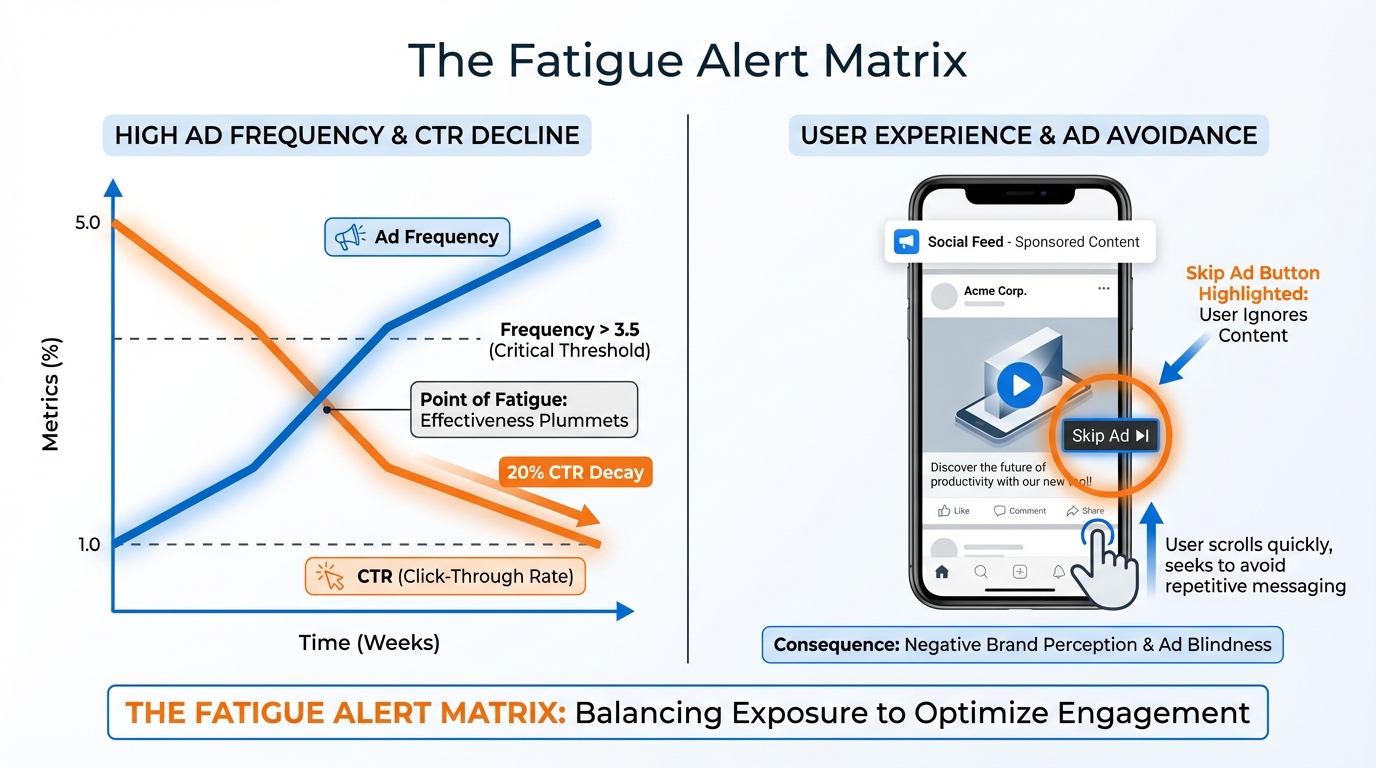
To combat creative fatigue Meta Facebook ads, media buyers must look beyond surface-level metrics. Creative fatigue is defined by a statistically significant CTR decay (typically ≥20% week-over-week) occurring alongside a rise in frequency and stagnant conversion rates (CVR). In the Indian context, where short-video consumption is at an all-time high, fatigue sets in faster due to “content blindness.”
The Fatigue Alert Matrix:
- Frequency Thresholds: If a cohort sees an ad more than 3.5 times in a 7-day window, overexposure is imminent.
- Thumb-Stop Rate Decay: A drop in the 3-second view rate indicates that your “hook” has lost its pattern-interrupt capability.
- CPA vs. CPC Divergence: If your cost-per-click remains stable but your cost-per-acquisition rises, the message is no longer compelling enough to drive action.
As noted by WARC, the saturation of digital spaces in 2026 means that “message wear-out” happens almost instantly. Brands need a creative fatigue Facebook ads solution India that operates at the speed of the feed.
2. The AI-Powered Refresh Workflow: Scaling Without Reshooting
The most significant breakthrough in 2026 is the ability to achieve an automatic creative refresh without production cost. Instead of starting from scratch, performance teams are using AI remix video assets existing to breathe new life into proven winners. This process involves taking a “master” video and programmatically altering its components to create “synthetic” variations that the platform algorithms perceive as fresh content.
How AI Remixing Works
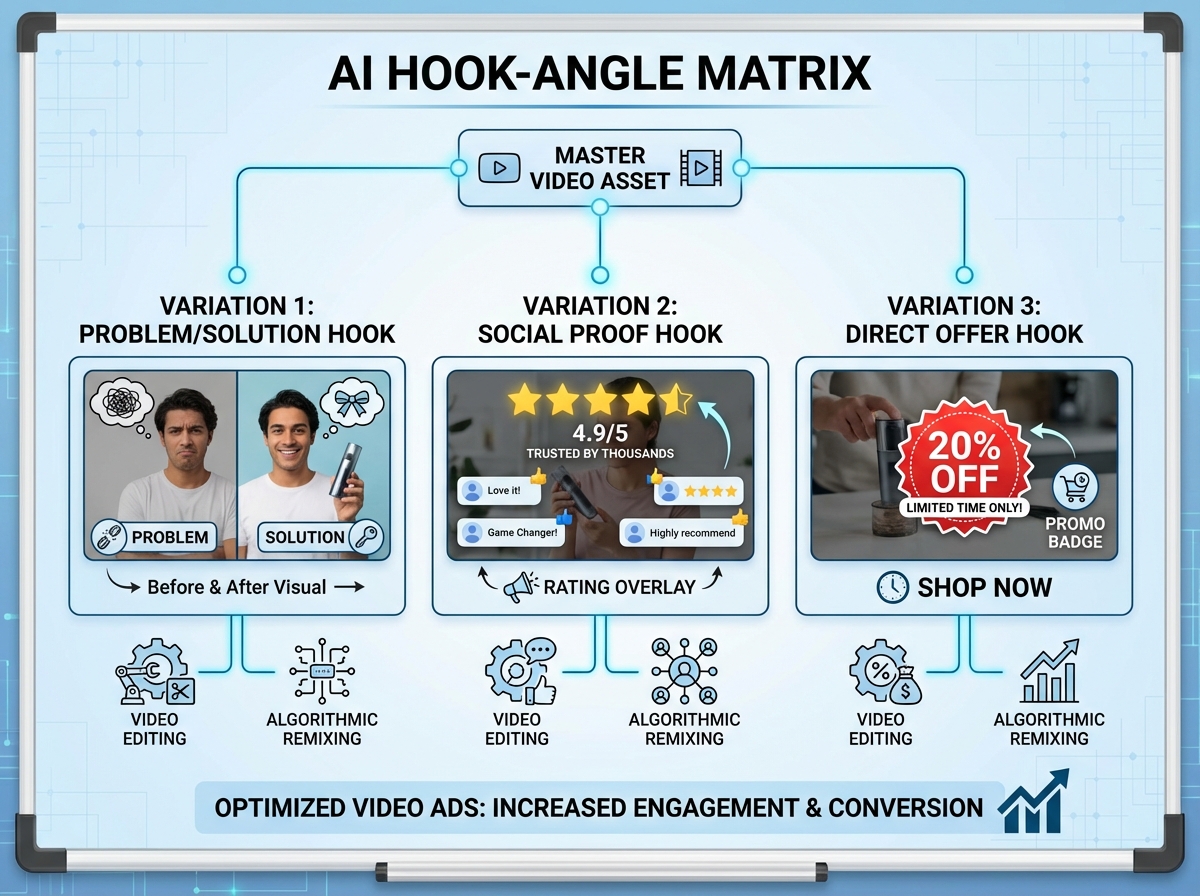
Platforms like Studio by TrueFan AI enable brands to deconstruct a video into its atomic parts: the hook, the body, the offer, and the call-to-action (CTA). By swapping these elements, you can generate a “Hook-Angle Matrix.” For example, a single beauty product video can be remixed into:
- The Problem/Solution Hook: “Tired of dry skin in the Delhi heat?”
- The Social Proof Hook: “Why 50,000 Indian women switched to this serum.”
- The Direct Offer Hook: “Flash Sale: Get 20% off for the next 24 hours.”
This video ad performance decline fix AI approach ensures that the algorithm always has something new to test. By changing just the first 3 seconds (the hook) or the background music, you can extend video ad lifespan AI tools by 200–400%. This is particularly critical during high-velocity periods like the Diwali or Big Billion Days sales, where ad spend is maximized and fatigue happens in real-time.
Atomcomm India reports that brands adopting AI-driven iteration are seeing a 60% reduction in content production timelines, allowing them to pivot strategies in hours rather than weeks.
3. The Modern Performance Stack: Variation Engines and Testing Automation
To manage the volume required for performance marketing creative automation D2C, a robust toolchain is essential. You are no longer just running “ads”; you are managing a creative ecosystem. The goal is to move toward Meta Google video ad refresh automation, where the system identifies a fatiguing ad and automatically swaps it with a pre-approved AI-generated variant.
The Essential Toolchain Components
- AI Hook Variation Generator Multiple Versions: This tool takes your primary value proposition and generates dozens of opening lines, tailored to different psychological triggers (curiosity, fear of missing out, or gain). Explore AI hook variation testing
- Video Ad Variation Generator AI India: A localized engine that not only changes the visuals but also adapts the language, currency (INR), and cultural nuances for different Indian states. See the video ad variation generator
- Video Creative Testing Automation AI Tools: These platforms integrate directly with Meta Ads Manager and Google Ads via API. They run “sprint tests”—spending a small budget on 20+ variants to identify a winner before scaling. Automate creative testing
Studio by TrueFan AI's 175+ language support and AI avatars allow brands to create these variations with professional-grade lip-sync and cloned voices. This level of AI ad creative generator variations scale was previously impossible without a massive localization budget. Now, a brand in Bangalore can launch a hyper-localized campaign in Tamil, Telugu, and Marathi simultaneously, with each video featuring a persona that resonates with the local demographic.
According to Tenjin, by the end of 2026, more than 50% of all digital ad creatives will be AI-generated or AI-enhanced. The “winner-takes-all” advantage goes to the teams that can test the most hypotheses in the shortest time.
4. The 30-60-90 Day Implementation Blueprint for Growth Teams
Transitioning to an AI-first creative workflow requires a structural shift. You cannot simply “buy a tool” and expect ROAS to recover; you must redesign your media buying habits around refresh ad creatives AI automatically bulk capabilities.
Day 0–30: The Foundation
- Asset Audit: Centralize all existing footage, UGC, and testimonials. Tag them by USP and “vibe.”
- The Hook-Angle Matrix: Create a library of 50+ hooks based on category heuristics (e.g., for Fashion: “Style Guide,” “Unboxing,” “Durability Test”). Build your testing matrix
- Integration: Connect your creative engine to your ad accounts to enable Meta Google video ad refresh automation.
Day 31–60: Scale Testing
- The 24x3x3 Rule: For every campaign, generate 24 hooks, 3 different lengths (6s, 15s, 30s), and 3 aspect ratios (9:16, 1:1, 16:9).
- Regional Expansion: Use AI to translate your top-performing English/Hindi ad into the top 4 regional languages. Scale variants by region
- Silent-First Optimization: Ensure all variants have bold, animated captions, as 80% of Indian mobile users watch videos with sound off in public spaces.
Day 61–90: Full Automation & Governance
- Fatigue Triggers: Set automated rules to pause any ad where the CTR drops 25% below the account average over a 3-day period.
- Continuous Iteration: Use the data from your winners to feed the AI hook variation generator multiple versions for the next cycle.
Solutions like Studio by TrueFan AI demonstrate ROI through their ability to cut the “cost-per-variant” from thousands of rupees to pennies, allowing for a “high-frequency, low-risk” testing environment.
5. Regional Dominance: The India-Specific Playbook for 2026
India is not one market; it is a continent of diverse linguistic and cultural preferences. In 2026, a “one-size-fits-all” Hindi ad is a recipe for creative fatigue in non-Hindi speaking states. To truly combat creative fatigue Meta Facebook ads, brands must embrace hyper-localization.
The Localization Strategy
- Linguistic Nuance: AI tools now allow for perfect lip-sync in regional dialects. An ad for a fintech app in rural Maharashtra should not just be “translated” into Marathi; it should use local idioms and feature an avatar that looks and sounds like a local community member.
- The Festival Calendar: India’s retail peaks are tied to festivals (Pongal, Onam, Durga Puja, Eid). AI allows brands to “skin” their existing ads with festival-specific overlays and offers in minutes.
- Price Sensitivity & Trust: Indian consumers are highly responsive to “Value” and “Trust” signals. Use AI to dynamically update price overlays (e.g., “Now at ₹999”) or trust badges (e.g., “1 Million+ Happy Indians”) based on real-time inventory or social proof data.
The IBEF E-commerce Report highlights that the next wave of growth is coming from Tier 2 and Tier 3 cities. These audiences have a higher affinity for video content in their native tongue. By using a video ad variation generator AI India, D2C brands can penetrate these markets without the overhead of regional production houses.
6. Compliance, Brand Safety, and Governance in the AI Era
As AI becomes the engine of creative production, enterprise-grade governance is non-negotiable. Performance teams must ensure that their AI video creative fatigue solutions India 2026 do not compromise brand integrity or legal compliance. Learn about real-time interactive AI avatars in India
Ensuring Ethical AI Usage
- Licensed Avatars: Only use platforms that provide fully licensed, consent-first AI avatars. This avoids the legal minefield of unauthorized deepfakes.
- Moderation Filters: Ensure your AI stack has built-in profanity and brand-safety filters to prevent the generation of off-brand content.
- Watermarking and Traceability: For enterprise accountability, all AI-generated outputs should be watermarked or logged in a centralized system.
- Data Security: Look for certifications like ISO 27001 and SOC 2, especially when handling sensitive brand assets or customer data.
As TalentSprint notes, the 2026 regulatory environment in India is increasingly focused on the transparency of AI-generated media. Brands that prioritize “walled-garden” safety will be better positioned for long-term stability.
7. Conclusion: The Future of ROAS is Algorithmic
The era of the “static” ad is over. In 2026, the brands winning on Meta and Google are those that treat their creative as a living, breathing software product—constantly updated, bug-fixed, and optimized. By implementing AI video creative fatigue solutions India 2026, you are not just “fixing an ad”; you are building a scalable engine for growth. See how AI remixing extends ad lifespan
The transition from manual production to performance marketing creative automation D2C is no longer an “innovation” project; it is a survival requirement. With the ability to refresh ad creatives AI automatically bulk, brands can finally match the velocity of the consumer’s thumb.
Sources:
- IBEF: Indian E-commerce Market Outlook 2026 - IBEF E-commerce presentation
- WARC: The Crisis of Creative Saturation - From relevance to saturation: why ad fatigue is getting worse
- Tenjin: AI Ad Creative Adoption Trends 2026 - 10 reasons to adopt an AI workflow now
- Dentsu-e4m: Digital Advertising Report 2026 - Dentsu–e4m report 2026
- Segwise AI: Multimodal Fatigue Detection - How to catch creative fatigue (2026)
- Atomcomm: AI vs Traditional Video Production in India - How AI video marketing is replacing traditional shoots
Frequently Asked Questions
How does AI handle regional Indian dialects compared to standard languages?
Modern AI engines in 2026 are trained on diverse datasets that include regional nuances. Unlike simple text-to-speech, these tools adapt the tone, cadence, and even the lip-sync movements to match the specific phonetic structure of languages like Tamil, Bengali, or Marathi. Studio by TrueFan AI's 175+ language support and AI avatars ensure that the “digital twin” of the speaker looks natural regardless of the language being spoken, which is crucial for maintaining trust in regional markets.
Will using AI-generated variations hurt my brand’s authentic image?
Quite the opposite. By using AI to remix real UGC (User Generated Content) and testimonials, you are actually scaling authenticity. The AI doesn’t “fake” the content; it reorganizes your real brand assets into formats that are more consumable for the audience. This prevents the “over-polished” look that often leads to ad blindness.
What is the typical ROAS lift after implementing AI creative automation?
While results vary by category, most D2C brands in India see a 15–25% reduction in CAC and a 20–40% lift in ROAS within the first 60 days. This is primarily driven by the “Fatigue Extension” effect—where your best-performing messages stay “fresh” for 3–4x longer because the audience is seeing different hooks and visual variations.
Can I use AI to refresh ads that are already underperforming?
Yes. This is a core part of a video ad performance decline fix AI strategy. Often, an ad underperforms not because the product is bad, but because the “Hook” (the first 3 seconds) failed to stop the scroll. By using an AI hook variation generator, you can take that same “underperforming” video, give it 10 new openings, and often find a version that outperforms your original benchmark.
How do I integrate these AI tools with my existing agency?
Most AI video platforms are designed to be collaborative. Your agency provides the creative strategy, the master scripts, and the high-level brand direction. The AI tool then acts as the production arm that executes the bulk variations. This allows your agency to focus on strategy rather than the manual labor of resizing and subtitling hundreds of videos.