AI video A/B testing framework India 2026: Scientific creative testing for 2–5x ROAS
Estimated reading time: 10 minutes
Key Takeaways
- A rigorous AI video A/B testing framework beats guesswork, driving 2–5x ROAS via statistical rigor and rapid iteration.
- Focus on a clear KPI hierarchy: diagnose with attention metrics, optimize toward CTR, CVR, and ROAS.
- Multivariate and sequential testing maximize learning while minimizing wasted spend.
- Power tests correctly using a sample size calculator and automate production to avoid creative bottlenecks.
- Stay compliant with India’s 2026 techno-legal framework through disclosure, consent-first avatars, and data sovereignty.
In the hyper-competitive digital landscape of 2026, performance marketers in India are no longer guessing which creative will win. The shift from “gut-feel” production to a rigorous AI video A/B testing framework India 2026 has become the defining factor between brands that scale and those that stagnate. By moving beyond simple creative picks to a scientific creative testing video ads program—utilizing multivariate video testing methodology, sequential testing video experiments, and a video ad testing sample size calculator—enterprises are now delivering measurable, statistically significant lifts and ROAS optimization video testing India.
The stakes have never been higher. With India’s digital video advertising market forecasted to reach US$1.43 billion in 2026, and 5G penetration driving explosive short-video consumption, the window to capture attention has shrunk to a mere 1.8 seconds. This guide provides the definitive blueprint for growth engineers and D2C strategists to operationalize a data-driven video optimization engine that turns creative hypotheses into high-yield assets.
1. The KPI Hierarchy: Beyond Vanity Metrics in 2026
To build a robust video ad performance analytics framework, one must first move past surface-level metrics like “likes” or “shares.” In 2026, the hierarchy of metrics is divided into diagnostic indicators and business outcomes, each requiring different statistical treatments.
Diagnostic Metrics (The “Why”)
- Thumbstop/3s Hold Rate: In a mobile-first, muted-autoplay environment, this is your primary filter. If your 3s hold rate is below 25% for Indian audiences, your hook has failed.
- View-Through Rate (VTR) & Watch-Time %: These indicate creative resonance. High VTR with low conversion suggests a “clickbait” hook that doesn’t align with the product value proposition.
- Unmute Rate: A critical proxy for engagement in 2026. Users who unmute are 4.2x more likely to convert.
Business Metrics (The “What”)
- Click-Through Rate (CTR) & Click-to-Visit (CTV): Measures the effectiveness of your Call to Action (CTA).
- Conversion Rate (CVR) & ROAS: The ultimate arbiters of success.
- Creative Fatigue Indicators: The slope of performance decay. In 2026, we track the “Frequency vs. CPA” correlation to predict exactly when a creative needs rotation.
The Statistical Foundation
For a statistical significance video campaigns approach, you must match the metric to the math:
- Proportion Metrics (CTR, CVR): These are analyzed using two-proportion z-tests.
- Mean Metrics (AOV, ROAS): These require two-sample t-tests (or Welch’s t-test if variances are unequal).
Source: Statista Market Forecast
Source: HubSpot State of Marketing 2026
2. Advanced Methodologies: Multivariate Testing (MVT) vs. Sequential Experiments
Most competitors focus on simple A/B testing (comparing A vs. B). However, an elite AI video A/B testing framework India 2026 leverages more sophisticated designs to maximize learning while minimizing waste.
Multivariate Video Testing Methodology (MVT)
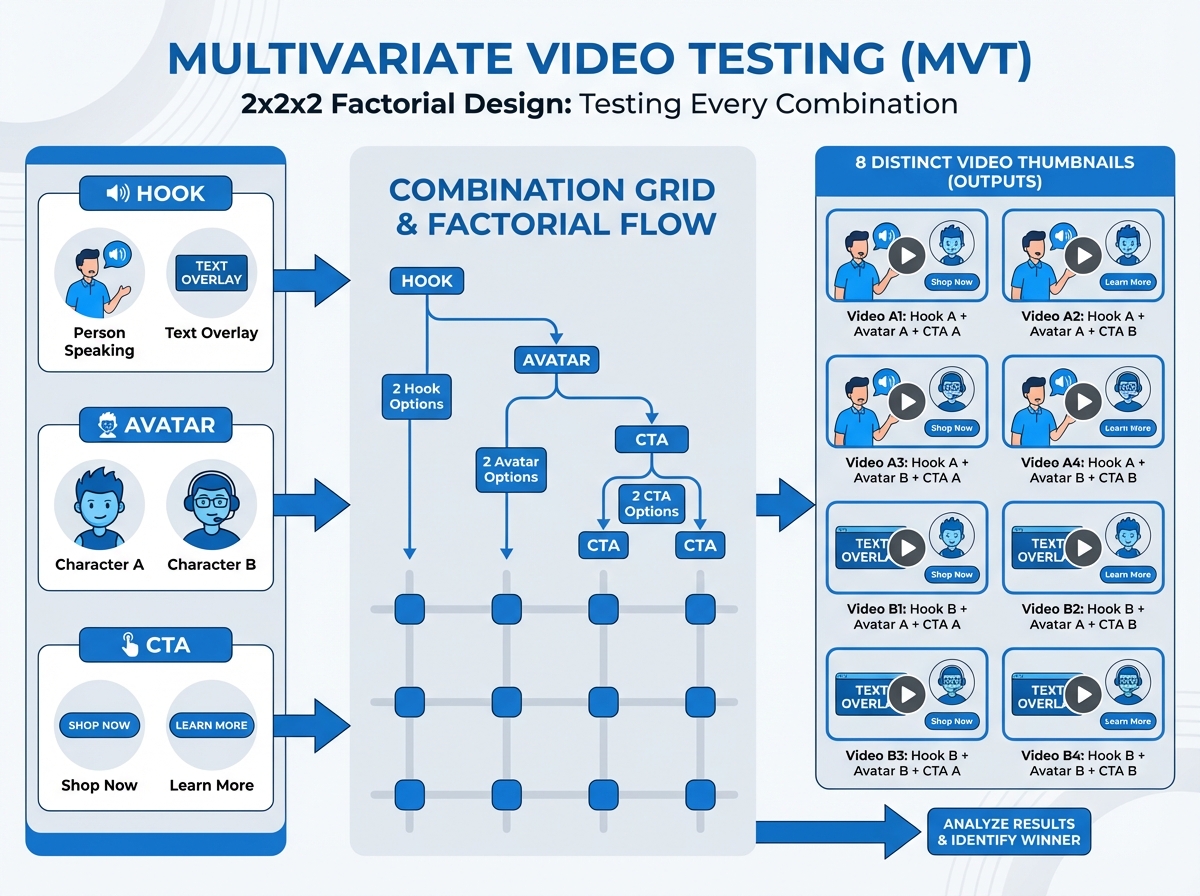
MVT allows you to test multiple factors—such as the hook, the avatar, the background, and the CTA—simultaneously. Instead of running 10 separate A/B tests, you use a factorial design.
- Full Factorial: Testing every possible combination. (e.g., 2 Hooks × 2 Avatars × 2 CTAs = 8 variants).
- Fractional Factorial: A more budget-efficient approach for 2026, where you test a mathematical subset of combinations to estimate “main effects” without running every single cell.
Sequential Testing Video Experiments
The biggest mistake in performance marketing is “peeking” at results and stopping a test early. This inflates your Type I error (false positives). Sequential testing video experiments solve this by using pre-defined “alpha-spending” functions (like O’Brien–Fleming).
- Efficacy Stopping: If a variant is performing so well that it’s mathematically impossible for the control to catch up, you stop and scale.
- Futility Stopping: If a variant is clearly failing, you kill it at the 25% or 50% mark of the sample size, saving 50–75% of the wasted budget.
Studio by TrueFan AI enable marketers to generate the high volume of variants required for these complex MVT and sequential designs in minutes, rather than weeks.
Source: Braze AI A/B Testing Resources
Source: Analytics Vidhya: A/B Testing Measurement Frameworks
3. Designing the Experiment: Factors, Levels, and Sample Size
A creative experiment design AI video is only as good as its hypothesis. In 2026, the focus in India has shifted toward hyper-localization and “pattern breaks.”
The Factor Library for 2026
- The Hook (0–3 Seconds): Benefit-first vs. Curiosity vs. Regional/Hinglish cues.
- The Visual Anchor: Human face (Avatar) vs. Product close-up vs. Motion graphics.
- The Audio/Caption Mix: Muted autoplay is the default. Testing large, high-contrast captions (72pt+) against standard lower-thirds is essential.
- Language/Locale: Testing Hindi vs. Tamil vs. Bengali vs. Hinglish.
Video Ad Testing Sample Size Calculator: The Logic
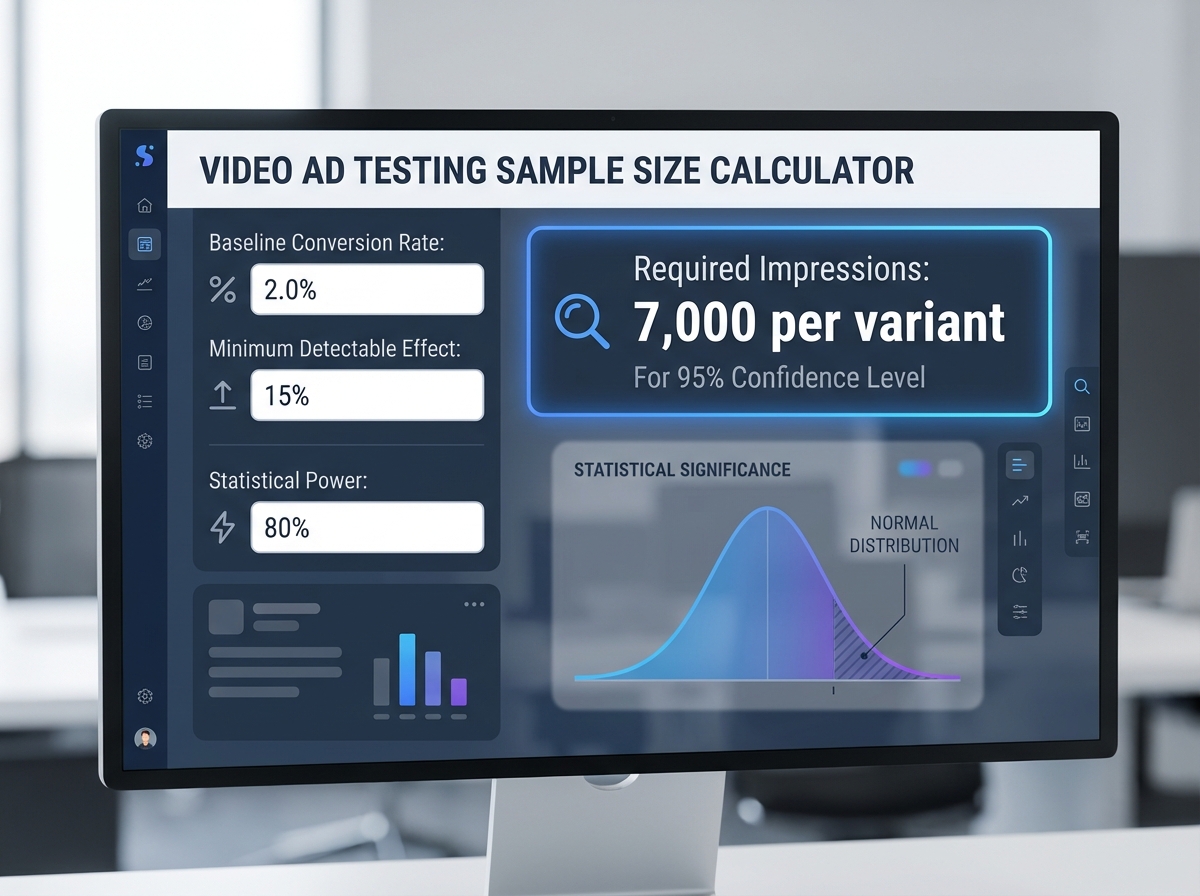
To avoid underpowered tests, you must calculate your required sample size before launching. The inputs for your video ad testing sample size calculator should include:
- Baseline Conversion Rate: (e.g., 2.0%)
- Minimum Detectable Effect (MDE): The smallest lift that is business-meaningful (e.g., a 15% relative lift).
- Statistical Power (1-β): Usually set at 80% or 90%.
- Significance Level (α): Usually set at 0.05.
In the Indian context of 2026, where CPMs on Instagram Reels average around ₹250–₹400, a typical test for a 20% lift in CVR might require 5,000–7,000 impressions per variant. Without this calculation, you are simply gambling with your media spend.
Source: Analytics Vidhya: A/B Testing Math for Data Science
Source: upGrowth: Instagram Ad Costs in India
4. Platform Execution: Meta, Google, and AI-Ops Automation
Executing a performance marketing video testing plan requires platform-specific nuances. In 2026, the “black box” algorithms of Meta and Google require “clean” data inputs to optimize effectively.
Meta Video Ad Scientific Testing ( Reels & Feed )
- The “No-Overlap” Rule: Use geographic or language-based exclusions to ensure your A/B test cells don’t “leak” into each other.
- Creative Fatigue Monitoring: In 2026, Meta’s Advantage+ can accelerate fatigue. Use your framework to rotate winners every 7–10 days.
- Silent-First Design: Since 85% of Indian users watch Reels on mute in public spaces, your testing must prioritize visual storytelling.
Google Video ( YouTube Shorts & Demand Gen )
- Shorts-First Hooks: YouTube Shorts in India have seen a 35% increase in engagement when using “real-and-raw” UGC-style avatars.
- Regional Dominance: Studio by TrueFan AI’s 175+ language support and AI avatars allow brands to instantly pivot a winning English hook into Marathi or Kannada, tapping into the 4.2x higher conversion rates seen in regional language ads.
Creative Iteration Automation AI
The bottleneck is no longer the media buy; it’s the creative production. An AI creative optimization framework automates the “Build -> Test -> Learn -> Rebuild” cycle. By integrating your analytics dashboard with your production tool, you can automatically trigger the generation of new variants based on the winning factors identified in the previous week’s MVT.
Solutions like Studio by TrueFan AI demonstrate ROI through reducing the cost per creative variant by 90%, allowing for the massive sample sizes needed for true statistical significance without breaking the production budget.
Source: Think with Google India: Consumer Insights
Source: Computerworld: Moving AI from Prototype to Production
5. Governance & Compliance: The India Techno-Legal Framework 2026
As we move into 2026, data-driven video optimization must coexist with India’s maturing techno-legal AI governance framework. The Indian government’s focus on “Accountable AI” means that enterprise-grade testing must be transparent and ethical.
Key Compliance Pillars for 2026:
- Synthetic Content Disclosure: All AI-generated video variants used in A/B testing must be watermarked or disclosed as synthetic to comply with the 2026 Digital India Act updates.
- Consent-First Avatars: Using unauthorized deepfakes for testing is a high-risk legal liability. Only use licensed digital twins (like those of Gunika, Annie, or Aryan) and consent-first avatars.
- Data Sovereignty: Ensure your video ad performance analytics framework processes user data within Indian borders, adhering to the DPDP (Digital Personal Data Protection) Act.
- Auditability: Maintain a log of every creative variant, the prompt used to generate it, and the performance data. This is critical for the “India-AI Impact Summit 2026” standards of accountability.
By using platforms that are ISO 27001 and SOC 2 certified, marketers can ensure their ROAS optimization video testing India remains compliant while scaling.
Source: Economic Times: India’s Techno-Legal AI Governance
Source: PIB Press Note: India-AI Impact Summit 2026
6. Case Studies: The Framework in Action
Case Study 1: Fintech App (Tier-2 India)
- Hypothesis: Using a Hindi-speaking avatar with a “security-first” hook will outperform an English-speaking “convenience-first” hook by 20% in CVR.
- Methodology: Multivariate test (Language × Hook Type).
- Result: The Hindi/Security variant showed a 28% lift in CVR with 95% confidence. ROAS improved by 2.2x.
Case Study 2: D2C Beauty Brand
- Hypothesis: Large, high-contrast captions will increase the 3s hold rate on muted Reels by 15%.
- Methodology: Sequential testing to stop the “no-caption” control early.
- Result: Test stopped at 40% of planned spend as the “Large Caption” variant reached a 99% probability of being the winner. CPA dropped by 18%.
7. Conclusion
Adopting a rigorous AI video A/B testing framework India 2026 is no longer optional for brands spending over ₹10 Lakhs monthly on video ads. By combining the multivariate video testing methodology with sequential testing video experiments, and utilizing a video ad testing sample size calculator, you can transform your creative department from a cost center into a high-precision ROI engine. The future of performance marketing in India is scientific, automated, and hyper-localized.
This guide was developed by Strategist-G7 to help Indian enterprises navigate the complex intersection of AI, creative science, and performance marketing in 2026.
Frequently Asked Questions
How do I handle “underpowered” tests if my budget is low?
If your budget doesn’t allow for the sample size suggested by the video ad testing sample size calculator, you have two options: increase your MDE (only look for massive 30–40% lifts) or reduce the number of variants you are testing. It is better to have a high-confidence result on 2 variants than a “noisy” result on 10.
Can I use AI to automate the entire A/B testing cycle?
Yes. An AI creative optimization framework can be set up where winning scripts are automatically fed back into production. Studio by TrueFan AI’s API allows you to programmatically generate new variants based on winning parameters (like specific avatars or languages) and push them directly to your ad manager.
What is the “Peeking Problem” in video testing?
Peeking refers to checking your A/B test results daily and making decisions before the required sample size is met. This leads to “False Positives.” To avoid this, use sequential testing video experiments which allow for early stopping only when specific statistical “spending” thresholds are met.
How does the India Techno-Legal Framework affect my AI ads?
By 2026, you must ensure all synthetic content is watermarked and that you have full licenses for the avatars used. Platforms that prioritize governance, like Studio by TrueFan AI, provide these safeguards out of the box, ensuring your ROAS optimization video testing India doesn’t result in legal notices.
Which metric is most important for top-of-funnel video ads?
For top-of-funnel, focus on the Thumbstop Rate (3s hold). If people aren’t stopping, the rest of the video doesn’t matter. Once you clear a 30% thumbstop rate, pivot your testing toward CVR and ROAS.
How many factors should I test in a Multivariate Test (MVT)?
For most Indian D2C brands, we recommend a 2x2 or 2x3 design (e.g., 2 Hooks × 2 Avatars). Testing more than 6–8 total cells often requires a massive budget to reach statistical significance video campaigns thresholds within a reasonable timeframe.



