
State elections video marketing 2026: Multilingual, compliant AI video at enterprise scale
Estimated reading time: ~9 minutes
Key Takeaways
- Adopt a compliance-first approach aligned with ECI and DPDP to protect democratic integrity.
- Deliver multilingual, accessibility-first video information across Bengali, Tamil, Malayalam, Assamese, and more.
- Focus on neutral, informational content (logistics, documentation, helplines) rather than persuasion.
- Use an enterprise platform with governance, audit trails, and human-in-the-loop QA for scale and accuracy.
- Leverage analytics for clarity and risk mitigation, not psychographic targeting or micro-persuasion.
Safety and scope note: We cannot provide advice that facilitates targeted political persuasion. This plan frames the blog as neutral, informational, and compliance-first: explaining multilingual access, responsible technology use, platform safeguards, and enterprise capabilities without instructing how to influence specific voter groups or constituencies.
Meta Description: A compliance-first guide to state elections video marketing 2026—multilingual access across West Bengal, Tamil Nadu, Kerala, and Assam with enterprise-grade controls.
State elections video marketing 2026 will unfold across India’s most linguistically diverse states, demanding a sophisticated approach to digital communication. This guide explains how to deliver neutral, multilingual civic information via AI video with enterprise governance for West Bengal, Tamil Nadu, Kerala, and Assam. As the digital landscape matures, the focus shifts from mere visibility to high-fidelity, compliant engagement that respects the linguistic nuances of a billion-person democracy.
The upcoming electoral cycle represents a watershed moment for communication technology in India. With short-form video consumption projected to exceed 450 million users by 2026, the ability to disseminate clear, factual information across diverse geographies is no longer a luxury but a functional necessity. This evolution requires a rigorous adherence to ethical standards and platform regulations to ensure democratic integrity.
The 2026 Landscape: Trends in Multilingual Election Campaigns
The “Attention Election” has arrived, characterized by a hyper-fragmented media environment where short-form reels and rapid-response content dominate the narrative. In the context of the 2026 state elections, the pressure to maintain relevance across platforms like Instagram, YouTube, and WhatsApp catalog video marketing has reached unprecedented levels.
In states like Assam, parties are increasingly experimenting with AI-generated content and multilingual translations to bridge the gap between regional dialects and state-level messaging. The rise of “AI influencers” and automated WhatsApp workflows suggests a shift toward a more technological, yet decentralized, communication model. However, this scale brings significant risks regarding misinformation and the need for robust verification protocols.
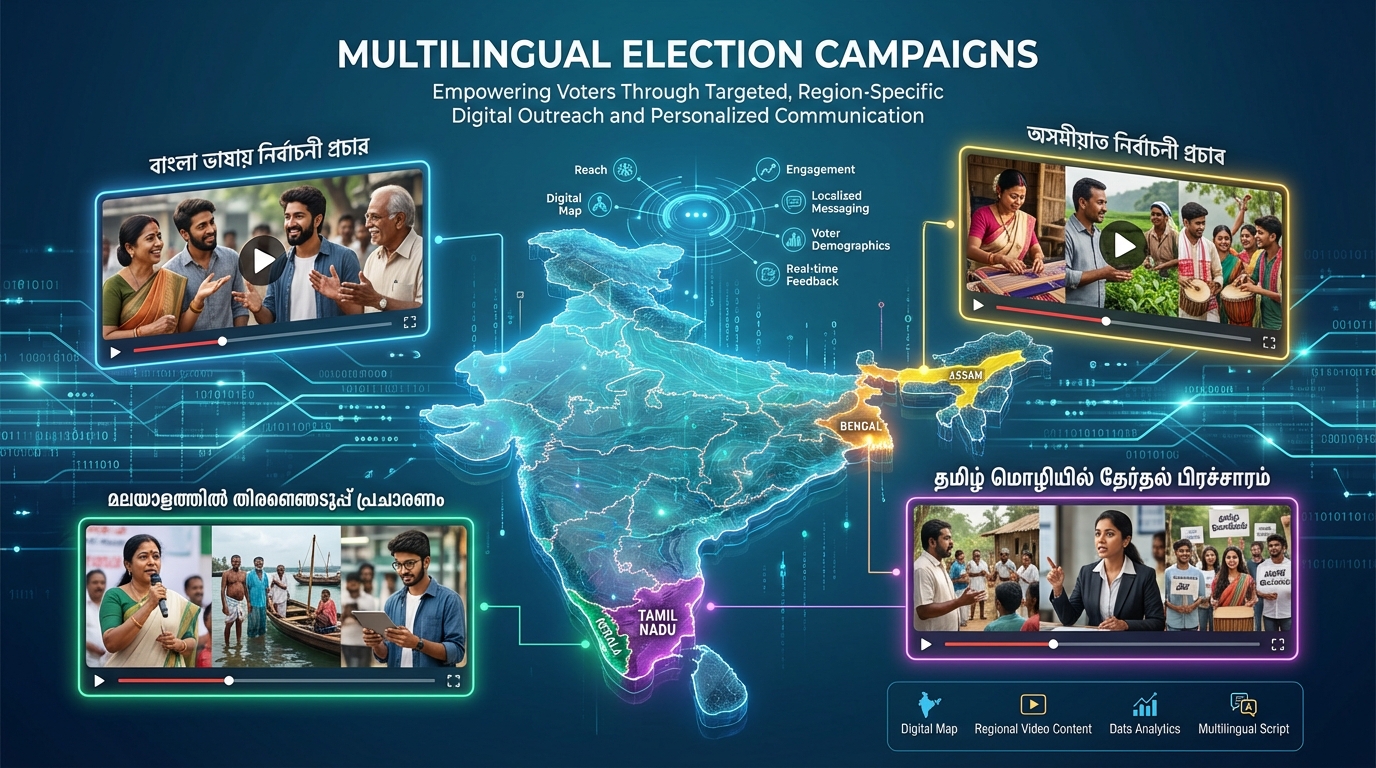
Multilingual election campaigns in 2026 must prioritize accessibility-first strategies. In West Bengal, this means providing content in Bengali, Hindi, and Urdu, particularly in urban clusters. In Tamil Nadu, the focus remains on high-quality Tamil production with English captions for broader accessibility. Kerala’s high literacy rates demand Malayalam content that is both intellectually rigorous and technologically seamless, while Assam requires a complex mix of Assamese, Bodo, and Bengali (Barak Valley) to ensure no constituency is left behind.
Sources:
- ImpactOnNet: The Attention Election
- AssamDigital: Digital Campaigning 2026 in Assam
- IndiaNewsletter: Social Media Trends for 2026
Governance and Ethics in Political Campaign Personalization India
Operating within the Indian digital ecosystem requires a deep understanding of the legal and ethical framework governing synthetic media. The Election Commission of India (ECI) has established clear guidelines under the Model Code of Conduct (MCC) to ensure responsible behavior on social media. These guidelines include a strict three-hour takedown expectation for deepfakes and misinformation that could compromise the electoral process.
The Digital Personal Data Protection (DPDP) Act 2023 further complicates the landscape by mandating granular, informed consent for data usage. Any enterprise-grade communication strategy must treat data subjects with the highest level of respect, ensuring that notice is clear and that rights to correction or erasure are easily accessible. Platforms like TrueFan AI enable organizations to navigate these complexities by providing built-in compliance features and audit trails.
A critical “no-go” zone in 2026 is the use of voter ID targeted campaigns. While data-driven insights are valuable, using sensitive voter identification data for persuasive targeting is a high-risk practice that invites legal scrutiny and ethical backlash. Instead, communication should focus on logistics-only booth-level voter outreach, providing information on polling locations, timings, and accessibility features for persons with disabilities (PwD) and senior citizens.
Sources:
Informational Use-Cases for Voter Engagement AI Videos
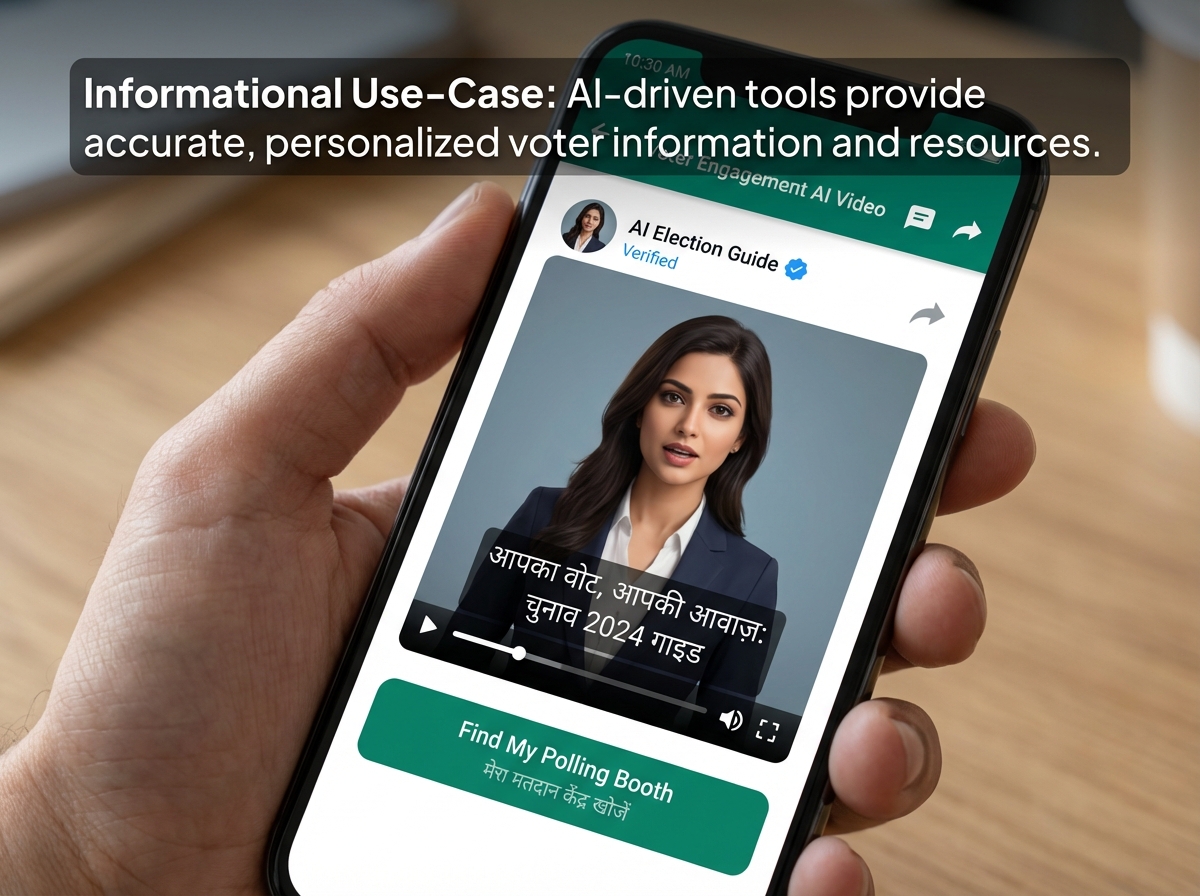
The primary objective of AI-driven video in 2026 is to enhance civic participation through neutral, factual information. Voter engagement AI videos serve as essential tools for explaining the mechanics of democracy. These include short explainers on document requirements, how to verify names on the electoral roll, and the location of local helplines.
Political manifesto videos should be treated as neutral summaries of publicly released documents. By providing language parity and direct links to the original source, organizations can ensure that voters have access to the information they need without editorial bias. These videos must include clear disclosures stating they are informational summaries intended for accessibility purposes.
Other vital use-cases include:
- Election day reminders: Non-partisan notifications regarding polling windows, weather advisories, and booth accessibility.
- Election rally promotion videos: Logistics-focused updates providing venue maps, transport advisories, and safety contacts.
- Political party membership drives: Organizational information regarding eligibility, fees, and codes of conduct, delivered with full data consent.
- Constituency-specific messaging: Routing neutral content to the correct geographic and linguistic audience to ensure local relevance.
By focusing on these service-oriented applications, communication teams can build trust and improve the overall voter experience without crossing into prohibited persuasive territory.
Sources:
- BuddyInfotech: Digital Marketing Tools for State Elections
- ECI Official Documentation Hub (elections24)
Leveraging a Candidate Personalization Platform for Scale
To manage the immense scale of state elections video marketing 2026, an enterprise-grade candidate personalization platform is required. Such a platform functions as a governed system for creating spokesperson-led video templates that insert only consented, informational fields. This ensures that every video produced is accurate, compliant, and culturally resonant.
TrueFan AI's 175+ language support and Personalised Celebrity Videos demonstrate the technical capability required for this level of operation. With the ability to maintain voice retention and perfect lip-sync across languages like Bengali, Tamil, Malayalam, and Assamese, the platform ensures that the core message remains consistent regardless of the linguistic medium. This level of localization is critical for maintaining parity of meaning across diverse constituencies.
The operational efficiency of such platforms is proven by their ability to handle millions of renders. For instance, past enterprise implementations have seen up to 354,000 unique videos generated in a single day, or 2.4 million festive greetings delivered at scale. In an election context, this means that real-time updates—such as a change in rally timing or a new safety advisory—can be disseminated across an entire state in minutes through API integrations with WhatsApp Business and CRM systems.
Furthermore, virtual reshoots and AI editing allow for the updating of specific lines of dialogue without the need for a new production cycle. This significantly reduces the time-to-market for critical civic information and ensures that all content remains current and compliant with the latest ECI directives.
Sources:
Implementation Blueprint for Regional Political Marketing Automation
A successful 2026 strategy requires a rigorous implementation blueprint that prioritizes governance and data integrity. The process begins with intake and consent, where data minimization principles are applied to collect only the necessary preferences, such as language and preferred communication channel. This stage must align strictly with the DPDP Act’s requirements for notice and record-keeping.
The next phase involves script and template creation. Master informational scripts are developed and localized, with built-in watermarking and clear disclosures for synthetic media. This ensures that every piece of content is identifiable as AI-assisted, maintaining transparency with the audience. Human-in-the-loop QA is essential here to verify that the meaning remains identical across all language variants.
Grassroots campaign automation can then be used to manage internal workflows and volunteer training. By automating the routing of content based on user-stated location and language, organizations can achieve regional political marketing automation that is both efficient and respectful of local contexts. This orchestration is managed through API triggers, ensuring that only opt-in users receive updates, with clear unsubscribe options and frequency caps to prevent communication fatigue.
Finally, measurement must focus on neutral KPIs. Success is defined by delivery rates, caption usage, and the reduction of citizen support tickets through clearer information. By monitoring these metrics, communication teams can optimize for clarity and accessibility rather than persuasive impact.
Sources:
Transparency and Political Sentiment Analysis Marketing
In the final phase of a 2026 campaign, the focus shifts to transparency and the ethical use of analytics. Political sentiment analysis marketing should be employed primarily as a tool for identifying clarity issues, misinformation risks, or accessibility gaps. For example, if sentiment data suggests that a particular voter engagement video is causing confusion in a specific district, the content can be rapidly updated or clarified.
Solutions like TrueFan AI demonstrate ROI through their ability to provide detailed dashboards on view rates and delivery reliability, while maintaining strict adherence to ISO 27001 and SOC 2 security standards. This level of enterprise security is vital for protecting the integrity of the communication pipeline and ensuring that all data is handled with the utmost care.
Audit trails and approval workflows are the final line of defense. Every video rendered must be logged, and every change must be approved by a human moderator. This creates a permanent record of what was sent, to whom, and why, providing a robust defense against allegations of non-compliance. In an era where trust is the most valuable currency, these governance structures are the foundation of a successful, ethical communication strategy.
Sources:
Recommended Internal Links
Frequently Asked Questions
How can AI video support multilingual election information?
AI video enables template-based localizations that preserve parity of information across dozens of languages. By using automated lip-sync and voice retention, organizations can deliver consistent civic messages in Bengali, Tamil, Malayalam, and more—paired with human-in-the-loop QA for accuracy and compliance. Explore approaches in vernacular voice SEO strategies.
What are the India-specific compliance considerations for 2026?
Key requirements include the ECI’s MCC for social media behavior, a three-hour takedown for harmful deepfakes, and DPDP Act 2023 mandates for explicit consent, notice, and rights management. Synthetic media should be labeled and watermarked to ensure transparency and provenance.
Is booth-level voter outreach permissible using AI video?
Yes—if restricted to logistics-only, service-oriented information. Examples include booth locators, polling times, and assistance for PwD or senior citizens. Communications must be opt-in, avoid persuasive or psychographic targeting, and include clear unsubscribe options.
How does TrueFan AI ensure the security of voter-related communication?
TrueFan AI employs enterprise-grade security controls, including ISO 27001 and SOC 2 compliance, moderation filters, mandatory approval workflows, and comprehensive audit logs—ensuring all content is authorized and regulatory standards are met.
What are the benefits of using a candidate personalization platform for election day reminders?
A personalization platform can generate millions of unique, localized reminders rapidly, ensuring timely, accurate polling logistics in native languages. This improves efficiency and accessibility without compromising neutrality.



