Climate adaptive marketing India 2026: How appliance and FMCG enterprises turn extreme weather into health-positive growth
Estimated reading time: ~12 minutes
Key Takeaways
- Climate adaptive marketing aligns real-time weather, AQI, UV, and WBGT data with products, content, and offers to drive health-positive outcomes.
- Temperature-triggered offers and regional logic boost conversions while safeguarding consumer trust during heat waves.
- Localized health impact visualization videos scale education and relevance across 175+ languages and regions.
- Brands win by pairing responsible cooling and water conservation nudges with financing incentives and inventory-aware automation.
- An integrated extreme weather commerce tech stack powers data ingestion, decisioning, dynamic content, and omnichannel activation.
Executive Summary
Climate adaptive marketing India 2026 is the enterprise practice of using real-time and forecasted weather, air quality, heat index/WBGT, and UV data to dynamically personalize products, offers, and videos by region, with safety-first health education that drives responsible commerce outcomes. By integrating weather prediction commerce and temperature-triggered offers, brands increase relevance, conversions, and trust during heat waves while promoting sustainable cooling solutions and health-positive behavior in an increasingly volatile environmental landscape.
The year 2026 marks a definitive shift in the Indian consumer landscape, where environmental volatility is no longer a seasonal anomaly but a core driver of enterprise strategy. As the India Meteorological Department (IMD) projects a significant increase in the frequency and intensity of heat waves across both traditional hotspots and coastal metros, the discipline of climate adaptive marketing India 2026 has emerged as the primary framework for resilient growth. Enterprises in the appliance and FMCG sectors are moving beyond reactive “summer campaigns” toward a sophisticated model of extreme weather commerce.
This evolution is fueled by a convergence of critical signals. Recent IMD guidance highlights that heat wave criteria are being met earlier in the year, with sub-division warnings now acting as real-time triggers for supply chain and marketing automation. Simultaneously, the Central Pollution Control Board (CPCB) reports that Air Quality Index (AQI) fluctuations are dictating daily health decisions for millions in the Indo-Gangetic Plain. In this context, “extreme weather commerce” is defined as the automated orchestration of merchandising, pricing, and messaging that activates when specific environmental thresholds—such as the Wet Bulb Globe Temperature (WBGT) or UV Index—are breached.
The financial stakes are immense. Global climate adaptation markets are projected to reach a $9 trillion investment opportunity by 2030, with India’s climate industry seeing a 29% increase in overall activity as of late 2025. For Indian enterprises, the transition to weather prediction commerce—using 7-to-10-day IMD outlooks to pre-assemble inventory and media plans—is the difference between capturing a 15% surge in cooling appliance demand and facing out-of-stock crises. By leveraging regional weather targeting, brands are transforming environmental challenges into opportunities for health-positive engagement and sustainable commerce.
Sources:
1. The Data Foundation: Weather Prediction Commerce in 2026
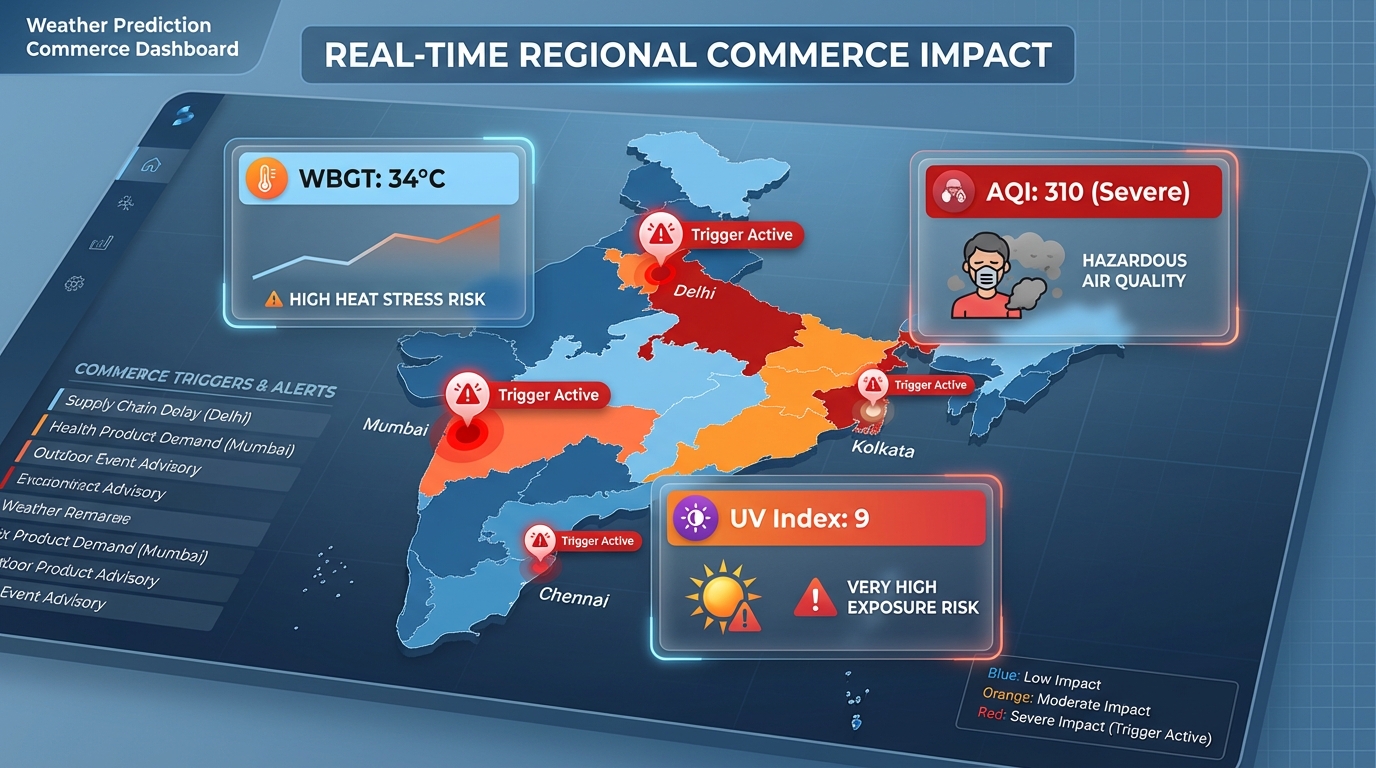
The technical foundation of climate adaptive marketing India 2026 rests on the ingestion of high-fidelity environmental signals. Enterprises must move beyond simple temperature readings to embrace a multi-dimensional data map that includes Heat Index, WBGT, AQI, and UV Index. Each of these signals represents a specific consumer pain point and a corresponding commercial opportunity.
- Heat Index and WBGT: While air temperature is a standard metric, the Heat Index (perceived temperature based on humidity) and Wet Bulb Globe Temperature (WBGT) are superior indicators of human heat stress. WBGT, which incorporates wind speed and solar radiation, is now the gold standard for outdoor activity advisories.
- Air Quality Index (AQI): Following the CPCB’s National Air Quality Index (NAQI) framework, enterprises track pollutants like PM2.5 and PM10. Marketing triggers are set to activate as cities move from “Moderate” to “Poor” or “Severe” bands, shifting focus from general wellness to respiratory protection.
- UV Index: Measured on a scale of 0 to 11+, the UV Index dictates the necessity for sun protection. High-UV alerts (Index 8+) trigger automated campaigns for SPF 50+ products and protective apparel, often 48 hours before the peak radiation occurs.
Weather prediction commerce utilizes these signals to create a “trigger map” at the city or ward-level PIN code resolution. By aligning these triggers with IMD sub-division warnings, enterprises can automate their response to localized weather events. For instance, if the IMD issues an “Orange Alert” for a specific district, the system automatically shifts the creative assets from “lifestyle” to “safety and hydration,” ensuring the brand remains helpful rather than opportunistic.
This granular approach allows for regional weather targeting that respects the vast climatic diversity of the Indian subcontinent. A heat wave in Delhi requires a different product mix (high-tonnage ACs and stabilizers) than a humidity spike in Chennai (dehumidifying detergents and cooling apparel). By normalizing these data streams into a centralized decisioning engine, enterprises ensure that every marketing dollar is spent where the environmental need is greatest.
Sources:
2. Heat Wave Product Personalization and Temperature-Triggered Offers
In the realm of extreme weather commerce, the ability to deliver the right product at the exact moment of environmental stress is a significant competitive advantage. Heat wave product personalization involves tailoring recommendations and bundles to local heat stress levels. This is not merely about showing an ad for a cold drink; it is about a data-driven alignment of inventory with real-time human needs.
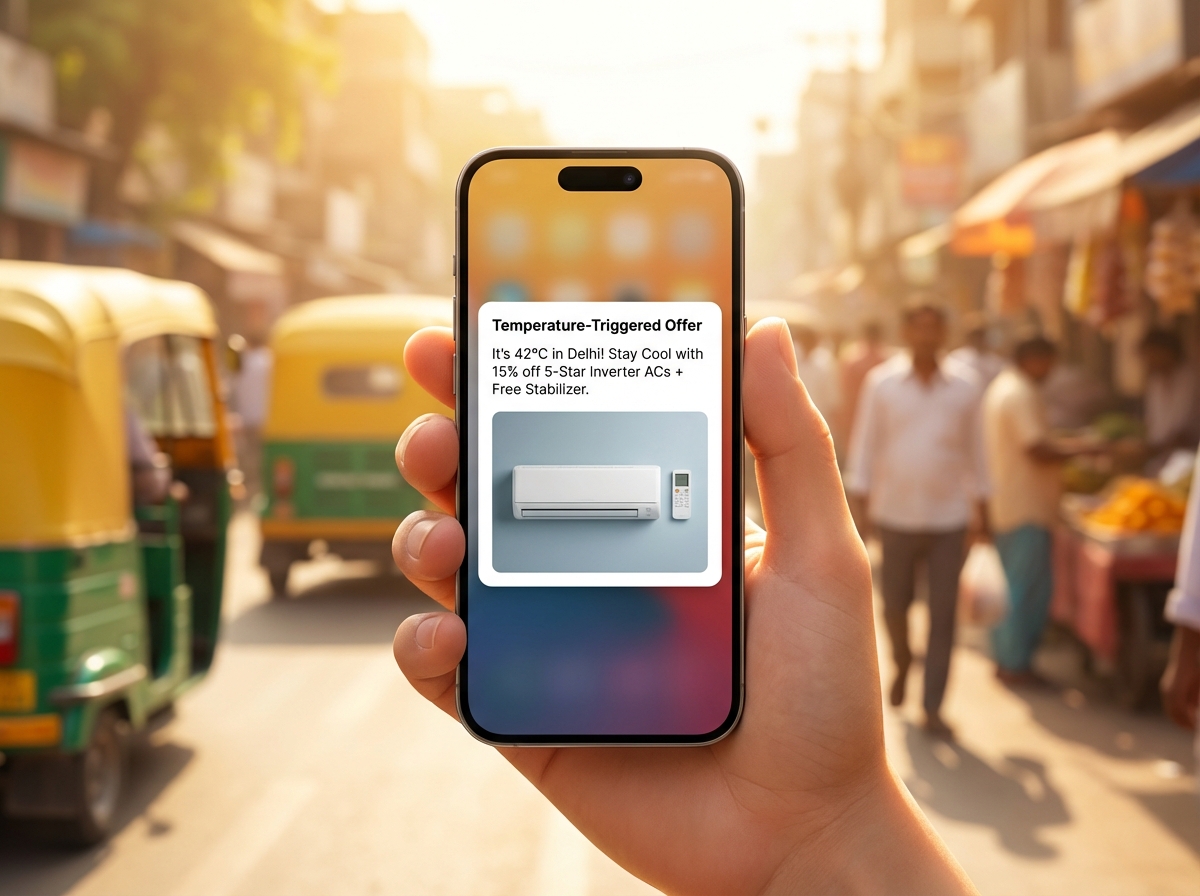
Temperature-triggered offers are the primary mechanism for this alignment. These are automated incentives released when local conditions cross predefined thresholds. For example, an appliance brand might set a trigger for 40°C in Delhi. When this threshold is hit, the enterprise automatically pushes a bundle featuring a BEE 5-star rated AC, a voltage stabilizer, and a smart plug for energy tracking. This approach addresses the consumer's immediate need for cooling while also solving the secondary pain point of rising electricity costs.
Consider the following regional logic for temperature-triggered offers:
- Bengaluru (38–40°C): Focus on air coolers and dehumidifying detergents. Since Bengaluru's infrastructure is often less prepared for extreme heat than northern cities, trial-size suncare add-ons and hydration kits see high conversion rates.
- Mumbai (Nighttime >30°C): Focus on sleep quality. Triggers activate messaging for inverter-tech fans, mattress cooling pads, and hydration reminders delivered via SMS to ensure restorative sleep during “tropical nights.”
- Indo-Gangetic Plain (>42°C): Focus on replenishment. Automated “nudge” campaigns for ORS, electrolytes, and bulk-buy beverage discounts are synchronized with instant-commerce delivery slots to ensure consumers don't have to step out in the heat.
Operational guardrails are essential to maintain brand integrity during these periods. Enterprises must implement inventory-aware triggers to avoid promoting out-of-stock items and “surge caps” to ensure pricing remains fair. Furthermore, sensitivity filters must be in place to pause commercial messaging in the event of red-alert emergencies or reports of heat-related mortality, shifting the tone entirely to public safety and CSR initiatives.
Sources:
3. Health Impact Visualization Videos: The Future of Regional Weather Targeting
One of the most potent tools in the climate adaptive marketing India 2026 toolkit is the use of health impact visualization videos. These are short, data-driven video assets that overlay live environmental risk indicators—such as the Heat Index, AQI, or UV levels—directly onto the creative. This provides immediate, localized context that justifies the product recommendation and educates the consumer on safety.
Platforms like TrueFan AI enable enterprises to generate these videos at a scale previously thought impossible. By integrating real-time data from IMD and CPCB, the system can auto-render videos that show a celebrity or brand ambassador explaining the current local risk. For instance, a video for a user in Lucknow might start with a frame stating, “Today in Lucknow: Heat Index 45°C (Danger),” followed by a personalized recommendation for hydration and a specific cooling product.
TrueFan AI's 175+ language support and Personalised Celebrity Videos allow these messages to resonate across India's diverse linguistic landscape. A farmer in Punjab receives a safety warning in Punjabi, while a tech professional in Hyderabad gets the same data-driven advice in Telugu or English. This level of localization is critical for health-positive marketing, as it ensures that safety instructions are clearly understood and actionable.
The creative schema for these videos typically follows a four-frame logic:
- The Signal: Displaying the local environmental risk (e.g., “UV Index 10: Very High”).
- The Advice: Providing a safety-first recommendation (e.g., “Seek shade between 11 AM and 3 PM”).
- The Solution: Introducing a relevant product (e.g., “SPF 50+ Sunscreen with sweat-resistance”).
- The Offer: A localized CTA with a validity window synced to the weather event.
By using virtual reshoots and AI-driven editing, enterprises can A/B test different safety messages or product variants without the need for expensive additional shoots. This agility allows brands to respond to a sudden dust storm or an unexpected AQI spike within minutes, maintaining a “live” connection with their audience that traditional video production cannot match.
Sources:
4. Air Quality Index Marketing and Sustainable Cooling Solutions
As air quality becomes a year-round concern in many Indian metros, air quality index marketing has evolved into a sophisticated discipline. This involves adapting creative and product positioning based on NAQI levels at a word-level resolution. During the winter-spring transition in Delhi NCR, for example, the focus shifts to air purifier filters, humidifiers, and anti-pollution skincare. The messaging is anchored in CPCB data, providing a transparent and authoritative basis for the commercial offer.
In the Indo-Gangetic Plain, where heat spikes often coincide with particulate matter surges, enterprises are deploying “dual-threat” campaigns. These promote respiratory-friendly home care products alongside fatigue-relief beverages. By acknowledging the compounding effect of heat and pollution, brands demonstrate a deeper understanding of the consumer's lived reality, moving from a “product seller” to a “resilience partner.”
Parallel to this is the promotion of sustainable cooling solutions. With India’s energy efficiency drive in full swing, enterprises are using heat waves as an opportunity to educate consumers on BEE star ratings and inverter technology. Campaigns emphasize optimal temperature settings (24–26°C) and the use of smart timers to reduce peak load stress on the national grid.
This “responsible cooling” narrative is particularly effective when paired with financing nudges. During a heat alert, an enterprise might offer an instant “Green Credit” or a trade-in bonus for old, inefficient AC units. This not only drives sales of high-margin, efficient appliances but also aligns the brand with national sustainability goals. The tone is one of “comfort without compromise,” positioning the brand as a leader in both consumer well-being and environmental stewardship.
Sources:
5. UV Protection Marketing Automation and Water Conservation Product Offers
The increasing intensity of solar radiation has made UV protection marketing automation a necessity for skincare and apparel brands. By setting triggers based on the UV Index (0–11+), enterprises can automate the delivery of safety messages and product offers. When the UV Index is forecasted to hit 8 or higher, the system triggers campaigns for high-SPF sunscreens, wide-brimmed hats, and UV-protective clothing.
This automation is most effective when it includes a 48-to-72-hour forecast. By pre-educating consumers about an upcoming “UV Spike,” brands can ensure that customers are stocked up before the risk peaks. This forward-looking approach, a hallmark of weather prediction commerce, shifts the consumer's mindset from reactive purchase to proactive protection.
Simultaneously, water stress has become a top adaptation priority for 2026. S&P Global identifies water scarcity as a critical flashpoint for enterprises, particularly in drought-prone districts. Climate adaptive marketing India 2026 addresses this through water conservation product offers. This includes:
- Rinse-less Detergents: Promoting personal care and laundry products that require minimal water in regions facing scarcity alerts.
- Eco-Cycle Education: Incentivizing the use of “Eco” or “Quick Wash” cycles on washing machines during periods of water stress, often paired with discounts on water-leak detection accessories.
- Greywater Reuse Tips: Providing actionable advice on how to reuse appliance water for gardening or cleaning, reinforcing the brand's commitment to resource conservation.
By tying these offers to real-time drought stress data, enterprises demonstrate a high degree of regional sensitivity. This not only drives the adoption of climate resilience products but also builds long-term brand equity as a socially responsible actor in the face of environmental crisis.
Sources:
6. Climate Resilience Products and Heat Stress Prevention Marketing
The ultimate goal of climate adaptive marketing India 2026 is to facilitate the adoption of climate resilience products. These are SKUs specifically designed to protect people and property from climate hazards, ranging from reflective roof paints and shade canopies to cooling apparel and portable hydration stations. Marketing these products requires a “safety-first” approach known as heat stress prevention marketing.
This strategy prioritizes health-positive actions—such as seeking shade, resting, and hydrating—over direct sales pitches. By anchoring communications on WBGT levels and IMD “Red Alerts,” brands provide a public service that naturally integrates their product solutions. For example, a hydration brand might launch a “Worker Safety Kit” campaign, providing outdoor workers with rest-shade-hydrate protocols alongside offers for electrolyte-enriched beverages.
Hydration reminder personalization is a key tactic within this framework. Using SMS, WhatsApp, or app pushes, enterprises can nudge consumers to increase their fluid intake when the Heat Index crosses dangerous thresholds. These journeys are often dayparted:
- Morning: “Pre-hydrate” reminders with a local temperature outlook.
- Noon: “Top-up” nudges with salt-replenishment advice (ORS/Electrolytes).
- Evening: “Recovery” tips to prepare for the next day's heat.
These micro-journeys are often paired with instant-commerce tie-ins, showing the nearest store availability or providing a discount code that expires as the heat wave subsides. By focusing on the “prevention” aspect of heat stress, enterprises move beyond transactional relationships to become an essential part of the consumer's daily survival and comfort strategy.
Sources:
7. The Enterprise Tech Stack: Implementing Extreme Weather Commerce
Successfully executing climate adaptive marketing India 2026 requires a robust, integrated tech stack that can handle real-time data ingestion and automated content assembly. The blueprint for Indian enterprises involves four critical layers:
- Data Ingestion Layer: Connecting to official streams from IMD (Mausam), CPCB (AQI), and international environmental sensors. This data must be normalized by city and PIN code to allow for hyper-local activation.
- Decisioning Layer: A rules-based engine that applies thresholds (e.g., “If Temp > 40°C AND Inventory > 20%, THEN activate Bundle A”). Advanced models also incorporate price elasticity data to optimize offers based on the severity of the weather event.
- Content Assembly Layer: This is where dynamic creative and video are generated. Solutions like TrueFan AI demonstrate ROI through their ability to render personalized, multilingual videos with live data overlays in under 30 seconds. This layer ensures that the creative is always relevant to the viewer's current environment.
- Activation Layer: Distributing the content across paid programmatic channels with weather triggers, owned assets (site/app), and direct messaging (WhatsApp/SMS).
Measurement and ROI in extreme weather commerce are tracked through a “KPI Tree” that varies by trigger type. For temperature-triggered offers, the focus is on incremental lift in conversion and Average Order Value (AOV) in “triggered” versus “control” districts. For health-led campaigns, engagement metrics on educational content and repeat purchase cadence for resilience products are the primary indicators of success.
Governance and ethics are paramount. Enterprises must ensure data accuracy and low latency to avoid sending “heat alerts” during a sudden rain shower. Furthermore, all health-positive messaging must be grounded in public advisories from the IMD or CPCB, avoiding medical claims and maintaining a tone of helpful guidance. By adhering to ISO 27001 and SOC 2 controls, brands can ensure that their use of generative AI and consumer data is both secure and compliant.
Sources:
Conclusion
The era of climate adaptive marketing India 2026 represents a fundamental maturation of the Indian enterprise. By embracing extreme weather commerce and leveraging advanced tools for health impact visualization videos, brands are doing more than just selling products—they are helping a nation navigate a more volatile climate. To see how your enterprise can prototype these data-driven experiences, book a TrueFan AI demo today and begin building your climate-adaptive activation strategy.
Recommended Internal Links
Frequently Asked Questions
What is climate adaptive marketing India 2026?
It is a strategic approach where enterprises use real-time environmental data (weather, AQI, UV) to personalize marketing, product offers, and health education. The goal is to increase brand relevance and consumer safety during extreme weather events.
How does weather prediction commerce differ from traditional seasonal marketing?
Traditional marketing is planned months in advance based on historical averages. Weather prediction commerce uses real-time and short-term (7–10 day) forecasts to automate inventory, pricing, and messaging, allowing for much higher precision and agility.
What are health impact visualization videos?
These are personalized videos that overlay local environmental data (like a 44°C Heat Index or 300+ AQI) onto the creative. They help consumers understand the immediate risk and provide a clear, data-backed reason to consider a specific product or safety action.
How can TrueFan AI help in extreme weather commerce?
TrueFan AI provides the enterprise-grade infrastructure to generate thousands of personalized, multilingual videos in real-time. By integrating weather data into their generative AI pipeline, brands can deliver localized safety warnings and product offers with perfect lip-sync and celebrity-led authority.
Is it ethical to market products during a heat wave?
Yes, provided the marketing is “health-positive” and prioritizes safety. The focus should be on providing solutions that mitigate heat stress (like efficient cooling or hydration) and following official IMD/CPCB guidance to ensure the messaging is helpful and responsible.
What is the ROI of temperature-triggered offers?
Enterprises typically see a significant lift in click-through rates (CTR) and conversions when offers are synced with local weather stress. By solving a problem exactly when it occurs, brands reduce the friction in the purchase journey and build stronger consumer trust.